
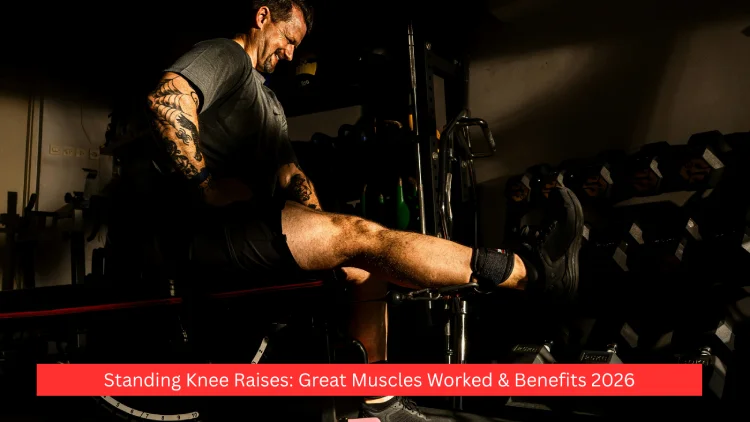

Standing knee raises are a simple bodyweight exercise that improves core strength, balance, mobility, and overall fitness. They require no equipment and can be done anywhere, making them ideal for home, gym, and rehab workouts. Despite their simplicity, they help build abdominal strength, improve posture, and enhance hip mobility. Suitable for all fitness levels, they can be made easier for beginners or more challenging with resistance and tempo changes.
- What Are Standing Knee Raises?
- Balance and mobility training
- Benefits of Standing Knee Raises
- Muscle mass is more important as people get older
- How to Perform Standing Knee Raises Correctly
- Standing Knee Raises Form Tips
- Common Standing Knee Raise Mistakes
- Standing Knee Raise Variations
- Standing Knee Raises for Abs
- Standing Knee Raises Workout Example
- Supporting Knee Comfort and Recovery
- Who Should Do Standing Knee Raises?
- Conclusion
- Frequently Asked Questions
What Are Standing Knee Raises?
One knee is raised over the other while standing straight; a body weight exercise. This movement is usually repeated alternately on one side or the other in a controlled fashion. Standing knee raises are performed without the use of equipment, do not require upper body strength, and can be performed anywhere, as opposed to hanging knee raises.
This exercise is a blend of balance, coordination, core, and lower body activation. The body needs to be stabilised on one leg during the movement, whilst the other knee is lifted. This stimulates many muscles in the body and promotes more efficient control of movement.
Common exercises that include Standing knee raises:
- Core training workouts
- Functional fitness routines
- Warm-up programs
- Senior fitness plans
- Athletic conditioning sessions
- Physical therapy exercises
Balance and mobility training
Due to the low impact of the exercise, many individuals with mild joint discomfort report enjoying the exercise without the same discomfort that they experience with activities like jumping or sprinting.
Knee raises while standing have been shown to provide mobility and independence for older adults. Balance and coordination can decrease as one gets older. Standing knee raises can help improve stability and strengthen the muscles involved with daily movements like walking, climbing stairs, and rising from a chair if they are performed regularly.
There are several muscles involved in standing knee raises. Standing knee raises involve multiple muscles.
One of the best aspects of standing knee raises is that they work a number of muscles at once. This exercise doesn’t focus on one area, but it gets the body to function as a whole unit.
Primary Muscles
Rectus Abdominis: Rectus abdominis – the “six-pack” muscle that raises the knee and stabilizes the torso throughout the movement.
Hip Flexors: The hip flexors play a crucial part in drawing the knee in towards the chest. These muscles are particularly important for walking, running, and athletic movement.
Lower Abdominals: The lower abdomen must move to control the lift and lower movements of the exercise.
Secondary Muscles
- Obliques: The obliques contribute to the stability of the torso and are even more engaged in the twisting variations.
- Quadriceps: The quadriceps are the muscles used for the standing leg to be supported and stabilized.
- Glutes: The gluteus muscles help balance and stabilize the hip.
- Lower Back Muscles: These muscles are used to control the body’s position during the exercise.
- Calves: Calves assist in balancing when on one foot.
The gluteus medius is one of the least exercised muscles in the body, according to many fitness professionals. This muscle is crucial for balance, knee alignment, and hip stability. As a performing and injury prevention exercise, knee raises with the stander do a great job of activating this often-neglected muscle group.

Benefits of Standing Knee Raises
There are many health benefits to standing knee raises besides just a workout for the abs.
1. Strengthens Core Muscles
Building core strength is vital for almost every action in everyday life and when playing sports.
Benefits of a stronger core include:
Improved posture
Better spinal support
Enhanced athletic performance
Less chance of developing lower back pain.
Improved movement efficiency
Standing knee raises are an exercise that must be done with constant stabilization, so the abdominal muscles are constantly active throughout the exercise.
2. Improves Balance and Coordination
The natural process of getting older diminishes balance. Exercises to challenge stability can help maintain coordination and minimize the risk of falls.
Knee raises to the standing position improve:
Single-leg balance
Body awareness
Joint stability
Movement control
Athletic coordination
Standing knee raises are frequently incorporated into warm-up exercises for athletes as they help to enhance the neuromuscular coordination and get the body ready to move.
3. Promotes fat-burning exercises
Standing knee raises are not a very high-calorie-burning exercise, but they can be combined to increase the calorie burn in a workout.
When performed continuously:
Heart rate increases
Calorie expenditure rises
Endurance improves
Increased cardiovascular fitness benefits build up.
Standing knee raises, when combined with a proper diet and regular exercise, can help you maintain healthy weight management.
4. Increases Hip Mobility
Sitting for extended periods in today’s society can cause tight hip flexors and decreased mobility.
To improve your standing posture. Standing knee raises benefit:
Improve hip flexibility
Promote joint movement
Reduce stiffness
Support walking mechanics
Enhance athletic performance
Improved hip mobility will also help to decrease unnecessary strain on the lower back and knees.
5. Supports Knee Health
Strong muscles around the knees are essential to the health of the knees. Standing knee raises do not directly strengthen the knee joint itself, but they do help to build the muscles that play a role in knee function.
Firm quadriceps, glutes, and core muscles add to:
Better knee alignment
Improved stability
Reduced injury risk
Better movement patterns
When knee pain is slight, many people unconsciously make the error of avoiding any kind of activity. When a knee problem is present, complete inactivity may weaken the muscles that support it and may exacerbate the problem over time. Strength and mobility can be maintained with appropriate low-impact exercises, such as standing knee raises.
The use of a particular tool is beneficial for older adults.

Muscle mass is more important as people get older
Knee raises are good for older adults to stand:
- Preserve mobility
- Improve balance
- Support independence
- Maintain coordination
Strengthen stabilizing muscles
Walking, standing knee raises, and light resistance training can be a great way to promote long-term joint health for seniors.
Recognize and support people who have symptoms related to nerves.
Some suffer from symptoms related to the nerves around the legs and knees. These sensations can range from tingling, numbness, burning sensations, weakness, or altered sensations.
Some gentle exercises promote circulation and movement that can be used to maintain function and mobility. Persons with severe nervous symptoms, however, should always be evaluated professionally before starting an exercise routine.
How to Perform Standing Knee Raises Correctly
Proper form is essential for maximizing benefits and minimizing injury risk.
- Step 1: Stand upright with feet shoulder-width apart.
- Step 2: Engage your abdominal muscles and maintain a neutral spine.
- Step 3: Lift one knee toward your chest.
- Step 4: Pause briefly at the top of the movement.
- Step 5: Lower the leg slowly and under control.
- Step 6: Repeat on the opposite side.
- Step 7: Continue alternating sides for the desired number of repetitions.
The movement should be controlled rather than rushed. Focus on quality over speed.

Standing Knee Raises Form Tips
Following proper technique improves muscle activation and effectiveness.
- Maintain Good Posture: Keep your chest lifted and shoulders relaxed.
- Engage the Core: A strong core improves stability and balance.
- Avoid Leaning Back: Leaning backward shifts stress away from the abdominal muscles.
- Move Slowly: Controlled movement improves muscle engagement and coordination.
- Breathe Naturally: Avoid holding your breath during repetitions.
- Focus on Stability: If balance is difficult, stand near a wall or sturdy support.
Common Standing Knee Raise Mistakes
Several common errors can reduce exercise effectiveness.
- Using Momentum: Swinging the leg reduces core engagement.
- Poor Posture: Rounded shoulders and excessive leaning reduce exercise quality.
- Rushing Repetitions: Moving too quickly often decreases muscle activation.
- Neglecting Core Engagement: The abdominal muscles should remain active throughout the exercise.
- Inconsistent Breathing: Steady breathing improves performance and control.
Standing Knee Raise Variations
- Basic Standing Knee Raises: Perfect for beginners learning movement mechanics.
- High Knee Raises: Performed at a faster pace to increase cardiovascular demand.
- Weighted Standing Knee Raises: Adding dumbbells increases resistance and challenge.
- Twist Knee Raises: Bringing the knee toward the opposite elbow increases oblique activation.
- Resistance Band Knee Raises: Bands add tension and improve muscle engagement.
- Standing Knee Raise Hold: Pause for several seconds at the top to improve balance and core activation.
Standing Knee Raises for Abs
Many people wonder whether standing knee raises effectively train the abdominal muscles.
The answer is yes.
Standing knee raises activate:
To maximize abdominal activation:
Visible abdominal definition still depends largely on body-fat percentage, nutrition, and overall training consistency.
Standing Knee Raises Workout Example
Beginner Routine
- 3 sets
- 10–12 repetitions per leg
- 30–45 seconds rest
Intermediate Routine
- 3–4 sets
- 15–20 repetitions per leg
- 20–30 seconds rest
Advanced Routine
- 4–5 sets
- 20–25 repetitions per leg
- Add resistance
Morning Mobility Routine
Many individuals experience stiffness upon waking. Gentle movement before fully getting out of bed can help prepare the body for activity.
Simple morning exercises may include:
- Ankle pumps
- Heel slides
- Gentle leg extensions
- Quadriceps contractions
- Light knee bends
After standing, performing standing knee raises can continue the mobility process and prepare the body for the day.

Supporting Knee Comfort and Recovery
Exercise is only one aspect of maintaining healthy knees.
Other supportive strategies include:
- Maintaining a healthy body weight
- Staying physically active
- Getting adequate sleep
- Managing inflammation
- Strengthening surrounding muscles
Many people use topical products to temporarily relieve discomfort. Common options include menthol-based rubs and warming creams. Products containing cooling or warming ingredients may provide temporary comfort, although they do not address underlying causes.
Some individuals also use oils during massage routines. Oils such as eucalyptus oil, peppermint oil, or ginger-infused massage oils are commonly chosen because of their soothing properties.
A proper sleeping position can also influence comfort. Many individuals find sleeping with a pillow between the knees or beneath the knees helps reduce stress on the joints during the night.
Who Should Do Standing Knee Raises?
Standing knee raises are suitable for:
- Beginners
- Athletes
- Older adults
- Home exercisers
- Individuals seeking a better balance
- People want stronger core muscles
- Those looking to improve mobility
The exercise is highly adaptable and can be modified to suit various fitness levels.
Conclusion
Standing knee raises are one of the most versatile bodyweight exercises available. They strengthen the core, improve balance, enhance mobility, support healthy movement patterns, and contribute to overall fitness. Because they require no equipment and can be performed almost anywhere, they fit easily into home workouts, gym routines, rehabilitation programs, and athletic training plans.
Whether your goal is stronger abs, improved coordination, better balance, healthier knees, or increased mobility, standing knee raises offer an effective and accessible solution. By practicing proper form and progressing gradually, you can enjoy long-term benefits while supporting overall physical health and movement quality.
Frequently Asked Questions
What are “standing knee raises”?
Easy core workout that helps to strengthen core, balance, and hip mobility!
Will they help you lose weight?
Yes, they can increase the number of calories burned during intense exercise routines, but they don’t specifically work on belly fat.
How many will I need to do?
Begin with 2-3 sets of 10-15 repetitions per leg and work up.
Do they work for novices?
Yes, they do not raise the impact on the body and are safe for beginners and older people.
Which muscles do they activate?
Leg stabilizers, glutes, lower abs, hip flexors, and core.