
The chest-supported dumbbell row is a great upper-body exercise to strengthen the chest, improve posture, and promote balanced muscle development. This variation is performed on an inclined bench, so the chest rests on the bench with less involvement of the lower back than traditional rowing, which emphasizes only the upper and middle back muscles.
- What is a chest-supported dumbbell row?
- Muscles Worked During the Chest Supported Dumbbell Row
- Benefits of the Chest Supported Dumbbell Row
- Set up for the chest-supported dumbbell row
- The student will also learn what not to do
- Chest Supported Dumbbell Row Variations
- Chest Supported Dumbbell Rows vs Bent Over Rows
- Sample Chest Supported Dumbbell Row Workout
- Who should perform the chest-supported dumbbell row?
- Conclusion
- Frequently Asked Questions
What is a chest-supported dumbbell row?
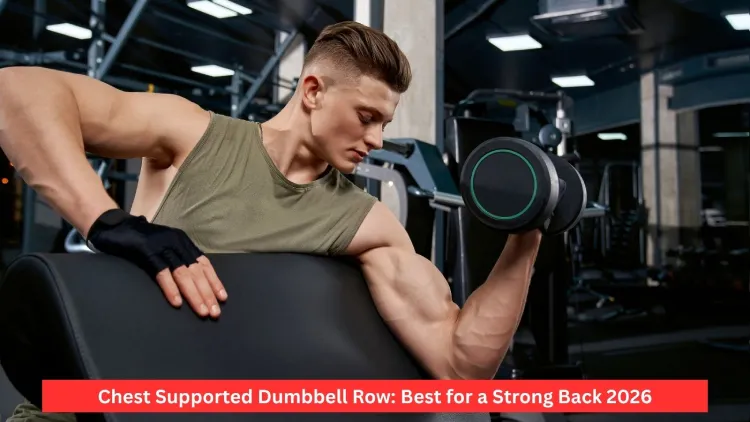
The chest-supported dumbbell row is a resistance training exercise that is performed on an incline bench to work the chest muscles while facing down. With dumbbells in both hands, pull the dumbbells upward towards your body, having to pull your chest up at the same time.
This is because the incline bench takes many of the shocks and stresses off the lower back that can be experienced when doing the bent-over row movement. This allows the movement to be more controlled and emphasizes the posterior (back) muscles.
The exercise is recommended for use in strength training, bodybuilding, and conditioning programs due to its stability and efficacy.

Muscles Worked During the Chest Supported Dumbbell Row
The upper and middle back muscle groups are the primary target of the dumbbell row, and there are several supporting muscle groups involved.
Primary Muscles
Latissimus Dorsi (Lats)
The latisse is the biggest muscle of their back,s which assists in drawing the arms down and back. They are of significant importance in the rowing cycle.
Rhomboids
The rhomboids are situated between the shoulder blades, help pull the shoulder blades back, and are part of the good posture mechanism.
Trapezius
The middle/trapezoid and lower/trapezius muscles stabilize and move the shoulder blades during the movement.
Secondary Muscles
- Rear deltoids
- Biceps brachii
- Brachialis
- Forearms
Rotator cuff muscles
The movement engages multiple muscle groups, making it a great compound pulling exercise.

Benefits of the Chest Supported Dumbbell Row
1. Reduces Lower-Back Stress
The chest supported dumbbell row’s no.1 benefit is the incline bench, providing support. This means your lower back can not act to stabilize your body during the movement as your chest remains in contact with the bench. This makes for a much reduced loading of the spine in comparison to bent-over rows. For those with lower back pain or who wish to pull without pain but still get the job done, it is particularly useful.
2. Enhance the isolation of the back muscles
You are stabilized, thus you can keep your entire attention on pulling with the back muscles and not balancing the torso. This results in an increased activation of the lats, rhomboids, and traps. The controlled setup assists with creating a greater mind-muscle connection that is significant for muscle growth and strength development.
3. Enhances Posture
Strongly targeted to the upper back muscles for good posture in this exercise. These muscles will help to draw the shoulder back to a healthier position, particularly for individuals who spend extended periods of time sitting. Regular training can also help promote the correct alignment of the spine and alleviate rounded shoulders over time.
4. Builds Balanced Strength
When working with two dumbbells, each side of the body is required to perform independently. This will also ensure that one is not dominating the movement and can correct strength/size imbalance. It contributes to a more balanced development of the back and a general increase in strength.
5. Increases Muscle Growth
The stable position enables you to dial in each rep with complete accuracy. This will help to increase the amount of time the muscle is under tension, which is crucial for growth. Since you will not be balancing, you can concentrate more on the back muscles that will produce enhanced hypertrophy outcomes.
6. Protection: You can safely use it with most exercise levels
The chest-supported dumbbell row is an easy workout to learn and is low risk for injury, making it a good exercise for beginners. For the advanced lifter, it can be difficult to increase the weight or add to the tempo to be a challenge. This makes it very flexible and could be used for any type of training programme.
Set up for the chest-supported dumbbell row
To do the exercise safely and effectively, follow these steps:
Step 1: Set Up the Bench
- Set the incline bench at an angle of about 30-45 degrees.
- Rest a DB to the left and right on the bench.
Step 2: Position Yourself
- Lying face down on a bench with the chest completely supported.
- Allow your arms to hang straight down while holding the dumbbells.
- Do not lift your feet off the ground.
Step 3: Engage Your Core
- Keep spine neutral and work the core.
- Laser is difficult to suffer; pull shoulders, back, down, before starting the motion.
Step 4: Row the Dumbbells
- Draw the dumbbells up toward your lower ribs/waist.
- emphasizes the use of the elbows to push back, not up and down with the hands.
Step 5: Squeeze at the Top
- Take a brief rest when your elbows are at the highest point.
- Through motion, draw shoulder blades together.
Step 6: Lower Under Control
- Slowly return dumbbells to the starting position.
- Keep control all the way through the whole arc of motion.
Recommended Repetitions
- Strength: 4–6 reps
- Muscle growth: 8–12 reps
- Endurance: 12–15 reps
Repeat this 3-4 times as per the training objective.
Proper Form Tips
Supporting the chest with the dumbbells on the row: Remember these points to get the most out of the movement!
- Maintain chest contact with the bench.
- Don’t shrug off the shoulder blade.
- Pull with your elbows.
- Take your arm movements big. Arm action should be full and large.
- Regulate the up/down approach.
- Keep a neutral neck position.
With a little finetuning, you can cause an even greater degree of muscle recruitment and muscular responsiveness to stimulation.

The student will also learn what not to do
Using Too Much Weight
When using too heavy a dumbbell, the weight may be thrown off the proper form, which will minimize back muscle activation. As opposed to controlled rows, you drop momentum. Select the weight that allows for smooth motion, complete control, and a correct squeeze at the top.
Insufficient R.O.M
Breaking reps down will limit muscle building. Always slowly lower the dumbbells completely and pull them up until the dumbbells are behind the ears so that the shoulder blades are fully squeezed together for maximum activation.
Shrugging the Shoulders
Relax, your shoulders will move away from your back and into your traps. Keep your shoulders level and back while squeezing the lats and mid-back.
Rushing the Movement
Short repetitions put less stress on the muscles and are not very effective. Repeat slowly once with a controlled pace with a slight squeeze at the end of the movement for enhanced effects.
Pressing the chest off the Bench
Leave the bench from your chest, and stability, proper isolation, is lost. Do not arch through the chest to prevent damaging the lower back and the form of the bench press.
Chest Supported Dumbbell Row Variations
Chest Supported Row using a neutral grip
Keep palms together, facing each other. This is a wrist-friendly grip that creates less stress in the wrist and shoulder, stressing the lats and mid-back heavily.
Wide-Elbow Row
Elbows should be held slightly apart in the pull. This will increase the emphasis on the upper back and back delts, giving thickness to the upper back.
Shoulders Supported Single Arm Row
Do one arm at a time. This helps to correct muscle imbalances and stabilize and control the muscles overall.
Incline Bench High Row
Move dumbbells up towards the chest rather than the hip. This increases the stress on the upper back and the back of the shoulders.

Chest Supported Dumbbell Rows vs Bent Over Rows
There is a lot of curiosity about which is better in relation to rowing, such as which rowing is more effective?
Chest Supported Dumbbells Row with Dumbbells
Pros
- Reduced lower-back strain
- Better muscle isolation
- Identifying your technique could be easier than it seems.
- Working well at increased training load
Cons
- Needs an inclined bench
A decrease in the involvement of stabilising muscles.Reduced involvement of stabilising muscles.
Bent-Over Row
Pros
- Greater total-body involvement
- Practices the stability of the core and lower back.Practices Core/Lower back stability
- Allows heavier loading
Cons
- Higher spinal stress
- Less easy to remember a technique
Either exercise is good, but the chest-supported dumbbell row is commonly used for specific back development.
Sample Chest Supported Dumbbell Row Workout
Beginner Routine
- Chest DB row supported – 3 sets, 10 reps
- One set of 12 reps, 3 sets done.3 sets of 12 done (Lat Pulldown).
- 2 sets × 12 reps (dumbbell curl)
Intermediate Routine
Heidens and dumbbell rows performed with the chest supported – 4 sets 8-10 reps
- Pull-Ups – 4 sets × 6–10 reps
- Sit Cable Row – 3 sets (x 10 reps.)
- Face Pulls – 3 sets × 15 reps
Advanced Routine
- Chest Supported Dumbbell Row – 5 sets × 8 repetitions.
- Weighted Pull-Ups – 4 x 6
- Repeat this exercise 4 sets of 8 reps.
- Rear Delt Fly – 3 sets × 15 reps
- Hammer Curl – 12 reps x 3 sets
Who should perform the chest-supported dumbbell row?
This exercise is suitable for:
- Rowers who are beginning their understanding of the mechanics of rowing.
- Bodybuilders seeking back hypertrophy
- Sportsmen who require the use of the upper body pulling force.
- People who experience problems with their lower back.
- Anyone who desires improved posture and back development
Working on its variety, it has become fit for just about all fitness levels

Conclusion
One of the best dumbbell back exercises to strengthen, thicken, and balance your back is the chest-supported dumbbell row. Instead of on a flat bench, an inclined bench position offers the least stress on the lower back, while helping to focus more on upper-back access. This exercise can fit into your training program for a variety of goals,s including building muscle, increasing strength, enhancing posture, or preventing injuries. The chest supported dumbbell row can be correctly used to build a better and stronger lat, rhino, traps, and back delto complexes while enhancing upper body pulling power and strength with the correct progression.
Frequently Asked Questions
1. In conclusion, which dumbbell exercise is better for a supported dumbbell row: Is it the bent over or the chest supported dumbbell row?
They’re both equally good, in general. The chest-supported dumbbell row allows for more back isolation with less stress on the lower back as compared with the bent-over dumbbell row, which requires more overall body stabilization.
2. How many repetitions will I do for a chest-supported dumbbell row?
For most, 1-2 times per week throughout the course of a back or upper-body routine will provide them with most of the benefits.
3. The question is, what bench angle works best for chest-supported dumbbell rows?
In most situations, the range of 30-45 degrees is ideal for the majority of lifters and guarantees a large scope of motion. Most people will get the best results at an incline of 30-45 degrees, and get a good range of motion.
4 Can beginners perform chest-supported dumbbell rows?
Yes. The exercise is easy to perform, and good form is supported because of the stability of the bench.