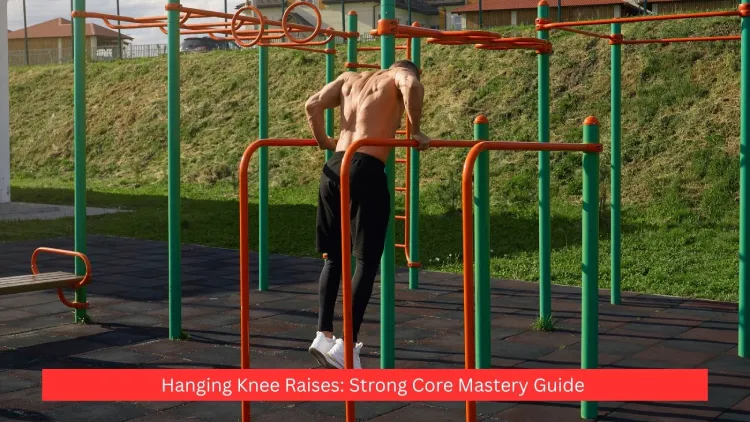

The hanging knee raise is among the best bodyweight moves to build stability, develop the abdominal muscles, and strengthen the core. This exercise works your abs, hip flexors, and obliques, and works your shoulders, upper back, and grip. Hanging knee raises are an effective exercise for beginners and more advanced trainees and can contribute to core strength and function if done properly and with controlled body movement.
- What Are Hanging Knee Raises?
- Muscles Worked During Hanging Knee Raises
- Benefits of Hanging Knee Raises
- How to Perform Hanging Knee Raises Correctly
- Simple Cool Down Exercises for Hanging Knee Raises
- Common Hanging Knee Raise Mistakes
- Hanging Knee Raises Variations
- Hanging Knee Raises vs Leg Raises
- Best Rep Range for Hanging Knee Raises
- Who Should Do Hanging Knee Raises?
- Safety Tips
- Hanging Knee Raises and Fat Loss
- Hanging Knee Raises Alternatives
- The Role of Core Training in a Complete Fitness Program
- Conclusion
- Frequently Asked Questions
What Are Hanging Knee Raises?
Knee raises in body weight core exercises are ones that are done while hanging from a pull-up bar or a captain’s chair with knees raised. The entire movement is performed with the knees moving towards the chest whilst keeping the top body stable and controlled.
This workout is a preferred exercise as it has a strong core component, plus greater control and stability of all four limbs of the body. It mainly focuses on the Abs, Hip Flexors, and Obliques, so it can be a good supplement for any fitness program.
The advantages of Hanging Knee Raises:
- Build core strength
- Develop abdominal muscles
- Enhance balance and stability
- Enhance grip strength
- Support better posture
- Increase body control
Hanging knee raises work well for beginners and advanced lifters and are one of the basic variations of this exercise you can perform that will more easily progress to further exercises like hanging leg raises and hanging toes to bar.
Muscles Worked During Hanging Knee Raises
Many individuals ask, “What do hanging knee raises do? This is considered an abdominal exercise, but several muscle groups are involved in the movement.
Primary Muscles
Rectus Abdominis
A lot of work is done when hanging with knees raised on rectus abdominis or the “six pack muscle. This muscle assists in bringing knees up, as well as maintaining spinal stability.
Abs hanging knee raises are actually selected for the particular reason that they strengthen and build up this region.
Lower Abdominals
While it is not possible to fully isolate a given part of the abdominals, hanging knee raises produce significant stimulation in the lower abdominal section.
This is one of the reasons that they are often featured at the front of the majority of core training exercises for gym programs that train hanging knee raises.
Secondary Muscles
Obliques
Its internal and external obliques are involved with stabilising the torso and preventing excessive movement rotation.
On top of that, some muscles are emphasised further than others when you are doing side-to-side knee raises.
Hip Flexors
The hip flexors are a key component to the ability to get knees up to chest.
These are ambulatory (strengthening hips): Hip flexors play a role in:
- Sprinting performance
- Jumping ability
- Athletic movement efficiency
Forearms and Grip Muscles
Each repetition will start with a hang. This is because the forearm and Grip muscles are continuously tensed.
Between kips and weighted kettlebell, athlete hanging knee raise squat, and overhead press workouts are starting to get more popular and are a great way to build grip endurance and core strength.
Shoulder girdle and upper back pain
Upper/back shoulders remain stable during the exercise.
These muscles will ensure that there is no excessive swinging and no swing execution on hanging knee raises.

Benefits of Hanging Knee Raises
You can get more benefits from hanging knee raises than it is associated with abdominal development.
1. Develops good core muscles
It is most apparent that it gives a stronger core.
A strong core strengthens:
- Athletic performance
- Lifting mechanics
- Balance
- Coordination
- Injury prevention
As they are an exercise performed from a hanging position, this action places more of a focus on your core muscles than some of the floor-based exercises that require stabilisation when moving.
2. Improves Athletic Performance
Core strength is a key component in the development of the athlete.
Core stability is active and relevant in many of the areas where we use our bodies, such as sprinting, jumping, changing direction, and lifting weights.
Many athletes add Hanging Knee Raises to their core workouts at the gym because the stronger the abdominal muscles, the more easily they transfer the energy throughout their bodies.
3. Supports Better Ab Development
The question of whether or not to hang knee raises for abs has been a topic of interest for many people.
The answer, of course, is that the hanging knee raises will really assist with building and toning the abdominal muscles, but how much body fat you have has the most to do with how visible your abs will be.
Even the best ab training becomes truly visible when it’s supported by a healthy body composition, allowing your abdominal muscles to show their full definition.
4. Improves Functional Strength
Hanging knee raises should be viewed in contrast to exercises that target only the abdomen and work out the body in a more functional way.
The exercise teaches core/mid-body stabilisation with movement in the upper and lower limbs separately.
5. Increases Forearm Strength + grip
Forearm endurance and grip strength are developed by holding your body weight.
This good fortune extends to:
6. Minimal Equipment Required
Grasp that all three require:
- Pull-up bar
- Captain’s chair
- The hanging knee raise machine enhances your core, lower body, and leg strength.
This provides for exercise being easily accessible in most trainings.
7. Enhances Posture
Poor posture can be caused by weak abdominal (core) muscles.
Strengthening the abs and adjacent stabilisers will provide proper structural support while you are on your feet during the day.
8. Good for men and women
The hanging knee raise is a common exercise for women’s fitness programs as it allows for building core strength without needing to use a lot of external resistance.
Movement may be adapted based on ability levels.
How to Perform Hanging Knee Raises Correctly
Correct technique while hanging knee raises is crucial to getting the most out of the exercise and to safely avoiding injuries.
Step 1: Grab the Pull-Up Bar
Grip overhand hands about shoulder width.
Let the body hang naturally while maintaining shoulder activity.
This position at the start of the exercise will provide stability for the movement.
Step 2: Engage the Core
Squeeze stomach muscles when making the move.
Think of gently bracing your core as if you’re preparing to stay strong and stable during impact, keeping your abdominal muscles fully engaged and protected.
This facilitates the maintenance of the controlled form and position of the core when raising knees to the air.
Step 3: Lift Knees
Lift knees towards chest belly strength.
Avoid swinging or using momentum.
The objective is to hang knee raises, slow, controlled core activation movements and not the fast reps.
Step 4: Pause Briefly
Squeeze abdominal muscles at the top position.
A short rest makes the muscular tension greater, making it more effective.
Step 5: Lower Slowly
Deepen the legs, moving under full control of the legs.
Do not let the knee fall back due to gravity.
Maintaining hanging knee raises allows for controlled execution and keeps muscles engaged throughout.
Simple Cool Down Exercises for Hanging Knee Raises
Beginners find it difficult to balance, hold, and control their bodies.
Beginner form pull-up practice should be done with a focus on hanging knee raises, then going to more volume.
Taking some useful beginner hints is:
- Perform fewer repetitions
- Focus on control
- Avoid excessive swinging
- Get in between the sets so you are well-rested.
- If necessary, use strengthening grips separately.
For those just starting, begin with:
- 3 sets
- 6–10 repetitions
- Controlled tempo
As a result of the continual strengthening, the exercise becomes increasingly easier over time.

Common Hanging Knee Raise Mistakes
Great results come from consistent effort paired with proper form, and improving your technique will naturally help you achieve even better results over time.
Using Momentum
Moving the body decreases activity in the abdominal muscles.
The abs should do the work, not momentum.
Raising Knees Too Quickly
Repetitions that are too fast can cause a decrease in muscle activation.
Effectiveness of controlled movement.
Incomplete Range of Motion
In a full range of motion, the abdominals are engaged more completely, helping you get the most out of each repetition.
Raise knees up to max height possible.
Relaxed Shoulders
Stable shoulders allow for protection of the joints and stability.
Excessive Arching
Keep your back straight when doing the movement.
Holding the Breath
Breathing properly enhances performance and control.
Raise knees as you exhale and lower knees as you inhale.
Hanging Knee Raises Variations
Hanging Alternating Knee Raises
This is a variation in which one knee is lifted at a time.
Benefits include:
- Improved balance
- Greater coordination
- Reduced difficulty
Single Leg Knees – Hanging
Single-leg knee raises are an exercise that focuses on single-side control and stability.
Knee Raises – Hanging Side to Side
This variation puts more emphasis on the obliques.
The knees glide to either side of the body.
Hanging Weighted Knee Raises
While basic trainees may perform straight knee raises with ankle weights or an ankle strap attached, advanced trainees can perform weighted knee raises by using dumbbells between their feet or weighted ankle straps.
Raised Knee on the captain’s chair
Hanging knee raise captain chair gym equipment provides extra back support.
This variation alleviates hand strain and can be ideal for those new to the game.
Hanging Knee Raises (or Captain’s Chair)
Numerous gyms are able to offer both.
Both exercises focus on the same muscles, but primarily require greater stabilisation in the hanging version.
Hanging Knee Raises vs Leg Raises
There is still a debate among fitness lovers about whether hanging knee raises or leg raises are better.
Hanging Knee Raises
Advantages include:
- Easier to learn
- Beginner friendly
- Less flexibility required
- Reduced lower-back stress
Hanging Leg Raises
- Advantages include:
- Greater difficulty
- Higher core demand
- Increased lower-abdominal activation
Improved sequence of more advanced callisthenics.Improved sequence to more advanced callisthenics.
Hanging leg raises vs hanging knee raises, neither one exercise is superior to the other.
It will be best by region on:
- Experience level
- Mobility
- Strength
- Training goals
It is important to have mastered hanging knee raises before using straight-leg knee raises for the majority of trainees.

Best Rep Range for Hanging Knee Raises
For Strength
- 3–5 sets
- 6–12 reps
For Muscle Growth
- 3–4 sets
- 10–15 reps
For Endurance
- 3–4 sets
- 15–25 reps
For Advanced Athletes
- Weighted variations
- Progressive overload
- Controlled tempo
It is better to be consistent than to have very high numbers of repetitions.
Who Should Do Hanging Knee Raises?
The exercise can be used with:
- Beginners
- Athletes
- Weightlifters
- Bodybuilders
- Recreational gym-goers
- Women
- Men
This is a basic exercise for the “core” that is commonly integrated into women’s hanging knee raises gym classes because of its functional incorporation of core power.
Safety Tips
Safety precautions when training:
- Warm up thoroughly
- Use secure equipment
- Avoid excessive swinging
- Maintain proper posture
- Always remember that the point is technique.
- Progress gradually
It is important for those with knee pain, extremely painful hips, or shoulders to seek advice from a medical expert before doing hanging exercises.

Hanging Knee Raises and Fat Loss
Whenever people generally hope to slim the belly fat, they believe that knee raises alone reduce belly fat.
The truth is, you can’t target fat loss to a specific area of the body.
There are three processes to fat reduction:
- Calorie deficit
- Consistent training
- Proper nutrition
- Adequate sleep
But, knee raises offer a better way of developing stronger abdominal muscles, which will be worth noticing when the body fat goes away.
The exercises that normally burn the most calories are:
- Running
- Sprint intervals
- Rowing
- Cycling
- Full-body resistance training
Together with hanging knee raises, they can yield better results than ab training alone can.
Hanging Knee Raises Alternatives
For some, a change might be needed.
Effective options include:
- Reverse crunches
- Dead bugs
- Captain’s chair raises
- Lying leg raises
- Ab wheel rollouts
- Plank variations
Toes to bar and hanging leg raises are great exercises for advanced ones who want an alternative to hanging weighted knee raises.
The Role of Core Training in a Complete Fitness Program
Hanging knee raises can be very effective exercises, but should be included in a balanced program.
Many trainers prioritise:
These types of movements assist the overall amount of relative strength across the body.
There is an increase in muscular imbalances and a decrease in athletic performance when lower-body training is omitted.
Strong legs support:
- Speed
- Balance
- Power
- Joint health
This is why it’s such an important point for experienced coaches to emphasise never to forget about the legs!

Conclusion
Knee raises turned on their side are a challenging bodyweight abdominal workout that strengthens abs, boosts athletes’ performance, increases grip strength, and helps with body control. Mixed variants, such as the captain’s chair or weighted variants, can be used for all levels of fitness, from beginners to advanced. To get the best results, watch form, the tempo, and the control of the movement, and try not to move with momentum. When practised regularly and recovered correctly, hanging knee raises can be a great core or strength exercise.
Frequently Asked Questions
1. Hanging knee raises do help build abs as they engage the core muscles?
Yes, they have an effective impact on the strengthening of the abs, particularly the lower section of the abs.
2. Can beginners perform hanging knee raises?
Absolutely yes, especially for beginners, maybe a few repetitions and build volume later.
3. Can I get rid of belly fat through hanging knee raises?
They help develop core muscles, and body fat comes from a general diet and how many calories one burns.
4. Hanging knee raises vs leg raises: Which is better?
The hanging knee raises will work for beginners, whereas the leg raises will be harder and will engage the core more.