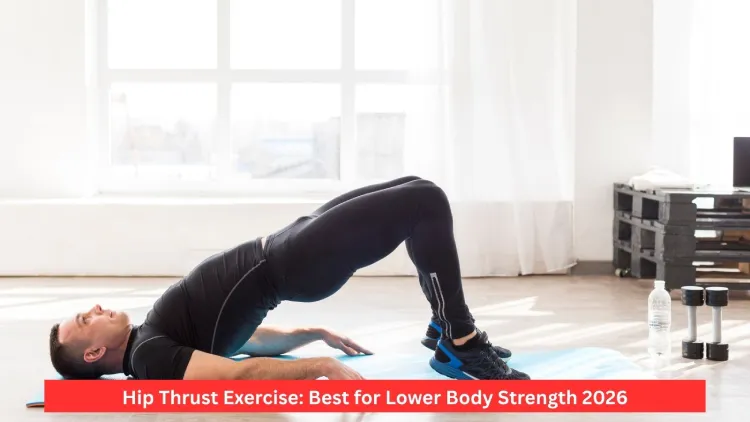

The hip thrust is among the very best lower-body movements for creating powerful and solid glutes. It works the glutes, the hip flexor muscles, and also some of the muscles of the lower back, core,e and hamstrings. The hip thrust exercise is a great addition to your workouts, even if you’re looking for better performance as an athlete, stronger legs, or building muscle. The hip thrust, unlike most conventional lower-body movements, has a greater focus on hip extension, thus uniquely targeting hip development. It can be done using your own body weight, resistance bands, dumbbells,s or barbell; it works for both beginners and intermediate fitness levels.
- What Is the Hip Thrust Exercise?
- Muscles Worked During the Hip Thrust Exercise
- Benefits of the Hip Thrust Exercise
- How to Perform the Hip Thrust Exercise
- Proper Hip Thrust Form Tips
- Common Mistakes to Avoid
- Hip Thrust Exercise Variations
- Dumbbell Hip Thrust
- Hip Thrust Exercise for Beginners
- Advanced Hip Thrust Training
- Sample Hip Thrust workout
- Who Should Perform the Hip Thrust Exercise?
- Conclusion
- Frequently Asked Questions
What Is the Hip Thrust Exercise?
The hip thrust exercise is performed by raising the hips up to an upper position when the upper back is supported on a bench or raised object. The main muscle for the movement is the glutes, which squeeze to raise the body and extend the hips.
The hack squat exercise is interesting in that it sets the glutes at their tightest point at the top of the exercise, at full hip extension. Hence, it has become one of the most popular workouts for stronger and more sculpted buttocks.

Muscles Worked During the Hip Thrust Exercise
The hip thrust exercise focuses on several significant muscle groups:
Primary Muscles
- Gluteus Maximus
- Gluteus Medius
- Gluteus Minimus
Secondary Muscles
- Hamstrings
- Quadriceps
- Core Muscles
- Lower Back Stabilizers
In addition to strengthening the upper hip, the hip thrust also works a number of other muscles at the same time, so it can also increase the strength and stability of the lower body in general.

Benefits of the Hip Thrust Exercise
The hip thrust exercise is one of the best exercises for the lower body to increase strength, enhance performance, and promote overall fitness. It is easier to go against these few exercises than to target the glutes.
1. Builds Stronger Glutes
The primary advantage of the hip thrust exercise is good glute development. It is an activator of the glute muscles, enhancing strength, shape, and power in the lower body.
2. Improves Lower-Body Strength
Daily use increases the strength of the hip, back of thighs, and supporting muscles. This enhances lower-body power and aids in other movements such as squats and deadlifts.
3. Enhances Athletic Performance
The hip thrust exercise is beneficial for athletes because it adds a functional movement component of explosive actions like sprinting, jumping,g and acceleration, which rely heavily on hip drive.
5. Adds Sharps Light
Wearing stronger glutes will assist with stabilizing the hips and with good posture throughout the day. This promotes balance, coordination, and decreases the strain on the lower back.
5. Increases Muscle Growth
The hip thrust exercise is very effective for building glute and surrounding muscle mass and strength, due to its heavy and controlled resistance.
6. Versatile and Accessible
This exercise is performed using body weight, dumbbells, or barbells and can be performed at every level of fitness, in a gym or at home.
How to Perform the Hip Thrust Exercise
Correct movement is accomplished when you follow these instructions:
Starting Position
- Sitting on the floor with the upper back against a solid bench.
- Lock your knees and put your feet on the floor.
- Stand about a hip’s distance apart.
- If resistance is to be used, place a weight across your hips.
Execution
- Tighten tummy, back, and leg muscles.
- Press through the pelvis to drive through the heels.
- Pull knees up to chest.
- Repeat until shoulders, hips, and knees are all aligned.
- At the top position,n squeeze the glutes.
- Slowly move your ips back to the starting position.
Repeat the procedure for the desired number of repetitions.
Proper Hip Thrust Form Tips
It’s important that your form is correct to get the best possible outcome and to minimise the risk of injury during hip thrusts.
Use your chin to tuck in your chin and jaw
Tilt your chin slightly down, rather than upward. This allows for keeping the back neutral and the neck properly aligned during the motion.
Drive Through the Heels
Gluteal thrust up the insides of your thighs. This will boost activation in the glutes to get more power per rep and will increase glute activation.
Fully Extend the Hips
Lift your hips up, so your whole body comes into a straight line from your shoulders to your knees. Tighten glutes at the top of the body, but do not overarch the lower back.
Control the Descent
Dip hips slowly and in a controlled fashion, not dropping mid-pelvis. Helps maintain muscle tension and enhances overall performance.
Engage the Core
Tighten your abs while performing the exercise. With a strong core, you will be more stable and have good form throughout.

Common Mistakes to Avoid
Skipping small form errors can significantly add to the effectiveness of the hip thrust exercise for your glutes.
Overarching the Lower Back
Don’t rely on your lower back to lift the weight. Concentrate on tightening the glutes rather than pressing the hips up too far.
Incorrect Foot Placement
Positioned far too forward or far too back will take the work out of the glutes. Until you feel a nice,e tight glute feel, adjust.
Rushing the Movement
When moving at a higher speed, there is less muscle activation. Move slowly and with controlled movements during each repetition performed.
A decreased range of motion
Halfway results in halfway going. When lifting, have full hip extension with control.
Skipping the Glute Squeeze
Then stop briefly at the top and squeeze your glutes to get more activation in the muscles.
Hip Thrust Exercise Variations
Hip thrust exercise can be adapted for different levels of fitness and can be performed for different fitness goals. These changes can be useful for both beginners and advanced lifters to continue to make their training exciting and beneficial.
Bodyweight Hip Thrust
A variation of the initiation focusing on proper form and glute activation is ideal for beginners. Requires no equipment, so it is a great initiation to building up strength and getting the pattern.
Barbell Hip Thrust
The common practice used to develop muscle and increase strength. The addition of a barbell enables progressive overload and is very effective for developing strong and larger glutes.
Dumbbell Hip Thrust
When using a press doesn’t seem like an effective choice, a quick alternative is. A dumbbell across the hips provides resistance, comfort, and is easy to use at home or in the gym.
Single-Leg Hip Thrust
One-leg balance, stability, and unilateral strength exercises are performed on one leg. This variation can also be used to highlight and make reparations to muscle imbalances across the left and right sides of the body.
Hip Thrust (With Resistance Bands)
Mobilises the glutes constantly throughout the movement. This versatility also makes the Resistance Bands easy to carry, which is great for working out at home or on the go.
Elevated Hip Thrust
Sits up on feet to further challenge glutes from an elevated position for range of motion. The intermediate and advanced exerciser seeking changes and variety should use this variation.

Hip Thrust Exercise for Beginners
If you’re new to the hip thrust exercise:
- Use just the weight of your body first.
- Practice first and then add resistance.
- Perform 2–3 sets of 10–15 repetitions.
- Take a break of 60-90 seconds between sets.
- Slowly build up the difficulty when getting stronger.
Establishing a good base provides stability for the form to prevent form breakdown when adding weight to the load.
Advanced Hip Thrust Training
The hip thrust exercise can be modified for advanced users.
- Increasing resistance.
- Performing higher-volume workouts.
- Adding pause repetitions.
- Using single-leg variations.
- Using resistance bands with barbells.
These approaches can help break through training plateaus and ensure more muscle-building potential.
Sample Hip Thrust workout
Try the following workout:
Beginner
- Hip Thrust (with body weight): 3 x 12
- Glute Bridge: 3×15
- Air Squat to your lower back 3 sets of 12 reps
Intermediate
Make sure to include these in your workout when you’re undertaking dumbbell or barbell training.
- Walking Lunges: 3 sets of 12 lunges on each leg.
- Romanian Deadlift: 3 sets 10 reps
Advanced
- Heavy Barbell Hip Thrust: 5x 6-8 reps
- Single-Leg Hip Thrust: 3 sets of 10 reps on each side.
- Bulgarian Split Squat: 3 sets × 10 reps each leg
Who Should Perform the Hip Thrust Exercise?
The hip thrust exercise can be done by:
- How to work the lower body for beginners
- Cross-Fit: Strength Builders.
- Athletes are looking for power for explosive plays.
- People who target their workout to develop their glutes.
- Those interested in enhancing the balance of the lower body muscles
Due to its versatility, it can be used by virtually anyone at any fitness level.

Conclusion
The hip thrust exercise is among the best exercises to strengthen and build glutes. It is a single movement that activates a lot of muscles and focuses on hip extension to help build the lower body, increase athletic performance, and improve strength. The hip thrust exercise is very beneficial when taught with correct form and repetition, either with body weight or heavy resistance. This personal movement can also be included in the fitness regimen, allowing you to enhance your glutes as well as a potent lower body.
Frequently Asked Questions
1. The question is, what is the hip thrust exercise good for?
The hip thrust exercise serves primarily as a strength-building exercise for the glutes, as well as boosting the strength of the quads, hips, hamstrings just below the knee, and another core lower-body muscle group, the overall strength of which helps to enhance athletic abilities such as running and jumping.
2 . When can you include hip thrusts in your workout?
Most people only need to do this 2-3 times per week. This way, they can recover from their workout but also develop the strength and muscles without any compromise.
3. Is hip thrust exercise suitable for beginners?
Absolutely, bodyweight hip thrusts are a great place to begin learning hip thrust form BEFORE introducing dumbbells or barbells.
4. Is hip thrust a good posture exercise?
Yes, firming up the glutes will support the hips and lower back and therefore enhance overall posture and movement control.