
Knee stretches are among the simplest types of stretches that can help improve flexibility, decrease stiffness, and help maintain healthy movement. Knee muscle tightness can hinder movement, make it more uncomfortable, and put additional strain on the knee. Stretching regularly helps increase range of motion, aids in recovery from exercise, and helps with being more able to perform daily activities.
The best way to do this is to do a combination of stretching, strengthening exercises, proper recovery, sleep habits, hydration, and balanced nutrition. If the pain in the knee is mild and the muscles are tight, persistent mobility exercises can be helpful, but extreme pain, swelling, instabili, ty or locking of the knee needs to be assessed by a health care professional. Knee stretches can help keep your joints moving smoothly and efficiently for everyone – from athletes to office workers, seniors to those who experience occasional stiffness.
- What are Knee Stretches?
- Short Answer: Well, do they work?
- Benefits of Knee Stretches
- Some of the most common causes of tight knees are explored
- The following stretches help protect your knee from pain and increase its flexibility:
- A Guide to Knee Stretches for Seniors
- Before exercising, perform stretches that involve the knee.
- After exercising, stretch the knees
- How many times should you stretch your knees?
- Sample 10-Minute Knee Stretch Routine
- Conclusion
- Frequently Asked Questions
What are Knee Stretches?
Knee stretches are exercises that help increase flexibility and mobility of the muscles, tendons, and connective tissues around the knee joint. The knee is essentially a hinge joint but relies a great deal on the health of the quadriceps, hamstrings, calves, glutes, and hip flexors.
Once tight, these muscles can affect the way that movements are made and put extra strain on the knee. This can lead to stiffness, discomfort, decreased mobility, and impaired ability to carry out daily activities over time. Stretching every day will help keep the muscle lengths of the lower body normal and the movement smooth.
Many people think that knee pain is always and only a problem inside the knee. Actually, it is limitations in neighboring muscles that can often play a role. This is why a thorough flexibility exercise program should work the whole lower leg and not just the knee.
The following stretches for the knee may benefit:
- Active people or sports enthusiasts
- People who work in the office and spend extended periods of time sitting.
- Older people who have stiffness problems.
- Individuals who have just finished a strenuous exercise.
- People who want to be more mobile.
- Anyone seeking to ensure the health of their joints.
A regular stretching program may be beneficial for maintaining comfort in movement and minimizing tightness that can happen as you age or when you don’t use your body enough.
Short Answer: Well, do they work?
Yes. If done properly and regularly, knee stretches can be helpful for improving mobility and function of the knee.
Stretching restores the normal movement patterns by decreasing the strain placed on muscles around the knee. The flexibility of the joint enables it to move through the intended range of motion more efficiently.
Potential benefits include:
- Improved flexibility
- Better mobility
- Reduced stiffness
- Enhanced circulation
- Improved athletic performance
Exercising with good posture and proper mechanics. Improved posture and movement mechanics.
Reduced muscular tension
Better recovery following exercise.Better recovery from exercise.
Many people also experience particularly tight knees after sitting for long periods of time. This is because the muscles around the joint stay short for a long time. To overcome this temporary stiffness, gentle mobility exercises and stretching can help.
But not all knee conditions can be helped with stretching. If you have severe ligament damage, have advanced arthritis, fractures, or severe meniscus damage, this must be assessed and treated by a professional. Stretching is best used as a component of a comprehensive approach such as strengthening, activity modification, recovery, and healthy lifestyle habits.

Benefits of Knee Stretches
People tend to concentrate on building strength but neglect flexibility exercises. Both parts are critical to healthy knees.
Improved Flexibility
The ability to flex muscles helps movement to be smoother and helps to minimize restrictions that can impact joint mechanics. Even everyday activities like climbing stairs, walking, squatting, and sitting up from a chair may feel easier because of the improved flexibility.
Improved ROM.Enhanced ROM.
Mobility of joints can be reduced due to old age and lack of physical activity. Stretch helps to keep healthy movement patterns and helps knees to move more efficiently in daily activities.
Reduced Stiffness
A common complaint for people starting stretching is that they want to loosen up the stiff joints. If it’s in the morning or after sitting all day, it’s time to get moving again with a mobility workout.
Enhanced Athletic Performance
Efficient movement is important for athletes. Flexible muscles allow for improved running, jumping, sprinting, cycling, and change of direction.
Reduce the possibility of getting injured.
Stretching does not prevent injuries completely, but it can help to minimize the stress placed on muscles and connective tissues when they are flexible.
Improved Circulation
Movement and stretching increase the blood supply to muscles and surrounding tissues. Better circulation helps with healing and can help alleviate tightness.
Better Recovery
Muscles may become tight and tired following physical activity. Gentle stretching exercises may be useful to help restore normal movement patterns and promote recovery.
Support for Healthy Aging
It is normal to lose flexibility as they get older. Regular stretching maintains mobility and independence in life.

Some of the most common causes of tight knees are explored
A tight knee is frequently a result of another condition. Understanding the underlying causes can help determine the most appropriate approach.
Prolonged Sitting
The most frequent cause of stiffness is sitting for too long. Those muscles surrounding the knee may contract when the legs are held bent for many hours.
Not getting enough physical activity.
Inactive muscles tend to become less flexible over time. Regular movement is important for maintaining joint mobility.
- Muscle Imbalances: As some muscles grow stronger or tighter than others, movement patterns can become less efficient, and joints like the knee can be stressed.
- Overuse: Muscular tension and fatigue can be caused by repeated running, jumping, climbing, or sports participation.
- Aging: A possible decrease in flexibility and mobility may be caused by natural changes in connective tissues.
- Previous Injuries: There is sometimes a residual stiffness after recovering from injury.
- Arthritis: The arthritic changes can lead to less mobility, particularly in elderly individuals.
Meniscus and Cartilage Problems
Some abnormalities in the structure of the knee can lead to a feeling of stiffness or discomfort when using it.
Poor Recovery Habits
Low energy, poor fluid balance, and excessive training loads could play a role in ongoing tightness.
Overuse injuries, arthritis, muscle imbalance, a nd previous injury to the knee are the four most common causes of knee discomfort.

The following stretches help protect your knee from pain and increase its flexibility:
The following stretches are helpful in making muscles more flexible that are directly involved in knee motion.
1. Standing Quadriceps Stretch
The quadriceps are important in regulating knee movements.
How to Perform
- Stand tall.
- Hold a wall, if necessary.
- Lift one knee behind you.
- Grasp your ankle.
- Bring your heel towards your buttocks.
- Maintain good posture of the trunk.
- Hold for 20–30 seconds.
Benefits
- Improves front-thigh flexibility
- Relieves muscle strain on the kneecap bone
- Takes care to move well
2. Hamstring Stretch
The tight hamstrings can affect how the lower body moves.
How to Perform
- Sit on the floor.
- Extend one leg.
- Make sure to bend the other leg.
- Squeeze forward through hips.
- Extend arms toward feet.
- Hold for 20–30 seconds.
Benefits
- Lengthens hamstrings
- Improves mobility
- Supports knee function
3. Calf Stretch
Flexibility of the calf is important for correct lower-body movement.
How to Perform
- Face a wall.
- Place hands against it.
- Take a step back with one foot.
- Keep the heel flat.
- Lean forward gently.
- Hold for 30 seconds.
Benefits
- Improves ankle mobility
- Supports knee mechanics
- Reduces lower-leg tightness
5. Standing Quad Stretch
This exercise is specifically on knee mobility.
How to Perform
- Find a comfortable seat in a chair.
- Slowly bend your knee.
- Move the foot down under the chair.
- Hold briefly.
- Move back to the starting position.
- Repeat 10–15 times.
Benefits
- Improves joint mobility
- Encourages comfortable movement
- Ideal for all levels of fitness
5. Heel Slide Stretch
Heel slides are often used for restoring motion.
How to Perform
- Lie on your back.
- Keep legs straight.
- Move one heel towards the hips.
- Knee bend is comfortable.
- Return slowly.
- Repeat 10–15 repetitions.
Benefits
- Improves flexibility
- Promotes movement
- Gentle and controlled
6. Figure-Four Stretch
This stretch is for the hips and glutes.
How to Perform
- Lie on your back.
- Cross one ankle over the other knee.
- Bring the supporting leg towards the chest.
- Hold 20–30 seconds.
Benefits
- Improves hip mobility
- Supports lower-body alignment
- Reduces muscular tension
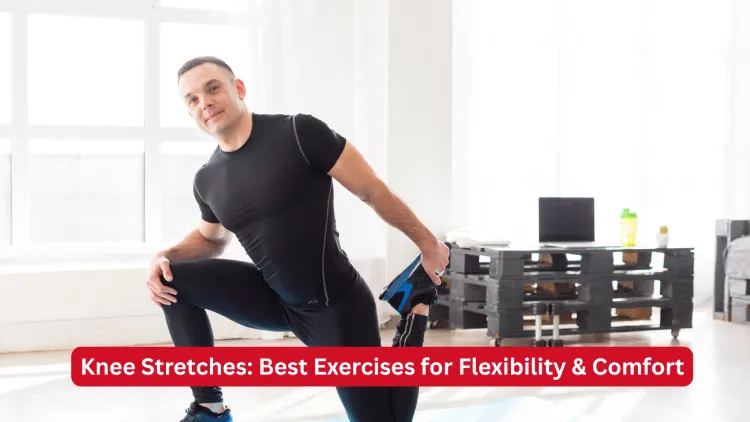
7. Hip Flexor Stretch
The tightness of the hip flexors can impact the motion of the knees.
How to Perform
- Get into the half-kneel position.
- Maintain chest and body upright.
- Shift hips forward.
- Hold 30 seconds.
Benefits
- Improves hip mobility
- Supports posture
- Enhances movement quality
8. IT Band Stretch
The IT band is on the outside of the thigh.
How to Perform
- Stand upright.
- Cross right leg over left.
- Lean sideways.
- Hold for 20–30 seconds.
Benefits
- Improves lateral flexibility
- Supports balanced movement
- Reduces tightness
9. Butterfly Stretch
This is a classic stretch that enhances the flexibility of the lower body.
How to Perform
- Sit comfortably.
- Press the soles of the feet together.
- Let knees fall out to the sides.
- Lean forward gently.
- Hold for 30 seconds.
Benefits
- Improves hip mobility
- Increases flexibility
- Supports movement quality
10. Child’s Pose
Child’s Pose is for relaxation and mobility.
How to Perform
- Kneel on the floor.
- Sit back towards your heels.
- Extend arms forward.
- Lower your chest.
- Hold for 30–60 seconds.
Benefits
- Encourages relaxation
- Improves flexibility
- Promotes mobility
A Guide to Knee Stretches for Seniors
It is common to experience increasing stiffness and less flexibility in joints as people get older. Fortunately, gentle stretching exercises can help to maintain mobility and independence.
Seniors should be concentrating on:
- Slow controlled movements
- Proper posture
- Ability to move freely in the joint.Being able to move freely within the joint.
Consistently but not intensely
Recommended stretches include:
- Heel slides
- Calf stretches
- Chair-assisted hamstring stretches
- Standing quadriceps stretches
Sit-ups, squats, kneeling to kneel to knee, etc.Sitting knee bend activities
Stretching exercises may be safer and more comfortable with the support of a chair or wall.
Mobility tasks can be useful for older adults to preserve walking function and balance, or mobility, as they age.

Before exercising, perform stretches that involve the knee.
It’s vital to train the body before physical activity.
Dynamic stretches before exercise are often better than long static stretches, as they help to warm up the muscles and get blood flowing.
Examples include:
- Marching in place
- Leg swings
- Walking lunges
- High knees
Controlled bodyweight squats
A good warm-up helps to reduce the shock to joints and muscles.
But the biggest pitfall is that people start working out too hard and too early. Cold muscles are less ready to deal with more challenging movement patterns.
Exercises can be performed more comfortably and efficiently after a 5–10-minute warm-up.
After exercising, stretch the knees
Following the activity, muscles can tighten up and become exhausted.
Static stretching is often used post-exercise to regain flexibility and promote recovery.
Good options include:
- Hamstring stretches
- Quad stretches
- Hip flexor stretches
- Figure-four stretches
- Calf stretches
Prolonged (20-30 seconds) holding allows the muscles to slowly relax.
A combination of stretching, adequate nutrition, and plenty of rest can enhance recovery further.
How many times should you stretch your knees?
The frequency is determined by your objectives and level of activity.
General recommendations include:
- Beginners: 3–4 sessions weekly
- Active adults: 5-7 sessions per week.
- The athletes: Everyday movement for the athletes.
- Office employees: Brief periods during the daylight hours.
- Consistency is more important than intensity.
Stretching a few minutes, several times a week, is often more beneficial than longer sessions of stretching rarely.
With consistent practice, many people will find that their knee tightness will begin to improve over time.
Here are some safety tips for stretching the knees:
The stretch should be gentle and manageable.
Important guidelines include:
- Warm up first
- Avoid bouncing
- Move slowly
- Maintain proper posture
- Discontinue if pain increases
- Breathe naturally
- Increase intensity gradually
One of the common errors is forcing into a painful position. This can make it difficult to move, instead of helping.
When the cause is stiffness, a little gentle movement and stretching of the knee can sometimes help if it hurts. If, however, the sharp pain, swelling, instability, or injury symptoms are significant, an evaluation by a healthcare professional should be considered before exercise.
Comfort can also be affected by good sleeping posture. Those who experience knee pain often sleep on their back with a pillow beneath their knees or on their side between their legs.
Good hydration and nutrition also help recovery. Certain people with joint pain may suffer nutritional deficiencies, such as low levels of vitamin D. But there are several things that could cause knee pain, and nutrition should be discussed with a health care worker.
Some drinks could help keep your joints healthy, such as water, smoothies made with fruits and vegetables that have little or no sugar content, and antioxidant drinks.
If you are unsure or have any concerns, consult a healthcare professional.
Although many stiffnesses will respond to stretching and activity changes, there are some symptoms that do need professional attention.
The following can be signs to watch for:
Significant swelling
Severe pain
- Joint instability
- Locking of the knee
- Weakness, inability to bear weight.
- Fever and joint symptoms.
- Sudden deformity
Symptoms that persist and get worse.
These situations can be an example of something more serious and warrant medical evaluation.
Orthopedic physicians can identify if symptoms are due to arthritis, meniscal damage, ligament injury, tendon issues, or other conditions.
For instance, arthritis may develop gradually and can initially cause stiffness after resting, whereas a meniscus injury can be caused by a twisting movement and cause a “catching” or “locking” sensation.
Sample 10-Minute Knee Stretch Routine
It’s possible to make a difference with a short daily routine.
- Warm-Up (2 Minutes)
- March in place
- Gentle leg swings
- Stretching Session (7 Minutes)
- Quad stretch: 30 seconds each side
- Latisse stretch: 20 seconds on each side
- Stretch calf (both sides): 30 seconds each
- Figure-eight stretch: 30 seconds each way
- Hip flexor stretch: 30 seconds on each side
- Cool Down (1 Minute)
- Child’s Pose
- Relaxed breathing
Complementing this with strengthening work like step-ups, glute bridges, and controlled squats may help promote healthy knee function as well.
Strengthening exercises are often one of the best long-term strategies for decreasing recurrent knee pain because strong muscles stabilize and support the knee.
Conclusion
Knee stretches are simple, but very effective, to help you be flexible, mobile, and healthy with your knee moving throughout your life. Stiffness, limited range of motion, and pain with movement can be a result of tight muscles around the knee. A regular stretch program can help to increase range of motion, improve circulation, and aid in maintaining good joint function.
Generally, the most effective results are achieved when flexibility training is paired with exercises that strengthen the body, getting a good night’s rest, drinking plenty of water, eating a balanced diet, and regular physical activity. In most cases of mild tightness, they should gradually improve over time with consistent movement and mobility exercises. But if the pain, swelling, instability, or other warning signs persist, they should not be ignored.
Knee stretches are beneficial for anyone looking to enhance their mobility, boost their sports performance, speed up recovery after exercise, or maintain healthy joints in the long run. The principle of consistency, using proper technique and patience, is always the ingredient to creating long-lasting results.
Frequently Asked Questions
Q. Do knee stretches help alleviate knee pain?
Yes. Knee stretches can relieve stiffness, increase flexibility, and aid in comfortable movement if tight muscles produce knee discomfort.
Q. How many times a day should I stretch my knees?
Knee stretches performed 3-7 times per week are beneficial in maintaining the flexibility, mobility, and health of the knee for most individuals.
Q. What is the best time to do knee stretches?
Dynamic stretches are great before exercise, and static knee stretches are usually more beneficial after exercising to recover.
Q. Is it safe to stretch the knees for senior citizens?
Yes. When done carefully, gentle knee stretching exercises can help seniors enhance flexibility, mobility, balance and movement in their knees.