


Bench Dips are a simple body weight exercise primarily targeting the triceps, with the chest and shoulders being activated! The exercises can be performed anywhere and at any time on a bench or chair and are great for beginners to try in the comfort of their own home. As long as they are executed correctly, they help in upper-body strength development, arm size, and pushing ability. For effective and safe results, though, the shoulders must be used to stretch in a controlled manner otherwise, using poor technique and/or going too deep can strain the shoulders.
- What are Bench Dips?
- Benefits of Bench Dips
- Do Bench Dips Work?
- Bench Dips Variations
- Bench Dips: Muscles Worked in Detail
- Bench Dips Form and Technique Breakdown
- Common Mistakes in Bench Dips
- Bench Dips vs Other Exercises
- Do Bench Dips Work?
- Bench Dips at Home Training Value
- Final Thoughts
- Frequently Asked Questions
What are Bench Dips?
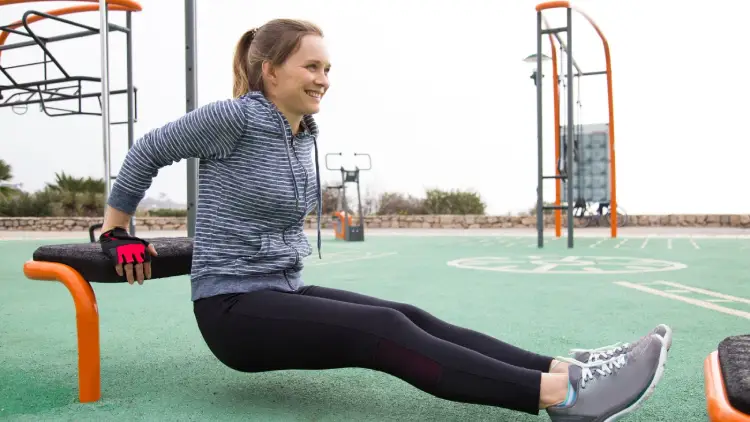
Bench Dips are an exercise using a bench or chair that primarily works the triceps. Place hands behind the body with feet on the ground or on another bench, and the action is simple and easy to execute.
The exercise consists of squeezing your body down, while bending your elbows, and then pushing up with your triceps. May be made as easy or difficult as preferred, depending on leg position and/or added weight.
Key Points
- Target primarily the triceps muscle
- Can use a bench, chair, or stable surface
- Requires little time and can be done at the gym or at home
- Easily programmable for all Levels traded from beginner to advanced
- May be made heavier and/or more bodyweight for strengthening
- Works on the core, shoulders, and chest for stability as well
Being easy to perform, with no equipment needed and easy to incorporate into just about any exercise, bench dips are popular.

Benefits of Bench Dips
But it’s not just because they are easy to do bench dips are popular for other reasons as well. They offer many advantages in terms of strength building, muscle development, endurance, and convenience.
Excellent Triceps Development
The biggest advantage of bench dips as a triceps exercise is their ability to isolate the triceps. The triceps will be under constant tension with the elbow extension being the main movement, thus throughout each repetition.
This can be improved via regular training, gaining more arm size, definition, and pressing with them.
Convenient for Home Workouts
Bench dips are a very convenient exercise.
Does not require expensive gym equipment or gym machines.
With a sturdy Chair or bench, a coffee table, or an exercise bench, it can be done safely in the home.
This enables them to be used for:
- Home fitness routines
- Hotel workouts
- Outdoor parks
- Office breaks
- Travel workouts
Builds Functional Upper-Body Strength
Whereas isolation-based exercises teach your body to move separately, bench dip exercises teach your body to move in coordination with each other.
With every rep your:
- Triceps produce force
- Shoulders stabilize
- Core maintains posture
- Uses the chest to help with the pressing motion
- Forearms become more stable with the grip
This functional strength translates to all sorts of pushing activities and much of sport.
Easy to Progress
One of the main reasons to perform bodyweight bench dips is the multitude of progression options.
The exercise can be made easier or harder just by changing the position of your body.
Progressions include:
- Bent-knee dips
- Straight-leg dips
- Elevated feet
- Single-leg dips
- Weight bench dips
- Slow tempo repetitions
- Paused repetitions
It works as a scalable exercise, allowing it to stay beneficial even when they become stronger.
Improves Pressing Performance
Many athletes use bench dips for the triceps to strengthen the lockout portion of pressing exercises.
The forearm muscles, which include the triceps, make an important contribution to:
- Bench press performance
- Push-ups
- Overhead presses
- Close-grip pressing
A dip vs bench press topic comes up often, but for many experienced lifters, both exercises are retained in the workout simply because they aren’t mutually exclusive, but complementary. Bench triceps dips build stronger triceps arms, which will enhance the power in one’s presses over time, particularly at the very end of the movement.
Supports Muscle Definition
Bench dips can be extremely effective if one wishes to have more structurally aesthetic upper arms.
They maintain a constant tension on the triceps muscle, which supports it both in terms of endurance and hypertrophy, in combination with progressive overload and proper nutrition.
While there is no single exercise that can give an all-in-one “ripped” appearance, toning the triceps alongside a fat-burning diet can boost arm definition.
Minimal Equipment Required
Dips with a bench are not like the dips done with the cable or machines, where much equipment is utilized.
All you need is:
- Workout bench
- Chair
- Couch edge
- Stable box
- Park bench
This accessibility has made bench dips still a recommended exercise in beginner workout programs at home.
Easily used with circuit training
Bench dips are easily set up, making them great to include in circuit training.
These are complemented with:
This is a great combination to help build muscular endurance while also having an effect on the number of calories that are burned.
Do Bench Dips Work?
The bench dip, if correctly executed, is a very good workout for the triceps, muscle endurance, and the delivery of stability to the upper body. These are particularly useful for those who train at home or who do not have proper equipment. They can be used to supplement your heavy compound arm work to build better arms at the end of your workout, but they won’t generate as much strength as a heavy compound lift.

Bench Dips Variations
Bench dips are so adaptable, with so many benefits. For individuals who are just starting out or at an intermediate level, you can pad and gain the benefits of bench dip triceps development without producing the increased intensity. Any individual who is beginning to work on building basic strength can conduct the activity and increase the intensity by utilizing different variations.
Beginner Bench Dips
If you’re new to bench dips for beginners, it’s the bent knee dip that you should start with first.
- Lowering of the hips/legs lessens the weight of the body
- Easier control of movement
- Explains and demonstrates the correct position for bench dips
- Minimizes the tension on shoulder joints.Lifts load from shoulders
This straightens your spine and develops confidence and starting positions for the more challenging versions.
Straight-Leg Bench Dips
Knees are close together, making it harder.
- More bodyweight resistance
- Higher triceps activation
- Better core engagement
- Bench triceps dips affect the quadriceps and triceps
When mastered, it is a natural progression in basic form.
Elevated Feet Bench Dips
Putting your feet on another bench loads intensity.
- Maximum load on triceps
- Strong core activation
- Advanced bodyweight challenge
- Good for progression in strength
Many athletes prefer using this variation since they are already familiar with performing bodyweight bench dips.
Weighted Bench Dips
For higher resistance, add weight:
- Plate on lap
- Weighted vest
- Dumbbell across thighs
This makes bench dip exercises like gym presses.

Bench Dips: Muscles Worked in Detail
If you’re studying bench dip muscles worked, it’s crucial to comprehend what each muscle is doing.
Triceps Dominance
The prime movers are the triceps. Bench dip triceps is one of the best bodyweight triceps builders. All of the pushes in the bench dips should utilize elbow extension.
Chest Activation
Many people who bench-dip ask the question: Do bench dips target the chest?
Yes—but only partially.
- Assist in the push with the lower chest.
- Slightly more activation when leaning slightly forward
- Primary: triceps.
Bench dips for chest are an option, although they are not the main chest builder.
Shoulder Involvement
Movement is stabilised by the front deltoids.
Triceps dips on a bench have the potential for excessive loading on shoulder joints, particularly due to the form you use when performing the dip too deep.
Core Engagement
Core stabilises your body.
- Prevents swinging
- Maintains balance
- Helps to maintain good posture while dipping
Bench Dips Form and Technique Breakdown
You can only take a usable bench dip if you’re in a perfect bench dip position. If you’re in the wrong bench dip position, it is not taken, and you won’t get good results or be safe.
Key Points
- Hands shoulder-width apart
- Elbows are held in close formation to the body
- Chest stays open
- Controlled lowering phase
- At 90′ elbow angle, halt
The right form of bench dips is when this occurs.
Breathing Control
- Inhale while lowering
- Squeeze the air out as you push up
This will stabilize and enhance the performance in the bench dip workout.
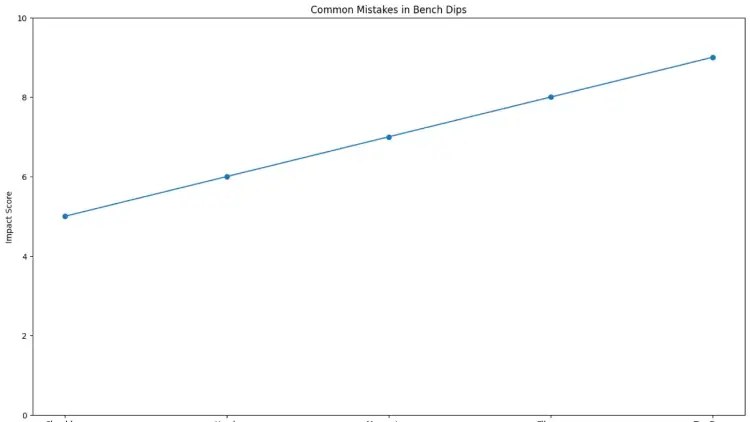
Common Mistakes in Bench Dips
Simple exercises such as bench dips are often incorrectly performed.
- 1. Going Too Deep: The lower the deceleration, the more stress and less control are created on the shoulder.
- 2. Flaring Elbows: The elbows should be controlled inwards – not outwards.
- 3. Using Momentum: When doing bench dips, triceps work is reduced due to having to bounce them rapidly.
- 4. Poor Hand Placement: Grips that are either too wide or too narrow are not efficient.
- 5. Shrugging Shoulders: This will get muscles out of the picture and put stress on joints.
Bench Dips vs Other Exercises
To get a grip on bench dips and the role they play in training, it’s important to understand comparisons.
Dips vs Bench Press
If dips vs bench press is a question, then:
- Bench press is easier with a heavier load and is moved with a focus on the chest
- Dips = body weight, focus on triceps
- Both complement each other
It’s common practice for many lifters to favorably incorporate both to build pushing strength.
Bench Press vs Dips
Bench press vs dips can be a frequent contentious topic.
- Bench press helps develop overall strength in the upper body
- Dips increase functional pushing ability
- The stabilizers are used more during the dip
They work together to help enhance performance in pressing movements.
Dips vs Bench Dips
Clearly, there’s a difference between the dips and bench dips:
- Parallel bar dips with body weight = more difficult substitute for full-body weight parallel bar dips.
- Bench Dips = Easy, done at home.
Sparsh targets the triceps, and there is a vast difference in intensity.
Dips vs Incline Bench
- Inclined bench presses hit the upper body. The upper chest is struck with incline presses.
- Dips target more towards the triceps and lower chest
- Different movement patterns
There is no better or worse between dips and incline bench it is just about different objectives.
Bench Dips vs Push-ups
- Push-ups = chest dominant
- Bench-dips involve the triceps muscles. Bench dips are triceps-dominant
- Both bodyweight staples
They are suitable to be paired up in the home setting.
Do Bench Dips Work?
Yes, bench-dips will work for:
Triceps hypertrophy
Arm endurance
Beginner strength building
Home workouts
But they’re not the only upper-body workout to consider if you are looking for balanced development.
Bench Dips at Home Training Value
At home, bench dips offer a lot of great benefits:
- No gym needed
- Easy setup
- Scalable difficulty
- Works productively in limited areas
As a result, it is among the best strength entry moves around.
Final Thoughts
Bench dips are a great, accessible body-weight training move to strengthen the triceps and boost upper-body endurance. If done correctly, they target the triceps primarily, and the chest and shoulder muscles are engaged as well.
Not complicated, can be performed at home, on a bench or chair, and are suitable for beginners and home workouts. Having proper technique is important, though, to prevent shoulder strain.
In general, bench dips are great for building arm muscles and should be performed in combination with other exercises and not in isolation.
Frequently Asked Questions
1. What are bench dips good for?
Bench-dips primarily help to tone, strengthen, and shape the triceps muscle, and they help to prepare the arms for pushing exercises (such as the bench press and the push-up).
2. Yes, bench dips can be harmful to your shoulders. Yes, bench dips can cause damage to your shoulders.
Yes, when performed poorly and/or susceptibility is greater than the height of the wall. The bench dip is designed to prevent shoulder stress.
3. Do bench dips develop muscle?
They can help develop a lot of muscle, particularly in the triceps, but if coupled with other exercises, they provide better than optimal results.
4. Bench dips vs Bench press?
No. Bench Press is going to help you get strong, and Bench-Dips are going to help you get a better triceps workout using body weight.