
Pull upwards exercises are essential for building upper-body strength, improving posture, and developing a balanced physique. These exercises, such as pulls, chin-ups, and rows, primarily target the back, biceps, and shoulders, with the core involved. This guide includes a discussion of the benefits, techniques, variations, progressions from beginner to advanced, and frequently asked questions about performance, safety, and training strategies.
- What are Pull Upwards Exercises?
- Benefits of Pull Upwards Exercises
- Best Pull Upwards Exercises
- Proper Form Tips
- Common Mistakes to Avoid
- Beginner Progression Plan
- Advanced Variations
- How Often Should You Train?
- Sample Pull Upwards Workout
- Extra Knowledge and General Wonders
- Final Thoughts
- Frequently Asked Questions
What are Pull Upwards Exercises?
Pull upwards exercises include a type of strength exercise, during which an individual lifts his/her body body or resistance upwards with the help of shoulder muscles. These exercises play an essential role in fitness as they mimic natural pulling patterns that are employed in everyday life, like pulling, lifting, or climbing things towards you.
When you undertake most upward movements, your body pulls against gravity. This makes them very efficient in developing relative strength, your strength relative to your body weight. The most recognizable one would be that of the pull upwards, however, in that category, there are also the chin-ups, lat pulldowns, and inverted rows, as well as resistance-based versions.
The phrase pull up is preeminently widespread outside of fitness. When training, it describes the elevation of your body with the help of a bar. It can also be used in everyday English to mean getting somewhere in the sense of pulling up to a place, as well as in slang to mean appearing somewhere confidently or purposefully. Regardless of these different meanings, in this guide, the emphasis is placed on strictly exercise-related applications.

Benefits of Pull Upwards Exercises
1. Strengthens Upper Body.
The largest benefits of pull upwards training include developing a great deal of upper-body strength. These exercises involve large muscles, such as the latissimus dorsi, which are in charge of pulling movements. With time, regular training will result in strong arms, shoulders, and back muscles.
Compared to isolation exercises, pull upwards exercises are compound exercises. It implies that more muscle groups will collaborate in an effort to enhance overall strength gains.
2. Improves Posture
Unhealthy attitudes, such as excessive time sitting and screens, also result in poor posture because of modern lifestyles. Pull up exercises help to strengthen the muscles of the upper back and pull the shoulders back into their correct position. This alleviates stooping and helps maintain a healthier back.
A good back is also useful to offset the push overdrafts, such as bench presses or push-ups.
3. Enhances Grip Strength
Grip strength is frequently disregarded, but it is an important aspect of fitness. In pull upwards, your hands should support your weight or resistance, which is in the form of your body, and this power, over time, builds your forearms and grip.
A tighter grip not only enhances performance in such exercises but also in other lifts such as deadlifts and carries.
4. Supports Functional Fitness
Pulling is an innate human action. Pull upwards directly becomes real-life activities, as seen in climbing stairs with the help of a railing, and in picking up heavy objects.
Strength acquired in these exercises enhances coordination, stability, and general physical ability.
5. Develops a V-Shaped Back
The aesthetic advantages of a pull upwards training are one of the most evident, which is the creation of a V-shaped torso. This is where the lats become wider, and the waist looks thinner as a result.
Such a build is usually equated with sports and power, and one of the elements of most fitness programs is pull upwards.

Best Pull Upwards Exercises
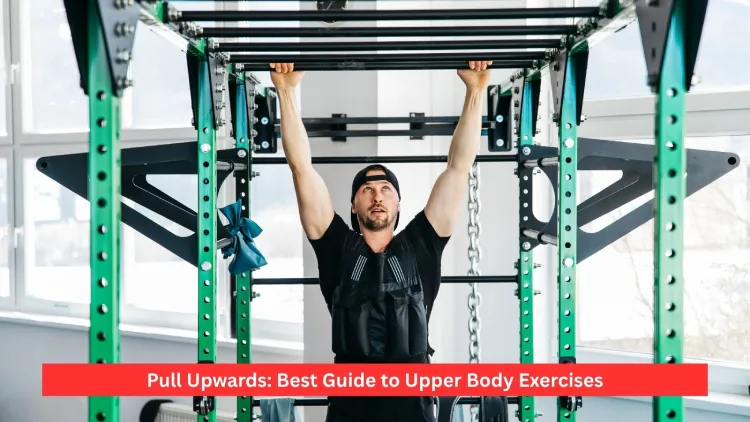
1. Pull-Ups
The basis of the pull upwards training is pull-ups, which are regarded as a standard in evaluating upper-body strength.
How to do it:
- Hold the bar with palm away (overhand grip).
- suspended therewith with arms stretched out.
- Pull, so that your chin is over the bar.
- Humbly descend, by degrees.
Pull-ups work mostly on the upper back and the lats, but also the shoulders, arms, and the core are utilised.
2. Chin-Ups
Chin-ups are like pull-ups except that instead of an overhand grip, an underhand grip is used, which puts more strain on the biceps.
How to do it:
- Lay your palms up on the bar.
- Gently lift yourself.
- Humbly on the undertest.
Chin-ups are easily learned and a good place to start pulling training upwards.
3. Lat Pulldown
The lat pull-down is an alternative that is machine-based and represents the pull-up motion.
How to do it:
- Seat before the machine and hold the bar.
- Draw the bar down to the upper chest.
- Gradually make a turn back to the original position.
This workout works well for people who are training to do their first pull-up.
4. Inverted Rows
Inverted rows are a horizontal pulling exercise, which complements vertical pull upwards.
How to do it:
- Find a bar to stand under.
- To keep your body straight.
- Pull on your chest towards the bar.
This is a friendly movement that is easy to learn.
5. Resistance Band Pull-Downs
The resistance bands provide an easy and convenient method of training pull upwards motions.
How to do it:
- Have the band over your head.
- Draw it down to you, to your breast.
- Modulate the pullout action.
It is an excellent workout program at home.
Proper Form Tips
Proper form is essential in achieving more results and avoiding the pull upwards injuries.
- Move with your core engaged.
- Do not swing or employ momentum.
- Use your back muscles to pull and not your arms only.
- Have the full range of motion.
- Maintain stability and control of your shoulders.
By concentrating on technique, it guarantees long-term improvement and minimizes the strain.

Common Mistakes to Avoid
- Using Momentum: Exercising your body minimizes muscle activity and puts you at risk of injury. Move slowly and at a pace.
- Incomplete Range Of Motion: Not completing the up or down limits. A full range is always needed to get greater strength gains.
- Ignoring Recovery: Progress can be slowed down by overtraining. Rest and relax your muscles.
- Shaky Hand Holding Back: A poor hold will bring you to the ground. Enhance it using basic exercises such as dead hangs.
Beginner Progression Plan
Their first pull-up has many individuals lose heart, but with progressive steps, they can reach their goal.
- Begin with exercises aided by resistance bands.
- Drill inverted balls.
- Assisted pull-up machines; use assisted machines where possible.
- Do negative reps (concentrate on slow lowering)
- Progressively do complete repetitions.
- Even the experience they have, however, can be used to gain strength even in a top position if they are beginners.
The training strategy that one can employ is the 3 3 3 rule, and this can be extended to pull upwards exercises. This means taking three sets, variation, and training thrice a week. It aids in generating regularity but does not strain the body, particularly for beginners.
Advanced Variations
When you have a strong base under you, more advanced pull upwards variations can be more intense and push your strength to the limit. To make the movements more challenging, they can involve resistance, altering the position of the body, or targeting the work to one side of the body.
- Weighted Pull-Ups: Introducing more weight (a belt or a dumbbell) will make it more difficult and help to gain serious strength and muscle mass.
- Wide Grip Pull-Ups: In a wider grip, increased attention is directed to the upper back and lats, which is useful in creating a more V-shaped body.
- L-Sit Pull-Ups: In this one, your legs are straight ahead as you pull yourself up. This is working your core very intensely as well as your upper body.
- One-Arm Pull-Up Progressions: These are extremely advanced and target strength development on an arm at a time. Advanced exercises are assisted one-arm pull and uneven grip variations.
These advanced pull upwards exercises put your muscles to the test in different ways, enhance control, and can break strength plateaus over time.
How Often Should You Train?
For optimal results:
- Pull upwards on train 23 times a week.
- Workout with both pulling and pushing exercises to develop the upper body in a balanced way.
- Give a minimum of 48 hours’ rest between heavy sessions.
Play with the volume depending on your experience level (inexperienced users should start with a lower volume, and those who are skilled in it can raise the intensity higher)
Training is as important as the process of recovery since all growth and strengthening of muscles takes place during rest, not during the process itself. Correct sleep, diet, and days of rest allow your body to mend the muscle fibers and enhance performance in subsequent pull upwards sessions.

Sample Pull Upwards Workout
Beginner:
- Inverted Rows – 3 sets, 10 reps each.
- Pull-Downs with Resistance Bands – 3 sets of 12 reps
- Negative Pull Ups – 3 x 5
Intermediate:
- Pull-Ups – 4 sets of 6–10 reps
- Chin-Ups – 3 sets of 8 pulls.
- Lat Pulldown – 3(10) reps.
Advanced:
- Weighted Pull-Ups – 4×5 Pull-Ups
- Wide Grip Pull-Ups – 3 sets of 8, giving birth to 24 reps.
- Inverted Rows – 3 sets of 12 reps
Extra Knowledge and General Wonders
In the U.S. fitness industry, a pull-up alternative means an exercise that exercises the same muscles as a pull-up but might be more comfortable or require alternative gear. They can consist of lat pulldowns, resistance band exercises, and rows. These options particularly come in handy with newcomers or those with injuries.
Talking of injuries, people having shoulder issues, including rotator cuff problems, must perform pull upwards training cautiously. Some may continue with some modified versions, although it is better to decrease the strain and aim at controlled pain-free movements or refer to a professional.
The impression made is that pull-ups are impressive, showcasing high relative strength. It needs coordination, control, and muscle growth to lift your entire body weight, and this makes them an appealing demonstration of being fit.
Pull-up exercises are also advantageous to women. No different category exists, such as a female pull-up–the motion is the same. Nevertheless, the exercise can initially become more difficult with variations in the upper body strength distribution. This is the reason why assisted variations start with many women, and gradually they advance.
Many novices, irrespective of gender, are reluctant to do pull-ups because they lack the strength of the upper body and grip strength to sustain the pull-up. Through regular training, right progression, and time, the majority of people are able to learn how to do them.

Final Thoughts
A strength exercise that includes pull upwards is a strength of such exercises. There is no match in their assistance in strengthening the upper body, improving posture, and in general fitness. Whether it is beginners on resistance bands or advanced athletes doing weighted versions, everyone has a challenge to do, as there are varying weights that can be used to increase the challenge of these exercises.
The keys to success are consistency, correct form, and progressive sequencing. Also, with some added pull upwards moves added to your routine, you will get stronger and more in control, and a better balance to your physique than before.
Frequently Asked Questions
1. What muscles do pull upwards exercises work?
The primary muscles involved in the development of pull upwards exercises are back muscles (particularly lats), biceps, shoulders, and core muscles. They also utilize the forearms and grip muscles, and are therefore a complete upper-body compound movement.
2. What should I do if I cannot do pull-ups now?
Unless you can do pull-ups, good substitutions are lat pull-downs, inverted rows, resistance band pull-downs, and negative pull-ups. These activities will be used to strengthen the muscles to one day be able to do full pull-ups.
3. How much time does it take you to do your first pull-up?
It is based on the level of your present strength, its regularity, and the training program. With proper pull upwards training, most beginners may take a couple of weeks to a few months to complete the initial full repetition.
4. Do pull-ups hurt a beginner or somebody with a shoulder problem?
Proper form and gradual progress of pull-ups indeed make it safe. Nevertheless, those experiencing shoulder or rotator cuff issues must take precautions, begin with less challenging options, and steer clear of any pain-inducing movements or put in a call to a professional before training.