
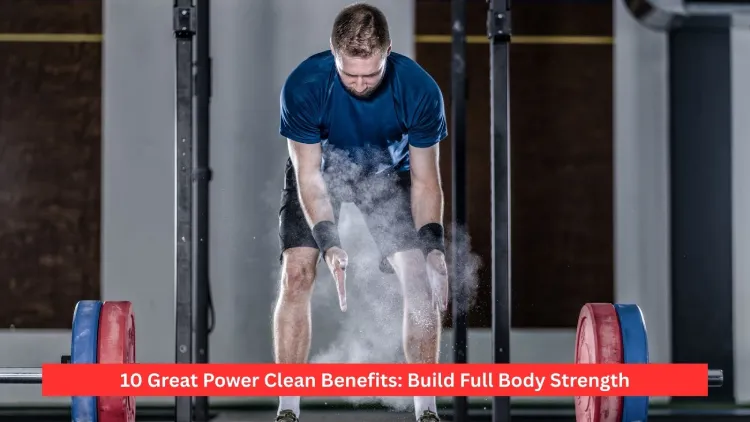

The power clean benefits is a weightlifting exercise that involves picking up a barbell from the floor and catching it overhead with a partial squat or the front-rack position. It builds explosive power, strength, coordination, and speed.

- What Is a Power Clean?
- Power Clean Benefits
- How to Do a Power Clean With Proper Form
- How Many Reps and Sets to Do?
- Common Power Clean Mistakes to Avoid
- Power Clean vs Deadlift: What's the Difference?
- Power Clean vs Hang Power Clean
- Can Power Cleans be beneficial for the beginner?
- Conclusion
- Frequently Asked Questions
What Is a Power Clean?
Power clean is a type of Olympic weight lifting exercise in which an individual lifts a barbell at the shoulders in a single movement, explosively lifting it off the floor. The lift is a combination of raw power, speed, and technical accuracy. It comprises 3 important stages:
- The Pull: Pulling the barbell straight up with the use of the legs and hips.
- The Explosive Extension: Straining the hips, knees and ankles and hoisting the shoulders to create a lifting motion.
- The Catch: To drop one side of the bar and have it received by the shoulders in a front-rack position.
In contrast to traditional forms of strength work, power cleans are not simply a matter of moving weight, but rather a matter of moving weight and speed, timing, and explosiveness.

Power Clean Benefits
1. Builds Full-Body Strength
The power clean involves multiple muscle groups: the legs, glutes, hamstrings, core, shoulders, and upper back. It has a general effect on strengthening and shouldn’t be used to work a specific muscle.
2. Develops Explosive Power
The power hip and leg drive will help train your body to generate power quickly. This can help to enhance your explosive movements like jumping, sprinting, and changing direction.
3. Improves Athletic Performance
The power clean is a compound lift that includes strength, speed, and force production and can be utilized in sports with explosive movements. It is commonly employed in athletes’ strength and conditioning programs.
4. Increases Lower-Body Power
Much of the force is produced in the power clean through the legs and hips. Consistent training will lead to more powerful glutes, hamstrings, and quadriceps.
5. Improves Coordination and Timing
The key to a successful power clean is the timing that occurs between the pull, hip extension, and catch. Repeating the movement can help develop coordination, balance and motor control skills.
6. Strengthens Core Stability
Your back muscles work to stabilize your torso while you pull and catch the barbell. This may help stabilize the trunk and give you more control during other strength exercises.

7. Improves Grip Strength
It’s a challenge for your hands and forearms to hold and pull a loaded barbell. It can help to increase grip strength and improve exercises like rows, deadlifts, and pullups over time.
8. Supports Muscle Development
The power clean is a lift that works multiple major muscles, but is mainly used to build power. Legs, glutes, upper back, shoulders, and arms move.
9. May Increase Calorie Expenditure
Power cleans involve multiple large muscle groups and will require a lot of effort, meaning this will lead to more energy expenditure in a workout. But overall calorie balance is the main determining factor in fat loss and not just power cleans.
10. Supports Functional Strength
The power clean develops integrated force production in the legs, hips, and upper body. These patterns of movement can contribute to strength and physical function for challenging activities of daily living and sport.
How to Do a Power Clean With Proper Form
Start with a manageable weight, and pay attention to the technique before increasing weight.
Step 1: Set Up the Barbell
Hold the barbell over the midfoot, with feet roughly hip-width apart. Hold the bar a bit wider than shoulder-width, and maintain a neutral back.
Step 2: Do the first pull
Forwards feet push and lift the bar off the floor. Pull the bar up to the level of your legs as you straighten your knees and hips.
Step 3: Explosively extend hips
Continue to press your hips forward, extend your knees and ankles as you bring the bar up to your thighs. This builds the force that propels the bar up. This provides the power to lift the bar.
Step 4: Pull Under the Bar
When the bar is high, immediately pull the body under the bar. Try to hold the bar in front of you, not out of your reach.
Step 5: Catch in Front-Rack Position
Catch the bar on the front of your shoulders with elbows facing forward. Land in a half squat, with chest up and core braced.
Step 6: Stand and Reset
Be mindful of posture and keep the bar under control while standing up. Lower in a safe manner, reset, and perform the movement with good form again.

How Many Reps and Sets to Do?
There are no standard and repeatable formulas for power cleans. This is based on experience, training objective, technique, and load.
- Beginner: Use light sets and focus on the technique first; load up the weights afterwards.
- Power development: Do low-repetition sets with a manageable load to be able to execute each repetition fast and explosively.
- Strength and power athletes: Sets, reps, load, ad and frequency of training should be modified according to the sport and overall training program.
- If the technique fails: End the set if technique, bar path, or speed of movement visibly decreases. It’s not about doing a specific number of reps; it’s about doing quality reps.
Choosing the Starting Weight
Use no weight or a light weight to ensure proper form. Gradually add weight as shape and control are developed. Don’t use a load just because it is heavy enough to make the movement.
Equipment Needed
A power clean typically needs a barbell, weight plates, and a solid lifting surface. Weightlifting shoes can make learning the movement easier to do, but aren’t always a necessary piece of equipment.
Rest Between Sets
Power cleans involve speed, coordination, and technical control. Rest sufficiently between sets to maintain good technique and explosive movement. The duration of the set rest may be different depending on the load, number of repetitions performed, fitness level, and training objective.

Common Power Clean Mistakes to Avoid
Some common technique mistakes can be avoided to allow you to perform the power clean more safely and efficiently.
1. Pulling with the arms too early.
Use the power of the legs and hips first, before bending the arms prematurely.
2. Allowing the Bar to float away
Don’t let the bar lose contact with your body during the pull. It may also be less efficient if the bar moves too far forward because it will make the catch more difficult.
3. Rounding the Back
Keep your torso stable and slightly upright in the set-up and pull. Try to prevent losing position as the weight comes off the floor.
4. Catching With Low Elbows
Once you catch, make sure to quickly rotate your elbows forward to achieve a stable front rack position.
5. Using Too Much Weight Too Soon
It can be challenging to keep proper technique when lifting heavy loads. Practice with light weights and gradually increase.
6. Losing Speed During the Pull
The power clean requires quick and efficient movement. If the tempo slows down due to the bar being too heavy, decrease the weight and try to focus on quality reps.
Power Clean vs Deadlift: What’s the Difference?
The power clean and deadlift serve different training purposes. The power clean emphasizes explosive force, speed, and coordination, while the deadlift primarily develops strength through controlled lifting.
| Feature | Power Clean | Deadlift |
| Main goal | Power + speed | Strength |
| Movement speed | Explosive | Controlled |
| Technical demand | High | Moderate |
| Athletic transfer | High | Moderate–high |
| Main focus | Rapid force production | Maximum force production |
You don’t necessarily need to choose one over the other. Power cleans can complement deadlifts by training explosive movement while deadlifts provide a strong foundation for maximal strength.
Power Clean vs Hang Power Clean
The only difference is the starting point of the movement.
- Power Clean: Starts with the barbell on the floor and must do the initial pull first, followed by the explosive extension.
- Hang Power Clean: Starts with the bar above the knees or thighs, and places greater emphasis on the explosive extension and catch.
- Technical difference: With the hang variation, the initial floor pull is eliminated; with the full power clean, the entire movement must be coordinated.
- For beginners: The hang variation may be helpful for the learning phases of hip extension and catching, but the beginner should learn the proper technique before loading it up.
- When to use them: If your program requires the full power clean, use that; otherwise, if required or desired, use the hang version.
Can Power Cleans be beneficial for the beginner?
Yes, but beginners should practise the movement with light weight first and then build up the weight. The power clean is a technical lift, so it’s more important to learn the correct positions and timing than to lift heavy weight.
Power Clean Safety Tips
- Ride light, focus on technique.
- Master the exercise first, then add weight.
- Pull bar tight to chest during pull.
- Keep trunk balanced during the movement.
- Avoid compromising your form for more repetitions.
- Participate in proper lifting practices and utilize a stable surface.
- Consider working with a qualified coach when learning the movement.
- If you have pain, stop the exercise.
For those who are new to Olympic-style lifting, it’s important to get someone to teach you the lift so you can learn it and avoid technique failures before trying to lift heavier.
Conclusion
The benefits of a power clean are better full-body strength, explosive power, coordination, core stability, grip strength, and athletic performance. Power cleans, if performed correctly, with proper programming and progressive changes, can be a valuable addition to a strength or fitness routine.
Looking to build your strength and mobility? Dive into greater workout ideas and workouts on Stretchlee from experts.
Frequently Asked Questions
What Are the Main Benefits of Power Cleans?
Power cleans can help to develop strength, explosive power, coordination, core stability, grip strength, and athletic performance.
What Muscles Do Power Cleans Work?
Their primary focus is on the glutes, hamstrings, quads, core, traps, shoulders, and forearms.
Can Power Cleans help you gain muscle?
Yes. Power cleans work a number of different muscle groups and may be used to build muscle growth; however, they are more for building explosive power and strength.
Do Power Cleans Make You Stronger?
Yes. These can enhance overall strength and power production in a well-balanced strength-training regimen.



2 thoughts on “What Are the 10 Best Power Clean Benefits for Strength?”
Can I just say what a relief to search out somebody who really is aware of what theyre talking about on the internet. You undoubtedly know learn how to deliver a difficulty to gentle and make it important. Extra folks must learn this and understand this side of the story. I cant consider youre not more in style because you undoubtedly have the gift.
Thank you so much! We truly value readers like you, and we always strive to share accurate, reliable information that makes a real difference.