
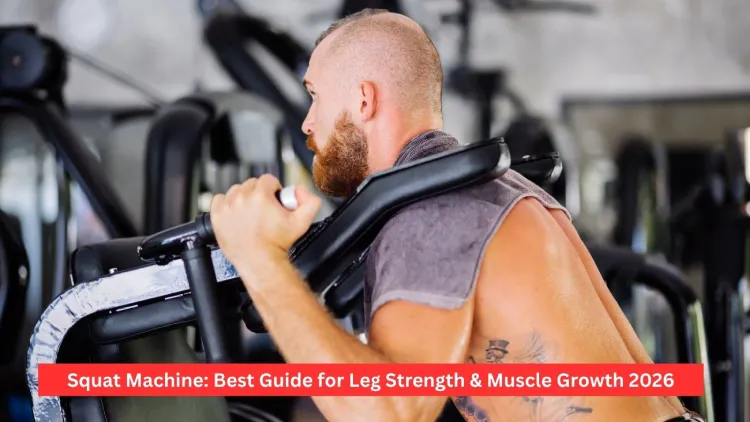

The squat machine is a powerful lower-body exercise machine that helps build leg strength, promote muscle growth, and improve stability. It provides guided movement, making workouts safer and easier for beginners, seniors, and people with balance or joint concerns. Different squat machine variations target the quads, glutes, hamstrings, calves, and core while reducing stress compared to traditional squats. With proper training and recovery, the squat can help improve overall fitness, mobility, and lower-body performance.
- What Is a Squat Machine?
- Muscles Worked by the Squat Machine
- Benefits of Using a Squat Machine
- Technique: Proper Squat Machine Form
- Best Foot Placements on the Squat Machine
- Squat Machine for Beginners
- Squat Machine for Muscle Growth
- Strength: Squat Machine
- Common Squat Machine Mistakes
- Squat Machine Workout Routine
- What is the frequency of the squat machine workouts?
- Here are some tips to get the most out of the squat machine
- The Squat Machine: Is It Safe?
- Best Squat Machine Exercises for Glutes
- Best Squat Machine Exercises for Quads
- Recovery after the SM session
- Squat machine and lower back health
- A squat machine and blood sugar support?A squat machine and blood sugar support?
- Squat Machine for Seniors
- So what's the best type of squat machine?
- Final Thoughts
- Frequently Asked Questions
What Is a Squat Machine?
A squat machine is a gym machine designed to help users perform squatting movements in a controlled and stable environment. Unlike free-weight squats, where balance and stabilization are major challenges, the squat machine guides the body through a safer movement path. This allows users to focus more on muscle engagement and less on balancing heavy weights.
This Machine is commonly used in commercial gyms, rehabilitation centers, sports facilities, and even home gyms. Many people prefer using a squat machine because it reduces stress on the spine while still allowing intense lower-body training.
There are several types of squat machine designs available today, including:
- Hack squat machine
- Smith machine
- Pendulum squat machine
- Belt squat machine
- Lever squat machine
- V squat machine
Each squat machine changes the angle and movement slightly, but all of them are designed to strengthen the lower body.
The squat machine is considered highly effective for improving:
- Leg strength
- Muscle growth
- Athletic performance
- Stability
- Joint support
- Functional movement
For beginners, the squat machine can make learning proper squat form easier. For advanced lifters, it allows heavier loading and targeted muscle development.

Muscles Worked by the Squat Machine
The squat targets multiple major muscle groups throughout the body. Although the lower body does most of the work, the exercise also activates stabilizing muscles that support posture and movement.
Quadriceps
The quadriceps are the primary muscles worked during most squat exercises. These muscles are located at the front of the thighs and are heavily involved in knee extension.
A squat machine with a lower foot placement usually increases quadriceps activation. Hack squats are especially effective for building bigger and stronger quads.
Glutes
The glute muscles play a major role during deep squat movements. The glutes help extend the hips and provide power during the upward phase of the exercise.
Higher foot placement on a squat machine generally increases glute activation.
Hamstrings
The hamstrings help stabilize the knee joint and assist with hip extension. Although they are secondary muscles in many squat exercises, they still receive significant stimulation.
Calves
The calf muscles help stabilize the ankle and maintain balance during movement.
Core Muscles
Even though the squat machine offers support, the core still works hard to maintain proper posture and spinal alignment.
Strong core muscles are essential for protecting the lower back during heavy training.
Benefits of Using a Squat Machine
The squat machine offers many benefits for people of all fitness levels. Whether you are a beginner, senior, athlete, or bodybuilder, the squat machine can improve your lower-body training.
Better Stability
One of the biggest advantages of a squat machine is stability. The guided movement path helps users maintain balance and proper posture.
This is especially useful for beginners who struggle with free-weight squats.
Reduced Lower Back Stress
Many squat machine variations place less stress on the spine compared to traditional barbell squats. This makes them useful for people with lower back discomfort or limited mobility.
For seniors and individuals with mild spinal issues, certain squat machine types, like the belt squat, may feel more comfortable.
Improved Muscle Isolation
The squat machine allows users to focus more directly on specific leg muscles without worrying about balancing the load.
This makes it highly effective for hypertrophy training.
Safe Heavy Training
Many people feel safer lifting heavy weights on a squat machine because the movement is controlled.
Safety stops and guided rails also reduce the risk of losing balance.
Better Confidence
This Machine can help users develop confidence before progressing to advanced free-weight movements.
Blood Sugar Support Through Exercise
Lower-body exercises such as squat training can help improve insulin sensitivity and support healthier blood sugar levels. Large muscle groups use glucose for energy during exercise, which may help reduce blood sugar spikes after meals.
Regular exercise combined with healthy nutrition can be beneficial for individuals managing type 2 diabetes or insulin resistance.

Technique: Proper Squat Machine Form
To avoid injury or to maximize muscle activation of a squat machine, the importance of form is emphasized.
Step 2:setup Properly
- Keep feet shoulder-width apart
- Maintain an upright torso.
- If necessary, press back flat against the pad.
- Hold onto the hold tightly.
Step 2: Engage the Core
Use abdominal muscles to press down before starting the action.
A stable core also stabilises the spine and helps with control.
Step 3: Lower Slowly
Slowly bend down, keeping feet and hips down.
Avoid rapid movement.
Step 4: Reach Proper Depth
Try to drop until thighs are parallel to the floor or lower, as needed.
Step 5: Push Through the Heels
Increase the pressure on the upward motion through the heels till you come back to the initial position.
Do not bounce on the bottom.
Best Foot Placements on the Squat Machine
The alignment of the feet alters the muscles that are worked in squat exercises.
High Foot Placement
A high foot position has a greater emphasis on the glutes and hamstrings.
This change can also help to minimize knee stress for many.
Low Foot Placement
A low foot position will engage the quadriceps more.
However, it could be a strain on the knees if there is limited mobility.
Wide Stance
Wider forearm engages the inner thighs and glutes.
Narrow Stance
A narrow stance works more on the outer quad muscle group.
Regular variation of foot placement affects the whole lower body development.
Variations for the Squat Machine Exercise
Each type of squat is effective in a particular way.
Hack Squat
Hack squats are among the leg training machines that are most popular.
Benefits
- Excellent quadriceps development
- Stable movement pattern
- Another good choice for building muscles.
The hack squat machine works well for a training session focused on building muscles.
Smith Machine Squat
The Smith machine provides vertical movement for the bar and controlled movement.
Benefits
- Easier balance
- Adjustable stance positioning
- Beginner friendly
Smith Squat is a popular workout option for those who are making the switch from machines to free weights.
Belt Squat
Belt squat is a different sort of squat than normal, using the weight around the hips as opposed to the shoulders.
Benefits
- Less spinal compression
- Great for your lower back being sensitive.
- Excellent glute activation
The belt squat is one of the most popular squat options among many trainers, and it is great for individuals who suffer from any kind of discomfort in the back.
Pendulum Squat
The pendulum squat initiates an automatic arcing movement, which helps to tighten the legs.
Benefits
- Deep range of motion
- Constant tension
- Intense quadriceps activation

Squat Machine for Beginners
The initial stages of learning are often challenging barriers for beginners to overcome: squat mechanics, balance, and confidence. It helps to make learning easier with the squat.
For those who are new to fitness, a squat machine can be beneficial:
- Develop correct squatting technique
- Improve coordination
- Develop their leg muscles.
- Gain confidence safely
Beginner Tips
- Start with lighter weights
- Focus on controlled repetitions
- Learn breathing techniques
- Use a correct stance for walking, running, jumping, and throwing.
- Don’t lock the knees!
For most of the beginners, training on the squat 1 to 2 times per week is beneficial.
Squat Machine for Muscle Growth
The squat machine is one of the best tools for the development of hypertrophy because it maintains constant tension in the muscles.
Best Rep Range
- 8–12 repetitions
- 3–5 sets
- Light to dark (moderate to heavy)
Progressive Overload
To help build muscle over time, resistance increases need to be made gradually.
Controlled Repetitions
Slow ecs increase time under tension and get muscles stimulated.
The squat can be a favored exercise for those wishing to enlarge their legs for bodybuilding purposes.
Strength: Squat Machine
The squat machine is also really good for developing leg power.
- Strength Training Guidelines
- 4–6 repetitions
- Heavy resistance
- Longer rest periods
Explosive upward movement
Heavy squat machine training makes you stronger:
- Quads
- Glutes
- Hamstrings
- Core muscles
The squat can enhance athletic power and overall functional strength.
Common Squat Machine Mistakes
The squat machine is not operated correctly by many individuals.
Using too much weight
Bad posture and an overworked joint can be brought on by too much weight.
Partial Repetitions
Half reps are considered low intensity and encourage no progression.
Knees Collapsing Inward
Do not let your knees come together and move closer to your toes; maintain a straight line pattern with legs through the entire motion.
Rounded Back
The rounded back doesn’t sit well on the spine, which means more stress on it.
Lifting the Heels
Lifting the Heels
Safety and outcomes are enhanced when these mistakes are avoided.
Squat Machine Workout Routine
The squat is one piece of exercise equipment which is capable of being incorporated into different training sessions.
Beginner Routine
- Squat machine – 3 sets x 12 reps
- Leg press – 3 sets × 10 reps
- Walking lunge – 2 sets of 12 reps
- Squat jumps – 2 sets × 1 rep (2-second count)
Intermediate Routine
- Hack squat – 4 sets × 10 reps
- Romanian deadlift – 4 sets or reps of 8
- Bulgarian split squat – 3 sets x 10 reps
- Each set is 12 repetitions of leg extension with 3 sets.
- Standing calf raises – 4 sets × 15 reps
Advanced Routine
There are never enough squats. Heavy squat machine – 5 sets x 6 reps.
- Angle press bench press – 4 sets × 8 reps
- Belt squat – 4 sets × 10 reps
- Half squat lunges – 4 sets × 20. Step ups – 4 sets × 10 steps.
- 5 sets of x 15 reps seated calf raises
What is the frequency of the squat machine workouts?
The frequency of training varies from person to person, depending on their objectives and recovery rate.
- Beginners:1–2 sessions weekly
- Muscle Growth:2 sessions weekly
- Advanced Lifters: Up to 3 sessions a week.
Muscle recovery and joint health are critical and require proper recovery.
Here are some tips to get the most out of the squat machine
- Warm Up Properly: DWU makes athletes “warm up” in order to enhance circulation and mobility.
- Control the Negative: Slowly reduce the stretch during the weight descent to build muscle tension.
- Use Proper Depth: Many times, deeper squats will provide better activation of the muscles.
- Wear Stable Shoes: Flat shoes increase balance and force production.
- Track Progress: Writing workouts can chart progression and be used to trace improvement over time.

The Squat Machine: Is It Safe?
The squat machine, in general, is safe if used correctly.
Because of the movement path controlled by the machine, many have a safer experience using the squat than free-weight squats.
But still, it can only be safe if:
- Proper technique
- Appropriate resistance
- Good mobility
- Controlled repetitions
Anyone having serious spinal problems, severe arthritis, or final injuries should check with a health care provider before doing lots of training.
Best Squat Machine Exercises for Glutes
The squat machine can be a very good machine for building the buttocks.
High Foot Placement
With feet up on the platform, the emphasis is off the knees and onto the glutes.
Deep Range of Motion
More intense squats elicit more glute engagement.
Slow Repetitions
Controlled reps help to build muscle tension and additional development.
Glute squat workouts are popular with athletes and physique competitors.
Best Squat Machine Exercises for Quads
To activate the quadriceps the most:
- Take a low foot placement.
- Keep your back straight.
- Keep feet just slightly tighter.
- The level of resistance should be moderate to heavy.
Hack squats are more than particularly beneficial for quads.
Recovery after the SM session
Rest is crucial after heavy squat machine workouts.
- Recovery Tips
- Extend the lower leg. Straighten leg.
- Drink enough water
- Consume protein-rich meals
- Sleep 7–9 hours
Do not over-train!
Good recovery equals good performance and less soreness!
Nutrition also helps repair muscles and maintain joint health. Some foods are high in calcium, magnesium, vitamin D, and omega-3 fats, which can help strengthen bones and spinal health.
Foods for healthy, active lives may include leafy green vegetables, fish, milk/dairy products, nuts and seeds, and fruits.
Squat machine and lower back health
The squat provides greater support compared to classic barbell squats, which is what makes it more attractive to many who experience minor lower back pain.
Some variations of the squat (particularly belt squats) can lessen the loading on the spine considerably.
But if you have serious back conditions like nervousness, back pain, a bulging disc, or a serious spinal problem, you have to exercise caution and do not compress to a larger extent.
Common lower back workouts that are suggested for health include:
Heavy compression on the spine can cause discomfort for some back pain sufferers.
The ideal equipment to work out on for older people who suffer from low back pain can vary according to their mobility and pain level. Recumbent bikes, elliptical exercise machines, and belt squats can be easier for many people to tolerate than many other forms of exercise.
Structural issues at L4-L5, like a large disc bulge, may not be “cured” with exercise alone, but can be improved with proper training to better support the body, assist with mobility, achieve happy spine posture, and manage pain.
A squat machine and blood sugar support?A squat machine and blood sugar support?
The exercises for the lower body engage some of the biggest muscles in the body, such as the squat machine.
When exercising, these muscles consume glucose as their fuel source, which could increase insulin sensitivity and potentially blood-sugar control over time.
People who have blood sugar problems are usually advised to lead an active lifestyle and engage in activities like walking, squats, cycling, and resistance training.
Some people work out with bodyweight squats after food, protesting to enhance insulin sensitivity.
When, what, and how often, when to eat, water, sleep, and consistency all influence blood sugar levels.
Caution should always be taken and proper medical guidance used before engaging in strenuous physical activity courses when already suffering from diabetes.
Squat Machine for Seniors
As long as it is utilized properly, the squat can be very beneficial for the older person.
An advantage for senior citizens may involve:
- Improved leg strength
- Better balance
- Increased mobility
- Joint support
- Reduced fall risk
Older adults are likely to be advised to use lighter resistance and slower movements.
The squat might also support independent living and the ability to utilize everyday actions as people grow older.
Strength training is one category of exercise that’s often deemed one of the finest ways to exercise for healthy ageing, as it helps maintain muscle mass, bone density, posture, and metabolism.
So what’s the best type of squat machine?
The perfect squat is determined by what your targets are.
Best for Beginners
Best for Quad Growth
Best for lower back comfort
Belt squat machine
Best for Advanced Lifters
Pendulum squat machine
Best for Overall Stability
Lever squat machine
A variety of squat machine movements can be used to see if there is a movement that feels “more natural” or will allow for more to be done.

Final Thoughts
The squat machine is one of the most effective workout apparatus for strengthening, building muscles, and stability of the lower body. It funnels which muscles – quads, glutes, hamstrings, and calves – and offers greater control and support compared to standard squats. The squat can be used for beginners, intermediate, and senior training for safer leg training. The squat can be one of the most effective ways to gain strength and fitness in your lower body with the proper form, regular exercise, and excellent recovery.
Frequently Asked Questions
1: Good squat machine for beginners?
Absolutely, squat beginner level friendly as they are stable and moves are designed in a range-controlled manner.
2: What muscles does the “Squat” machine target?
The squat primarily works the quadriceps, buttocks, hamstrings, calves, and core muscles.
3: What’s the difference between using the squat machine and using squats?
The squat machine provides greater support and stability, and standard squats provide improved balance and general athleticism.
4: How frequently do you have to use the squat machine?
The squat can actually be used 1 to 3 times a week by most people, given their fitness objectives and recuperation capacity.



2 thoughts on “Squat Machine: Best Guide for Leg Strength & Muscle Growth 2026”
Hey! Would you mind if I share your blog with my myspace group?
There’s a lot of people that I think would really enjoy your content.Please let me know.
Many thanks
Thank you! Yes, feel free to share—we really appreciate it