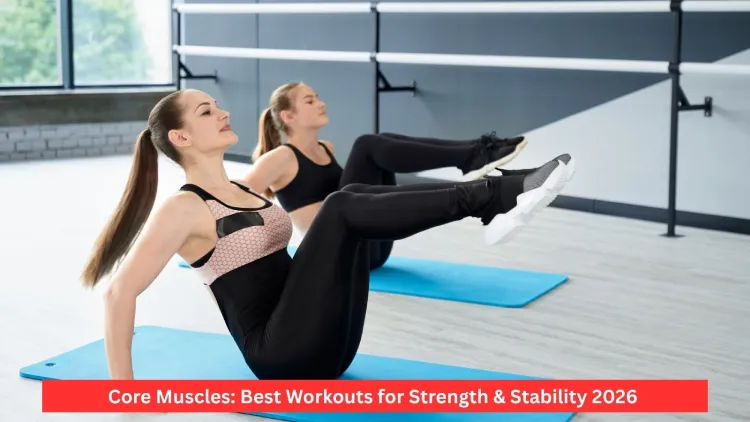

Core muscles exercises build core muscle strength to help improve how the spine, hips, and pelvis move, and help to build more efficient daily movements and athletic performance. Having strong core muscles will assist you with balance, posture, stability, and lifting power, and help prevent injuries. These exercises to tackle include: planks, side planks, bird dogs, dead bugs, mountain climbers, Russian twists, bicycle crunches, leg raises, hollow body holds, and reverse crunches.
Even several days a week of regular training can bring significant improvements within 10-15 minutes. Slow movements, breathing, and walking also help for effective core activation and enhanced long-term strength. In this guide, there is no chapter dedicated to theory, but instead, it is all about exercises, the right ways to do them, workout programs, and useful information on how to build a solid core.
What are core muscle exercises?
Core muscle exercises refer to exercises that aim to develop strength in the core muscles (those associated with the stability of the trunk and power transfer between the upper and lower body). Many people imagine the core muscles to be made up of only the six-pack muscles, but the core can be split into a number of muscles that function together to facilitate motion.
The primary muscles engaged are Rectus Abdominis, Internal and External Obliques, Transverse Abdominis, Erector Spinae, Multifidus and Diaphragm, Pelvic Floor muscles, and those around the hip area. The four deep core muscles, which stabilize the body’s spine before movement, have come to be known as the “four deep muscles,” and among them are the transverse abdominis, multifidus, diaphragm, and pelvic floor muscles.
Most exercises require multiple muscle groups, which allows them to perform core exercises instead of isolation exercises. This means they are useful, which helps their movements when you are lifting groceries, climbing stairs, running, or playing sports, etc., during your daily activities.
Around the gym, stabilizing core muscles is essential to having good posture, maintaining spinal alignment, and providing a solid base for almost all exercises performed.

Benefits of Core Muscles Exercises
Try regular core muscle exercises, and you will reap rewards in more than just your appearance.
Better stability is among the top benefits. The stronger the core muscles, the more efficient that the body’s use of its motion will be, thereby transferring excess strain to the joints and muscles.
One other significant advantage is that the postures are improved. People with weak core muscles tend to develop rounded shoulders, an overarching lower back, and poor body mechanics. Exercises that this will strengthen will promote good sitting, standing, and walking posture.
In addition, the legs generate power that travels down through the core joints and out into the upper body to affect the athlete’s performance. Whether throwing a ball, sprinting, jumping, or lifting weights, a stable midsection is essential for efficient force transfer.
Core muscle exercises strengthen core muscles that offer stabilization to the spine during movement and lessen the risk of lower back pain since they are not dependent on passive structures, such as ligaments.
Additional benefits include:
- Improved balance and coordination
- Better movement efficiency
- Enhanced lifting technique
- Increase in your stamina while exercising.
- Increased body control
- Improved functional fitness
- Better breathing mechanics
- Reduced injury risk
These qualities can be progressively enhanced over time through moderate practice.
Best Core Muscles Exercises
1. Plank
The plank is one of the best core muscle exercises that doesn’t involve any movement. The plank is an isometric exercise, the type of exercise your muscles do when your body remains static, so that the muscle must contract to move the body. This enhances stability, endurance,e and body strength that will carry over into activities and sports throughout the day.
Corrected properly, the plank activates rectus abdominis, the lower back, the shoulders, the obliques, the transverse abdominis, as well as the glutes and even legs. Because of the number of muscles used, it is regarded as perhaps a base workout for novices and experienced athletes equally.
How to Perform
- Rest forearms on the floor, elbows under the shoulders.
- Place your legs behind and stand on the tips of your toes.
- Keep the body from side to side.
- Tighten abdominal muscles and squeeze glutes.
- Position eyes slightly forward, but with a neutral neck position.
- Maintain the stretch with a normal breath.
Benefits
- Completes overall core endurance exercises
- Improves muscular endurance
- Troublesome areas on the upper back and shoulders are strengthened.
- Supports and improves posture and body control
- Requires no equipment
- Develops improved performance in lifting and sport activities.Improves lifting and sports performance.
Common Mistakes
- Having hips tummy tuck down towards the ground
- Legs are straight, but hips are lifted too high to the ceiling.
- Not breathing, but instead taking gases in and out of the lungs by holding the breath.
- Standing with a full sacral lift, straining the neck.Full sacral lift and straining the neck looking up.
- Attempting to hold time as much as possible rather than ensuring good form time.Over-speeding, looking for hold time rather than good form time.
Progression Tips
Starters may begin at 20 seconds and increase by one second each week. Weighted planks or plank variations like shoulder taps or plank reaches for more advanced can be included for advanced.
The plank is a simple core exercise that can be seen as one of the “big three” core exercises due to its contribution to anti-extension strength – meaning resisting too much movement in the spine and maintaining stability.

2. Side Plank
Side plank works the muscles that are not frequently addressed in basic ab exercises. This exercise focuses on imbibing the lateral stabilizers rather than focusing on forward stability, therefore strengthening the obliques of muscles supporting the spine. It also supports the hip, the buttocks, and improves the endurance of the shoulder, which is beneficial for runners, athletes, and anyone looking to improve their balance.
How to Perform
- While on your side with your legs straight.
- Hold your forearm on the ground right under your shoulder.
- Place your feet together or step forward to improve your balance.
- Raise your hips so that the body is straight.
- Tighten your core and do not move forward or back.
- Once you are in that position, before moving to the other side, hold it.
Benefits
- Tightens abdominal muscle tone (external and internal obliques)
- Improves lateral stability
- Improves balance and coordination
- Supports spinal alignment
- Builds shoulder endurance
- Avoid weakness on the opposite end of the other leg.
Common Mistakes
- Allow hips to drop
- Moving the shoulders forward as they rotate. Shoulder rotations forward.
- Holding the breath
- Spending too much time on the shoulder instead of putting the strain on the whole body.
Progression Tips
This exercise can be done with bent knees with minimal challenge or lifted top leg or extended upper arm for more challenge for the advanced exerciser.
Side planks strengthen rotational control, thereby improving daily activities like carrying groceries, climbing stairs, and doing sports.
3. Dead Bug
The other weird thing about this dead bug exercise is that it is one of the easiest to do and the best exercises for beginners to build core stability. It focuses on moving slowly and safely and instructs the body on how to keep the backbone from moving when the arms and legs move. It is especially helpful for those seeking a firm core to build, but also not putting too much pressure on the lower back.
How to Perform
- On your back, flat on the floor.
- Extend both arms up towards the ceiling.
- Knee bent at a 90-degree angle.
- Contract the abdominal muscles.
- With one arm over head, and the other leg extended, drive forward slowly.
- Go back to the starting position.
- Repeat on the other side.
Benefits
- Engages lower core muscles
- Makes upper and lower body work together better
- Supports the lower back.Supports lower back position.
- Enhances spinal stability
- Promotes good movement routines
- Develops muscles under control and not momentum.
Common Mistakes
- Retracting the glutes (sitting up straight in the hips)
- Moving too quickly
- Failure to brace the abdominal area
- Reaching with arms extending beyond control.
Progression Tips
Use slow reps and concentrate on keeping your lower back flat on the floor. As control is improved, increase the duration of the “hold” to each extension.
The exercise is excellent for people looking to add to their workout, and one of the main purposes of learning how to engage the core muscles is before using the limbs.

4. Bird Dog
The bird dog becomes stable and tests balance and coordination. Promotes good posture, helps to build muscles around the spine and hips, and promotes control and good movement. As it is a two-sided movement of arm and leg, it also helps to communicate between the left and the right.
How to Perform
- Begin on your hands and knees.
- Have your hands below your shoulders.
- Place knees directly over hips.
- Tense abdominal muscles.
- Raise one arm forward and the opposite leg backward.
- Avoid twisting and maintain level hips.
- Before returning to the starting position, hold for a brief time.
Alternate sides.
Benefits
- Strengthens spinal stabilizers
- Improves posture
- Builds coordination
- Enhances balance
- Stimulates the buttocks and lower spine muscles.
- Learns how to produce effective movement patterns
Common Mistakes
- Rotating the hips
- Raising the leg too high.
- Stretching up to the sky, holding the chin up high.
- Running too fast and badly, unsteadily
Progression Tips
Hold at end range for 2-3 seconds, then return. There are light ankle weights and resistance bands for advanced variations.
Bird dogs are also sometimes part of evidence-based core training with plank and curl-up variations, as they increase stability without putting additional tension on the spine.

5. Mountain Climbers
They are one of the best fitness routines as both mountain climbers condition the whole body and activate the core. They boost the heart rate and build the muscles of the abdomen, shoulders, hips, and legs. If done properly, they will increase strength and work capacity.
How to Perform
- Start in a high plank position, with hands underneath shoulders.
- Tighten your core muscles and keep your body straight.
- Bring the knee to the chest.
- Bring the opposite knee towards the same leg.
- Alternate legs, moving and controlling.
- Keep your torso stable at all times during the exercise.
Benefits
- Elevates heart rate
- Strengthens the core
- Improves muscular endurance
- Sends the message to the shoulders and hips to engage
- Burns calories efficiently
- Improves coordination and agility
Common Mistakes
- Increased pelvic movement beyond “normal” range
- Taking very sloppy or uncoordinated steps
- Losing plank alignment
- Making speed a priority over technique
Progression Tips
For beginners, they should take mountain climbers slowly, emphasizing posture and control. Those who are advanced and intermediate have the option to run or jog faster, or can set the intervals for 30-60 seconds. Controlled, not quick, is the key with mountain climbers, making them a great all-body exercise to build up core strength, while simultaneously enhancing your overall level of fitness and activity.
Common Mistakes Made in Core Muscles Exercises
Typical errors are using too fast movements, holding the breath, and relaxing the proper lower back or hip alignment. Another problem is that many people also neglect to do the necessary pre-exercise core exercises or overtrain without recovery. Bad form decreases results and can add to the likelihood of injuring yourself, so training slow and controlled movement is the key.

Final Thoughts
Consistency is the key to strong core muscles, and complexity is an unnecessary obstacle. Regularly perform simple exercises such as planks, bird dogs, and dead bugs, to significantly enhance stability, posture, nd general strength. Practice good form, be consistent, and your core strength will gradually improve over time.
Frequently Asked Questions
1. How often should core muscles be trained?
Core muscles may undergo training 3-5 times a week d, depending on the intensity of the muscle training. Low-intensity exercises like this length can even be performed every day as long as recovery and quality are accounted for.
2. Does walking contribute to building core muscles?
Yes, walking engages stabilising of core muscles – when the spine is held upright, nd the core is lightly engaged throughout the gait.
3. Are 10 minutes of abdominal work a viable amount of time?
Absolutely, 10 minutes that’s done with a proper form and consistent manner can be helpful. It is better to do a few short and concentrated workouts than a lot of low-quality ones.
4. Is it possible to build muscle strength in the core?
Yes, it is possible to build up the core muscles with regular practice and work, starting with simple exercises such as walks on the plank, dead bug,s and bird dogs, and then build up to more intensity.