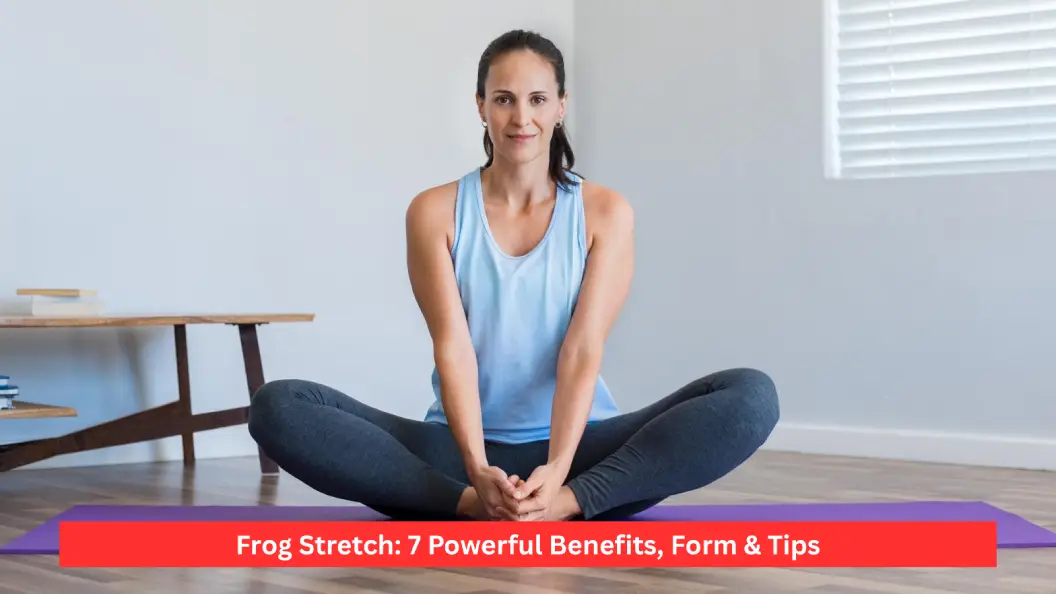

The frog stretch is a hip-opening exercise to work the inner thighs and groin. It can help increase hip joint flexibility and improve comfort during daily movements. Learn the proper technique for the frog stretch, what it does for you, and beginner tips to avoid putting unnecessary stress on your knees and hips.
- What Is the Frog Stretch?
- How to Do the Frog Stretch Correctly
- What Muscles Does the Frog Stretch Work?
- 5 Benefits of the Frog Stretch
- How Long Should You Hold the Frog Stretch?
- How Often Should You Practice?
- Common Frog Stretch Mistakes
- Frog Stretch Modifications for Beginners
- Frog Stretch vs. Butterfly Stretch
- Is the Frog Stretch Safe for Everyone?
- Try This Simple 5-Minute Hip Mobility Routine
- Final Thoughts
- Frequently Asked Questions
What Is the Frog Stretch?
The frog stretch is a flexibility exercise done on the floor that works mainly the muscles that run down the inside of your thighs, called the hip adductors.
The frog stretch is known as the frog stretch because your bent legs are in the position a frog is in when it rests. It could also be referred to as a frog pose stretch, especially when using yoga.
This exercise is not like hamstring or hip flexor stretches, but it works on muscles that pull your legs toward your center.
The exercise is often part of flexibility exercises, yoga, and mobility exercises.
The traditional position, however, can be quite intense. It’s considered a mid-level hip-opening stretch, and because of that, gentle variations are particularly helpful for those who don’t have a lot of experience with stretching.
Frog Stretch at a Glance
| Feature | Details |
| Main target | Inner thighs and hip adductors |
| Exercise type | Static stretch |
| Difficulty | Intermediate, with beginner modifications |
| Equipment | Exercise mat |
| Starting hold | 15–30 seconds |
| Main purpose | Hip and inner-thigh flexibility |
How to Do the Frog Stretch Correctly
You don’t need exceptional flexibility to begin. What matters is finding a position that creates gentle tension without causing pain.
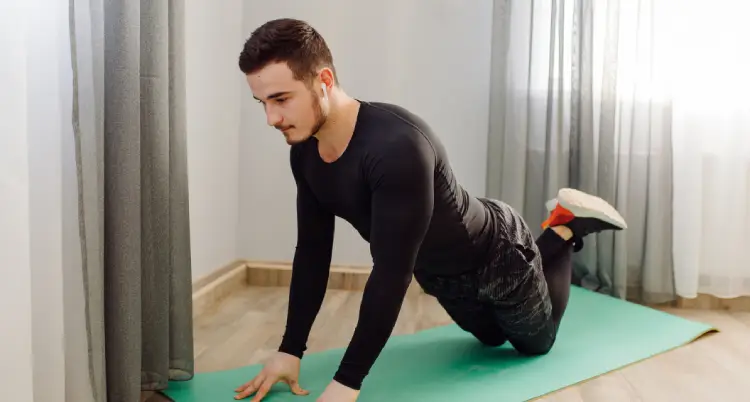
Follow these six steps.
Step 1: Start on Your Hands and Knees
Get onto an exercise mat with your hands beneath your shoulders and your knees below your hips.
Keep your back in a comfortable, neutral position.
If your knees are sensitive, place folded towels beneath them before starting.
Step 2: Slowly Spread Your Knees
Gradually slide your knees away from each other.
Move slowly rather than trying to reach your widest position immediately.
You should begin feeling tension along your inner thighs. That’s your signal to stop widening if the stretch already feels sufficient.
Step 3: Position Your Feet
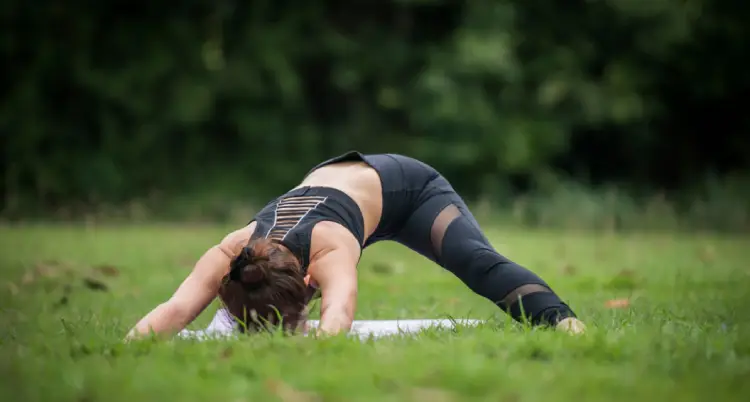
Keep your knees bent and let your lower legs extend outward.
In the traditional position, your knees form approximately 90-degree angles, with the insides of your lower legs resting on the floor.
Don’t force this alignment if it creates discomfort.
Step 4: Lower Your Upper Body
If comfortable, bend your elbows and lower your forearms onto the mat.
Keep your shoulders relaxed and your spine comfortably lengthened.
You can stay supported on your hands if lowering onto your forearms feels difficult.
Step 5: Gently Move Your Hips Backward
Slowly shift your hips toward your heels.
Stop when you notice a comfortable stretch through your inner thighs and groin.
Avoid forcing your hips farther back just to deepen the position.
Step 6: Hold and Release
Breathe naturally while holding the stretch for around 15–30 seconds.
When finished, gently move your hips forward and bring your knees closer together.
Rest briefly before repeating.
Quick tip: A successful frog stretch should feel controlled. If you’re holding your breath, shaking from discomfort, or feeling sharp pain, reduce the intensity.
What Muscles Does the Frog Stretch Work?
The frog stretch focuses mainly on the muscles on the inner thighs, known as hip adductors.
They are involved in the co-ordination and stabilisation of your hip during movement and help pull your legs together.
These are the primary muscles engaged:
- Adductor magnus: Large inner thigh muscle that helps stabilize and move the hip.
- Adductor longus: Pulls your thigh towards the middle of your body.
- Adductor brevis: Helps pull the thighs together.
- Gracilis: Aids in hip adduction and knee movement.
- Adductor Magnus: Adducts the hip and flexes the thigh.
The muscles are stretched when your knees are apart.
A sensation may be felt around the groin and surrounding hip tissues as well.
But the frog stretch isn’t focused on stretching the hamstrings, glutes, or hip flexors. The different exercises are beneficial for those areas.
5 Benefits of the Frog Stretch
The biggest advantage of this stretch is its focus on inner-thigh flexibility. It may also support broader mobility goals when combined with other exercises.
1. Improves Inner-Thigh Flexibility
Your adductor muscles help control sideways leg movement.
When these muscles feel restrictive, wide-leg positions may become uncomfortable.
Regular, gentle stretching can help improve your available range of motion over time.
The key is consistency rather than trying to achieve dramatic flexibility changes in one session.
2. Supports Better Hip Mobility
Hip mobility allows you to move your legs in different directions comfortably.
The frog stretch specifically challenges hip abduction, which occurs when your thighs move away from your body’s midline.
Practicing this position may help you become more comfortable with wider hip movements.
Still, flexibility is only one part of mobility. Strength and control matter too.
3. Complements Squat and Mobility Training
Your hips and inner thighs play important roles during squats and other lower-body movements.
If limited adductor flexibility makes a wide stance uncomfortable, stretching these muscles may be a useful addition to your routine.
However, doing frog stretches won’t automatically improve squat depth. Strength, ankle mobility, and individual hip anatomy also influence your movement.
4. Offers a Break From Sitting
After spending hours at a desk, moving your hips into a different position can feel refreshing.
The frog stretch gives your inner thighs an opportunity to move through a range they may not experience during prolonged sitting.
It isn’t a cure for sitting-related pain, but it can be one part of a routine that includes walking, movement breaks, and strengthening.
5. Fits Easily Into a Flexibility Routine
You don’t need special equipment or a gym membership.
A comfortable mat and a little floor space are enough.
Once you’ve learned the movement, you can include it after workouts or during dedicated stretching sessions.
For well-rounded mobility, pair it with exercises that target other hip movements rather than relying on one stretch alone.
How Long Should You Hold the Frog Stretch?
For beginners, 15–30 seconds is a practical starting point, provided the position feels comfortable.
General American College of Sports Medicine flexibility guidance recommends static stretching holds of around 10–30 seconds for most adults.
Here’s a simple approach:
| Experience | Suggested hold |
| First-time beginner | 10–15 seconds |
| Beginner | 15–30 seconds |
| More comfortable | 20–30 seconds, repeated |
| Experienced | Adjust gradually according to comfort |
These aren’t strict rules. Your body may need shorter holds, especially when you’re learning.
How Often Should You Practice?
Start with two or three sessions per week.
As the position becomes more comfortable, you can adjust your frequency without forcing progress.
Stretching works best as a consistent habit. You don’t need to chase a deeper position every day.
Common Frog Stretch Mistakes
A few small technique errors can turn an otherwise useful stretch into an uncomfortable experience.
Spreading Your Knees Too Wide
Going straight into the deepest position can create excessive tension around your groin.
Fix: Move your knees outward gradually and stop at a manageable stretch.
Pushing Your Hips Too Far Back
Forcing your hips toward your heels may increase pressure unnecessarily.
Fix: Use a small backward movement. Going farther isn’t always better.
Ignoring Knee Discomfort
Your knees support part of your body weight during the exercise.
Fix: Use extra padding, narrow your stance, or choose another exercise if discomfort continues.
Arching Your Lower Back
An exaggerated lower-back arch can make the position harder to control.
Fix: Keep your spine comfortably aligned and avoid forcing your pelvis into an extreme position.
Holding Your Breath
If you can’t breathe normally, the stretch may be too intense.
Fix: Ease out slightly and focus on slow, relaxed breathing.
Frog Stretch Modifications for Beginners
These are easier alternatives to the frog stretch if it’s too difficult.
Supported Frog Stretch
Fold towels under your knees and place your hands on the mat.
Keep knees just wider than hip-width.
This will minimize the need to occupy a tight joint right away.
Narrow-Knee Frog Stretch
Do not spread your legs apart widely, but simply keep the knees turned a few inches outwards.
Carefully move back until a slight sensation of tension is felt in the inner thigh.
As you get more comfortable, you can try going further wider.
Butterfly Stretch Alternative
Sit on the floor with the soles of your feet together, and your knees relaxed outwards.
Avoid rounding your back and tucking your knees in toward the floor.
If it is causing you discomfort to stand on your knees, this may be a more comfortable option.
Frog Stretch vs. Butterfly Stretch
Both stretches target your inner thighs, but they use different positions.
| Frog stretch | Butterfly stretch |
| Performed on hands and knees | Performed while seated |
| Emphasizes a wide-knee position | Uses bent knees with feet together |
| Can place pressure on the knees | Avoids kneeling pressure |
| Often more demanding | Often easier for beginners |
Neither exercise is universally better.
Choose the frog stretch if you’re comfortable kneeling and want to explore a wide-hip position.
Choose the butterfly stretch if you prefer a seated movement or need a gentler starting point.
You can also use both in the same flexibility routine.
Is the Frog Stretch Safe for Everyone?
Not necessarily.
People with recent groin strains, knee injuries, hip problems, or recent lower-body surgery should seek appropriate professional guidance before attempting it.
Stop immediately if you experience sharp pain, hip pinching, numbness, or joint discomfort.
A gentle pulling sensation through the inner thighs can be normal. Pain inside the hip or knee joint isn’t something you should push through.
Your natural hip structure also influences which positions feel comfortable.
Remember, the goal is better movement—not forcing your body to match someone else’s flexibility.
Try This Simple 5-Minute Hip Mobility Routine
Want an easy way to include the frog stretch in your day?
Try this short routine after a gentle warm-up.
| Exercise | Duration |
| Marching or walking in place | 1 minute |
| Gentle standing hip circles | 1 minute |
| Butterfly stretch | 30 seconds |
| Supported frog stretch | 30 seconds |
| Rest and reposition | 30 seconds |
| Gentle frog stretch repetition | 30 seconds |
| Relaxed walking or movement | 1 minute |
Move at a comfortable pace and skip anything that causes pain.
This routine isn’t a complete mobility program, but it offers a manageable starting point for exploring hip movement.
Final Thoughts
Frog stretch is a good exercise to increase flexibility in the inner thighs and get used to wide hips.
It’s not necessary to spread your knees as wide as they will go or to hold the stretch for a few minutes to get the benefit.
Move slowly, with some padding if necessary, and with comfortable movement.
It’s better to reinforce it with a bit of practice than to push it.
Want to keep improving your flexibility? Explore more stretching and mobility guides on Stretchlee to build a routine that works for your body.
Frequently Asked Questions
Is the frog stretch good for tight hips?
It can help if limited inner-thigh flexibility contributes to your tightness. However, hip stiffness may involve other muscles or joints, so different exercises may also be necessary.
Does the frog stretch help with middle splits?
It targets muscles involved in wide-leg positions, making it a potentially useful supporting stretch. Achieving middle splits also depends on other mobility factors, strength, and individual anatomy.
Why does the frog stretch hurt my knees?
Possible reasons include floor pressure, excessive knee positioning, or joint sensitivity. Add padding and reduce your range. Stop if pain continues.
Can I do the frog stretch every day?
You may be able to practice gentle stretching daily if it remains comfortable, but daily frog stretches aren’t required. Starting two or three times weekly is reasonable.