


Knee push ups help build chest, triceps, shoulders, and core strength and are beginner exercises. This is an easier form of pushup to learn good form and strength for full pushups by using less body weight.
- What Are Knee Push Ups?
- How to Do Knee Push Ups
- Knee Push Ups Muscles Worked
- Are Knee Push Ups Effective?
- What Are the Benefits of Knee Push Ups?
- Can Knee Push Ups Build Muscle?
- How many knee pushups should be performed?
- What Happens If You Do 100 Knee Push Ups Every Day?
- Knee Push Ups vs Regular Push Ups
- Knee Push Ups vs Wall Push Ups
- Common Knee Push-Up Mistakes
- Knee Push Up Workout for Beginners
- Conclusion
- Frequently Asked Questions
What Are Knee Push Ups?
Knee push-ups are a variation on the regular push up exercise that uses your knees instead of your feet as a point of contact on the floor. Also known as kneeling push ups or assisted push ups, they allow you to minimize resistance on the upper body while still working the chest, triceps, shoulders, and core.
This is an easy level push ups exercise to learn proper form, build upper body strength, and increase muscular endurance. Knee push ups can be a great exercise if you can’t yet do a regular push up and can help you build up to doing a push up.
How to Do Knee Push Ups
It’s more important to get the form of the knee push up right than to do many.
Follow these steps:
- Sit on the floor on all fours on a soft surface.
- Hold your hands about shoulder width.
- Start to shift your knees slightly back, so your body is in a straight line from head to knees.
- Do not look far forward; keep the head in a neutral position.
- Brace your abs, and keep your hips under control.
- Slowly lower chest toward the floor by bending elbows.
- Do not allow elbows to flare too far.
- Lower as far as you can while maintaining good form.
- To get back into the starting position, press palms.
- Perform again for the desired number of reps.
Consider using the whole body as a single unit of movement. The common error is to allow the chest to move, but not the hips.
ACE advises keeping the torso firm and engaging the core throughout the bent-knee push-up.
Adjust hand position and/or try on a higher surface if your wrists are uncomfortable. If there is sudden and abnormal pain, this is a sign to stop.
Knee Push Ups Muscles Worked
The primary muscles engaged in knee push ups are the muscles of the chest, triceps, shoulders, and muscles in the trunk area that keep the body stable.
| Muscle | Main role |
| Chest | Helps press the body away from the floor |
| Triceps | Straighten the elbows during the push |
| Shoulders | Assist with the pressing movement |
| Core | Stabilizes the torso |
| Upper-back stabilizers | Help control the shoulder blades |
The chest muscles, specifically the pectoralis major, make a significant contribution to the pushing movement. The triceps are also very much involved, as they assist with extending the elbows.
While your core is not the primary muscle you’re training, it has a very important role. The movement through your body is restricted by your abdominal and trunk muscles during each rep.
Studies investigating the variations of the push-up have identified significant contributions from the pectoral and triceps that also can vary with the position of hands and body.
The resistance involved with knee pushups is less than the resistance involved in regular pushups, which means there is a chance that fewer muscles may be activated. That doesn’t mean they’re not usable; it just means that this exercise is more appropriate for your current fitness level if push-ups are too hard.
Are Knee Push Ups Effective?
Knee push ups are good, especially if they are a suitable challenge.
If a regular push-up is too hard, doing it from the knees will enable you to work the same basic pushing movement with less resistance. This can help you develop strength and confidence, which will support you in your steps.

It’s all about how challenging the exercise is, and not what the name is.
For instance, if you are able to do 5 knee push ups and are getting the last 2 repetitions hard, it might be giving you a great training stimulus. If you can do 40 reps with little effort, then you may want to try a more challenging variation.
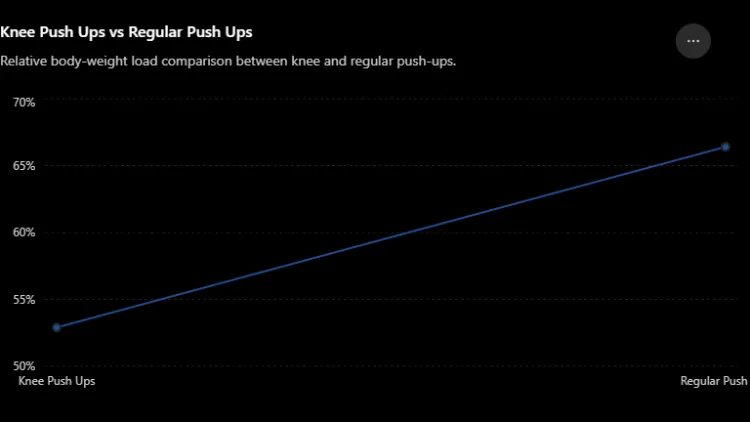
Studies have shown the on-knees push up carries less body weight compared to the standard push up. In one study, the initial load was roughly 52.9% of body weight for the on-knees variation and was 66.4% of body weight for the standard push up.
That’s one of the reasons that knee push-ups are easier.
What Are the Benefits of Knee Push Ups?
The following are some of the practical knee push up benefits for beginners and recreational exercisers.
1. They Are Beginner-Friendly
The main benefit is that it is accessible. If that person is not able to do the standard push up, he or she can usually start by doing a modified push up.
This will allow you to get used to the movement and not have to immediately face the full resistance of a normal rep.
2. They Strengthen the Upper Body
Knee push ups target the triceps, shoulders, and chest. Regular training can help improve your ability to perform other pushing movements.
3. They increase muscular endurance.
Repeated controlled repetitions may help increase your muscle’s resistance to fatigue.
This is beneficial for novice runners who are developing for more standard pushups.
4. Technique learning assistance.
The exercise is easier, so you can concentrate on hand placement, elbow position, core control, and range of motion.
Often, using a modified exercise will have a smoother transition to a standard push up if good technique is developed.
5. They require no equipment!
There is no need for any extra space on the floor! This makes knee push-ups a useful option for exercises at home, during a trip, or when you need to train rapidly.
Can Knee Push Ups Build Muscle?
Knee push ups do build muscle, particularly if you’re a beginner.
Progressive muscle development is the result of the balance between adequate training stress and recovery. The beginning student might find a relatively light resistance to be a very strong stimulus, since his muscles are not yet very adapted.
However, the exercise eventually needs to become more challenging.
If you are able to do man,y many knee push ups without getting fatigued, maybe more reps isn’t the best way to go. Instead, you can make the task more difficult by progressing to incline Push ups, assisted full push-ups, or full Push ups.
Research into push-up training has demonstrated pushups can increase strength and muscle development when pushups are an appropriate training stimulus.
Therefore, can you make your chest with your knee push-ups? Yes. However, the amount of muscle gained will be determined by how hard you train, how you progress, what you eat, your recovery, and your starting fitness.
How many knee pushups should be performed?
No single number is suitable for everybody.
For a novice, 2-3 sets of 5-10 controlled reps would be a good beginning. Take rest periods between sets and emphasize good form.
If you can do 10 reps, don’t keep adding reps; make it more difficult.
For example:
- Beginner: 2 sets of 5-8 reps
- Developing strength: 3 sets of 8–12 reps
- Better beginner: 3 sets of 10-15 repetitions
- Ready to progress: Start to perform more challenging push-up variations
You don’t have to do knee push-ups daily. The general guidelines for strength training are to train each major muscle group at least 2 times per week and then allow for adequate recovery.
How often you can do this is dependent on your overall exercise regimen and recovery speed.
What Happens If You Do 100 Knee Push Ups Every Day?
If you’re new to exercising, 100 knee push-ups daily can build up muscular endurance.
But 100 reps are not necessarily better than 20 or 30 good reps.
Your body gets used to training again and again. After 100 repetitions are performed relatively easily, the amount of resistance may no longer be sufficient to achieve the same level of improvement.
In addition, there’s a practical reason why it’s not good to do too many repetitions on a daily basis: Your muscles and joints might not have enough time to recover if the exercise is done too much or in an improper way.
A better way is to progressively build up the difficulty.
For example:
Incline push-ups, assisted push ups, standard push ups, knee push ups!
If wrist, elbow, or shoulder pain still occurs, dial back the training load and check your form.
Knee Push Ups vs Regular Push Ups
Both variations use the same basic pushing pattern, but standard push-ups require more resistance.
| Feature | Knee Push Ups | Regular Push Ups |
| Difficulty | Easier | Harder |
| Support | Knees and hands | Feet and hands |
| Upper-body load | Lower | Higher |
| Beginner-friendly | Yes | Depends on strength |
| Main muscles | Chest, triceps, shoulders | Chest, triceps, shoulders |
A standard push-up requires you to maintain a longer body position and support more of your body weight through your hands.
That does not mean knee push-ups are a “bad” version. They simply represent a lower-resistance progression.
There is also no scientifically accurate formula saying that five knee push-ups equal one regular push-up. Because individuals differ in body weight, strength, technique, and fatigue, repetition equivalence is not fixed.
Knee Push Ups vs Wall Push Ups
Wall push-ups are generally easier than knee push-ups because your body is positioned more vertically and less body weight is directed through your hands.
That’s why they’re beneficial for complete novices in push-up training.
It can progress this way:
Aim to perform four sets of each. Complete 4 sets of each of the following push-ups: Wall push-up, Incline push-up, Knee push-up, Standard push-up
It is not necessary to do this sequence in order. A person who can comfortably perform knee push ups can be ready for incline or full push ups.
The objective is to select the variation that you can perform at a good standard while being challenging.
Exercise the correct way to move on from knee push ups to regular push ups.
You don’t want to save your first hundred knee pushups for your first full push up.
Instead, slowly work up to more challenging variations.
Step 1: Master Knee Push-Ups
Do controlled repetitions with a steady torso and range of movement.
Step 2: Try Incline Push-Ups
Place your hands on a stable elevated surface. This makes it harder than wall push-ups, but easier than floor pushups.
Step 3: Slow negatives practice.
Get into the top of a standard push up position and slowly lower towards the floor. This will give you an opportunity to practice the more difficult move.
Step 4: Assisted Full Push Ups
Do one that allows you to work on the full-body position but minimises resistance.
Step 5: Standard Push-Ups Test
If the harder forms are manageable, then try the complete form with correct technique.
Common Knee Push-Up Mistakes
Here are the most common errors of a knee push up to avoid:
- Letting the Hips Drop: If the lower back sags, then you are losing core control. Tighten your abs and maintain correct posture.
- Raising the Hips Too High: You shouldn’t have your hips too far behind your shoulders. Try to have your body held upright, parallel with your knees.
- Flaring the Elbows: Excessive outward motion of the elbows will cause the motion to be less controlled. Maintain a relaxed, normal position for them.
- Rushing Repetitions: Repetitions tend to be more rapid, which causes less control. Sink slowly and use your core to move back.
- Cutting the Range of Motion: Half reps may be easier, but they could not give the same training effect as a controlled rep with a comfortable range of motion.
- Chasing Numbers: It is far less beneficial to do an inadequate number of poor repetitions than to perform 10-15 controlled repetitions.
Knee Push Up Workout for Beginners
Here is a simple four-week starting plan:
| Week | Sets | Repetitions |
| 1 | 2 | 5–8 |
| 2 | 2–3 | 6–10 |
| 3 | 3 | 8–12 |
| 4 | 3 | 10–15 |
Perform the workout around two or three times per week, depending on your overall training routine and recovery.
You do not need to reach the top of the repetition range if your form starts breaking down.
Once you can comfortably complete the final week, consider moving to a more difficult variation rather than simply adding dozens of repetitions.
Conclusion
Knee push ups are an excellent beginner exercise for chest, triceps, shoulder, and core conditioning. They are easier to learn and perform with proper resistance, which is less than that of regular push-ups. Do controlled repetitions in the beginning, and then move on to different versions as you grow stronger.
Frequently Asked Questions
1. Are Knee Push Ups Effective?
Yes. Knee push ups can build chest, triceps, shoulder, and core strength while helping beginners learn proper push-up form.
2. Can Knee Push Ups Build Muscle?
Yes. They can support muscle growth, especially for beginners, when performed consistently and with enough training resistance.
3. How Many Knee Push Ups Should I Do?
Beginners can start with 2–3 sets of 5–10 controlled repetitions. Increase the difficulty as your strength improves rather than only adding more reps.
4. Are Knee Push Ups Easier Than Regular Push Ups?
Yes. Knee push ups place less resistance on the upper body, making them easier than standard push-ups and useful for progressing toward full push-ups.