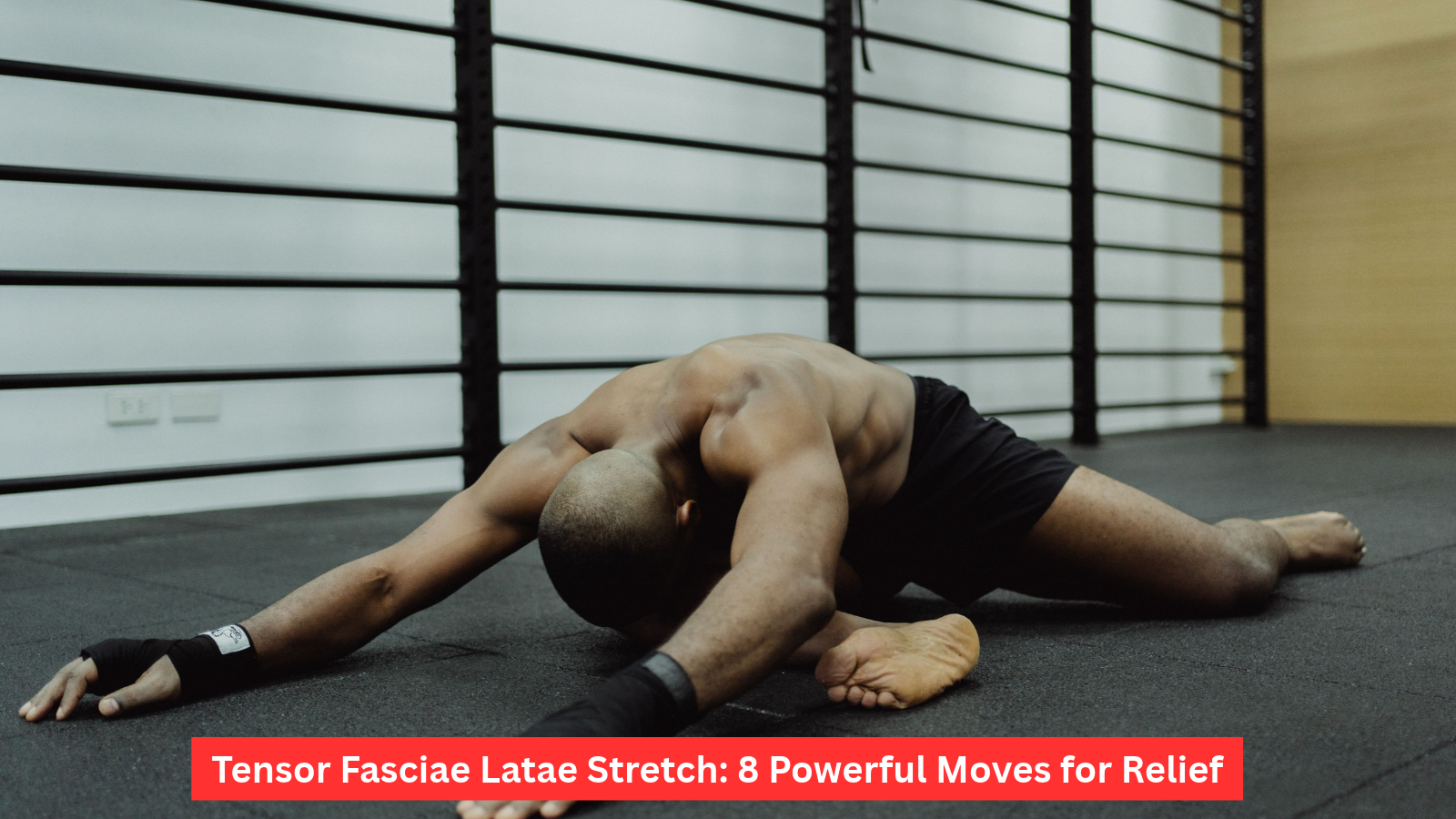

A stretch of the tensor fasciae latae helps to relieve outer hip tightness and increase hip mobility. Sitting for long hours or running can make your TFL muscle stiff. These 8 simple stretches and strengthening exercises can help increase flexibility and promote improved hip movement.
- What Is a Tensor Fasciae Latae Stretch?
- Quick TFL Stretch Routine at a Glance
- What Is the Tensor Fasciae Latae, and How Do You Know It's Tight?
- What Is the Best Tensor Fasciae Latae Stretch?
- 1. Standing Cross-Leg Side Bend
- How Long Should You Hold a TFL Stretch?
- How to Build Your Routine
- How Long Does It Take to Loosen a Tight TFL?
- When To Quit or Call a Professional?
- Conclusion
- Frequently Asked Questions
What Is a Tensor Fasciae Latae Stretch?
The small muscle on the front-outer side of the hip is called the TFL, and the tensor fasciae latae stretch lengthens it. For stretching, bring your leg back and across your body, keeping your pelvis tucked under your body. Stretch 2 to 3 times on each side 3 – 5 days per week for about 30 seconds per stretch.
Why bother? If you have a tight TFL, you may experience stiffness in your outer hip after running, a long drive, or sitting for an extended time at work. These are easy maneuvers that will take approximately 10 minutes.
Key Takeaways
- The tensor fasciae latae (TFL) is a small muscle in the hip that attaches to the outside of your thigh and the iliotibial (IT) band.
- The TFL is stretched when the thigh is moved backwards (hip extension) and across the body (hip adduction).
- Never bounce when doing a static stretch, and stretch for a minimum of 30 seconds following a short warm-up.
- This is because having strong glutes, particularly the gluteus medius, will take some of the workload off of a tired TFL.
- If sharp pain, numbness, or tingling occurs, discontinue and consult a professional if outer hip pain persists or worsens.
Quick TFL Stretch Routine at a Glance
| Exercise | Sets x Reps or Hold Time | Best For | Level |
| Standing cross-leg side bend | 2–3 x 30 sec each side | Quick desk break | Beginner |
| Wall side lean | 2–3 x 30 sec each side | Deeper standing stretch | Beginner |
| Half-kneeling TFL stretch | 2 x 30–45 sec each side | Front-outer hip | Beginner–Intermediate |
| Side-lying TFL stretch | 2 x 30 sec each side | Gentle floor stretch | Beginner |
| Supine cross-body leg drop | 2 x 30 sec each side | Outer hip and lower back | Beginner |
| Foam roller TFL release | 30–60 sec each side | Tender spots | Intermediate |
| Side-lying clamshell | 2 x 12–15 each side | Glute medius strength | Beginner |
| Glute bridge | 2–3 x 12 | Glute max strength | Beginner |
What Is the Tensor Fasciae Latae, and How Do You Know It’s Tight?
The tensor fasciae latae (TFL) is a small muscle at the front-outer edge of your hip, just below the bony point at the front of your pelvis. It helps lift your thigh forward and out to the side and turn it inward. It also tightens the IT band, which runs down the outside of your thigh to the knee.
The TFL sits between layers of the IT band and works with other muscles to move and steady both the hip and the knee. It often feels overworked in runners and people who sit a lot.
Common signs your TFL is tight:
- An ache or tight spot at the front-outer hip, about where a pants pocket sits.
- Your hip feels stiff when you stand up after sitting for a long time.
- Your knee tends to drift inward when you squat or step down.
Research on the TFL is still mixed. A 2020 review found that many common clinical ideas about its role in hip and knee problems aren’t well supported yet, so treat stretching as one helpful tool.
What Is the Best Tensor Fasciae Latae Stretch?
The best tensor fasciae latae stretch combines hip extension and hip adduction with a tucked pelvis. The half-kneeling TFL stretch does this most directly, while the standing and wall versions work anywhere. Pair 2 or 3 stretches with glute strengthening for the best results.
Most beginners lean their upper body and forget the pelvis. When I teach these stretches, I cue “tuck your tailbone first, then lean,” and the stretch moves right into the outer hip.
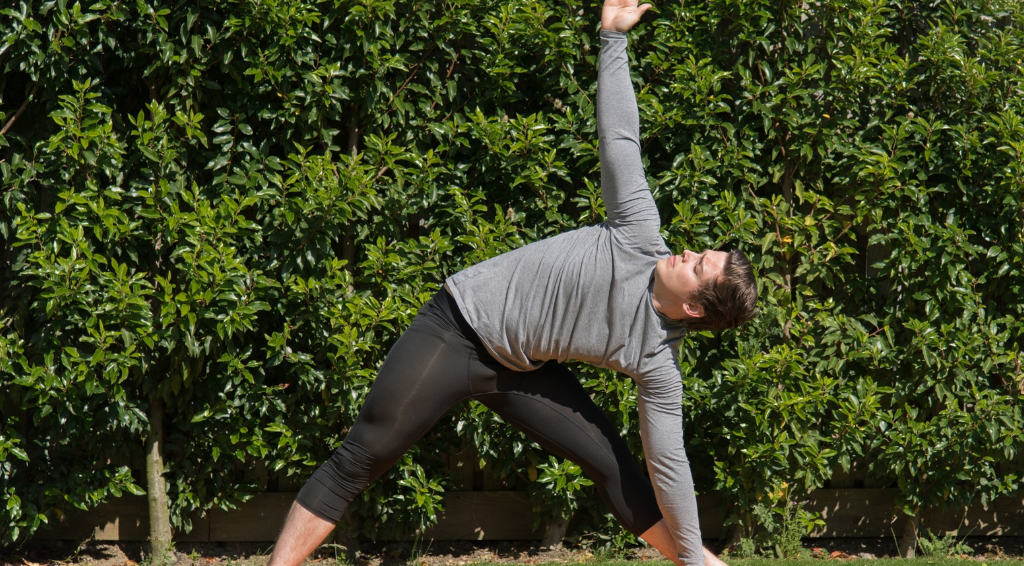
1. Standing Cross-Leg Side Bend
- Target: This simple stretch extends the TFL without the floor.
- Place the right leg behind the left leg and stand tall.
- Tilt your buttocks slightly and clench your right buttock.
- Extend the right arm up and bend the upper body to the left.
- Gently push right hip out to right side, until stretch is felt. Stop if you feel any pinching.
- Dose: 2-3 sets of 30 seconds side-by-side, 3-7 days per week
- Feel it here: The front-outer right hip and down the side of your thigh
- Mistake: Bending forward at the waist, rather than side to side
- Easier: Hold a chair or counter for balance
- Harder: Extend top arm further across and maintain for 45 seconds.
2. Wall Side Lean
Purpose: The wall lets you push your hip farther to the side for a deeper stretch.
- Purpose: Allows you to push your hip further to the side for greater stretch.
- Face a wall with your right side to it, about an arm’s length away.
- Rest your right hand against the wall at shoulder level.
- Bring the right leg through the left leg.
- Slowly lower the right hip towards the wall, keeping the pelvis tucked.
- Dose: 2-3 holds of 30 seconds each side,3-5 days a week
- Place your fingers here: Outer right hip, upper thigh
- Common error: Aligning hips to face the wall, so that the chest is facing the wall as well.
- Easier: Stand closer to the wall so the hip doesn’t have to move too far
- Harder: Step away from the wall to create a greater hip shift
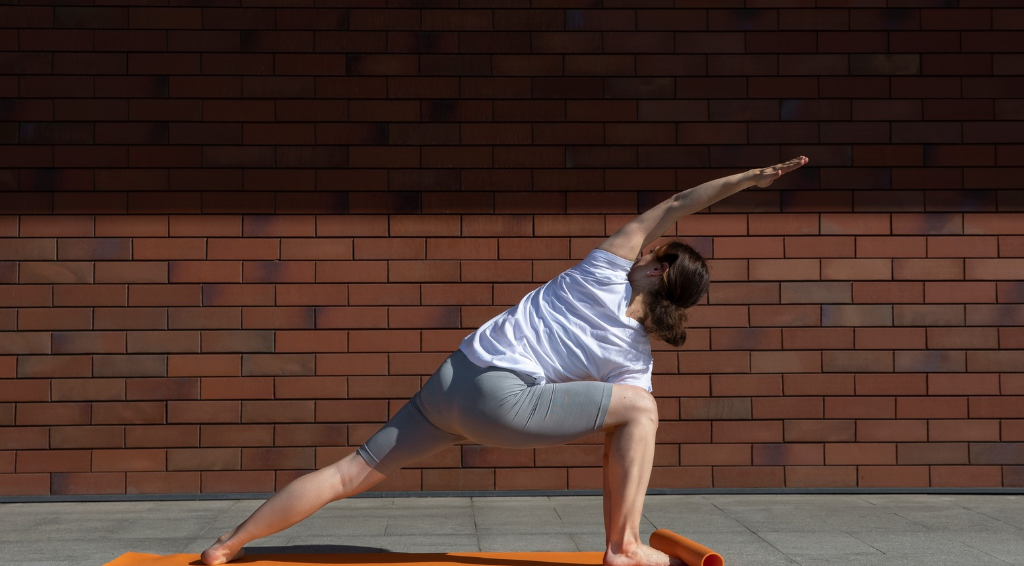
3. Half-Kneeling TFL Stretch
Purpose: This is the most direct way to stretch the front-outer hip.
- Kneel on your right knee on a pad, with your left foot flat in front of you.
- Tuck your tailbone and squeeze your right glute.
- Shift your weight forward until you feel a stretch at the front of your right hip.
- Turn your right foot slightly outward and lean your torso to the left.
- Keep your lower back flat. Don’t arch to go deeper.
- Dose: 2 holds of 30–45 seconds each side, 3–5 days a week
- Feel it here: The front-outer right hip, near your pocket
- Common mistake: Arching your lower back instead of tucking your pelvis
- Easier: Skip the side lean and just shift forward
- Harder: Raise your right arm overhead as you lean
4. Side-Lying TFL Stretch
- Purpose: In this gentle floor stretch, gravity does the work.
- Lie on your left side, near the edge of a bed or bench with your bottom knee bent for support.
- Move your right (top) leg straight backwards behind you.
- Slowly lower your right leg to the floor.
- Maintain a level pelvis. Don’t roll backward.
- Dose: 2 holds of 30 seconds each side, 3-5 days a week.
- Press here: On the outside of the hip and up the side of the thigh.
- Common mistake: Allowing the top leg to shift forward, thereby reducing the stretch.
- Easier: Do it on the floor with a less wide range
- Harder: Hold for 60 seconds and breathe slowly for the leg to sink.
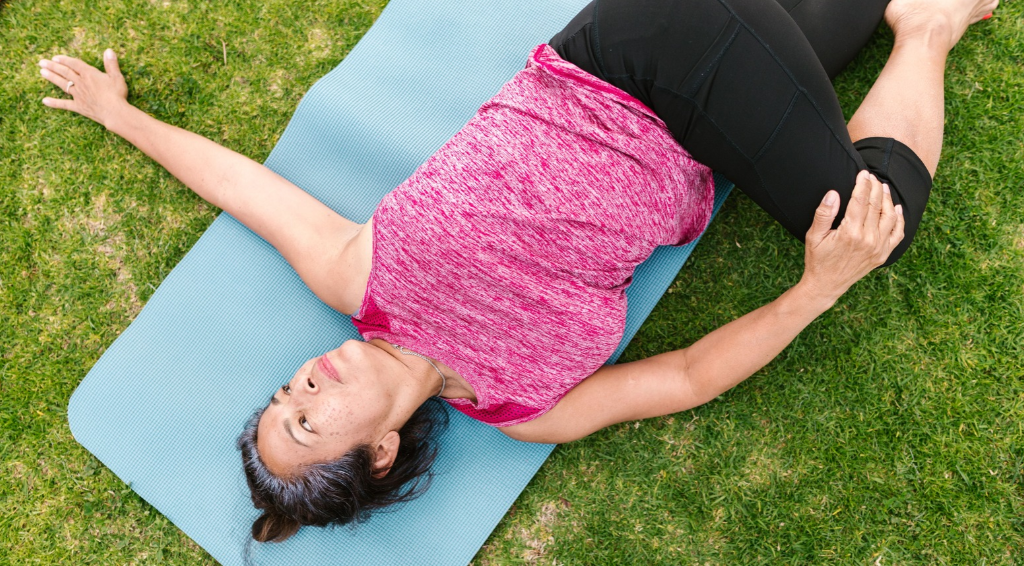
5. Supine Cross-Body Leg Drop
Purpose: This relaxed stretch eases the outer hip and lower back.
- Lie on your back with both legs straight.
- Bring your right leg across your body toward the floor on your left.
- Keep your right shoulder on the floor and stretch your right arm out to the side.
- Use your left hand to guide the leg down gently. Don’t force it.
- Dose: 2 holds of 30 seconds each side, 3–7 days a week
- Feel it here: The outer right hip and lower back
- Common mistake: Letting your right shoulder lift off the floor
- Easier: Bend your right knee before crossing it over
- Harder: Keep the leg straight and reach it farther across
6. Foam Roller TFL Release
Purpose: Rolling may ease tender spots before you stretch.
- Lie face down at an angle, with the foam roller under your right front-outer hip.
- Support yourself on your forearms and roll slowly over a 2- to 3-inch area.
- Pause on a tender spot for 20–30 seconds and breathe.
- Stay off bone and back off if you feel sharp pain.
- Dose: 30–60 seconds each side, 3–4 days a week
- Feel it here: The fleshy front-outer hip, not the bony side of the hip
- Common mistake: Rolling down the bony IT band instead of the muscle
- Easier: Use a soft roller and put more weight on your hands
- Harder: Use a firmer roller or a lacrosse ball
7. Side-Lying Clamshell
- Purpose: Clamshells activate the gluteus medius to reduce strain on the TFL.
- On the left side, with knees bent and feet together.
- Squat and tuck your butt. Tilt your pelvis and roll slightly forward.
- Keep feet together and lift the top knee.
- Slowly descend for 2 seconds. Never permit the pelvis to rock backwards.
- Dose: 2 sets of 12–15 each side, 2–4 days a week
- Feel it here: On the back outer hip (glute), NOT the front of the hip.
- Common error: supporting the knee with the hips going back to raise the knee high.
- Easier: Make the lift smaller
- Harder: Place a light resistance band above your knees to increase resistance.
8. Glute Bridge
- Purpose: To strengthen glutes to get hips to share the load better.
- Lie on your back on the floor, knees bent, feet together at hip-width.
- Tighten your lower abdomen slightly and push through your heels.
- Raise your hips such that your upper and lower body form a straight line from the shoulders to the knees.
- Hold the squeeze in your glutes for 2 seconds, and then slowly lower. Stop if you feel it in your lower back.
- Dose: 2–3 sets of 12, 2–4 days a week
- This is in the back of your thigh muscles and glutes.
- Typical error: Rounding in the lower back at the top.
- Easier: lift halfway up
- Harder: Do single-leg bridges
How Long Should You Hold a TFL Stretch?
Hold each TFL stretch for 30 seconds and repeat it 2 to 3 times per side. If your hips are very tight, work up to 45 or 60 seconds. Harvard Health says static holds of 30 seconds to 2 minutes work best after a warm-up, and that you should never bounce.
How often should you stretch your TFL?
Stretch your TFL 3 to 5 days a week. Do the strength moves (clamshells and bridges) 2 to 4 days a week.
How to Build Your Routine
The 10-minute version (3–5 days a week):
- Standing cross-leg side bend – 2 minutes
- Half-kneeling TFL stretch – 3 minutes
- Side-lying clamshell – 3 minutes
- Glute bridge – 2 minutes
The 20-minute version (2–3 days a week): Do all 8 moves in order. Start with the foam roller, then the stretches, and finish with clamshells and bridges.
How Long Does It Take to Loosen a Tight TFL?
Most people feel looser after just one session. You’ll typically see your hips begin to move more easily after a few weeks (3-5 sessions per week). Keep the strength moves in every week, as this will help the change stick.
When To Quit or Call a Professional?
If you experience sharp pain, numbness, tingling, or weakness, or if the pain in the outer hip persists for over 2 weeks or becomes worse, stop and consult your doctor or physical therapist. If you have recently injured your hip, fallen, or had hip or knee surgery, seek clearance before commencing.
Red flags:
- Sharp or stabbing pain during stretching
- Numbness, tingling, or burning down the outside of the thigh
- Waking up at night with pain in the back of your head.
- Pain that persists for over 2 weeks, or worsens over time.
Stretchlee Tip: To locate the TFL, make sure to turn out your back foot.
The TFL flexes the thigh inward,d so you stretch it more when the thigh is just turned outwards a little. When doing the half kneel stretch, make sure your back foot is rotated out approximately 20-30 degrees and tuck your pelvis in before leaning. It then comes to your right, next to your pocket.
Conclusion
A tight front-outer hip usually comes from long sitting, lots of running, or glutes that aren’t pulling their weight. Start with the 10-minute routine three times this week, and keep every stretch gentle and pain-free. A regular tensor fasciae latae stretch works best when paired with glute strength, so keep the clamshells and bridges in your plan. Recheck how your hip feels after sitting for two weeks.
Frequently Asked Questions
How do I know if my TFL is tight?
You may feel tightness or aching in your front-outer hip, especially after sitting or running.
Is the TFL the same as the IT band?
No. The TFL is a small hip muscle, while the IT band is connective tissue running along your outer thigh.
Can a tight TFL cause knee pain?
It may contribute to outer knee discomfort, but persistent pain should be checked by a healthcare professional.
Should you stretch the TFL every day?
Yes, gentle daily stretching is usually fine. Hold each stretch for 30 seconds and reduce frequency if soreness develops.