
The dumbbell bent over row is an easy workout to strengthen your back and upper body with dumbbells. It can be done with 2 arms, 1 arm, or a bench. Think about a stable posture, controlled movement, and correct form, not too heavy a load.
- What is a dumbbell bent over row?
- Dumbbell Bent Over Row Muscles Worked
- How to Do a Dumbbell Bent Over Row
- Dumbbell Bent Over Row Form Tips
- Dumbbell Bent Over Row at Home
- Dumbbell Bent Over Row Variations
- Dumbbell Bent Over Row vs Single-Arm Dumbbell Row
- Benefits of the Dumbbell Bent Over Row
- Common Mistakes to Avoid
- How Many Sets and Reps Should You Do?
- What Can You Use Instead?
- How to Progress With This Exercise
- Who Can Do Dumbbell Bent Over Rows?
- Conclusion
- Frequently Asked Questions
What is a dumbbell bent over row?
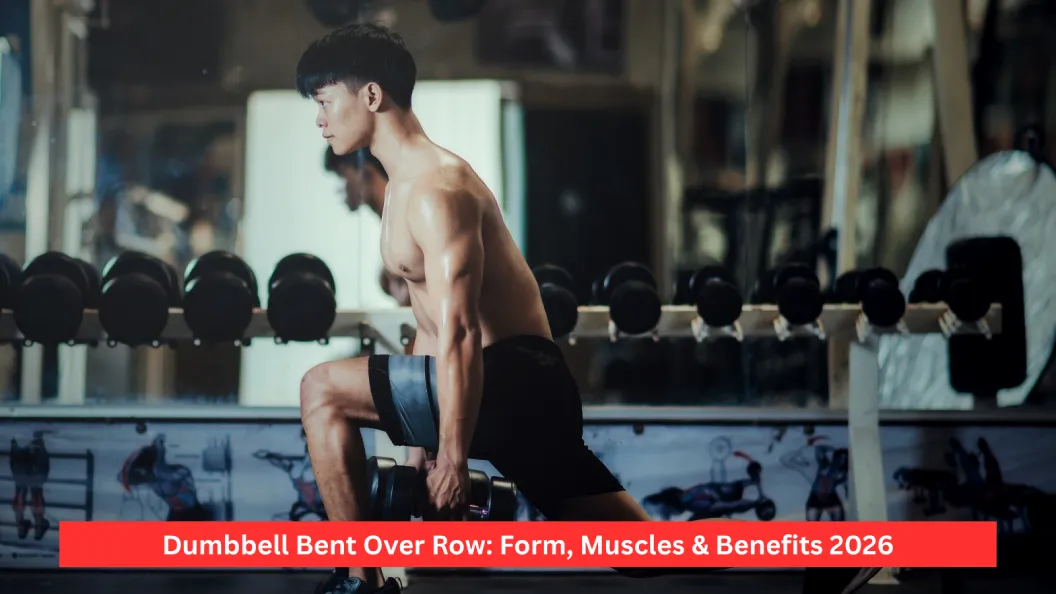
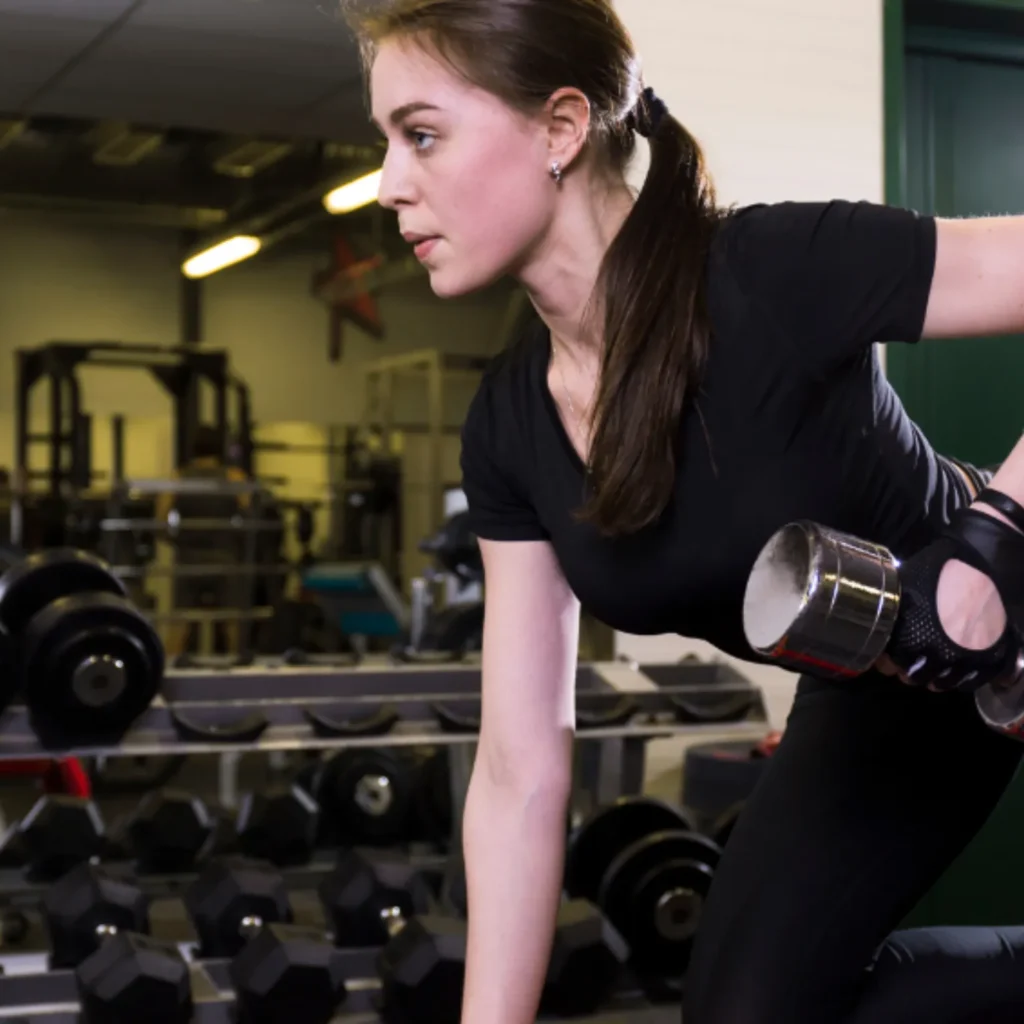
A dumbbell bent-over row is a pulling exercise done from a forward-leaning position. The weights are below your shoulders; pull them towards your chest and lower them under control.
When positioning, keep your feet about hip width apart and slightly flex your knees. Move your hips back, maintaining a neutral position in your back. From that position, swing the dumbbells towards your ribs and slowly move them back to the starting position.
This exercise can be called a bent-over dumbbell row, bent over row with dumbbells, or just a dumbbell row.
Most often done in a two arm position but can be done one arm or with a bench for added support.
Dumbbell Bent Over Row Muscles Worked
This is a multi joint action exercise as it works several muscles simultaneously and is therefore well suited for upper body and whole-body exercises.
Latissimus Dorsi
The latissimus dorsi, or “lats,” are massive muscles that run down the side of the back. They assist in bringing the upper arms back inwards when rowing the boat.
Rhomboids
Rhomboids are located between the shoulder blades. They help control the shoulder blades as you pull the dumbbells toward your torso.
Trapezius
The trapezius muscle is a large, powerful muscle that covers the upper back and neck. During rows, various sections of this muscle help stabilize and move the shoulder blades.
Rear Deltoids
The posterior (back) deltoids are behind the shoulders. They help when upper arms go towards the back.
Biceps
The main focus of the movement is on the back, but the biceps are also involved as they help bend the elbows when pulling.
Forearms and Grip
Your forearms help you maintain your grip on the dumbbells. Using heavier weights can make grip a limiting factor.
Core and Lower-Body Stabilizers
The bent-over position is stabilized by your abdominal and trunk muscles. Your legs also give you a solid foundation throughout this movement.
How to Do a Dumbbell Bent Over Row
It is better to learn the correct technique than to select a heavy weight. Begin this exercise with a weight that enables you to execute all repetitions without changing your position.

Step 1: Stand With the Dumbbells
Feet should be separated about hip-width. Start with a dumbbell in each hand, with your arms hanging down.
Relax your shoulders, gaze slightly ahead or towards the ground, but don’t force your neck into an unnatural position.
Step 2: Bend Your Knees
Maintain a slight bend in your knees. Don’t squat low.
This will give your hips space to move backwards without restriction.
Step 3: Hinge at the Hips
Move your pelvis towards the back and your trunk forward. Maintain a neutral spine; don’t round your back.
Once you get to the rowing position, your torso should be stable.
Step 4: Set Your Arms
Allow the dumbbells to hang below your shoulders. Tighten your abdominal muscles before pulling.
Step 5: Pull the dumbbells
Move the elbows in the direction of the back, and move the weights towards the ribs or lower body.
Do not just lift dumbbells with your hands; rather, pull with your elbows.
Step 6: Pause at the Top
At the end of the movement (when the weights are at their maximum height), take a very brief pause, but maintain control over your shoulders.
Do not lift the dumbbells too high.
Step 7: Lower Slowly
Lower the weights until your arms are again extended. Maintain control in the descent.
This is one rep.
Dumbbell Bent Over Row Form Tips
Proper form allows you to utilize the exercise properly without allowing it to become uncontrolled.
These are some things to remember:
- Keep back straight.
- Slightly flex knees.
- Move hips back, not forward; just bend.
- Tighten core muscles between reps.
- Maintain a relatively stable torso.
- Extend arms behind head.
- Don’t shrug off.
- Do the weights in a gentle manner.
- Regulate the movement downwards.
- Make sure to use the correct weight.
The most frequent mistake is attempting to make the activity more challenging by loading weights that are too heavy. If the torso is moving up and down with each rep, decrease the weight and concentrate on control.
Dumbbell Bent Over Row at Home
You can easily perform this exercise at home. The standard version only requires placing benches or special equipment in the right place.
All you need is:
- A pair of dumbbells
- A space where one can stand up.
- A stable floor
- Suitable training weight
This is a great movement for individuals who like a straightforward exercise program at home.
Dumbbell Bent Over Row at Home Muscles Worked: back, shoulders, and arms.
Muscles that are worked at home are the same as those worked in a gym. Lats, rhomboids, trapezius, rear shoulders, biceps, forearms, and core can all be used in the movement.
It is the technique, resistance, range of motion, and consistency of the exercise that is important, not where you do it.
If you’re looking for a simple home workout, you can pair up different rows with a variety of exercises like push-ups, squats, lunges, shoulder presses, etc., for a workout that works multiple areas of the body.
Dumbbell Bent Over Row Variations
The setup may be changed to make it easier or harder to move around, or to train different muscles.
Single-Arm Dumbbell Row
The single-arm version can be used to perform one side at a time.
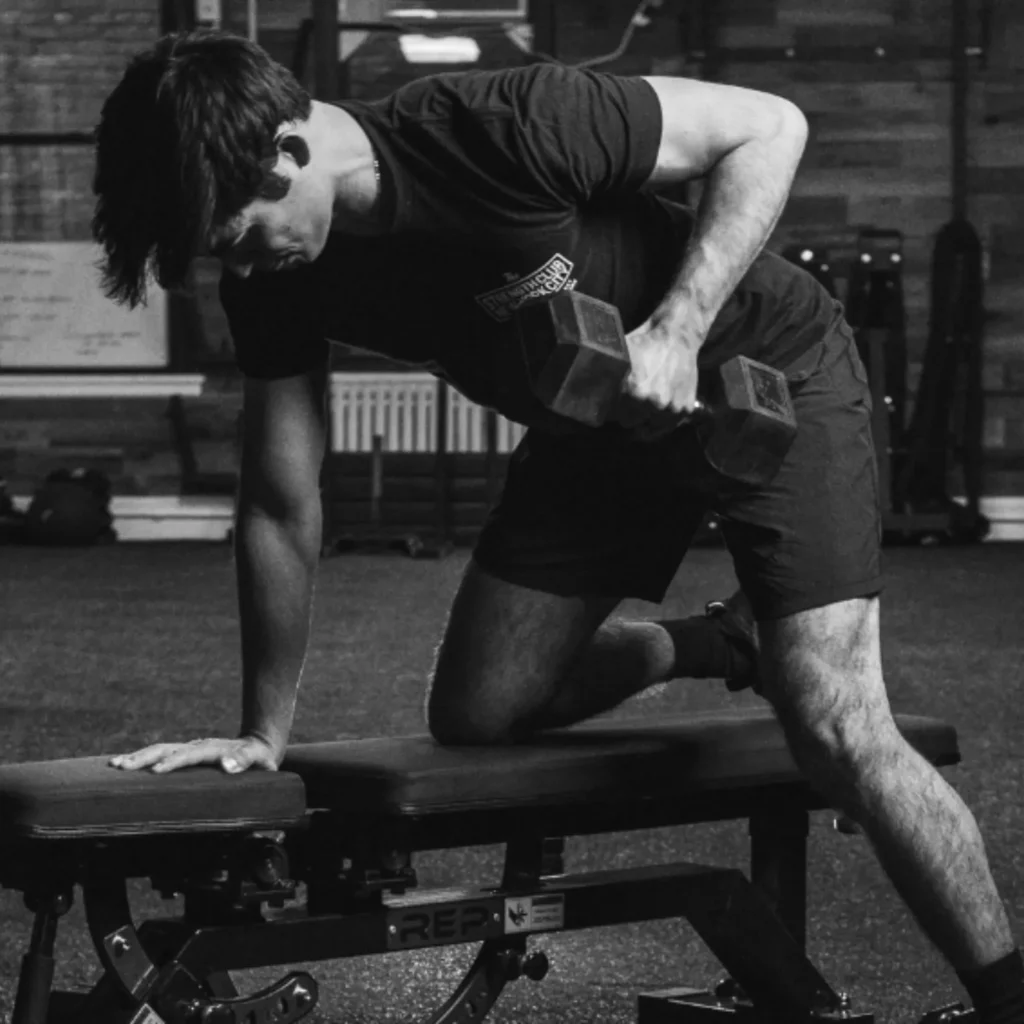
You can rest one hand on a bench or other stable surface and use the other hand to hold the dumbbell. Draw the weight up toward your mid-body, gently bring it down, and perform the desired number of reps before switching sides.
This set-up can give you extra stability and will allow you to work on one side at a time.
Standing Two-Arm Row
This standing version does not need any support and uses two dumbbells.
Once you have your hip hinge, lift both weights towards your body simultaneously.
It is a great choice for practicing at home since there is no need for a bench.
Dumbbell Row on a Bench
The bench supported row provides extra support for your body.
A common single arm version is for one hand and one knee on the bench, with the other foot on the ground. While holding the dumbbell in your free hand, row it towards your body.
Your body may be more supported, so you will be able to focus more on the movement.
Double Dumbbell row on a bench.
Alternatively, if the setup doesn’t allow for safe and comfortable movement, use a bench-supported position with a dumbbell in each hand.
The extra support may make maintaining the stability of the torso less difficult, allowing you to concentrate more on the pulling action.
Tripod Dumbbell Row
The 3-point base stabilizes the weight of the tripod row. Often a single-arm movement.
This version may be beneficial when more stability is desired than that offered by an unsupported standing row.
Dumbbell Rows Without a Bench.
Don’t need a bench to perform dumbbell rows!
The standard standing variation can be performed at any place where you can hinge forward safely. This is a great time saver if you’re training at home, as you don’t need to purchase extra equipment.
When you’re new to the exercise, begin with a lower weight and take some time to practice keeping your torso in place.
Dumbbell Bent Over Row vs Single-Arm Dumbbell Row
Both exercises train similar areas, but they have different setups.
| Feature | Two-Arm Dumbbell Row | Single-Arm Dumbbell Row |
| Weight | Usually two dumbbells | Usually one |
| Movement | Both arms together | One arm at a time |
| Bench | Not required | Optional |
| Stability | Greater torso demand when unsupported | Easier with support |
| Training style | Bilateral | Unilateral |
| Home use | Very convenient | Very convenient |
Neither option is automatically better.
The two-arm version is useful when you want both sides to work together. The single-arm variation can be helpful when you prefer unilateral training or want to use a supported setup.
Benefits of the Dumbbell Bent Over Row
- Builds Back Strength: The motion works multiple muscles that are involved with pulling and upper-body strength. It may be beneficial to include it in a back workout.
- Works Multiple Muscles: The row involves many muscles of the back, arms, shoulders, grip, and trunk and is not an isolation exercise.
- Easy to do at home: The standard variation only requires dumbbells, so it is appropriate for small home gyms.
- Improves Pulling Strength: It’s important to have strong pulling muscles for other exercises and activities in everyday life that require pulling or carrying.
- Offers Flexible Variations: The exercise can be modified using one arm, adding support, or changing equipment.
- Meets multiple training objectives: Rows can be incorporated into general fitness, muscle building, or strength programs with appropriate programming.
Common Mistakes to Avoid
Excessive use of weight.
Using too heavy a weight can result in poor technique. It is okay to begin swinging the dumbbells or doing torso movements to finish the repetition.
Choose a load that allows you to stay in control.
- Rounding Your Back: Your spine should stay in place while moving. Don’t collapse through your upper or lower back while bending forward.
- Swinging the Dumbbells: The exercise should be monitored. If you need some momentum to get the weights moving, try to lower the weight.
- Pulling Only With Your Arms: Your arms are engaged, but it’s not just a biceps curl. Consider taking elbows back and bringing weights to the body.
- Shrugging the Shoulders: Don’t keep pulling your shoulders towards your ears again and again. Maintain the shoulder position throughout the movement.
- Rushing the Repetitions: Repeating quickly may cause difficulty in positioning. Take a steady pace and control both ways.
How Many Sets and Reps Should You Do?
Your ideal number of sets and repetitions depends on your experience and training goal.
| Goal | Sets | Reps |
| Beginner | 2–3 | 8–12 |
| General fitness | 2–3 | 10–15 |
| Muscle building | 3–4 | 8–12 |
| Strength | 3–5 | 5–8 |
These ranges are general guidelines, not strict rules.
If you are new to resistance training, begin with a manageable weight and focus on technique. As you become stronger, gradually increase the resistance while keeping your form consistent.
What Can You Use Instead?
There may be times when you want to modify an exercise due to equipment, comfort, or variety of exercises.
- One-Arm Dumbbell Row: A simple alternative that allows training of one side at a time and is possible with bench support.
- Chest-Supported Dumbbell Row: The following variation to chest support minimises the need for an unsupported torso position.
- Resistance-Band Row: If you don’t have dumbbells, a resistance band is a helpful resource for the home workout.
- Cable Row: Cable machines offer the flexibility of resistance and a fixed point of the row.
- Barbell Row: Another compound pulling exercise to target many of the same areas is the barbell row.
Your choice of best alternatives depends on your equipment, comfort, and training objectives.
How to Progress With This Exercise
Sometimes it doesn’t necessarily mean increased weight.
Once you have mastered the technique, you can increase the resistance in your training. You might also be able to add repetitions to your desired range, increase your control, or increase the number of working sets.
If you can do three sets of eight reps, you may eventually increase to three sets of 10 or 12 reps before moving on to heavier dumbbells.
Slow progress (not sacrificing technique).
Who Can Do Dumbbell Bent Over Rows?
There are a variety of exercise programs that can accommodate this type of exercise.
It can be beneficial for:
- Students learning the fundamentals of pulling movements
- Individuals in home training programs.
- Workouts for gym enthusiasts to build a stronger back.
- Full-body workout programs
- Upper-body routines
- Dumbbell-only training plans
Intermediate and novice level should begin using light or moderate weight and master hip hinge position prior to attempting heavier weight.
If exercising causes sudden or intense pain, discontinue and seek guidance from a suitably qualified health and fitness professional, not continue the exercise and attempt to work through the pain.
Conclusion
The dumbbell bent over row is a great exercise to build up the strength of the back and upper body. It involves minimal equipment and may be modified for various training environments.
The basic standing version is great when you’re looking for a straightforward workout that doesn’t require a bench. For extra support, use a bench or do the one-arm version.
Keep your trunk stable, hip hinge controlled, keep repetitions smooth, and use an appropriate weight. This movement can be a great addition to your strength training routine with consistent practice and progressive overload over time.
Frequently Asked Questions
What is a dumbbell bent over row?
The dumbbell bent over row is a pulling motion from a hip hinged position. Primarily targets back muscles and also targets shoulder, biceps, forearm, and core muscles.
What muscles does the dumbbell bent over row work?
Mainly works on the lats, rhomboids, and trapezius. Rear deltoids, biceps, forearms, and core also assist during the movement.
Can you do dumbbell bent over rows at home?
Yes. All you need is a pair of dumbbells and sufficient room for a safe workout. For the standard standing variation, there is no need for a bench.
Is a single-arm dumbbell row better than a bent over row?
There are no real advantages to either of these options. A single arm row can be more stable, or it can be done as a two arm row.