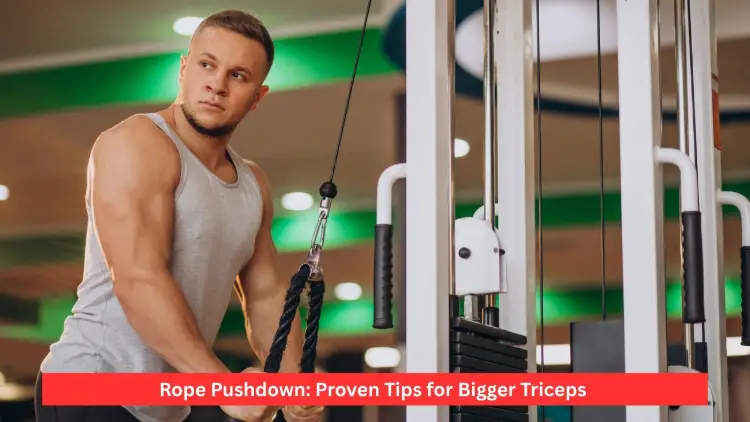

The rope push-down is a great exercise for creating well-developed and firm triceps. It activates all three heads of the triceps muscle, enhances arm strength, and can be performed at any fitness level. This guide will explain to you what muscles are being targeted with the rope pushdown exercise, how to do it correctly, how it will benefit you, common mistakes, best rotations, and alternatives.
- What Is a Rope Pushdown?
- Who should do Rope Pushdowns?
- Muscles Worked During Rope Pushdown
- Rope Pushdown Head Worked
- Rope Pushdown for Back: Does It Work?
- Benefits of Rope Pushdown
- How to Perform the Rope Pushdown Correctly
- Proper Breathing Technique
- Recommended Tempo
- Triceps Rope Pushdown Form Checklist
- Common Rope Pushdown Mistakes
- Final Thoughts
- Frequently Asked Questions
What Is a Rope Pushdown?
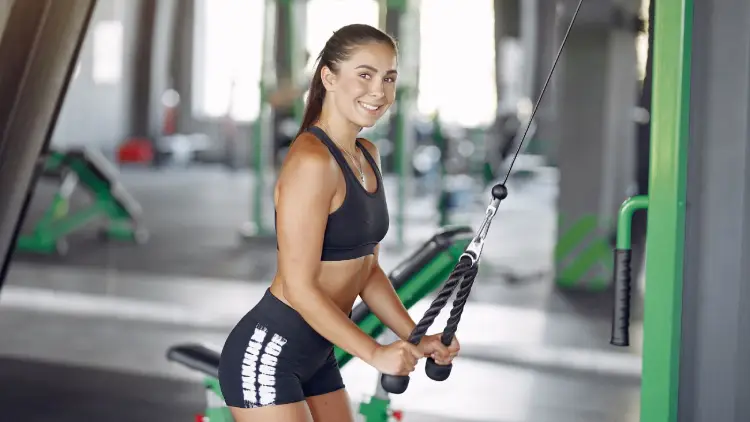
Rope pushdown is an arm-working cable isolation exercise using a cable rope attachment that works the triceps. It keeps tension on the arm throughout the entire movement and is an excellent choice to strengthen and give it shape.
Key Features
- Works all three parts of the triceps muscle
- Uses a cable machine with a rope attachment
- Maintains constant stress on muscles for more growth
- Allows a natural wrist movement, reducing joint strain
- Ideal for beginners and the advanced lifter as well
- This exercise is usually completed after the upper-body session to completely work out the triceps
May include overhead rope push-down or single-arm rope push-down for additional activation of the muscle group.
Who should do Rope Pushdowns?
Rope pushdowns can be incorporated into the training of nearly anyone, including:
- Newbies who are into correct triceps isolation exercises
- Intermediate lifters looking to grow muscle size
- Powerlifters and bodybuilders seeking to build as massive a triceps as possible
- Athletes working on their pressing power
- Men and women with a desire to get their arms defined
- People are recovering from shoulder pain and require a specific triceps exercise
The movement is so effortless and effective that it is being used in gyms everywhere
Muscles Worked During Rope Pushdown
The rope pushdown is mainly for the triceps and has some stabilizer muscles.
Primary Muscle
Triceps Brachii
- Long Head: Adds overall arm size and is emphasized during overhead rope pushdown variations.
- Lateral Head: Creates the horseshoe-shaped appearance of the triceps.
- Medial Head: Supports elbow extension and improves overall arm strength.
Secondary Muscles
Other muscles that are affected include:
- Forearms: Help maintain a strong grip on the rope.
- Wrist Stabilizers: Make sure there is no stabilisation of the wrists throughout the move.
- Front Shoulders (Deltoids): Help hold upper arms stable.
- Core: Supports and stabilizes the whole body and/or moves the body through space without exerting excessive force.
This exercise is one of the best options available when it comes to full triceps development, as the muscles used are in the pushdown with a rope.
Rope Pushdown Head Worked
A common beginner’s question is which triceps head is most activated.
It’s all three, all of them.
The lateral head, however, will see the strongest contraction towards the end of the elbow move. When your long head works with an overhead movement such as the triceps rope overhead extension, it gets involved in the exercise much more.
For full arm strength and growth, rope pushdowns should be done alongside overhead exercises.
Rope Pushdown for Back: Does It Work?
A common fallacy about the rope pushdown for back is that it is a good back exercise.
The truth is, the rope pushdown shouldn’t be used to exercise the back muscles.
Rather, it is mainly the triceps that are targeted, with the lats, shoulders, and core just holding the movement in place.
If you’re aiming at development in the back, try the following exercises:
They are much more suitable options.
The pushdowns with the rope should continue to be a separate exercise for the triceps in your upper body training session.
Benefits of Rope Pushdown
Decades of lifters have done the rope pushdown workout with its many benefits without ever losing its popularity among novice and advanced users. The purpose of this move—whether it’s to bulk up muscles, build strength, or add arm definition—is quickly achieved with regular repetition.
Builds Bigger Triceps
The most significant benefit of the rope pushdown is that it works the triceps without having to use bigger muscles such as the chest or shoulders.
At all points during the movement, the cable is going to offer constant resistance to the triceps, so you will be able to keep them under tension for the entire time that you perform your triceps repetitions. This tension lasts for a long period and is the major factor in the growth of muscles, so it works well to increase the size of the arms.
Secondly, rope pushdowns set up the full range of the triceps, which is not the case with compound exercises, where the performance deficit in the chest and/or shoulders could be a limiting factor in the exercise.
Improves Arm Definition
As a matter of fact, well-built triceps certainly help in creating the appearance of muscular arms.
The triceps make up about 2/3 of the upper arm, and toning them with rope pushdowns can give you bigger and more defined arms.
When performing arm training exercises, bodybuilders will frequently finish with several sets of rope pushdowns to stimulate the muscle fibers and give a greater definition to the muscles.
How to Perform the Rope Pushdown Correctly
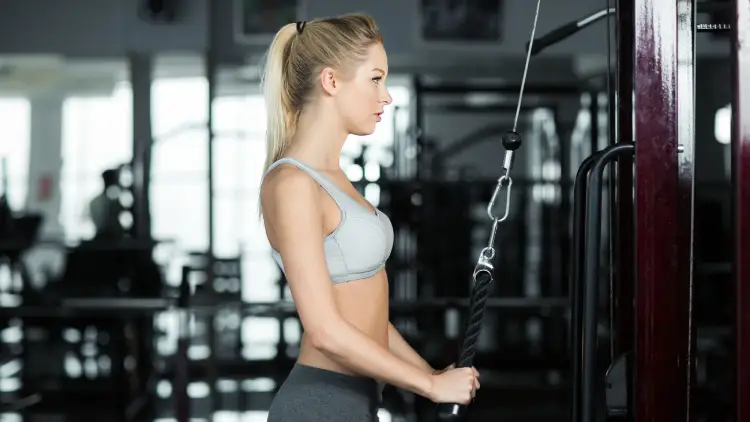
It is important to master the correct triceps rope pushdown form to ensure optimal muscle development and injury prevention.
Effective movement may seem easy, but small technique mistakes can decrease effectiveness and create unnecessary strain on the joints.
Complete each rep properly following these instructions:
Step 1: Set Up the Machine
First, start by implementing a rope handle to the top pulley of the triceps pushdown machine.
Change the position of the cable until the rope is hanging close to the level of the upper chest.
Select a weight that will enable you to complete all repetitions properly.
Don’t choose something so heavy that it will cause you to lose control or swing your body around.
Newcomers will typically need a lower setting until a proper form is developed.
Step 2: Assume the Starting Position
Facing the cable machine, feet should be set about shoulder-width apart.
Keep a solid athletic position.
Now holding the rope with both hands, using a neutral grip (palms facing each other).
Raise elbows towards body and maintain a locked position.
Slightly bend knees and tighten abs.
If you need to bend forward, slightly, but not too far.
From the start position:
- Chest remains lifted
- Spine stays neutral
- Shoulders stay down
- Wrists remain straight
- Elbows stay tucked
This helps get your body ready for a safe and effective movement.
Step 3: Push the Rope Down
This is when the working period of the exercise should take place.
Straighten your elbows as you push downwards with the rope.
Avoid using momentum.
Close your hands to your thighs, then start to pull the ends of the rope apart.
This extension will cause an increased triceps contraction.
Keep the arms straight, continue extending forward as far as you can.
At the bottom:
- Arms will be close to the body throughout
- Wrists stay neutral
- There is a slight separation between the rope ends
- Applies the greatest stress on the triceps
Sustained for one second at the end of the contraction.
This delay elicits greater activation of the muscles involved and enhances the quality of each rep each time.
Stage 4: Return Under Control
The lowering phase is as important as the pressing phase.
Let the rope up slowly while opposing the pull of the cable.
Never allow the weight stack to fall back.
As you return:
- Elbows to the body
- Maintain good posture
- Don’t shrug
- Stop when forearms are about 90° flexed
Immediately begin the next repetition.
CEs are helpful for increased muscle building and decreased injury risk.
Proper Breathing Technique
Many lifters don’t pay much attention to breathing, but it is important for performance.
Here is a quick and easy format:
- Exhale when bringing the rope up
- As you push downward on the rope, you breathe out
- You can continue to breathe in a rhythmic pattern throughout the set
Do not take breath-holding exercises unless they are very heavy, under close professional supervision.
Recommended Tempo
Take your time with each rep and avoid being rushed.
The ideal tempo is:
- Two seconds, pushing down at the same time
- One-second squeeze
- 2-3 seconds up and back
Lower reps will create more time under tension and may actually yield more hypertrophy than higher reps with heavy loads.
Triceps Rope Pushdown Form Checklist
Before each set, use this checklist.
- Elbows move in close to the body
- Stand with a stable stance
- Brace your core
- Fully extend your elbows
- Separate the rope at the bottom
- Slowly lower the weight
- Avoid swinging
- Maintain neutral wrists
- Focus on squeezing the triceps
If you can get these bases down, then each workout will be optimized.
Common Rope Pushdown Mistakes
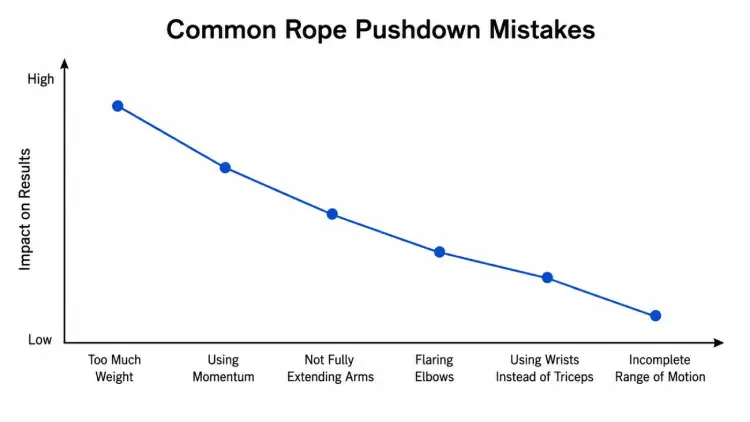
Although the rope pushdown isn’t a difficult exercise, it is one that many lifters make an unknowing mistake, either to decrease muscle activation or increase the risk of injury.
By avoiding these common triceps-building mistakes, you can improve the effectiveness of your triceps-building efforts.
Using Too Much Weight
The most common error is putting excessive weight on the cable machine that surpasses the handling capacity.
If the resistance is too great, your body will naturally compensate by either swinging backward or using the shoulders to help move the weight.
As it is too heavy, you will witness the following signs:
- Leaning backward
- Shortening the rope when pulled as if violently pushed down
- Losing elbow position
- Loss of Range of Motion
- A muscular imbalance between flexors and extensors is prevented
Decrease the amount of weight until you are able to perform all reps with good form without any difficulty.
Again, correct form will lead to better long-term results than heavier weights with bad form.
Allowing the Elbows to Drift Forward
Elbows move in conjunction with the torso throughout the entire repetition.
As they push forward, your shoulders start helping as well, and lower triceps load. When they creep forward, your shoulders are also helping, which decreases the load on your triceps.
Visualize putting your elbows to your ribs all the way through the movement.
They will stay put if you keep them stationary, which means that your triceps have to do the bulk of the work.
Swinging the Body
Isolation exercise will do no favors for momentum.
Some lifters have a backlash as the weight moves down the back.
This could increase the amount of weight lifted, but it will also reduce tension in the triceps.
Instead:
- Stay balanced
- Squeeze your core (abdominal, hip) muscles tightly
- Keep forearms moving do not move trunk, legs, or hips
- Elbows should be used as a hinge
The rest of your body should stay very still.
Not Separating the Rope
Many people move the rope straight down with their fingers, not spreading the ends of the rope.
This reduces the range of motion and peak contraction.
When approaching the end, spread hands apart and turn hands out slightly to pull apart the rope.
This one subtlety is often more effective for the lateral (outside) head of the triceps.
Incomplete Range of Motion
Another frequent error is to only do part of the exercise.
Clinching before complete elbow extension will limit muscle activation and growth.
Each rep should have:
- Grasps complete stretches of the musical line
- Hanging in Howe at the end
- Controlled return
If movements are trained in the full range of motion, then over time, better hypertrophy will be achieved.
Final Thoughts
The rope pushdown exercise is one of the best triceps exercises you can perform to make your triceps stronger, bigger, and firmer. The correct form of the triceps rope pushdown, coupled with slow and controlled movements, allows you to effectively target all three heads of the triceps to work and boost upper-body power as well as arm definition. This exercise can be a useful addition to just about any workout program, whether you’re doing the standard rope pushdown, the overhead rope pushdown, or an appropriate variation of the rope pushdown. Emphasize good form, progressive overload, and consistency to obtain the greatest results and greater arm strength and muscle building.
Frequently Asked Questions
1. Which muscles are being targeted with the rope pushdown?
The rope pushdown: The main muscles trained with this exercise are the three heads of the triceps muscle—the long, lateral (outside), and medial (middle). It also works the forearm, wrist, and shoulder girdles for stability.
2. Is there a better rope push-down or a straight bar push-down?
Both are effective. The rope pushdown stimulates the muscles more and provides more range of motion, but the straight bar pushdown lets you carry more weight.
3. Am I allowed to do a rope pushdown without a cable machine?
Yes. Use resistance bands or a variation without any bands that can be done using rope extensions – triceps that are overhead, dumbbell extensions, or close-grip push-ups.
4. What kind of sets and reps are recommended?
Strengthen muscles by doing 3-4 sets with 10-15 reps, going up with increasing weights, achieving controlled form.