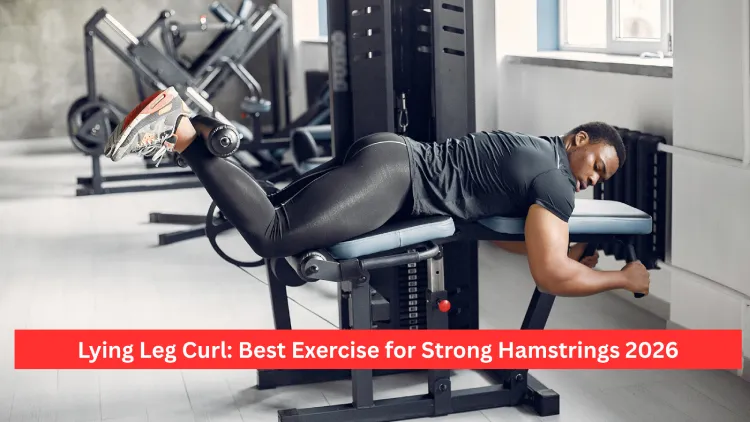

The lying leg curl is a great hamstring workout to help you develop stronger legs, boost athletic prowess, aid knee health, and add lower-body muscle definition. Primarily targets hamstrings, and it does a fair amount of work on glutes, calves, and stabilization muscles. There is no need to use a machine for the lying leg curl; it can be done with bands, sliders, or stability balls and is suitable for beginners and advanced users.
- The lying leg curl is what?
- The Lying Leg Curl targets the following muscle groups:
- Secondary Muscles Worked
- Benefits of the Lying Leg Curl
- The correct way to do the lying leg curl exercise.
- For the Lying Leg Curl, make sure that the form is correct.
- Common Mistakes to Avoid in the Lying Leg Curl
- Best Range of Motion for Lying Leg Curl
- Lying Leg Curl Variations
- How to do Lying Leg Curl Without a Machine.
- Lying Leg Curl to Seated Leg Curl
- Putting the lying leg curl into your exercise
- Sample Lying Leg Curl Exercise Routine
- Should the lying leg curl be used by beginners?
- Can the Lying Leg Curl Help Knee Stability?
- How Often Exercises Should You Do The Lying Leg Curl?
- Lying Leg Curl for Building Muscle
- Lying Leg Curl for Athletes
- Cellulite, Muscle Tone, and Training the Lower Body
- Weak Hamstrings and Muscle Imbalances
- So what is the best Leg Machine for the buttocks?
- Here are some safety tips for the Lying Leg Curl
- Conclusion
- Frequently Asked Questions
The lying leg curl is what?
An isolation machine workout for the hamstrings at the back of the thighs, the lying leg curl is a machine exercise. During this exercise, you lie face down on a bench and bend your knees to bring the weighted pad towards your buttocks. It is also popular in bodybuilding, sports, physical therapy, and strength training to strengthen the hamstrings and boost the performance of the lower body.
The lying leg curl is a compound exercise that targets the hamstring muscles directly to help develop hamstring growth, knee stability, posture, and general leg balance, unlike compound exercises such as squats and lunges.
The Lying Leg Curl targets the following muscle groups:
The lying leg curl mainly works the hamstrings, but a few supporting muscles are engaged throughout the exercise.
Primary Muscles Worked
Hamstrings
There are three big muscles in the hamstrings:
- Biceps femoris
- Semitendinosus
- Semimembranosus
These muscles make up the muscles that:
- Knee flexion
- Hip extension
- Sprinting power
- Jumping ability
- Lower-body stability
The lying leg curl targets the knee flexor directly, making it a great hamstring isolation exercise.
Well-toned hamstrings also contribute to good posture and lower back support. Poor mobility, too much sitting, not enough resistance training, or overdeveloped quadriceps are all common causes of weak hamstrings.
Many people have a resistance to the hamstrings, which means it can take a bit of time and consistent training to build them up properly.
Secondary Muscles Worked
Glutes
Glutes are engaged to stabilize the hips through the movement. Although the lying leg curl is not a glute workout, the glute muscles are still engaged, particularly if the hips stay flat on top of the bench.
Others see some glute growth from routine lying leg curl work due to the tendency for more powerful hamstrings to create more powerful glutes.
Calves
The gastrocnemius muscle in calves aids in knee flexion. Calf involvement will vary slightly depending on foot position.
Core
Abdominal muscles provide stability to the body during the entire exercise.
Benefits of the Lying Leg Curl
The lying leg curl offers a number of advantages other than muscle building.
1. Builds Stronger Hamstrings
The lying leg curl is mainly used for hamstring development. Tight hamstrings facilitate better movement, enhance athletic ability, and lower body power.
The hamstrings are one of the most challenging muscles to build, making exercises such as the lying leg curl very important.
2. Supports Knee Health
Well-developed hamstrings provide support to the knee joint. The quadriceps and hamstring muscles must work equally to avoid excess strain on the knees.
Strengthening the muscles around the knee is of benefit to many people who have mild knee pain. Leg extensions can sometimes worsen some knee problems when done the wrong way, but hamstring exercises, such as the lying leg curl, may provide enhanced stability of the knee.
Most likely, knee pain is first noticed in midlife due to muscle weakness, limited mobility, lack of activity, being overweight, or years of repetitive stress. Increasing the strength of the hamstrings will decrease this risk.
3. Improves Athletic Performance
Hamstring strength is crucial for athletes for the following:
- Sprinting
- Running
- Jumping
- Deceleration
- Explosive movements
Lying leg curl enhances the strength of the legs, which can assist athletes in creating more force during sporting activities.
4. Enhances Leg Appearance
The hamstring looks well developed and has enhanced leg fullness from both the side and rear view. The lying leg curl is a popular exercise among bodybuilders for providing a more well-rounded appearance to their lower body.
Well-developed hamstrings give the appearance of bigger legs.
5. Helps Improve Muscle Balance
A lot of people focus on training the quads more than the hamstrings. This imbalance, over time, has the risk of increasing injury and of having a negative impact on posture.
The lying leg curl is used to restore muscular balance.
6. May assist in minimizing the presence of Cellulite

While strength training cannot take the place of diet and lifestyle changes for destigmatizing cellulite, it can help you make your skin look better by increasing muscle mass and decreasing body fat. Hamstring and glute exercises, including lying leg curl, can help to tone and tighten the lower half of the body.
Other factors that impact cellulite appearance include hydration, nutrition, collagen support, and fat loss. If you drink sufficient water, the elasticity of the skin will improve, as well as the circulation, and the skin will look smoother.
In some cultures, massage techniques, dry brushing, herbal oils, and circulation-based therapies are also used to enhance the texture of the skin. However, there is no single technique that can permanently get rid of cellulite.
The correct way to do the lying leg curl exercise.
The lying leg curl is a great exercise for building leg muscle, but it demands good form to get the most out of it.
- Adjust the machine: Lie face down on the machine, with your knee joint over the pivot point of the machine.
- Take Handcuffs to Handles: Keep the handles close to you for stability of your upper body.
- Brace Your Core: Tighten abdominal muscles and press hips into the bench.
- Fold in the Weight: Bend knees slowly and move the pad towards the glutes.
- Squeeze the Hamstrings: Hold briefly at the end of the movement and squeeze the hamstrings completely.
- Lower Slowly: Slowly bend knees to lower body under control until legs are almost straight.
Controlled negatives increase the tension of the muscles and can enhance muscle growth.
For the Lying Leg Curl, make sure that the form is correct.
A good lying leg curl technique increases the safety and effectiveness of the exercise.
It is important to maintain the Movement Slow throughout.
Fast repetition is not as effective as controlled repetition in achieving muscle activation.
- Do not arch the Lower Back: Too much arching will take stress off the hamstrings.
- Target Full Range of Motion: Partial reps are not conducive to building muscle.
- Don’t Use Excessive Weight: There is a tendency to load too much weight and to lose form.
- Breathe Properly: Take the breath out as you curve the weight down, and breathe in as you lower the weight.
Common Mistakes to Avoid in the Lying Leg Curl
There are a few common mistakes that lower the effectiveness of the lying leg curl.
- Using Momentum: Swinging the legs decreases the hamstring pull.
- Lifting the Hips Off the Bench: One of the more frequent lying leg curl errors is that this workout is performed incorrectly. Raising the hips will decrease the isolation and can stress the lower back.
- Going Too Heavy: Excessive weight can reduce the ROM and increase the risk of injury.
- Rushing Repetitions: Slow reps tend to give a more effective muscle activation.
- Ignoring Warm-Ups: Cold muscles have a greater risk of strain.
- Overtraining Hamstrings: Overtraining the hamstrings can cause soreness, fatigue, loss of performance, and muscle tightness.
The following are indications of overtraining of muscles:
- Constant soreness
- Reduced strength
- Poor sleep
- Fatigue
- Joint discomfort
- Low motivation
An essential factor for muscle growth is recovery.

Best Range of Motion for Lying Leg Curl
A rep range is required to be within 10% of the desired number of reps.
For Muscle Growth
- 3–4 sets
- 8–15 reps
- For Strength
- 4–5 sets
- 5–8 reps
For Endurance
- 2–3 sets
- 15–20 reps
The hamstrings are a muscle that typically responds well to moderate and high repetitions in a slow tempo.
Lying Leg Curl Variations
There are several variations of the lying leg curl that can provide hamstring exercises from several different angles.
- Single-Leg Lying Leg Curl: Single limb training helps to enhance muscular balance and coordination.
- Stability Ball Leg Curl: This bodyweight exercise involves the low back, core, and glutes extensively.
- Resistance Band Curl: Resistance bands are a great home training option.
- Slider Hamstring Curl: Sliders or towels on a nice smooth floor make a great body-weight hamstring exercise.
- Nordic Hamstring Curl: Nordic curl is an exercise that is seen as one of the best exercises for hamstrings due to its extreme eccentric loading.

How to do Lying Leg Curl Without a Machine.
Everyone doesn’t have access to gym equipment. Thankfully, there are a number of options that simulate the lying leg curl motion.
The Hamstring Curl is a resistance band exercise for strengthening the hamstring muscles.
Hold a resistance band to something solid and bend your knees to lie face down.
- Stability Ball Curl: On back with heels on the ball, pull the ball toward the body.
- Slider Curl: Put towels under your heels on a flat surface and drag your feet up towards your buttocks.
- Dumbbell Leg Curl: Grab a dumbbell securely and then lie on a bench.
The exercises below are great alternatives to leg curls at home.
Lying Leg Curl to Seated Leg Curl
Both exercises effectively train the hamstrings, but each has unique benefits.
- Lying Leg Curl
- Advantages:
- Strong muscle contraction
- Comfortable setup
- Easy for beginners
- Excellent isolation
- Seated Leg Curl
- Advantages:
- Greater hamstring stretch
- Longer muscle tension
- Improved flexibility benefits
There is some research that indicates stretch is good for muscle growth, which might provide a minor edge to seated curls in terms of growth.
Nonetheless, the lying leg curl is one of the most productive hamstring exercises that can be performed.
Putting the lying leg curl into your exercise
The lying leg curl can be used in several workout formats.
After Compound Movements
Do the following exercises:
The lying leg curl could be used first in the workout to focus on hamstrings.
In Athletic Programs
Lying leg curls are frequently performed with sprint exercises and explosive movements.
Sample Lying Leg Curl Exercise Routine
Gluteus Maximus and hamstring exercise routine.
- Romanian Deadlift: 4 sets x 8 reps
- Lying Leg Curl: 4 sets x 12 reps
- Bulgarian Split Squat: 3 sets x 10 reps
- Hip thrust: 4 x 10 reps
- Walking lunges: 3 sets x 12 reps
- Standing calf raise: 4 sets x 20 reps
This exercise is a good posterior chain exercise.
Hip thrusts are one of the most effective exercises for glute growth as they work to build big glutes with heavy weights.
Should the lying leg curl be used by beginners?
Yes, the lying leg curl is an easy exercise, and the path of movement is controlled.
Some of the advantages for the beginners are:
- Lower injury risk
- Easy learning curve
- Effective hamstring isolation
- Improved muscle awareness
Beginners should concentrate on technique, not weight.
Can the Lying Leg Curl Help Knee Stability?
The lying leg curl can help support knee stability by strengthening the hamstrings that help support the knee during the movement.
Insufficient hamstrings can add stress to the knees and cause pain when exercising, such as running, climbing, or jumping.
To keep knees healthy over the years, strength training is a great addition to mobility work.
The following exercises are not recommended for people with sensitive knees:
- These incorrect deep squats can lead to pain in the lower back.
- Excessive and improper long extensions.
- Jumps with poor landing mechanics
- Excessive high-impact training
It is important to have the proper form and balanced programming.
How Often Exercises Should You Do The Lying Leg Curl?
The lying leg curl is effective for most people:
- 1–3 times weekly
- The recovery time will take:
- Workout intensity
- Overall training volume
- Sleep quality
- Nutrition
- Experience level
For some people, hamstrings will take longer to heal, so rest is important.
Lying Leg Curl for Building Muscle
The lying leg curl is a popular exercise for bodybuilders, as the hamstring detail definitely adds more to the body’s aesthetic appeal.
Developed hamstrings create:
- Better leg symmetry
- Improved side profile
- Improved aesthetics of the rear leg.Better aesthetics of the back leg.
- Better body balance and proportion.
Some of the best bodybuilders incorporate the lying leg curl into their Romanian deadlift and stiff-leg deadlift routine to get the most out of their hamstrings.
The hamstring is one of the most genetically and muscle fiber-dependent muscles to build, as well as being one of the most difficult to maintain for consistent growth.
These are the typical requirements for lifters who want to build large hamstrings:
- Progressive overload
- Proper nutrition
- Consistent training
- The full range of motion is observed.
- Sufficient recovery
Lying Leg Curl for Athletes
A well-developed hamstring is very beneficial for athletes, since it is associated with speed and explosiveness.
The lying leg curl will help strengthen:
- Sprint acceleration
- Deceleration control
- Jump performance
- Injury prevention
- Lower-body coordination
Hamstring injuries are frequent in sports that require sprinting, turning, and changing direction suddenly. These muscles can be strengthened to decrease the risk of injury.
Cellulite, Muscle Tone, and Training the Lower Body
Many people who are interested in the lying leg curl are also interested in firmer legs and glutes.
These factors affect cellulite:
- Genetics
- Hormones
- Skin thickness
- Fat distribution
- Lifestyle factors
Resistance training can help to tone skin and burn more body fat, which could help improve the look of cellulite, but it won’t work to instantly remove it.
Popular skin care nutrients that promote healthy skin include:
- Vitamin C
- Vitamin E
- Collagen-supporting nutrients
- Omega-3 fatty acids
Some people report that collagen supplements help their skin be more elastic.
Moisture is also important for skin quality. Water helps keep the blood flowing and the skin healthy.
Lifestyle habits, body composition, skin thickness, and genetics may give different populations the appearance of having varying amounts of cellulite.
Weak Hamstrings and Muscle Imbalances
Poor hamstring strength is quite prevalent in today’s society due to the amount of time we are sitting.
Weak hamstrings can be due to:
- Sedentary lifestyle
- Lack of resistance training
- Poor posture
- Overdeveloped quadriceps
- Insufficient protein intake
- Inadequate recovery
Insufficient strength of hamstrings will impact:
- Athletic performance
- Knee stability
- Hip function
- Running mechanics
The lying leg curl is one of the best exercises to correct these weaknesses.
So what is the best Leg Machine for the buttocks?
There are a number of gym machines that are effective at targeting the glutes.
Popular options include:
- Hip thrust machine
- Cable kickback machine
- Smith machine
- Stair climber
- Leg press
This machine is known as a lying leg curl machine.
While the lying leg curl is primarily a hamstring movement, it does help to build glutes with hip stabilization.
The best combination is hamstring training along with glute exercises for maximum glute growth.
Here are some safety tips for the Lying Leg Curl
The lying leg curl is done safely by:
- Warm up properly
- Use controlled movement
- Don’t pull hard on the weight.
- Keep hips stable
- Progress gradually
- Stretch after training
Stop the exercise if the pain is sharp and not the usual muscle fatigue.
A few also utilize massage therapy along with mobility drills and useful oils to help with joint comfort. In traditional wellness practices, some oils that are often used for temporary knee relief are eucalyptus oil, peppermint oil, ginger oil, and sesame oil.
Conclusion
The lying leg curl is still one of the finest exercises for strengthening the hamstrings, boosting leg performance, and developing well-rounded leg development. This exercise can be beneficial for anyone looking to build muscle, enhance athletic performance, support the knee, or improve the look of their legs.
Using good form, progressive overload, and adequate recovery to perform the lying leg curl repeatedly will lead to increased strength of the hamstrings, healthier knees, better posture, and stronger legs.
The exercise is also great when paired with glute training, compound exercises, and athletic conditioning. If you don’t have a machine, there are a few great ways to train the same movement pattern at home!
The lying leg curl is a must-have in any leg training program.
Frequently Asked Questions
1. Lying leg curl primarily targets what area of the body?
The main muscles worked in the lying leg curl are the hamstrings of the back of the thighs, along with the glutes, calves, and stabilising muscles from the sides for support and balance.
2. Is it possible to perform a lying leg curl without a machine?
Absolutely, other exercises can be done with resistance bands, stability balls, sliders, and even dumbbells that simulate the hamstring curl pattern at home.
3. Does the lying leg curl benefit the health of the knees and balance of the muscles?
Yes, strengthening hamstrings with the lying leg curl can help increase knee stability, minimize quadriceps to hamstring muscle imbalance, and potentially decrease the risk of injury if performed correctly.
4. Common errors to avoid in the lying leg curl are?
These include overloading the weight, getting hips off the bench, relying on momentum to lift, completing reps quickly, and not moving the full range of motion, all of which decrease effectiveness and increase risk of injury.