
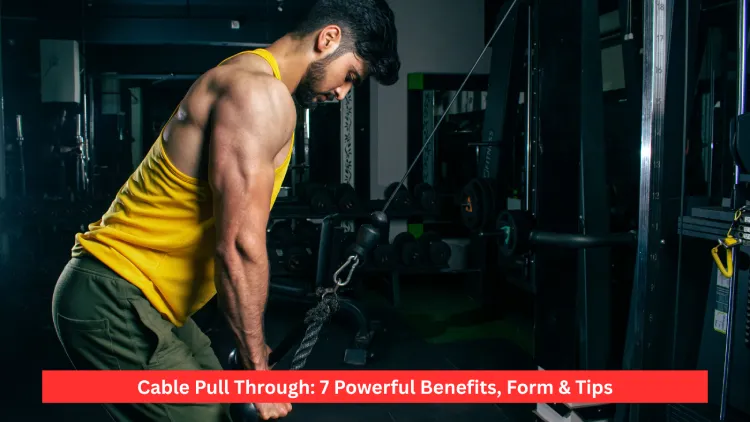

The cable pull-through is a compound cable exercise that works the glutes, hamstrings, and core. Bend hips back and then press forward in a controlled movement. Begin with 3×10-15 to develop strength in the posterior chain and enhance hip hinge movement.
- What is a Cable Pull Through?
- Does Cable Pull Through Make Sense?
- Cable Pull Through Muscles Worked
- How to Do the Cable Pull Through
- Cable Pull Through Form Tips
- Cable Pull Through Benefits
- How Many Cable Pull Through Sets and Reps Should You Do?
- How Heavy Should a Cable Pull Through Be?
- Common Cable Pull Through Mistakes
- Cable Pull Through vs. Romanian Deadlift
- Cable pull-through vs. Kettlebell swing.
- Cable Pull Through vs. Hip Thrust
- Alternatives to Cable Pull Through.
- Cable Pull Through Variations
- Cable Pull Through Workout
- Should the Cable Pull Through be included in the Glute Training routine?
- Should the Cable Pull Through be performed by the beginner?
- Cable Pull Through Without a Machine
- Cable Pull Through at Home
- Cable Pull Through Upper Body
- Cable Pull Through Women Muscles Worked
- Cable Pull Through Women Benefits
- Cable Pull Through Women Exercises
- Cable Pull Through Women Results
- Conclusion
- Frequently Asked Questions
What is a Cable Pull Through?
Cable pull-through is a lower body resistance training exercise that trains hip extension.
Hold a rope to the bottom cable pulley and face the pulley away from you. Keep the rope between your legs and move forward until you tighten the rope with the cable.
Move hips backwards with a slight bend in the knees. Gently push hips forward and stand up.
The movement is like the Romanian deadlift or the kettlebell swing, except the resistance is applied from behind the body.
A cable pull through w/rope is the standard setup, as the cable lets your hands move naturally between your legs.
Does Cable Pull Through Make Sense?
Yes. It can be beneficial for:
- To strengthen glutes and hamstrings
- Practicing hip-hinge mechanics
- Adding posterior-chain volume
- Training hip extension
- Complementing squats and deadlifts
Not always the better alternative to all of the other glute exercises, but it is a handy accessory exercise that can have adjustments in resistance.
Cable Pull Through Muscles Worked
Primary cable pull-through muscles used are the glutes and hamstrings.
1. Glutes
The emphasis of the cable pull-through glutes is due to hip extension.
The gluteus maximus muscles contract to pull your body back up as you push your hips forward.
Consider using your hips to move instead of arms to pull the rope.
2. Hamstrings
The hamstrings help to straighten the hip and to slow the back end.
There should be tension along the back of your thighs during the hinge.
3. Adductors
The inner thigh muscles help to move and stabilize the hip.
4. Core
Your core (abdominals) stabilizes your torso during hip motion.
5. Lower Back
The main function of the lower back is to provide stability. If you feel the cable pull through your lower back, rather than the glutes, then decrease the weight and check your form.
How to Do the Cable Pull Through

Step 1: Set Up the Cable
Take one piece of rope and tie it on the bottom pulley.
Facing away from the machine, grip the rope between your legs. Move forward until the cable is taut.
Step 2: Brace Your Core
Tighten abdominal muscles, maintaining control of the spine. Maintain relatively straight arms.
Step 3: Push Your Hips Back
Keep knees slightly bent and push hips backwards.
Let your upper body bend forward in a natural position. Avoid performing the movement as a “full squat.
Step 4: Reach the Bottom
Hinge further until hamstrings and glutes are tight.
Don’t let technique fall apart before you reach the end of the session.
Step 5: Drive Your Hips Forward – The action of your hips is to move them forward.
Squeeze your buttocks together and thrust your hips forward.
While standing, squeeze your buttocks.
Step 6: Repeat
Let the cable gently pull your hips backwards under control and repeat.
Cable Pull Through Form Tips
For better technique:
- Maintain a small bend in the knee.
- Move your buttocks toward the back.
- Maintain control of your spine.
- Maintain cable tension.
- Do NOT pull using the arm.
- Stretch your leg muscles in the back.
- Push hips forward.
- Squeeze your glutes.
- Do not lean back at the top!
- Control each repetition.
The cue is “hips back, hips forward.
Cable Pull Through Benefits
1. Builds Stronger Glutes
The exercise is great for hip extension and can provide valuable resistance in your glute routine.
2. Trains the Posterior Chain
It stimulates the glutes and hamstrings, whilst the core and other muscles maintain stability.
3. Helps You Learn the Hip Hinge
The controlled movement will assist beginners to grasp a pattern that is employed in deadlifts, RDLs and kettlebell swings.
4. Provides Adjustable Resistance
Cable machines allow you to increase or decrease resistance easily.
5. Complements Squats
Squats and pull-throughs will train different patterns of movement, so they are useful together.
6. Supportive for various levels of training.
Light resistance can be used for learning the movement for beginners or for accessory work for experienced lifters.
How Many Cable Pull Through Sets and Reps Should You Do?
| Goal | Sets | Reps |
| Technique | 2–3 | 10–15 |
| General fitness | 3 | 10–15 |
| Glute development | 3–4 | 10–15 |
| Endurance | 2–3 | 15–20 |
For most people, 3 sets of 10–15 reps is a good starting point.
Use a weight that challenges you without causing poor form.
How Heavy Should a Cable Pull Through Be?
There is no universal weight, as cable machines have different resistance systems.
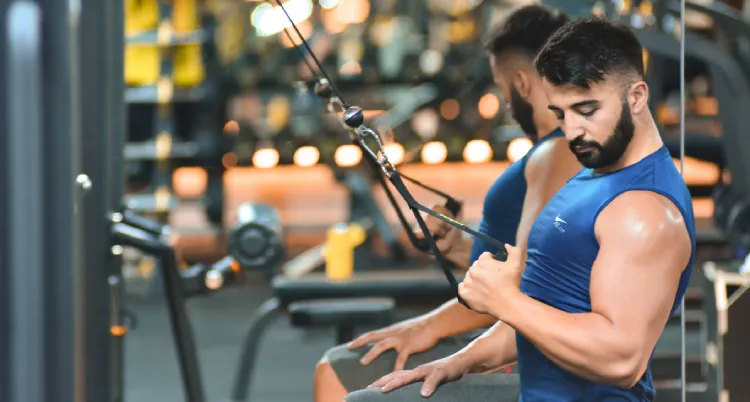
To begin with, start with a manageable load,
where you can:
- Maintain balance
- Control the hinge
- Stand up and squeeze each buttock and hamstring.
- Do your target reps
- Avoid momentum
- As your ability improves, raise the resistance slowly.
Common Cable Pull Through Mistakes
1. Turning It Into a Squat
Don’t bend over too far at the knees. Keep your weight on your buttocks!
2. Using Your Arms
The rope is held in your hands; the movement is in your hips.
3. Lower back rounding down
Decrease the load or range of motion if controlled positioning of the spine is not possible.
4. Going Too Heavy
Too much momentum and bad form can be the result of excessive weight.
5. Leaning Back at the Top
Sit up tall, squeeze buttocks without over-arching the back of the hips.
6. Moving Too Fast
Maintain a controlled tempo, especially in the backward phase.
Cable Pull Through vs. Romanian Deadlift
The cable pull through and Romanian deadlift both use a hip hinge, but they are different exercises.
| Feature | Cable Pull Through | Romanian Deadlift |
| Resistance | Behind body | In front |
| Movement | Hip hinge | Hip hinge |
| Glutes | High | High |
| Hamstrings | High | High |
| Loading | Moderate | Usually higher |
| Equipment | Cable + rope | Barbell/dumbbells |
An RDL is often more demanding because it can be loaded heavily and requires you to control the resistance in front of your body.
Cable pull-through vs. Kettlebell swing.
Both exercises are hip extension, but how they are executed is different.
Typically, cable pull-throughs are slow and controlled.
The kettlebell swing is a dynamic and explosive movement that uses the hips to create the force.
While they are similar movements, not all programs use the same interchangeable one.
Cable Pull Through vs. Hip Thrust
Both exercises work the glutes, but in different ways.
Hip thrust involves raising your hips up with the upper back supported.
Cable pull-through is done standing and with a backwards and forward hip hinge.
Both can work in a comprehensive glute workout.
Alternatives to Cable Pull Through.
A good cable pull-through alternative is an exercise that works hip extension or the posterior chain.
- Romanian Deadlift: One of the closest alternatives is an RDL since it shares the same hip-hinge pattern.
- Hip Thrust: An effective choice for focusing on glute development.
- Kettlebell Swing: Alternative hip extension that is more explosive.
- Good Morning: A hip hinge exercise that works the posterior chain.
- Resistance-Band Pull Through: A good alternative if there is no cable machine available.
Cable Pull Through Variations
- Rope Cable Pull Through: A rope attachment between the legs is used for the standard version.
- Cable Pull Through – Wide Stance: You can get a different balance and feel from a slightly wider stance.
- Pause Cable Pull Through: Stop at the bottom for a moment before pushing hips forward.
- Slow eccentric cable pull-through: Move hips backwards for more control/rechallenge.
Cable Pull Through Workout
Here’s an easy lower-body exercise:
- Squat – 3 × 6–10
- Romanian Deadlift – 3 × 8–12
- Cable Pull Through – 3 × 10–15
- Walking Lunge – 3 × 10 each leg
- Calf Raise – 3 × 12–20
Four exercises can be an effective session if they are carefully selected to include the major movement patterns and sufficient training volume.
Should the Cable Pull Through be included in the Glute Training routine?
Yes.
The glutes are big hip extensor muscles; therefore, they are important to this movement.
If you want to work the glutes more:
- To push your hips backward.
- Maintain cable tension.
- Push buttocks forward.
- Do not overextend knees.
- Clasp glutes tightly at the top position.
- Don’t use it as your sole glute workout.
Should the Cable Pull Through be performed by the beginner?
Yes.
Light resistance can be used for beginners to learn the hip hinge before using more resistance.
Make sure to do slow, controlled repetitions and don’t lift too much weight.
The best way to experience the feel of the cable pull through in the glutes.
If you are primarily feeling the stretch in the lower back:
- Reduce the weight.
- Hip buttocks further back behind you.
- Brace your core.
- Slightly bend the knees.
- Don’t arch back too far.
- Push hips forward.
- Don’t lean back at the top.
- Reduce the speed of the movement.
- You should be getting a lot of work from your glutes and hamstrings.
Cable Pull Through Without a Machine
The cable pull-through without a machine can be done with a resistance band.
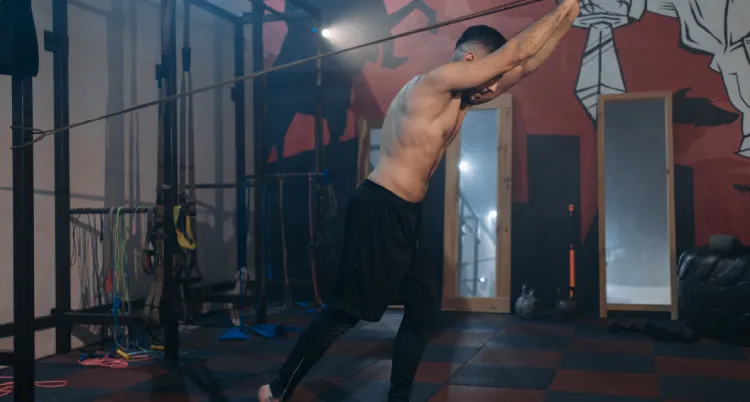
Tie the band to a solid object behind you. Keeping it between the legs, step forward to create tension and repeat the hip hinge movement.
Other alternatives include:
- Romanian deadlifts
- Kettlebell swings
- Hip thrusts
- Good mornings
- Glute bridges
Cable Pull Through at Home
If you have a home cable machine, then a cable pull-through can be performed at home.
So, if you don’t have one, resistance bands will do.
Some of the exercises that might be performed as a posterior chain workout in your home are:
- Band pull-throughs
- Romanian deadlifts
- Glute bridges
- Kettlebell swings
- Single-leg RDLs
- Always ensure that bands and anchor points are tight.
Cable Pull Through Upper Body
The traditional Cable Pull Through is NOT an upper-body exercise.
It primarily focuses on exercises for the lower body and back.
Arms, shoulders, and upper back primarily assist in maintaining and stabilizing the rope.
Cable Pull Through Upper Body Muscles Worked
Your grip, forearms, shoulders, and upper back can help to control the rope, but should not be the main focus.
The cable pull-through upper body exercise is a great gain for overall upper body fitness.
Limited direct benefits in upper body.
Row, lat pulldowns, face pulls, and cable presses are upper-body development exercises.
Cable Pull Through Upper Body Exercises
For a complete cable workout, perform pull-throughs in combination with:
- Cable rows
- Lat pulldowns
- Straight-arm pulldowns
- Face pulls
- Cable chest presses
Cable Pull Through Upper Body Variations
These can be done with cable exercises to certain muscles of the upper body but are not to be confused with the cable pull through.
Cable Pull Through Shoulders
Primary target areas do not include shoulders.
If shoulders get tired, make sure to keep pulling the rope with your arms.
Cable lateral raises and other shoulder exercises are better options for direct shoulder training.
Cable Pull Through Women
This exercise may be beneficial to both women and men as it works the same muscle groups.
It can be paired with lower body exercises like squats, hip thrusts, lunges, and Romanian deadlifts for women who are targeting their lower body.
Cable Pull Through Women Muscles Worked
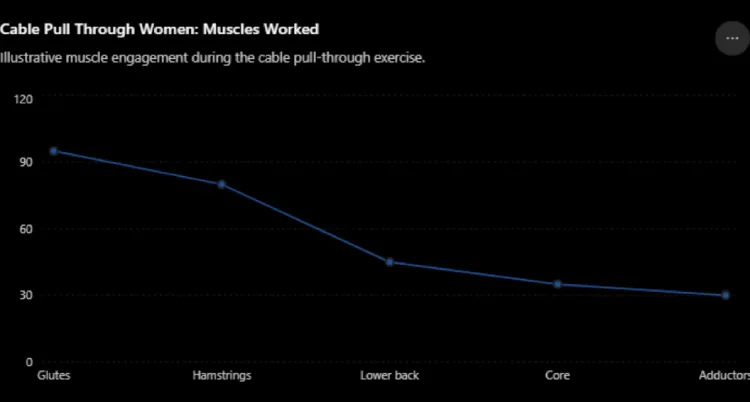
The main muscles:
- Glutes
- Hamstrings
- Adductors
- Core stabilizers
- Lower-back stabilizers
Cable Pull Through Women Benefits
Potential benefits include:
- Stronger glutes
- Better hip-hinge mechanics
- Stronger hamstrings
- Posterior-chain development
- Adjustable resistance
Cable Pull Through Women Exercises
This is a basic low back workout that can incorporate the following exercises:
- Squats
- Romanian deadlifts
- Cable pull-throughs
- Hip thrusts
- Walking lunges
Cable Pull Through Women Results
Results will vary based on consistency of training, resistance progression, nutrition, recovery, genetics, and programming.
There is no one magic exercise that you can perform to achieve a particular physical effect.
Conclusion
The cable pull-through primarily works the glutes, hamstrings, and hip extension. Increase the number of sets to 3 sets of 10-15 reps, but concentrate on proper form and not on heavy weight. Train it in combination with squats, RDLs, hip thrusts, or kettlebell swings for a completely balanced lower body workout; train it gradually and with consistency.
Frequently Asked Questions
Which muscles does a cable pull-through exercise work?
Primarily, it works on the glutes and hamstrings; the core is used for stability.
How do you do a cable pull-through?
Squeeze your buttocks and push your hips forward with slightly bent knees, while maintaining a slight back bend in the hips.
Would it be worth doing the cable pull-through?
Yes. It supports development of strength in the back line and helps develop hip hinge movement.
What other exercise can replace the cable pull-through?
Do RDLs, hip thrusts, kettlebell swings, or resistance band pull-throughs.