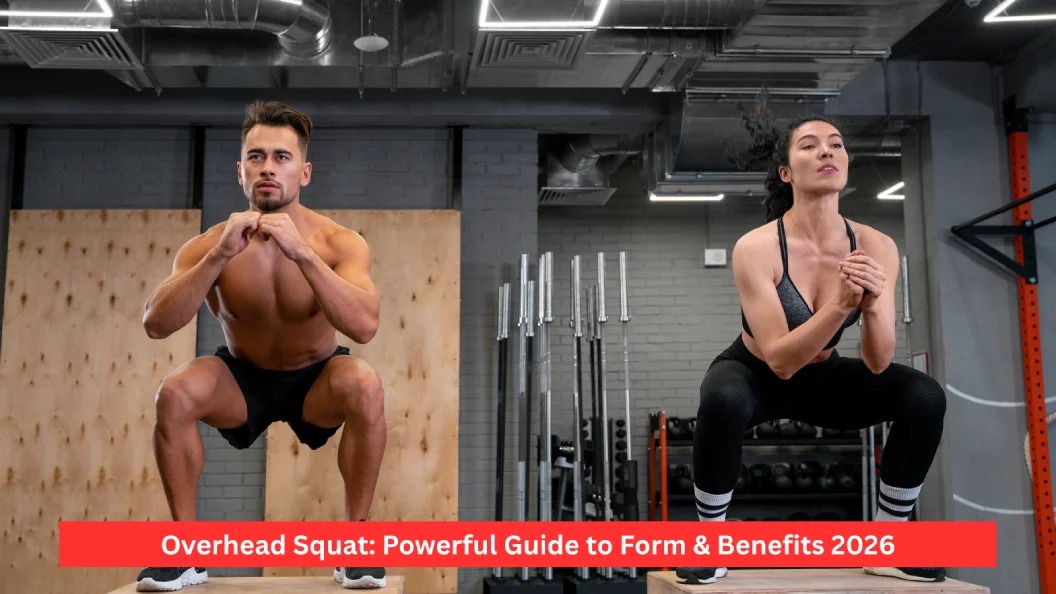

The overhead squat is a full-body exercise that involves performing a squat and holding a weight above your head. It challenges balance and mobility while training the legs, hips, core, shoulders, upper back, and ankles. It is important to use good form or technique rather than loading heavy, since the bar must maintain stability over the body. If you are a beginner, you should begin with a PVC pipe, a broomstick, or an empty bar before adding resistance.
- What Is an Overhead Squat?
- What Muscles Does the Overhead Squat Work?
- How to Do an Overhead Squat Correctly
- How Deep Should You Squat During an Overhead Squat?
- What Are the Benefits of the Overhead Squat?
- Common Overhead Squat Mistakes
- How to Improve Your Overhead Squat
- Use an Overhead Squat Assessment
- Overhead Squat vs. Regular Squat
- How Many Overhead Squats Do You Need to Do?
- Can Beginners Do Overhead Squats?
- When is an overhead squat appropriate for a workout?
- Overhead Squat CrossFit Training
- Squat to overhead press vs. overhead squat.
- How to run the Overhead Squat Assessment?
- What Weight Should You Use for Overhead Squats?
- Which Squat Is Most Effective?
- Can the Overhead Squat be the hardest kind of squat?
- Why Are Overhead Squats Harder Than Regular Squats?
- Why Can't I Do an Overhead Squat?
- Which muscles will get bigger from squats?
- Which of the Squats is the best for an individual who has "Bad Knees"?
- What are the 3 most common squats?
- Are Squats the King of All Exercises?
- Are Squats the best exercise?
- What is the Mother of all exercises?
- Which exercise is the best?
- What are the 5 exercises you should do daily?
- Which is the hardest exercise?
- Conclusion
- Frequently Asked Questions
What Is an Overhead Squat?
An overhead squat is a multi-joint lift that involves lowering into a squat with a barbell overhead. Your arms remain straight, your chest stays controlled, and the weight should remain in the middle of your body.
This exercise is a combination of lower and upper body strength and mobility, and is not a typical squat. You should have enough movement in your ankles, hips, shoulders, and upper back to keep your body steady.
This exercise is generally used in Olympic weightlifting and overhead squat CrossFit training. It is also a great movement-control exercise, as small weaknesses can become apparent as you perform it.
What Muscles Does the Overhead Squat Work?
The following muscles are engaged during the overhead squat: several major muscle groups.
1. Quadriceps
As you get up from the bottom position, the quadriceps straighten the knee. They are very active in the rising direction.
2. Glutes
Your glutes work to extend the hips and give you power when standing. They also help to keep you stable while you’re squatting.
3. Core
Abdominal muscles, obliques, and deeper trunk muscles are used to stabilize the torso. It is important to have a strong core so that there is no unwanted movement in the body when the weight is overhead.
4. Shoulders
Shoulders hold the bar and assist in keeping the overhead position. They should not appear to let the weight drop to the front of the body.
5. Upper Back
The upper back stabilises the shoulder blades and supports an upright posture. This is particularly relevant as it comes to the end of the squat.
6. Hamstrings
The hamstrings are also involved in the movement of the hip and control the descent. Their job is more apparent when performing a deeper squat.
7. Calves and Ankles
The calves help stabilize the ankle, and ankle mobility helps you go deep without raising the heels.
How to Do an Overhead Squat Correctly
Place feet shoulder-width apart. Grab the bar wide and push it up overhead. Elbows should be straight; shoulders should be active.
Breathe in and brace your core muscles. Start to lower your hips as you bend your knees. Maintain control of the chest and keep heels on the floor.
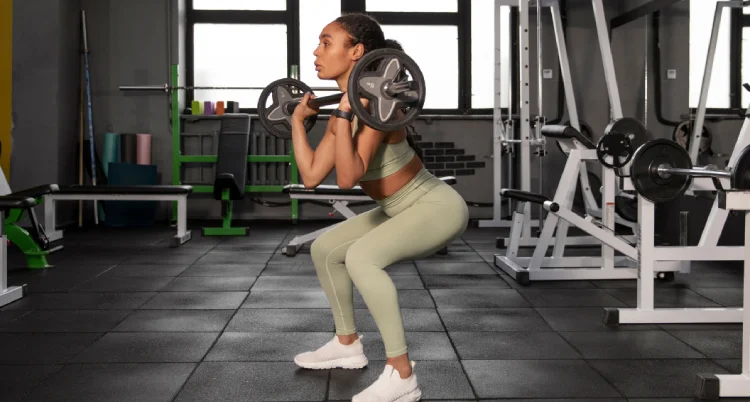
Practice going down as low as possible without losing your place. Stand up with your feet pushed through, and reach your hips and knees back to standing.
Position the bar over the middle of your foot all through the movement. If it gets too far forward or too far back, take the weight off and practice the technique.
How Deep Should You Squat During an Overhead Squat?
The depth depends on your mobility, control, and body structure. A good repetition will typically go to at least parallel, and even many seasoned lifters will go deeper.
Avoid forcing depth by letting your heels lift, knees drop, or spreading your back (or back muscle line out of position). The aim is to move in a controlled way and not just to go to a predetermined depth.
Before increasing weight, develop ankle, hip, and shoulder mobility if they are not at a comfortable depth.
What Are the Benefits of the Overhead Squat?
Improves Mobility
It uses ankle, hip, and shoulder movement in the exercise. Routine light resistance practice will aid in gaining awareness and working on these positions.
Builds Full-Body Strength
More than one group of muscles will be engaged on each rep. This makes the overall challenge of the movement greater to accomplish than many individual exercises.
Develops Balance
Holding a load overhead while squatting challenges your ability to control your body. Improving balance can help to enhance overall movement quality.
Strengthens the Core
You will need to keep your trunk rigid and allow your hips and legs to move. This allows the exercise to be beneficial for bracing and body control.
Improves Coordination
Legs, hips, shoulders, and core should all be engaged. This makes for a movement pattern which needs to be timed and coordinated.
Tests Movement Control
A light overhead squat may exhibit areas of restriction in mobility, stability, or technique. This is why it is sometimes employed as a part of movement screening by coaches.
Common Overhead Squat Mistakes
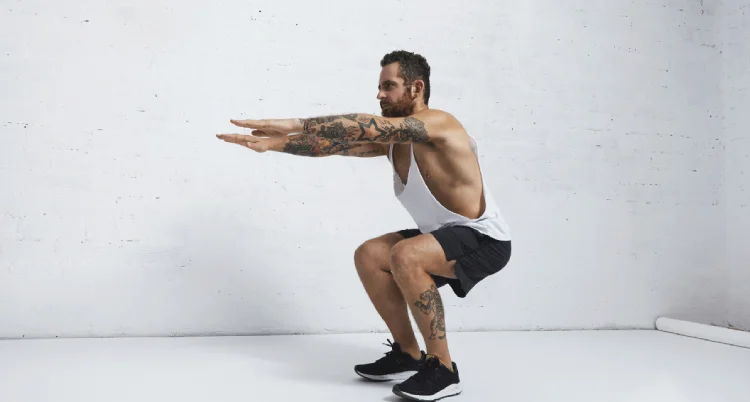
Using Too Much Weight
Technical issues may be hard to see and can be dangerous when there is heavy resistance. Begin slowly and build up the intensity.
Letting the Bar Move Forward
It is harder to maintain balance when the bar comes towards the feet. Keep it piled over the middle of your foot.
Lifting the Heels
Limited ankle mobility or poor control is suggested by raised heels. Try to practice some ankle mobility, and use a smaller weight.
Collapsing the Knees
Your knees should move with your feet. Don’t let them collapse inwards when going down or up.
Losing Core Tension
If the trunk is not relaxed, it can result in excessive leaning or movement. Tighten your body as you lower and keep it tight all the way down.
Rushing the Movement
The faster reps you do, the more difficult it will be to control the bar. Work at a steady speed and practise each position.
How to Improve Your Overhead Squat
Practice With a PVC Pipe
For practice, use a PVC pipe or broomstick, as there is not much resistance in the movement. This would be helpful in learning positioning.
Improve Ankle Mobility
If your ankles don’t move well, it may be hard to keep your heels flat on the floor. Mobility and calf stretches can help.
Work on Shoulder Mobility
You should have adequate range of motion in your shoulders to allow the bar to remain overhead. Include shoulder mobility exercises in the warm-up.
Strengthen Your Core
Exercises like planks, dead bugs, carries, and other trunk exercises can help you develop tension.
Practice Tempo Squats
Slow reps will allow you to find out where you lose control. If you can keep proper alignment, stop briefly at the bottom.
Use an Overhead Squat Assessment
The overhead squat is a widely used assessment tool to see how well the body moves. Coaches can analyze the position of the feet, knees, hips, body, arms, and the position of the bar.
An overhead squat assessment chart can be used to structure these observations, but it must be considered a screening tool, not a diagnosis.
Overhead Squat vs. Regular Squat
A regular squat mainly emphasizes lower-body strength, while the overhead version adds greater demands on the shoulders, upper back, core, and mobility.
| Feature | Overhead Squat | Regular Squat |
| Main focus | Full-body control | Lower-body strength |
| Mobility demand | High | Moderate |
| Shoulder involvement | High | Low to moderate |
| Balance demand | High | Moderate |
| Beginner difficulty | Higher | Lower |
| Typical loading | Light to moderate | Moderate to heavy |
Neither variation is universally better. Your choice should match your training goal and ability.
How Many Overhead Squats Do You Need to Do?
If this is your first time doing this, you should begin with 2-3 sets of 3-8 controlled reps with very light resistance. The sets and repetitions may vary with the experience of the athlete and program.
Quality always goes before quantity. Stop the set if the technique fails; don’t try to finish the set.
Can Beginners Do Overhead Squats?
Yes, but novices should first master the pattern before training with a loaded barbell. A PVC pipe, broomstick, or empty bar will be a better starting point.
If you struggle with the overhead squat or cannot get the depth, work on mobility and basic squat strength more than what you are going to focus on overhead.
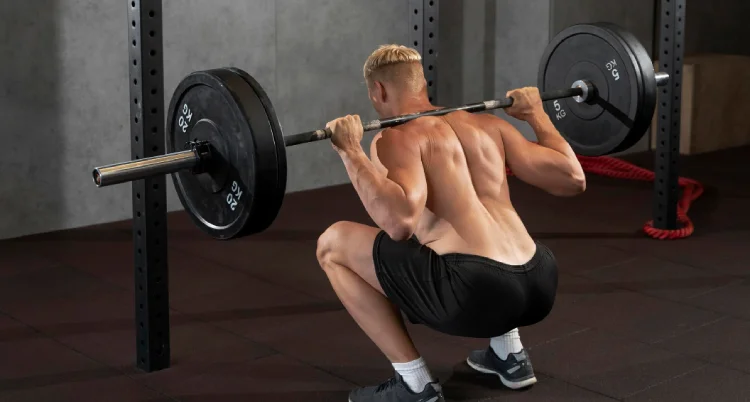
When is an overhead squat appropriate for a workout?
These can come at the start of the workout when you are fresh and can concentrate on technique. This is very helpful if the exercise is being used as a skill development exercise.
If your form breaks down rapidly, don’t use it as a conditioning exercise.
Overhead Squat CrossFit Training
The overhead squat CrossFit exercise is one of the exercises that is commonly employed in technical workouts or Olympic lifting combinations. It can be done individually or as a part of a series of movements.
Fatigue can affect technique, so athletes should use a level of resistance they can control the entire length of the workout.
Squat to overhead press vs. overhead squat.
Squat to overhead press is an exercise that incorporates a squat and an overhead press. While squatting, the weight is close to your shoulders and pushed up overhead as you stand up.
Overhead squat is not the same as this since the weight stays overhead throughout the squat movement.
The squat overhead press may be beneficial for conditioning and for whole-body training, while the overhead squat is more stability/mobility/control oriented.
How to run the Overhead Squat Assessment?
A coach observes the way the body is moving when the exercise is completed during an assessment. These are the common areas that include foot position, knee tracking, hip movement, torso angle, arm position, and bar alignment.
The aim is to detect movement restrictions that can influence movement. Does not automatically guess at the cause of a problem.
What Weight Should You Use for Overhead Squats?
No one good weight for all. A good initial load is the one where you are able to finish all reps with proper form.
That might be as simple as employing a PVC pipe or empty bar for many beginners. Only add resistance when you’re able to control the movement consistently.
Which Squat Is Most Effective?
The best squat will vary depending on what you’re trying to achieve. Back squats can be helpful for strength, goblet squats can be implemented for beginners, and overhead squats can focus on mobility and control.
Don’t search for one perfect type; select one that is appropriate to your training needs.
Can the Overhead Squat be the hardest kind of squat?
This is one of the more challenging squat variations due to the overhead position in combination with the lower body movement.
But, as with everything else, it’s a challenge for some. The difficulty of a squat can vary based on mobility, strength, experience, and body proportions.
Why Are Overhead Squats Harder Than Regular Squats?
The overhead position is an additional stability and mobility requirement. The arms must be held straight, and the hips, knees, ankles, and torso must be controlled.
The exercise is much more difficult than just a squat due to the fact that a slight mistake in movement will cause a loss of balance.
Why Can’t I Do an Overhead Squat?
This is often due to poor balance, unfamiliarity with the movement, weak core control, or limited ankle or shoulder mobility.
Experiment with lowering the resistance and using a PVC pipe. If it hurts, stop and ask for advice from a suitably trained person.
Instead of overhead squats, try these exercises:
If the movement is too hard, try exercises that develop similar attributes. Goblet squats can help to establish general squat control, and front squats help to build strength in the lower body in a different upper-body position.
Shoulder mobility, ankle drills, and core exercises can be done individually prior to trying the overhead variation again.
Which muscles will get bigger from squats?
Squats can build up the strength of the quadriceps, glutes, hamstrings, and core. They will also target calves, adductors, upper back, and shoulders, depending on the variation.
The emphasis of muscles varies according to stance, depth, load,d and style of squat.
Which of the Squats is the best for an individual who has “Bad Knees”?
Not everyone who has knee issues has the same type of squat that’s right for them. There is a need for a good range of motion, the right resistance, and proper technique.
Always seek personal guidance and advice when squatting if it causes pain that is persistent or significant.
What are the 3 most common squats?
Some of the popular variations are bodyweight squat, goblet squat, and barbell back squat. They have varying levels of resistance and technical demands.
Another type of squat is the overhead squat, which focuses more on mobility and upper body stability.
Are Squats the King of All Exercises?
Squats are referred to as the ‘king of exercises’ for the number of large muscle groups they recruit and because they have numerous variations. There is no official king, queen, or one best exercise, though.
This is also true of phrases like “mother of all exercises.” These are non-scientific descriptions, not classifications.
Are Squats the best exercise?
Yes, if you are looking to move up the career ladder. Squats can be used to develop qualities that are not trained with other exercises such as deadlifts, presses, rows, lunges, pull-ups, and the like.
A typical exercise routine usually consists of multiple movement patterns rather than just a single exercise.
What is the Mother of all exercises?
Squats, or any other compound exercises that are difficult, can be referred to as the “mother of all exercises” informally. There is no standard definition for fitness.
The question that matters is whether it suits you and your goal, whether it’s something you’ve done before, and what your plan is for training.
Which exercise is the best?
No single exercise is the most powerful. There are different movement patterns needed for strength, power, endurance, mobility, and conditioning.
Squats, deadlifts, Olympic lifts, jumps, and presses are just some of the exercises that can produce physical performance in a variety of ways.
What are the 5 exercises you should do daily?
Not all 5 exercises have to be done daily. Recovery is built into training; certain exercises will need more recovery than others.
A single exercise could be a squat variation, a push-up, a row or a pull-up, a hip hinge, and a core exercise. Variations and frequency are based on fitness and the overall program.
Which is the hardest exercise?
The most challenging exercise is different for each person. What is challenging for one athlete may be easy for another.
The overhead squat can be difficult as it is a multi-joint, multi-limb movement which involves mobility, strength, balance, and coordination.
Conclusion
The overhead squat is a challenging compound exercise that works a lot more than just the legs. It tests the mobility, stability, balance, coordination, and strength from the ankles to the shoulders.
It is important to master the movement first in order to pursue heavier weights. Use a training tool that’s easy to use, builds mobility, maintains core tightness, and gradually adds resistance.
The overhead squat doesn’t have to be the most important exercise. As an element of a comprehensive training regimen that is appropriate for your objectives and skill level.
Frequently Asked Questions
1. What muscles does the overhead squat work?
The overhead squat targets the quadriceps, glutes, hamstrings, core, shoulders, upper back, calves, es and ankles.
2. What are the benefits of overhead squats?
Overhead squats can enhance mobility, balance, coordination, core stability, and control of movement throughout the body.
3. Why are overhead squats so difficult?
They require strength, flexibility, balance, and coordination simultaneously. The movement may be more difficult if there is restriction in the ankle or shoulder.
4. How much weight should be used for overhead squats for beginners?
For beginners, using a PVC pipe, broomstick, or a bar is the first choice. Add weight when regular technique and control are developed.