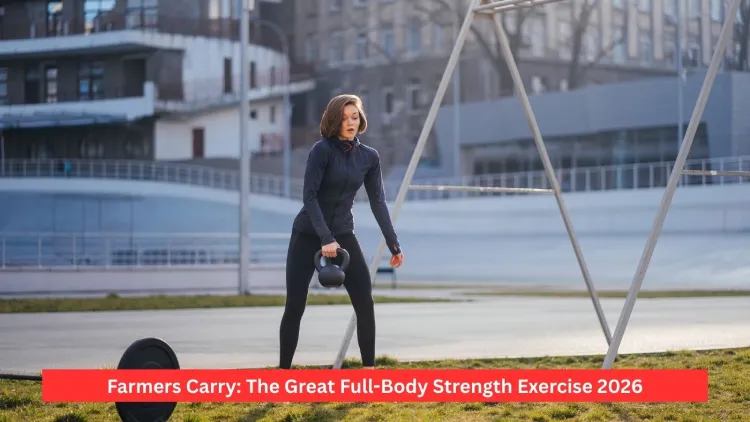

One of the best functional strength exercises for building total body fitness is the farmers carry. Holding one weight in each hand and walking will help increase grip strength, core stability, posture, and stamina. The farmers carry engages several muscle groups simultaneously, increasing the benefit of the exercise for daily activities and sports. Here, everyone will get to know how to do the farmers carry with proper form, why it is good for you, the muscle groups involved, common mistakes you have to avoid, and popular variations along with some tips to use in training.
- What Is the Farmers Carry?
- Muscles Worked During the Farmers Carry
- Benefits of the Farmers Carry
- How to Perform the Farmer's Carry Correctly
- Proper Farmers Carry Form Tips
- Common Farmers Carry Mistakes
- Best Farmers Carry Variations
- Farmers Carry for Beginners
- Farmers Carry for Strength
- Farmers Carry for Endurance
- Farmers Carry for Fat Loss
- Who Should Do the Farmers Carry?
- Safety Tips
- Sample Farmers Carry Workout
- Final Thoughts
- Frequently Asked Questions
What Is the Farmers Carry?
The farmers carry, also known as the farmer’s walk, is a simple but highly effective full-body exercise. It involves holding a heavy weight in each hand, standing tall, and walking for a set distance or time while maintaining good posture. Common equipment includes dumbbells, kettlebells, trap bars, or farmer’s carry handles.
This exercise is considered a functional movement because it mimics everyday activities like carrying grocery bags, luggage, or heavy objects. At the same time, it improves strength, balance, coordination, and endurance by challenging multiple muscle groups throughout the body.
Muscles Worked During the Farmers Carry
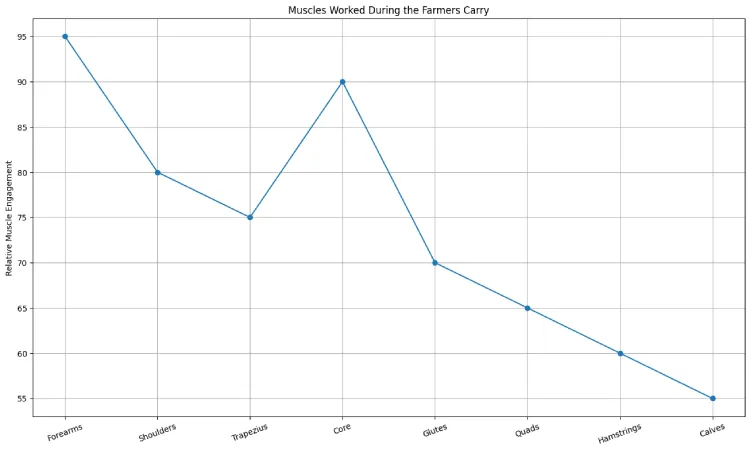
The farmers carry targets several major muscle groups at once, making it an excellent compound exercise for building total-body strength.
Forearms and Grip
Your forearms and grip muscles work continuously to hold the weights securely, helping improve grip strength and endurance.
Shoulders
The shoulders stabilize the weights and keep your arms in the correct position throughout the movement.
Trapezius
The trapezius muscles support the shoulders and upper back, helping you maintain an upright posture while carrying the load.
Core
Your abdominal muscles, obliques, and lower back stay engaged to stabilize the spine and prevent unnecessary movement.
Glutes
The glutes help drive each step forward while keeping the hips stable and supporting proper walking mechanics.
Quadriceps
The quadriceps control knee movement and provide strength and stability during each stride.
Hamstrings
The hamstrings work with the glutes to stabilize the hips and assist with smooth, controlled movement.
Calves
The calf muscles help maintain balance and provide the push needed for each step, improving lower-body endurance.
Benefits of the Farmers Carry
Builds Incredible Grip Strength
One of the biggest benefits of the farmers carry is its ability to develop grip strength. Since you’re holding heavy weights throughout the exercise, your hands, fingers, and forearms remain under constant tension. A stronger grip can improve your performance in exercises like deadlifts, pull-ups, rows, and other lifting movements, while also making everyday tasks such as carrying bags or lifting heavy objects easier.
Strengthens the Entire Core
The farmers carry is an excellent core exercise because your abdominal muscles, obliques, and lower back work together to keep your torso stable. Unlike traditional core exercises that involve bending or twisting, this movement teaches your core to resist unwanted motion, improving overall stability and functional strength.
Improves Posture
Carrying weights while maintaining an upright position encourages proper posture. The exercise helps strengthen the muscles that support your spine, shoulders, and upper back, promoting a neutral spine and reducing the tendency to slouch during daily activities.
Increases Functional Strength
The farmers carry closely mimics real-life movements, making it one of the best exercises for building functional strength. Whether you’re carrying groceries, luggage, or heavy equipment, the strength gained from this exercise transfers directly to everyday activities.
Improves Balance and Stability
Walking with heavy weights challenges your balance and coordination. Your core and lower-body muscles constantly work to keep you stable, helping improve overall body control and reducing the risk of falls or injuries.
Enhances Athletic Performance
Many athletes include the farmers carry in their training because it improves several key performance areas, including:
- Full-body strength
- Grip endurance
- Core stability
- Running and walking mechanics
- Overall athletic performance
Supports Fat Loss
Since the farmers carry engages multiple muscle groups at the same time, it increases energy expenditure and burns more calories than many isolation exercises. When combined with a healthy diet and regular training, it can support fat loss and improve overall fitness.
Builds Mental Toughness
Holding heavy weights while walking requires focus, determination, and endurance. As you gradually increase the weight or distance, the farmer’s carry helps build mental resilience, allowing you to push through challenging workouts with greater confidence.
- Back and down
- Engaging your core muscles
- Looking straight ahead
How to Perform the Farmer’s Carry Correctly
Step 1: Choose and Position the Weights
Start with two dumbbells, kettlebells, or farmer’s carry handles on the floor next to your feet. Select a weight to challenge you, but make sure you keep good form throughout the movement.
Step 2: Stand with Proper Foot Placement
Place your feet hip-distance apart. Balance both feet and line up to lift weights with footwork that is balanced.
Step 3: Lift the Weights Safely
Bend your hips and knees without letting your back go straight. Be sure to hold the handles in your hands and lift the weights by pushing up with your heels; don’t let your back round or move your arms up and down.
Step 4: Set Your Posture
When standing up, keep an upright posture by:
- Keeping your chest up
- Pulling your shoulders
This posture helps protect your spine and improves stability while walking.
Step 5: Walk with Controlled Steps
Begin walking using short, steady steps. Move at a comfortable pace and keep the weights close to your sides without letting them swing excessively.
Step 6: Stay Balanced
Keep your body upright throughout the movement. Avoid leaning forward, backward, or to either side, as this can reduce stability and place unnecessary stress on your lower back.
Step 7: Complete the Planned Distance or Time
Continue walking until you reach your target distance or time while maintaining good posture and a firm grip on the weights.
Step 8: Lower the Weights Properly
When you finish, stop carefully and lower the weights by bending your hips and knees. Place them on the floor with control instead of dropping them to reduce the risk of injury.
Proper Farmers Carry Form Tips
For the best results:
- Keep your spine neutral.
- Brace your core throughout the movement.
- Walk slowly and under control.
- Avoid shrugging your shoulders.
- Keep your breathing steady.
- Grip the weights firmly.
- Maintain even weight distribution.
Common Farmers Carry Mistakes
Using Too Much Weight
One of the most frequent errors is using a weight that is more than you can handle. Conditions like poor posture, loss of walking control, and injuries can result from excessive weight. Use a small amount of weight and add weight as you build strength.
Taking Large Steps
Straight legs don’t look as quick as a long reach but can lead to loss of stability and make balancing more difficult. Rather, make short and controlled steps,s maintaining good posture whilst keeping the motion smooth.
Looking Down
If you are walking, you should be looking forward and not looking at the ground, which will cause your neck and upper back to round. Don’t look up or down; your eyes must remain level with your body to keep your spine neutral and help keep your entire body in better alignment.
Rounding the Back
A rounded back puts extra strain on the back, which also decreases the effectiveness of the exercise. Protect your lower back by maintaining a strong, elevated chest, pulled-back shoulders, and engaged core throughout.
Shrugging the Shoulders
Lifting while carrying heavy weights is a common mistake made by many, and they are not aware that they are lifting their shoulders to their ears. This puts unwarranted tension into the neck and upper traps. At the same time, exercise the shoulder rhythm and relax the shoulder; pull them slightly back and down while performing the exercise.
Holding Your Breath
Buildup of fatigue and loss of stability can result from holding your breath. Rather, inhale and exhale regularly during the exercise, taking a natural breath in and out, and keep your core activated to aid endurance.
Best Farmers Carry Variations
Dumbbell Farmers Carry
The most popular and simplest kind of dumbbell exercise that the majority of people take. Maintaining shoulder posture, pick up a dumbbell in each hand and start walking. Good for strengthening grip, core, and functional fitness.
Kettlebell Farmers Carry
This is a version of the variation where the kettlebells are used instead of the dumbbells. The weight is placed below the level of the handle, which alters your center of gravity, making the weight easier on your hands, forearms,s and stabilizing muscles.
Trap Bar Carry
The carry with the trap bar enables power to be lifted off the floor and weight to be distributed evenly around the body. The variation is perfect for creating total body sstrengthnd is widely used in strength training and athletic training routines.
Suitcase Carry
The suitcase carry is when the dumbbell or kettlebell is held in one hand, and the carriage is walked. Its one-sided load causes your trunk to engage more to stabilize the body in space, which is great for balance, stability, and anti-lateral flexion strength.
Rack Carry
Rack carry is a movement with dumbbells or kettlebells that are held at shoulder height in the front rack position. This works great for upper body and core work and enhances shoulder stability and posture as well.
Overhead Carry
In the overhead carry, pick up 1 or 2 weights overhead and walk your arms fully extended. It’s an advanced twist that will engage the core, shoulder stability, and balance and is a fantastic exercise for individuals with experience.
Sandbag Carry
The sandbag carry is an unstable movement where you replace weights with a sandbag, which moves as you walk. This will make your core and the muscles that hold you up more difficult and help foster coordination, functional strength, and body control.
Farmers Carry for Beginners
If you don’t know or use the correct technique for the farmers carry, then work on these first and then add weights. Try doing lower-level dumbbells or kettlebells where you can take a nice walk with good posture. Walk for 20-30 seconds with chest lifted, core engaged, and shoulders relaxed. Do 2-3 sets, taking 60-90 seconds between sets. After an exercise that seems comfortable, slowly add to the weight or length of walking.
Farmers Carry for Strength
For maximum strength, perform exercises at heavier weights that are challenging, but done with good form. Move for 20–40m per set, emphasizing controlled steps and having a tight grip. Go through 3 – 5 sets with a 2 – 3 minute rest interval to ensure you fully recover between sets and can perform at your best.
Farmers Carry for Endurance
Use moderate weights to lift these weights for a longer duration but not at the cost of sacrificing form. Walk for 45-90 seconds, 3-4 rounds continuously. This variation allows for better grip endurance, cardio fitness, and overall body stamina.
Farmers Carry for Fat Loss
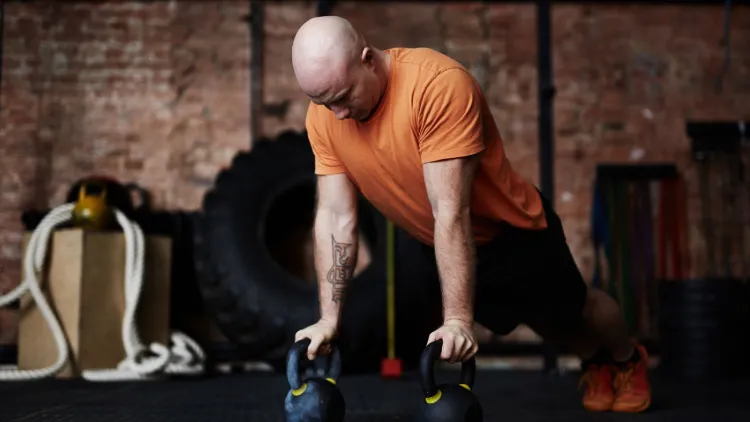
A conditioning exercise other than the farmers carry can be done to burn calories. Use it with bodyweight exercises to maintain a high heart rate and enhance fitness.
Example Circuit:
- Farmers Carry
- Push-Ups
- Bodyweight Squats
- Burpees
- Mountain Climbers
Repeat 3–5 times, allowing rest as necessary between rounds.
Who Should Do the Farmers Carry?
It can be made as easy or hard as desired by altering the weight or the length of the walk and is well suited to walkers of all levels of fitness.
It is particularly recommended for:
- Children just starting with functional strength training
- Intermediate lifters who want to enhance grip and core stability.
- Very advanced athletes who are training for general fitness
- CrossFit participants
- Strongman competitors
- Did you notice older people use lower weights to work on balance and mobility?
- Anyone who wants to see an improvement in their working out capacity while performing their own activities will find this workout very useful.
Safety Tips
The farmers carry must be performed with proper safety and efficacy, so do check the weights before your session and warm up properly. Keep the chest high and the core tight the entire way through the exercise. Use comfortable footwear and perform it on a flat, hard surface to prevent slipping or falling due to loss of balance. Discontinue the exercise if pain/discomfort occurs. Once you strengthen, slowly add the weight and/or distance of the movement to avoid sudden jumps in intensity and getting injured.
Sample Farmers Carry Workout
| Exercise | Sets | Distance |
| Farmers Carry | 3 | 30 meters |
| Suitcase Carry | 3 | 20 meters each side |
| Rack Carry | 3 | 20 meters |
| Overhead Carry | 2 | 15 meters |
Final Thoughts
Carrying the chores is one of the best ways to build total body strength, grip endurance, and the core stability that is needed to perform the exercises. But although rather simple, it has great benefits, as it trains your body to act efficiently while loaded. The farmer carry can be utilized to increase strength, stability, and resilience in the long term, whether you’re trying to get stronger, get better at your sport, or get better at moving around.
Frequently Asked Questions
Which muscles does the farmer’s carry work?
The farmer’s carry works multiple muscle groups in the forearms, grip, shoulders, trapezius, core, glutes, quadriceps, hamstrings, and calves. One of the best full-body functional exercises is considered to be it.
2. How much do I need to weigh to do the farmer’s carry?
Select a weight that provides sufficient resistance to challenge, but not to the extent of disrupting good posture and controlled walking. If you’re new to weightlifting, then you have to ease your way in and perform with a lighter weight as you gain strength, and you can then increase the weight.
3. What is the frequency of the farmer’s carry?
As a farmer’s carry, it takes little to no special training and can be done anywhere, a couple of times weekly as an aspect of a strength or conditioning program. Remember to give plenty of rest between sets, particularly when performing heavy sets.
4. Can the farmers carry plan help you lose fat?
Yes. The farmers carry works several muscle groups simultaneously, allowing for greater calorie expenditure and enhanced overall fitness. It can also help to achieve weight loss when used alongside a proper diet and workout regimen.