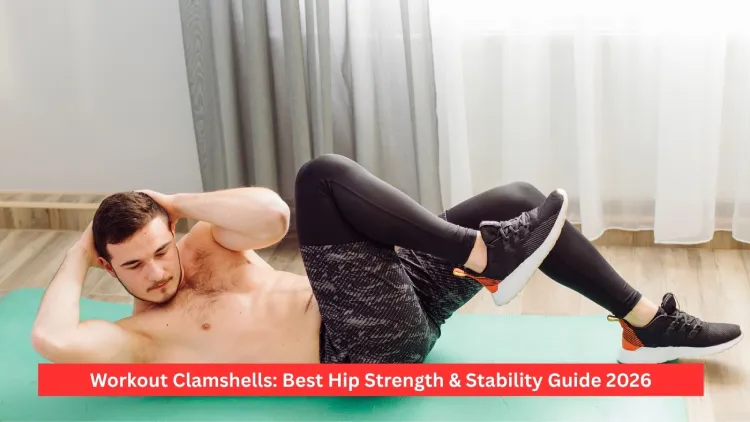

The workout clamshell is a simple yet very effective hip strengthening workout, which works the gluteus medius and deep stabilizing hip muscles. Their benefits include enhancing knee alignment, aiding in joint stability, and being commonly used in strength training and rehabilitation exercises. Correctly executed work-out clamshells are able to decrease the strain of the knees, improve the efficiency of the movement process, and offer support for longevity of the joint, primarily for individuals who sit for extended durations, have weak glutes, or require low-impact strengthening activities.
What are Workout Clamshells?
Workout Clamshells are a controlled hip outside lying exercise that will begin to strengthen the hip abductors and stabilize the pelvis. For workout “clamshells,” the motion is rapid but concentrated – and the top knee swings up and up, the bottom knee remaining stationary the entire time, like a clam opening.
Although clamshells are easy to perform, they are one of the most essential lower-body activation exercises. They are often employed in warm-ups, rehab exercises, and mobility sessions, as they directly engage muscles that are not typically exercised during the day-to-day routine.
Workout clamshells are particularly beneficial as today’s lifestyle tends to include long periods of sitting for long durations, diminishing hip stability, and lessening the engagement of the glutes. This can impact posture over time, along with walking patterns and even the alignment of the knees. This makes workout clamshells a basic exercise that’s often recommended before more advanced exercises for the lower body.
In a nutshell, workout clamshells aren’t simply an exercise; they’re a remedial exercise pattern that assists in recovering natural hip function.

Muscles Worked in Clamshells
The workout clamshells mainly target the glute area, specifically the gluteus medius (one of the least realized muscles of the human body).
During workout clamshells, several different muscle groups get activated:
- Gluteus medius (main stabilizer)
- Gluteus minimus (deep hip support)
- Internal rotators of the hip are deep from the outside.
- Core stabilisers (indirect engagement)
- Pelvic stabilizing muscles
One of the least talked about muscles of the day is the glute medius, which is directly engaged in workout clamshell exercises. This muscle can also be used to maintain the level pelvis during walking, running, and single-leg movements. Its weakness creates a lack of stability in the body, which may result in increased stress on the knees and the lower back.
Workout clamshells also have indirect attention for posture, since strengthening the lateral hip chain, which supports balance and balance, is also crucial for posture.
Interestingly, the gluteal muscles, particularly the glute max, are known as a “power muscle” in the fitness world because of their function in explosive movement. The glute medius, however, is more of a “stability muscle”, and balance is essential during workouts, but it is not about power; clamshells are therefore essential during workouts.
Low muscle tone and tightness in the glutes often lead to symptoms such as knee pain, poor posture, and single-legged stability. The workout clamshells reverse these problems by reactivating muscle tissues that are hidden in their dormant state.
How to Do Workout Clamshells Correctly
Getting the MoMax from workout clamshells comes as a result of proper technique. This generally is a small movement, so little detail doesn’t make much difference.
Inclined execution of workout clamshells that are done step by step:
- Lying on your side, your knees are just bent 90 degrees.
- Line the hips, shoulders, and legs up in a straight line.
- Maintain a stretched position of the feet during the entire motion.
- Relax the core before starting workouts with the clamshells.
- Raise the top knee above the level of the pelvis while avoiding any movement of the pelvis.
- Hold at the end of the movement for a short while.
- Aim to bring the knee back down in control.
The workout “clamshells” should activate the side of the glutes, not the lower back or thighs. Any sensation of strain in another part of the body is a sign that the form of the rest of the body needs to be adjusted.
Key focus points:
- Do not roll the hips back to the detriment of the athlete.
- Maintain slow and controlled movements.
- Rocksteady workout clamshells
- Make sure that you concentrate on engaging the glutes in the exercise and not on the knee height.
Workout clamshells can develop great mind-muscle association with the hip stabilizers when executed properly, providing better performance results for almost all lower-body exercises.

Benefits of Workout Clamshells
Fitness clamshells are not just about getting muscles activated; they have a plethora of advantages.
1. Improves Hip Stability
The primary advantage of workout clamshells is greater hip stability. Hip stabilizers are important for movement patterns in walking, running, and squatting to be smooth.
2. Enhances Glute Activation
Many have a problem with “inactive glutes” because of sitting for extended periods. The muscles then get fired again when the clamshells are moved while you are in the workout, allowing them to respond in compound movements.
3. Maintains Knee Alignment and provides relief of Knee Discomfort
Knee collapse in and out during motion can be due to weak hips. Increased lateral hip control is achieved with workout clamshells, which can help alleviate excessive joint stress and improve improper knee alignment.
4. Will assist with Joint-Friendly Training and Arthritis Support.
Low-impact exercises, such as workout “clamshells,” are often part of joint-friendly exercise programs. If someone has stiffness or some minor joint pain, controlled activation exercises, such as workout clamshells, can help to maintain mobility while minimizing stress.
Every movement, in general, is good for the health of your joints, as it assists in ensuring all the parts have blood circulation flow, is enriched with lubrication, and also maintains balance in your muscle groups. The low impact and controlled nature of workout clamshells is ideal for this group.
5. Develops Posture and Pelvic control
Clamshell exercises help to strengthen muscles that stabilize the pelvis. The correct alignment of the pelvis helps to contribute to better posture and less strain in the lower back.
5. Improves Posture and Pelvic Control
One of the biggest advantages athletes can get from workout clamshells is that they make running more efficient, reduce cutting gestures, and balance in dynamic exercises.
7. Aids to avoid muscle imbalances
Strong and weak muscles can sometimes become imbalanced, possibly because of modern lifestyles. Clamshells are used in workouts to help rebalance the hip area.
Full-Body Movement Indirect Support #8
While workout clamshells work on a relatively small muscle group, they have an impact on whole body mechanics because they enhance force transfer from the lower body to the rest of the body.

Common Mistakes to Avoid
Despite how straightforward workout clamshells are, little form faults can make it less effective and move the motivation away from the buttocks. You do not need the heavy resistance of a workout; clamshell and technique are more important than effort.
1. The hips are rolled backwards.
A frequent clam-shelling error is the roll of the top hip back. This decreases the glute activation and the stability work for the gluteus. This exercise uses the lower back and deep glutes to the side rather than the side of the glutes. Maintain hips aligned while performing workout clamshells.
2. Using momentum
A lot of people pick up everyday workout clam shells too rapidly, employing swinging, not control. This decreases muscle tension and so decreases results. Exercise clamshells work much better with slow but controlled movement, and a brief pause at the top of the move.
3. Lifting too high
Another common error in clamshell workouts is “over-lifting”. Running too high will usually result in hip rotation and will put pressure on the glutes. It’s about MOVEMENT, not height. STOP when the side glute is engaged.
4. Poor breathing control
Don’t hold your breath with the workout clamshells, or they will decrease stability and flex. Controlled breathing is very useful for maintaining control and boosting performance.
5. Lack of consistency
If you do workout clamshells every so often, they’ll not build long-term strength. Hip stability and muscle fireness may need to be practiced regularly to increase over time.
Variations of Clamshells
You can modify features of workout clamshells quickly, in order to suit various degrees of fitness and objectives. Adjusting resistance, speed, or position will ensure that the exercise is still effective, yet improve glute activation and hip stability.
1. Resistance Band Clamshells
To make workout clamshells more difficult, a band is placed above the knees, which offers more outward tension. This targets the sides of the glutes to activate further and boost strength and activation.
2. Isometric Hold Clamshells
Knee at the top for a couple of seconds is done in this version of the workout, clamshells. This develops endurance and enhances control by holding muscles under stress for a longer period of time.
3. Slow Tempo Clamshells
Workout clamshells that work slower get better control, and decrease momentum. This will keep the glutes active during the movement and help to establish muscle connection.
4. Elevated Clamshells
To make workout clamshells less stable, the hips/feet should be elevated a bit from the floor, so there is a need for better balance and more challenge on stabilizing muscles.

How to Include Clamshells in Your Workout
Depending on what your training objectives are, the workout clamshell can be utilized in more than one training environment.
Warm-up Activation
Workout clamshells can be done before lower-body training to prime the glutes and prepare the hips to move.
- A rehabilitation or recovery programme will be undertaken when necessary.
- Clamshells are frequently incorporated into low-intensity exercises to rebalance, stabilize, and restore joint and muscle function to their proper state.
Strength Training Support
Workout clamshells enhance muscle engagement and movement when used in conjunction with squats, lunges, or deadlifts.
Daily Movement Routine
You don’t need to do the workout clamshells for long periods of time, just frequently enough to offset the effects of long periods of sitting.
Intensity is not as important as consistency to work out clamshells.
Who Should Do Clamshells?
Workout clam shells can be used for all sorts of people:
- Those with tight and weak buttocks!Men and women with inactive, weak glutes!
- Sitting for extended periods of time during work.
Strength training newbies
Make things more comfortable for runners. Make running more comfortable for athletes.
People engaged in exercise programs that will not aggravate the joints.
The correction and improvement of human posture.Individuals involved in the correction and improvement of human posture.
With workout clamshells, it is particularly effective for people who have reduced hip control or instability because it focuses directly on the hip stabilizing muscles that are involved with these alignments.

Final Thoughts
Although workout clamshells look easy, they’re one of the best exercises for stabilizing and strengthening the muscles they may be forgetting about, and achieving proper movement patterns. The benefit of them is that they work muscles that are usually neglected in regular exercise. Regularly using workout clamshells can help develop posture, help improve knee alignment, maximize training on a joint-friendly basis, and help improve overall lower body mechanics. The clamshell is a great exercise for injury prevention, performance enhancement, and even just movement correction, and it provides many, many benefits for very little stress on the body over the long-term.
Frequently Asked Questions
The clamshell workout is intended to
Clamshells target the gluteus medius and activate and strengthen the sides of the glutes. This helps with the stability of the pelvis, helps control the movement, and ensures that the knees and lower back are not overworked or strained as a result of the improved alignment.
Yes, glute activation can help to ease knee pain.
Yes, here are the proper glute activation tips to lessen knee stress. If the glute muscles are weak, it may lead to the knees rotating inwards as activity progresses, placing more strain on the joint. Exercise clamshells can also assist in toughening hip stabilizing muscles, enhancing the line of the knee, and minimizing pain while exercising.
What are the indications of weak butts?
Symptoms range from being unable to balance well, knee instability, low back pain with activities, and problems with one-leg movements. It also may cause some decreased performance in running, lunging, or squatting exercises because of a lack of stability around the hips.
4) How to effectively perform workout clamshells?
Slow and gradual, with good form, are the best attributes to use. Maintain hips stacked and not rolling back muscles, and make sure to concentrate on the side buttocks. It’s all about regularity: when you consistently practise your workout clamshells, you’ll improve your activation and strength over time.