
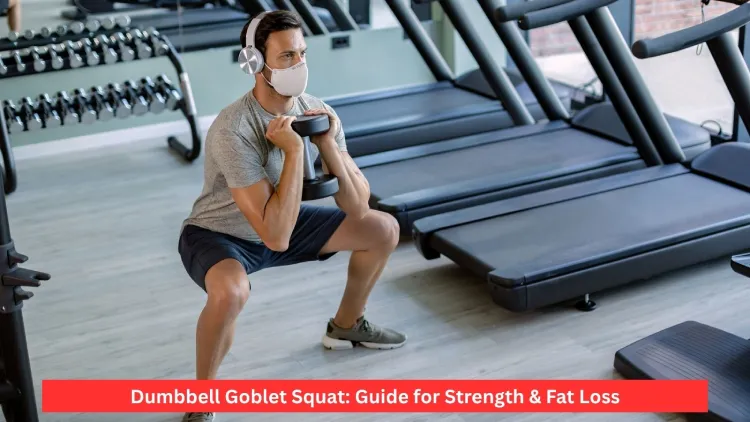

The Dumbbell goblet squat is a simple yet effective lower-body exercise that builds strength, increases mobility, and helps improve squat technique. Holding a dumbbell at chest height keeps the body upright and simultaneously works the thighs, hips, hamstrings, and abdominals, reducing stress on the lower back. Suitable for both beginners and more experienced athletes, it’s a versatile movement for burning fat, building strength, and improving overall fitness.
- What is the goblet squat?
- Muscles Worked in the Goblet Squat
- How to Perform Dumbbell Squats Correctly (Step by Step)
- Benefits of Dumbbell Squats
- Dumbbell Squat Variations
- Common Mistakes to Avoid
- Training Tips for Best Results
- Dumbbell Goblet Squat for Weight Loss & Knee Health
- Goblet Squat vs Other Squat Variations
- Who should do dumbbell squats (goblet squats)
- Safety, Injuries, and Considerations
- Importance of Exercise Science and Fitness
- What most hinders muscle growth?
- Number One Fitness Habit for Longevity
- Conclusion
- Frequently Asked Questions
What is the goblet squat?
The goblet squat is a compound lower-body exercise in which you perform a full squat movement while holding a dumbbell close to your chest. Having the weight in front of your body keeps your torso upright, improving posture and squat mechanics.
Simply put, the goblet squat is a controlled squat pattern that teaches proper alignment, balance, and depth without requiring heavy equipment. Many instructors use the goblet squat as a training method before moving on to the barbell squat.
Key Features of the Goblet Squat
- The weight is held at chest height (“goblet position”).
- It promotes proper spinal alignment.
- It increases hip and ankle mobility.
- Suitable for both beginners and advanced athletes.
Proper execution of the goblet squat ensures proper knee motion and keeps the abdominal muscles engaged throughout the movement.
Muscles Worked in the Goblet Squat
The goblet squat is a compound exercise that engages the entire lower body, activating several large and stabilizing muscle groups.
Core Muscles
- Quadriceps (front of the thigh)
- Gluteus maximus (hip strength)
- Hamstrings (posterior chain)
Secondary Muscles
- Abdominal Muscles (abs and obliques)
- Lower back stabilizer muscles
- Calf muscles for balance
This makes the Goblet Squat extremely effective for lower-body development.
Why is it so effective?
Because the weight is loaded forward, the abdominal muscles must constantly stabilize the spine. Therefore, many trainers consider it one of the most functional squat variations available.

How to Perform Dumbbell Squats Correctly (Step by Step)
Performing dumbbell squats correctly is essential for safety and results.
Step 1: Starting Position
- Stand with your feet shoulder-width apart
- Hold a dumbbell vertically at chest height
- Bend your elbows toward your knees
- Keep your chest out
This is the basic position for dumbbell squats.
Step 2: Lowering
- Slightly push your hips back
- Bend your knees and slowly lower yourself
- Place your heels on the ground
- Keep your torso upright
This ensures proper execution of dumbbell squats.
Step 3: Lower Position
- Achieve at least parallel to the floor
- Maintain a neutral spine
- Avoid bending your knees inward
This is the deepest position for dumbbell squats.
Step 4: Ascent Phase
- Push up with your heels
- Activate your hip and thigh muscles
- Return to a standing position
Repeat with a controlled rhythm.
Important Tip
Imagine sitting between your legs, not on your knees.
Benefits of Dumbbell Squats
Dumbbell squats are an important lower-body exercise suitable for all fitness levels and offer benefits in terms of strength, mobility, and balance.
1. Improves Squat Mechanics
The front-loaded position promotes an upright posture, helping improve squat depth and control, and reducing common errors.
2. Increases Functional Strength
Dumbbell squats improve overall mobility by strengthening the muscles used in everyday activities such as walking, lifting, and climbing.
3. Improves Knee Stability
When performed with proper control, they strengthen the muscles around the knee, improving balance and joint support.
4. Promotes joint health
Proper execution of the dumbbell cup squat helps reduce stiffness and improve movement quality, increasing the mobility of the hips, knees, and ankles.
5. Suitable for beginners
The beginner version of the dumbbell cup squat is easier to learn than the barbell squat, making it ideal for those new to training and wanting to build strength safely.
6. Promotes fat burning
It increases calorie expenditure because it simultaneously engages several large muscle groups and, when combined with proper training, promotes weight loss.
7. Strengthens abdominal muscles
Holding the dumbbell at chest height keeps the abdominal muscles engaged throughout the movement, improving balance and posture.
Dumbbell Squat Variations
Different variations help you achieve specific goals and increase your progress.
- 1. Light Dumbbell Squat: Performing light dumbbell squats improves technique, mobility, and endurance.
- 2. Heavy Dumbbell Goblet Squat: The heavy dumbbell goblet squat focuses on strength and hypertrophy.
- 3. Heels-Up Goblet Squat: The heels-up goblet squat improves knee depth and range of motion, especially for those with limited ankle mobility.
- 4. Lateral Goblet Squat: The dumbbell lateral goblet squat improves lateral strength and athletic movement.
- 5. Slow-Paced Goblet Squat: The slow movement increases the time spent under tension for muscle growth.
- 6. Pause Squat Variation: Holding the bottom position develops explosive power and control.

Common Mistakes to Avoid
Although dumbbell squats (goblet squats) seem simple, improper technique can reduce results and increase the risk of injury. Paying attention to proper form is essential for strength, balance, and safe progression.
1. Leaning Forward
A common mistake when performing dumbbell squats is leaning too far forward. This reduces leg activation and increases pressure on the lower back. Keeping your torso upright helps maintain proper alignment and improve muscle activation.
2. Lifting Your Heels
If your heels lift off the ground during a dumbbell squat, it usually means the weight is shifting forward. This helps improve balance and encourages better squat depth. Keeping your entire foot on the ground improves balance and control.
3. Knees Inward
During the movement, your knees should be aligned with your toes. Inward sagging is often caused by weak hip muscles or poor control and can reduce joint stability if repeated.
4. Holding the weight too low
For proper dumbbell squat execution, the dumbbell should be held close to chest level. Keeping it in the right position improves abdominal activation and helps maintain better posture control.
5. Insufficient depth control
Not going deep enough limits muscle activation, especially in the hip and thigh muscles. A full, controlled range of motion is important for the best results and strength development.
6. Performing the movement too quickly
Performing repetitions too quickly reduces muscle tension. A slower, more controlled pace improves balance, stability, and overall effectiveness of the exercise.
Training Tips for Best Results
Follow these training principles to maximize proper dumbbell squat form:
- Start with light weights before increasing the weight
- Focus on a controlled pace
- Keep your elbows tucked inside your knees
- Maintain proper posture and keep your chest up
- Train 2-3 times a week
Progression Strategy
Start with a squat with light dumbbells, then gradually increase the weight.
Dumbbell Goblet Squat for Weight Loss & Knee Health
Dumbbell squats are commonly used in weight loss programs and rehabilitation.
For Weight Loss
- They Engage Large Muscle Groups
- They Increase Heart Rate
- They Burn Calories Efficiently
For Knee Pain
Many people ask if squats are helpful for knee pain. When performed correctly, dumbbell squats strengthen the quadriceps and improve knee mobility, reducing discomfort.
However, improper technique can worsen pain, so controlled movement is essential.
Adaptations for Knee Problems
Those with knee problems can:
- Reduce the starting depth
- Use lighter weights
- Perform a variation with the heels raised
Squats for Seniors
A 70-year-old can perform squats if approved by a doctor and using light resistance. Squats improve balance, bone density, and mobility, but depth and load must be carefully controlled.

Goblet Squat vs Other Squat Variations
Understanding the differences helps you choose the right exercise.
Goblet Squat or Dumbbell Squat
- Goblet Squat: Weight on the Chest
- Dumbbell Squat: Weight on the Hips
Goblet squats improve posture more effectively.
Dumbbell Front Squat or Goblet Squat
Front squats are more advanced and use a barbell or two dumbbells. Goblet squats are better for learning proper mechanics.
Goblet Squat or Dumbbell Sumo Squat
Sumo squats work the inner thighs more, while goblet squats focus on balanced development of the entire leg.
Which is better?
For beginners, goblet squats are often the best starting point due to their balance and controlled form.
Who should do dumbbell squats (goblet squats)
The dumbbell squat (goblet squat) is an extremely versatile exercise that can be adapted to almost any fitness level, from complete beginners to advanced athletes. Because it’s easily scalable in terms of weight, depth, and tempo, it fits well with many different training goals, including strength, fat burning, mobility, and rehabilitation.
Beginners learning squat mechanics
The basic version of the dumbbell squat is one of the best starting points for those new to weight training. It teaches proper squat depth, posture, and balance without the complexity of a barbell load. This helps build a solid foundation before moving on to more advanced lifts.
Strength-building athletes
Athletes use dumbbell squats (goblet squats) to improve lower-body strength, stability, and movement control. It helps develop explosive power and coordination, which translates into athletic performance such as running, jumping, and changes of direction.
Improve mobility in older adults
For older adults, the dumbbell and cup squat exercise can improve balance, leg strength, and joint mobility.
When performed with light weights and a controlled depth, it promotes independence in daily activities such as sitting, standing, and walking.
People with posture or movement problems
People with poor posture or limited mobility can benefit from the upright position promoted by the proper execution of the dumbbell and cup squat. Over time, it helps improve spinal alignment and hip and ankle flexibility.
Fat-burning workout programs
Because it engages several large muscle groups, the dumbbell and cup squat is often included in fat-burning workouts. It increases calorie expenditure and heart rate, making it an effective full-body conditioning workout.
Rehabilitation and Controlled Recovery
In some rehabilitation settings, proper cup squat form is used to rebuild strength and restore movement patterns. However, if used for rehabilitation purposes, it should always be performed under the supervision of a professional.
People with Scoliosis (Situations Requiring Caution)
People with scoliosis can sometimes perform controlled squats to increase strength and balance, but the appropriateness of proper cup squat form depends on the severity of the condition. It is always advisable to consult a doctor before including it in a training program.

Safety, Injuries, and Considerations
Dumbbell and cup squats are generally safe, but improper technique or excessive weight can cause problems. Good control and proper technique are important to prevent strains.
Most Common Squat Injuries
When incorrect technique is used in dumbbell and cup squats, the following may occur:
- Knee strains due to misalignment
- Lower back pain due to a forward-leaning posture
- Hip stiffness due to limited mobility
Considerations for Spinal Problems
Be alert if you notice the following symptoms during dumbbell and cup squats:
- Unbalanced shoulders
- Visible spinal imbalance
- Pain during movement
Fundamental Safety Rule
If you experience pain, reduce the weight, correct your technique, or discontinue the exercise.
Importance of Exercise Science and Fitness
The cup squat is often included in discussions of the “king of exercises” because it simultaneously engages multiple systems: strength, balance, mobility, and coordination.
It is also an integral part of many core training systems and is sometimes included in lists of “super exercises” like squats, deadlifts, push-ups, pull-ups, and planks.
What makes it effective?
- It engages the entire body.
- It’s gentle on the joints
- Adjustable difficulty level
- It’s a high-calorie burn
What most hinders muscle growth?
Progress in dumbbell squats can slow if you neglect basic training habits.
- 1. Adequate sleep: improves recovery and enhances strength performance.
- 2. Consistent training: supports steady and continuous muscle growth.
- 3. Correct technique: improves muscle activation and helps reduce the risk of injury.
- 4. Proper rest: enhances recovery, reduces fatigue, and improves overall performance.
- 5. Gradually: increasing weight supports continuous strength gains and better progress.
Number One Fitness Habit for Longevity
Consistent strength training with movements like the dumbbell goblet squat is one of the best habits for long-term health.
- Bone Health: Helps strengthen bones and maintain density.
- Muscle Retention: Supports muscle mass and prevents age-related loss.
- Better Balance: Improves stability and reduces fall risk.
- Metabolism: Keeps metabolism active and supports overall health.

Conclusion
The dumbbell goblet squat is one of the most effective, safe, and versatile lower-body exercises available today. It improves strength, posture, mobility, and overall fitness while being accessible to beginners and advanced lifters alike.
From fat loss to knee stability and athletic performance, the goblet squat dumbbell exercise provides complete lower-body development when performed with proper technique.
Whether you are training at home or in the gym, mastering the goblet squat with a dumbbell is a long-term investment in strength, movement quality, and injury prevention.
Frequently Asked Questions
1. Are dumbbell goblet squats effective?
Yes, the dumbbell goblet squat is very effective for building strength, improving mobility, and learning proper squat form.
2. How heavy should a goblet squat be?
Start light and focus on control. Increase weight gradually while maintaining good goblet squat dumbbell form.
3. Can goblet squats help with knee pain?
Yes, if done correctly. Proper goblet squat with dumbbell form can support knee stability, but poor form may cause discomfort.
4. What is the correct form?
Hold the dumbbell at chest level, keep your chest up, squat down with control, and push through your heels while keeping your knees aligned.

2 thoughts on “Dumbbell Goblet Squat: Guide for Strength & Fat Loss”
Your writing is so inspiring and motivating I always leave your blog feeling more determined and resilient
Thank you so much! We’re glad our content inspires and motivates you. Your kind words mean a lot to us!