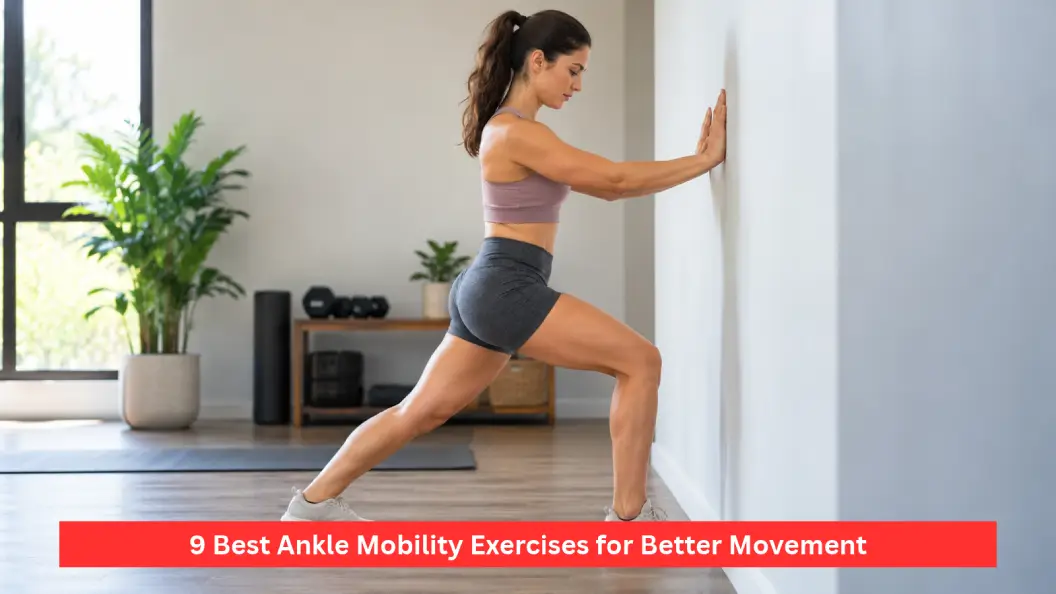

Ankle mobility exercises are designed to enhance flexibility, movement, strength, and stability of the ankle joints. Exercises such as ankle circles, knee-to-wall, calf stretches, and heel raises can help loosen the joint and support daily activities. Most take a few minutes, require no special equipment, and can be done at home.
- What Is Ankle Mobility?
- Why is Ankle Mobility Important?
- 9 Best Ankle Mobility Exercises
- Which Ankle Exercises Should You Choose?
- How to Check Your Ankle Mobility
- Common Ankle Mobility Mistakes
- Simple 5-Minute Ankle Mobility Routine
- Who should avoid or adapt ankle mobility movements?
- Conclusion
- Frequently Asked Questions
What Is Ankle Mobility?
Ankle mobility refers to the range of motion and ease of movement of your ankle in various directions.
Your ankles are active on every step, in the step up and down, when you squat, and when you turn. They depend on the cooperation of the joints, muscles, tendons, and ligaments.
There are four important movements:
- Dorsiflexion: Lifting your foot towards your shin.
- Plantarflexion: Pointing your toes down as in standing on tiptoes.
- Inversion: Rotating the sole inwards.
- Eversion: Rotation of the sole outwards.
Mobility is more than just how far they can stretch. Muscular strength and control are also important to make use of the available movement.
This is why there is a need to have a well-rounded routine that includes range of motion exercises, stretching, strengthening, and balance exercises.
Why is Ankle Mobility Important?
Your ankles affect your feet and legs’ mechanics when moving daily.
If dorsiflexion of the ankle is limited, it may be more difficult to keep heels on the floor when squatting. It could also be difficult to walk downhill or down stairs.
Ankle motion has an impact on foot strike and offset in runners and athletes.
But simply improving ankle mobility is not a surefire way of achieving better athletic performance or a reduction of injuries. There is also a requirement for strength, coordination, training, and personal physiology.
You can develop some of these attributes using a balanced routine, without straining any of your joints into awkward positions.
9 Best Ankle Mobility Exercises
Start with movements that feel easy to control. You can gradually add more challenging exercises as your comfort and coordination improve.
1. Ankle Circles
One of the easiest exercises for learning to move in multiple directions is ankle circles.
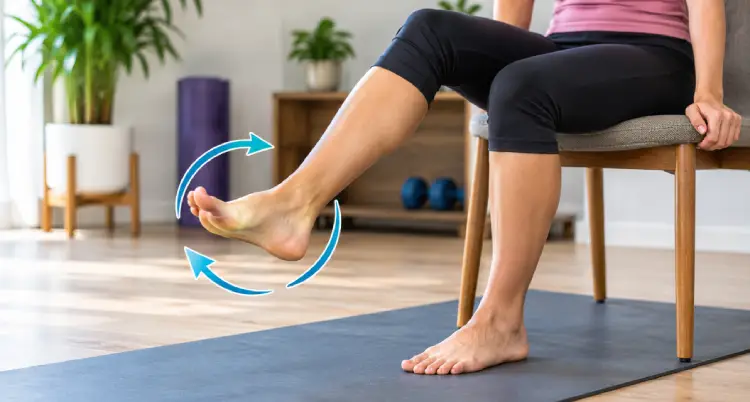
How to do it:
- Sit on a chair comfortably, feet relaxed.
- Raise one foot off the ground.
- Gently turn foot on foot so ankle rolls clockwise.
- Complete 10 controlled circles.
- Go in the other direction for 10 more circles.
- Repeat with the opposite ankle.
- Avoid turning your whole leg; instead, try to move your foot.
Tips for the beginner: If larger movements don’t feel comfortable, make smaller circles.
Best used for: Gentle warm-ups and ankle ROM.
2. Ankle Alphabet
Ankle alphabet promotes controlled movement without the need for other equipment.
How to do it:
Sit on a chair or lie down comfortably with 1 leg raised.
- Raise foot slightly.
- If your big toe were a pencil, what color would it be?
- Trace the letters A-Z in the air slowly.
- Your lower leg should remain fairly stationary.
- Repeat with the other foot.
Typing large letters isn’t necessary. Minimal smooth motions are adequate.
If it’s becoming tedious to learn the entire alphabet, start with a couple of letters.
Ideal for: Newcomers trying out various directions of working with the ankle.
3. Knee-to-Wall Ankle Mobilization
The knee-to-wall exercise focuses on ankle dorsiflexion, the movement that brings your shin forward over your foot.
How to do it:
- Face a wall and place one foot a short distance away.
- Keep your entire foot flat on the ground.
- Slowly bend your front knee toward the wall.
- Allow the knee to travel in the same general direction as your toes.
- Keep your heel grounded throughout the movement.
- Return to the starting position and repeat 8–10 times.
If your heel rises, move your foot closer to the wall.
You should feel controlled ankle movement rather than sharp pinching at the front of the joint.
Best for: Practicing dorsiflexion used during squats and stair movements.
4. Standing Calf Stretch
Your calf muscles can influence how comfortably your ankle moves upward.
The straight-knee calf stretch primarily emphasizes the gastrocnemius muscle.
How to do it:
- Stand facing a wall with both hands resting against it.
- Step one leg backward.
- Keep your back knee straight and your heel on the floor.
- Bend your front knee slightly.
- Gently move your body forward until you feel a stretch in your back calf.
- Hold for 20–30 seconds before switching legs.
Avoid bouncing or pushing through discomfort.
Beginner tip: Shorten your stance if keeping the rear heel down feels difficult.
Best for: General calf flexibility.
5. Bent-Knee Calf Stretch
The bent-knee variation places greater emphasis on the soleus, a deeper calf muscle.
How to do it:
- Stand near a wall for support.
- Move one foot slightly behind the other.
- Keep both heels on the floor.
- Slowly bend both knees.
- Shift your body forward until you feel gentle tension in the lower calf of your back leg.
- Hold for approximately 20–30 seconds, then switch sides.
Don’t allow your rear heel to rise as you move forward.
Best for: Complementing straight-knee calf stretching and exploring ankle dorsiflexion.
6. Seated Ankle Dorsiflexion and Plantarflexion
This gentle exercise helps you practice moving your ankle upward and downward.
How to do it:
- Sit upright on a chair.
- Extend one leg comfortably or lift your foot slightly.
- Pull your toes upward toward your shin.
- Pause briefly.
- Slowly point your toes away from you.
- Repeat 10–15 times before changing feet.
Keep the movement smooth rather than forcing either end position.
Beginner tip: Reduce the range if your ankle feels stiff.
Best for: Everyday ankle movement and low-impact mobility practice.
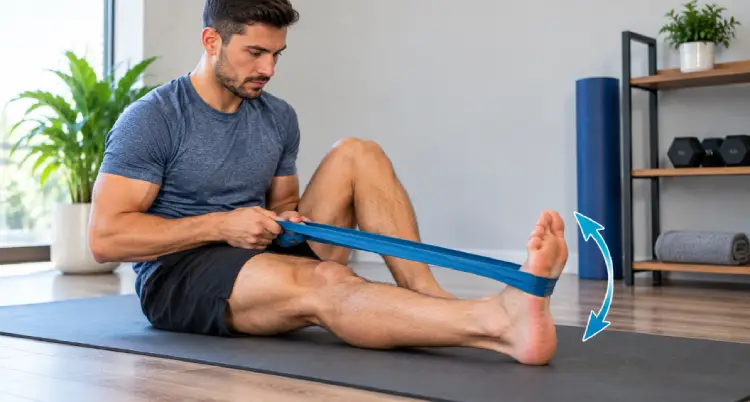
7. Resistance Band Ankle Exercises
Resistance bands add light muscular work to familiar ankle movements.
How to do it:
- Sit on the floor with one leg comfortably extended.
- Loop a light resistance band around the ball of your foot.
- Hold both ends securely.
- Slowly point your toes forward against the band’s resistance.
- Return to the starting position with control.
- Complete 8–12 comfortable repetitions.
For resisted dorsiflexion, use an appropriately secured low anchor and pull the foot toward your shin against light resistance.
Check that the band and anchor are secure before starting.
Best for: Building strength that supports controlled ankle movement.
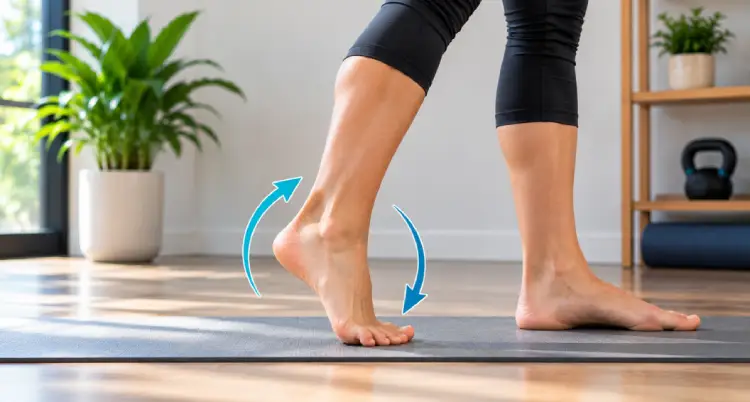
8. Standing Heel Raises
Heel raises improve strength and control of the calf muscles while training them for plantarflexion.
How to do it:
- Stand up straight with your back to a wall or a stable chair.
- Position your feet about hip distance apart.
- Slowly lift both heels from the floor.
- Hold your balance for a short while on the balls of your feet.
- Slowly lower your heels down.
- Repeat 8–12 times.
- Try not to swing forwards or to rush through the reps.
Tip for beginners: If needed, use both hands to provide support.
Ideal for: Calf Strength and Ankle Control in Normal Activities.
9. Supported Single-Leg Balance
Balance exercises to test your ability to control your ankle when standing.
How to do it:
Stand next to a sturdy countertop or chair.
- Put your feet hip-width apart.
- Place one foot on the ground and stand on one leg.
- Slowly raise your opposite foot off the floor.
- Maintain a comfortable balance for 10-20 seconds.
- Alternate legs and repeat.
- Watch and use assistance as necessary.
Do not use unstable surfaces until you can move the basic movement comfortably.
For: Balance, coordination, and ankle stability.
Which Ankle Exercises Should You Choose?
Different exercises develop different qualities.
| Exercise | Main focus |
| Ankle circles | General range of motion |
| Ankle alphabet | Multidirectional movement |
| Knee-to-wall drill | Dorsiflexion |
| Standing calf stretch | Gastrocnemius flexibility |
| Bent-knee calf stretch | Soleus flexibility |
| Seated ankle flexion | Controlled ankle movement |
| Resistance band exercise | Muscular strength |
| Heel raises | Calf strength and control |
| Single-leg balance | Stability and coordination |
You don’t need all nine movements every day. Choose exercises that match your current needs and abilities.
How to Check Your Ankle Mobility
A simple knee-to-wall check can help you observe how your ankle moves.
Stand facing a wall with one foot positioned a short distance away.
Keeping your heel on the floor, bend your knee forward until it touches the wall.
If you can perform the movement comfortably, gradually move your foot farther back and try again.
Repeat on your other side.
Notice whether one ankle requires a noticeably shorter distance or whether your heel lifts earlier.
This gives you a way to compare your own movement, but it isn’t a medical diagnosis. Pain, previous injuries, and individual anatomy can affect the result.
Don’t force a painful position to achieve a particular measurement.
Common Ankle Mobility Mistakes
Small technique problems can make exercises less effective or more uncomfortable.
Lifting Your Heel During Knee-to-Wall Drills
If your heel rises, you’re no longer practicing the same grounded movement.
Fix: Move your foot closer to the wall and use a smaller range.
Letting Your Foot Roll Excessively Inward
Your foot may collapse inward as you move your knee forward.
Fix: Maintain comfortable contact through your heel and forefoot, keeping the knee moving generally toward the toes.
Moving Too Quickly
Rushing through exercises reduces your opportunity to control each movement.
Fix: Slow down and use smooth, deliberate repetitions.
Forcing a Painful Range
More movement isn’t always better.
Fix: Reduce the range or stop if you experience sharp pain, joint pinching, or unusual discomfort.
Skipping Strength and Balance
Stretching alone doesn’t develop every quality needed for ankle control.
Fix: Include appropriate strengthening and balance exercises in your wider routine.
Simple 5-Minute Ankle Mobility Routine
If you’re short on time, begin with this practical routine.
| Exercise | Time |
| Seated ankle circles, both directions | 45 seconds |
| Seated ankle flexion and pointing | 45 seconds |
| Knee-to-wall mobilizations, both ankles | 60 seconds |
| Standing calf stretches, both legs | 60 seconds |
| Supported heel raises | 30 seconds |
| Supported single-leg balance, both sides | 60 seconds |
The total is five minutes.
Move slowly and adjust the timing if you need additional rest.
This routine is intended for general mobility practice, not rehabilitation after an ankle injury.
Who should avoid or adapt ankle mobility movements?
Exercise caution and follow medical advice before starting exercises if you have a recent ankle injury such as a sprain, suspected fracture, severe swelling, significant instability, or recent surgery.
If sharp pain, swelling, numbness, or an ankle that feels like it might give out occurs during movement, stop.
An individual’s recovery from injuries may require a customized rehabilitation program, not a standard fitness program.
Conclusion
Ankle mobility exercises can be used to improve movement, flexibility, strength, and control.
Begin with some basic exercises like ankle rotations and knee-to-wall. Once you’re more comfortable, include calf stretching, heel raises, and balance exercises.
There’s no need to force progress. It’s better to practice within a controlled range and improve than to go for all-out range.
If you’re looking for easier stretches and mobility guidance, check out Stretchlee and create a stretching plan that works for you.
Frequently Asked Questions
1. What Are the Best Ankle Mobility Exercises for Beginners?
Some good starting exercises include ankle circles, knee-to-wall, and gentle calf stretches.
2. What can I do to increase ankle dorsiflexion?
Regularly perform knee-to-wall drills and calf stretches, but don’t force them if they cause pain.
3. Can Ankle Mobility Exercises Help With Squats?
Yes, they can help to increase the depth and the range of motion of the squat.
4. How much should I do Ankle Mobility exercises?
Begin with a few short sessions each week and increase or decrease as you feel comfortable with your progress.