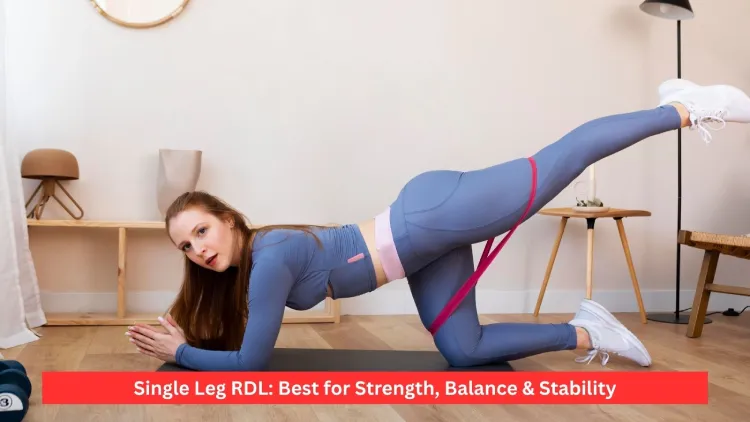

The Single Leg Roman Deadlift, or “Single Leg RDL,” is an efficient movement to strengthen your glutes, hamstrings, and stability. It works the posterior chain, improves balance and coordination, balances muscle development, and boosts sports performance. It might initially be awkward to perform, but with practice, the single leg RDL can be a potent exercise for building muscle, improving balance, and preventing injuries. From improving muscle definition and overall body composition to enhancing lower-body strength and athletic performance, the single-leg RDL can elevate your lower-body training.
- What is the Single Leg RDL?
- Muscles Worked in Single Leg RDL
- Single Leg RDL Form (Steps)
- Key Form Tips
- Benefits of Single Leg RDL
- Common Mistakes to Avoid
- Variations of Single Leg RDL
- How to Add Single Leg RDL to Your Workout
- Who Should Do Single Leg RDL?
- Progression Tips
- Additional Insights on Strength Training and RDL Variations
- Glute Development and Aesthetics
- Final Thoughts
- Frequently Asked Questions
What is the Single Leg RDL?
The single leg RDL is a single-leg hip-hinge move. The single-leg RDL is different from conventional deadlifts in that both of your feet will remain in contact with the ground. It’s a movement that requires you to balance, use your core, re and better control your body.
Simply put, the single leg RDL is more about movement control than brute strength. It is about achieving balance, coordination, and muscle activation, as well as strength. For this reason, the single-leg RDL is a staple exercise in sports training, rehabilitation, and functional fitness.
Performing the RDL in a single-leg position is like lifting something off the ground or standing on one foot when walking. As a result, the single-leg RDL is very functional.

Muscles Worked in Single Leg RDL
The single leg RDL mainly works the muscles of the posterior chain, which means “pulling muscles” and muscles around the hip. This group of muscles is crucial for strength, good posture, and performance.
Primary Muscles
- Hamstrings: These help control and brake the weight during the descent and extend the hips.
- Glutes: Powerful muscles that are fired during the upward phase.
Secondary Muscles
- Abdominal muscles: Keep your waist upright and from rotating: Keep your waist upright and from rotating
- Lower back: Keeps you upright
- Ankles and calves: Help maintain balance
Another key benefit of the single leg RDL is that it draws out weak spots. It will leave you with a burning sensation on the weaker side of your body. This promotes better balance and symmetry in the long run.
This exercise is also great for developing glutes. A standard question always asked is, “Do RDL variations build glutes?” and the answer is, yes – if they are done right. The single-leg RDL will help time under tension and muscle contraction, both of which lead to muscle growth.
Single Leg RDL Form (Steps)
The single leg RDL is a balance, control, and hip movement exercise. Slow down and take control of the movement.
1. Starting Position
Keep your feet shoulder-width apart. Distribute the weight of your body onto one foot and slightly lift the other foot. Be sure to stand tall and firm.
2. Engage Your Core
Engage your abs to maintain posture. It helps you keep your balance and protects the lower back during the single leg RDL.
3. Hinge at the Hips
Replace your hips and lean forward. At the same time, kick your free leg backwards. Move with slow, controlled movements.
4. Maintain Alignment
Make sure to keep your back upright and your body extended from head to toe. Be sure to keep your hips and spine in alignment.
5. Lower with Control
Go as low as possible while still getting your torso close to the ground, or until you establish a stretch in your hamstrings. Be careful you don’t go too far down.
6. Return to Standing
Press through the heel of your standing foot, contract your glutes,s and return to the starting position.
7. Repeat and Switch
Perform your reps on one leg and then switch and repeat. Make sure that the (a)nhd of the movement stays the same.
Key Form Tips
For best results when performing the single-leg RDL, use the following tips:
- Keep your hips facing down
- Slow down and don’t rush
- Keep a bend in your supporting knee
- Stand tall with chest and head up
- Keep the weight in the centre
The single-leg RDL can be challenging for beginners. This commonly occurs due to coordination and balance. But your balance will improve with time.

Benefits of Single Leg RDL
The single leg RDL is not only a great exercise for building strength, but also has many other benefits.
1. Improves Balance and Coordination
Standing on one leg allows your stabilizer muscles to become involved. This helps with balance and proprioception.
2. Strengthens Posterior Muscles
The single-leg RDL is great for posterior chain development. Posterior muscles improve posture, prevent injuries, and increase sports performance.
3. Enhances Glute Development
The single-leg RDL is a great exercise for glute muscle growth. It’s a great exercise to place stress on the glutes during the lifting portion.
4. Corrects Muscle Imbalances
Training with only one leg at a time promotes bilateral muscle development.
5. Improves Athletic Performance
With the single-leg version of the RDL, you can become more explosive and athletic as a result of the strengthened hip muscles and improved stability.
6. Supports Injury Prevention
The stabilizer muscles being stronger takes the stress off the joints, particularly the knees and hips.
Common Mistakes to Avoid
The single-leg RDL is a simple exercise to perform, but not everyone does it properly.
1. Rounding the Back
This decreases results and risks injury.
2. Losing Balance
For lack of balance, use support or limit the movement.
3. Using Momentum
Momentum takes away tension in the muscles when you swing your leg.
4. Twisting the Hips
Keep hips facing forward.
5. Holding Weight Incorrectly
Holding the weight on the wrong arm is less effective. For most exercises, holding the weight in the opposite hand will increase engagement and stability.
Correcting these errors will lead to better results.

Variations of Single Leg RDL
The single-leg RDL is a multivariate exercise that can be scaled to your skill, strength, and training objectives. You can adjust the weight/support to make the exercise simpler to perform or harder for strength and muscle development.
1. Single Leg RDL with body weight
This version is great for beginners, and it’s the most basic of the single-leg RDLs. It’s a great exercise to teach balance and the hip hinge pattern without using weights.
In this version, it’s all about control. You are using proper balance and weight shift, and you get a feel for the movement. It’s also useful as a warm-up or to improve coordination.
2. Dumbbell Single Leg RDL
Dumbbell RDLs are a popular variation. The dumbbell adds weight, and it stimulates greater muscle contraction in the glutes and hamstrings.
You can hold the dumbbell in either hand, but placing it in the same hand as your front foot may be more stable and allow for more core engagement. This variation is a popular exercise for both strength and muscle building.
3. Single Leg Kettlebell RDL
This version will feel different because of the kettlebell’s centre of mass. The lower and forward placed mass further challenges your balance.
This single-leg RDL is a great exercise for strengthening grip coordination and control. It also promotes fluid movement and balance, and is a common exercise in functional training.
4. Single Leg RDL with Barbell
This is a more advanced version of the single-leg RDL for advanced lifters. Using a barbell means that more weight can be used, thus improving strength in your posterior chain.
But it requires good balance and core control. Due to the weight used, it’s also important to be absolutely strict to prevent injury. This move is most often used after you have perfected the other variations.
5. Supported Single Leg RDL
The assisted RDL uses a wall, chair, or rack. This will help make the balance part of the exercise easier to manage so you can pay attention to movement patterns.
This is a great way to increase confidence in the single-leg RDL, particularly for novices or those recovering from balance concerns. And once you have this mastered, you can reduce the support and work towards being able to complete the movement alone.

How to Add Single Leg RDL to Your Workout
The single-leg RDL can be performed with different exercise routines.
- Strength training: 3-4 sets with 8-12 repetitions.
- Muscle building: Supersets with moderate weight
- Athletic training: With dynamic movements
- Warm-up: Can be done first
It may combine with squats, lunges, or hip thrusts.
It’s commonly pitted against the standard RDL or squats. Squats are gaining a reputation as the “king of exercises” because of the whole-body nature of the exercise, but the single-leg RDL is superior for balance and stability, and can be used for unilateral training.
Who Should Do Single Leg RDL?
The single-leg RDL can be done by:
- Beginners (with bodyweight)
- Athletes
- Fitness enthusiasts
- Those with mild injuries
This is difficult, but it becomes easier to perform.
Progression Tips
To progress the single-leg RDL:
- Increase weight gradually
- Slow down the movement
- Extend the range of motion
- Add pauses at the bottom
For a person weighing 70 kg, it is recommended to begin with a lighter weight (5-10 kg).
Additional Insights on Strength Training and RDL Variations
The single-leg RDL is compared to other lifts, such as the deadlift and stiff-leg deadlift. Each has its place in training.
- Deadlifts can lift heavier and build overall body strength
- RDLs emphasise glutes and hamstrings
- Unilateral RDL trains stability and balance
RDLs can be more difficult due to their demand for posture and control. But they’re far safer than stiff-leg deadlifts, as they place less stress on lower back muscles.
Glute Development and Aesthetics
For better glute aesthetics and to correct a “flat butt,” the single-leg RDL is an excellent exercise. When you pair it with other moves, such as hip thrusts and squats, you have a comprehensive glute routine.
Glute training not only looks good but also boosts performance and posture. Developed glutes help maintain spinal alignment and prevent injuries.

Final Thoughts
The single-leg RDL is not simply a lower-body exercise; it is a full-body exercise that develops strength, stability, and balance. It may be challenging initially, but with regular practice, you will see gains in muscle growth and balance. Whether you want to build muscle, improve sports performance,e or focus on your balance, the single-leg RDL is a great exercise to do. By maintaining correct form, building up to it slowly, and practising regularly, the single-leg RDL can help you achieve your goals.
Frequently Asked Questions
1. Is the single-leg RDL hard?
The single-leg RDL can be difficult if it’s a new move for you because it not only strengthens, but also balances, coordinates, and stabilizes. Typically, it’s balance or coordination. But the single-leg RDL can be made easier to learn by starting with your own weight and with support.
2. Is the single-leg RDL good for the muscles?
Yes, the single-leg RDL is great for muscle hypertrophy (size) in the glutes and hamstrings. With correct form and additional weight (such as dumbbells or kettlebells), it provides sufficient tension to build muscle.
3. What weight should I use for single-leg RDL?
It varies per person. Start with a lightweight enough to maintain perfect form and balance. You can build weight as you get stronger. The sense of the single-leg RDL is to bring focus to the movement.
4. Is single-leg RDL better than other lower-body exercises?
The single-leg RDL is not “the best,” but it is “the different”. It’s the best exercise for stability, muscle balance, and glute tone. It is more for stability and balance than bilateral exercises such as squats and the deadlift.