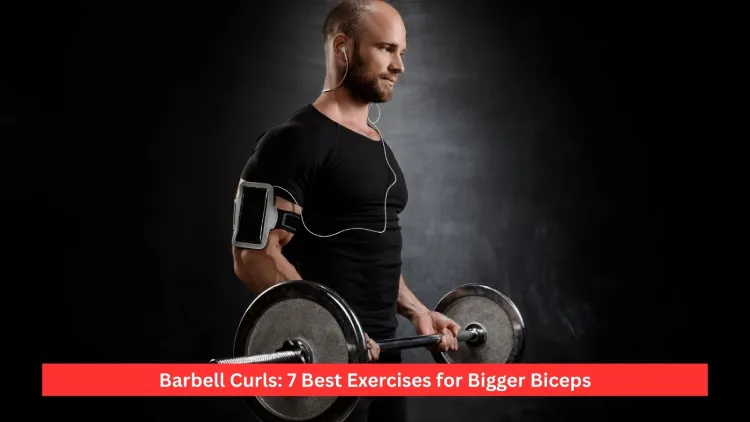

Barbell curls are one of the best exercises to build bigger and stronger biceps. This classic movement works the forearms, enhances arm size, strength, and definition. Simple yet effective, it boosts upper-body performance and is widely used in bodybuilding, athletic training, and general fitness, making it ideal for both beginners and experienced lifters.
- What Are Barbell Curls?
- The muscles involved during barbell curls include
- Benefits of Barbell Curls
- The Proper Technique of Barbell Curls
- Common Mistakes to Avoid
- The best Barbell curl variations
- The two are: Barbell Curls and Dumbbell Curls
- How to make barbell curls work better
- Sample Barbell Curl Workout Routine
- Strength Levels and Weight Expectations
- Shoulder or Biceps Problems: Training With this
- Who Should Do Barbell Curls?
- Conclusion
- Frequently Asked Questions
What Are Barbell Curls?
Barbell curls are a resistance-training exercise that improves the strength and develops the biceps muscles. The movement entails raising a barbell from the level of the thigh to the level of the shoulders with a close position of the elbows to the body. The contraction of the biceps controls the upward movement, and the muscles are also involved in the lowering stage through managed tension.
Since the barbell is attached to both hands, it enables the lifter to use a heavier weight as compared to most of the single arm exercises. Barbell curls are particularly effective when using progressive strength training and muscle growth.
Important facts concerning barbell curls
The major muscle involved Biceps brachii.
- The biceps muscle helps in the flexion of the elbow and also the rotation of the forearm. Barbell curls directly target the muscle group.
Involved secondary muscles: Forearms and shoulders.
- These muscles are useful in grip strength and stabilization as the movement takes place.
Equipment required: Barbell
- Either a straight barbell or an EZ curl bar can be used, depending on wrist comfort and position.
Barbell curls performed regularly can build up arm strength greatly, and one can develop the upper body.

The muscles involved during barbell curls include
Even though the biceps are the main muscles that are involved in the body when doing barbell curls, several assisting muscles are involved in the process. The knowledge of these muscles is useful in gaining the most from the exercise.
1. Biceps Brachii
- The primary muscle that is used in curling.
- Elbow flexion and forearm rotation are his responsibility.
As you raise the barbell, the biceps shorten and pull the weight upwards to the shoulders.
2. Brachialis
- This is underneath the biceps muscle.
- Helps a great deal in flexing the elbow.
This is a muscle that can be strengthened to build up fatter arms and general arm strength.
3. Brachioradialis
- A muscle in the forearm, which helps when lifting.
- Supports the wrist and elbow in the curls.
The muscle will be more active when lifting weights which are heavier.
4. Shoulder Stabilizers
- The front side of the shoulder contributes to the stabilization of the arm.
- The upper arm is supported in the same position during the exercise.
Even though shoulders are not the primary area of concern, it is assistive in balancing.
Benefits of Barbell Curls
Curls with a barbell have numerous benefits to individuals who wish to have firmer and more pronounced arms. The exercise is a major strength training exercise that has been used for decades.
1. Builds Bigger Biceps
- Permits more substantial resistance than several types of curls.
- The heaviness of the loads is an effective stimulus for muscle growth.
Regular practice using barbell curls would be very helpful in making the arms larger in due course.
2. Enhances the strength of the upper body.
- Makes muscles, which are involved in pulling, stronger.
- Favours such exercises as rows and pull-ups.
Bigger muscles enhance fitness in the gym and in everyday life.
3. Enhances Muscle Definition
- Attacks the biceps sculpture and arm.
- Makes the muscles more visible in case of low body fat.
Several bodybuilders use barbell curls to be able to build their arms.
4. Energy-Saving Strength-Training
- The two arms are engaged at the same time.
- Progressive overload can be readily increased.
This renders the exercise the best in long-term strength building.

The Proper Technique of Barbell Curls
This is because it is important to use proper form when performing barbell curls to gain maximum results and minimize the risk of injury. A lot of difference is in the right technique, even though the movement may appear simple.
Step-by-step instructions
Step 1: Standing erect with the barbell
- Grasp the bar in an underhand position and have your feet positioned shoulder wide.
Step 2: Have close elbows to the organism
- When performing the exercise, you have to keep your elbows close to your torso.
Step 3: Curl the bar upward
- The barbell should be drawn gradually to the chest with the help of biceps contraction.
Step 4: Squeeze at the top
- Rest a moment at the peak of the movement to get the muscles well tapped.
Step 5: Lower the bar slowly
- Hold the weight back to the initial position.
Additional technique tips
- Straussen’s back and pelvis.
- During the swinging of the bar, do not use momentum.
- emphasis is made on controlled movements rather than speed.
Fast repetitions usually yield less muscle activity compared to slow and gradual repetitions.
Common Mistakes to Avoid
Although a person can perform barbell curls, they are a simple exercise that is done incorrectly by most individuals. These are some of the errors that should be avoided to achieve better outcomes and avoid injuries.
1. Using Excessive Weight
- Poor form is a result of too much weight.
- The body then begins to swing upwards to raise the bar.
Begin with low resistance that can be changed progressively to higher resistance.
2. Swinging the Upper Body
- Momentum decreases the action of the biceps.
- It creates tension in the lower back.
Stay still with your torso during the exercise.
3. Moving the Elbows Forward
- This changes the attention from the biceps to the shoulders.
- It reduces the activation of muscles.
Keep the elbow in an eligible position.
4. Repetitions which are too rapid.
- Rapid repetitions lower the tension of the muscles.
- Slow tempo enhances engagement of the muscles.
The restriction of the movement aids in the generation of additional muscle development.
The best Barbell curl variations
Your training routine can be enhanced by incorporating new variations to it, which may help you build your muscles and avoid plateauing in training.
1. EZ Bar Curl
- Uses a curved bar, which minimizes strain on the wrist.
- Easier to use for individuals with joint pain.
Novices normally use this variation.
2. Close-Grip Barbell Curl
- Hands brought closer to each other.
- Stresses the external section of the biceps.
This aids in improving the optimal performance of the arms.
3. Wide-Grip Barbell Curl
- Hands are further apart than the shoulder.
- Stripes in the depth of the biceps.
It helps in the development of thicker arms.
4. Drag Curl
- The bar is moved upwards and kept close to the torso.
- More attention is paid to the long head of the biceps.
Such variation is in arm workouts in many advanced lifters.
The two are: Barbell Curls and Dumbbell Curls
The two exercises are both very good for arm training, though they have some slight differences in advantages.
Barbell curls
- permit increased weight to be lifted.
- The arms are combined to develop strength.
They are perfect to develop the general arm strength.
Dumbbell curls
- The arms are independent of each other.
- Assists in eliminating strength imbalances.
They also offer a greater scope of movement.
Choosing the best option
The combination of both exercises is normally the most effective. The barbell curls develop strength, whereas dumbbell curls enhance balance and muscle symmetry.

How to make barbell curls work better
To optimize the performance of barbell curls, a systematic approach should be observed, and consistency should be emphasized on training.
Learn to concentrate on mind muscle connection.
- Focus on flexing the biceps with every repetition.
- Do not hurry up with your sets.
This enhances muscle contraction and development.
Use progressive overload
- Very slowly put on more weight.
- Increase repetitions or sets with improvement of strength.
Among the most crucial variables of muscle growth is progressive overload.
Train with proper volume
- Most lifters will be able to work out on three sets per exercise.
- According to the principle, doing the same muscle in too many exercises can decrease recovery.
Training provides muscles with a chance to develop effectively.
Maintain proper recovery
- During rest intervals, muscles increase in size.
- One will need sufficient sleep and nutrition.
The development of the muscle is also helped by protein consumption and adequate hydration.
Sample Barbell Curl Workout Routine
Barbell curls can be incorporated into your arm training program very easily with the help of a simple routine.
Beginner routine
- Barbell curls -3 sets of 10-12repetitions.
- Hammer curls: 3 sets of 10 reps.
- Concentration curls: 3 sets of 12 reps.
This weighted exercise is aimed at working the biceps in various directions.
Intermediate routine
- Barbell curls- 4 sets of 8-10 reps.
- EZ bar curls -3 sets of 10 reps.
- Incline dumbbell curls -3 sets-12 reps.
Progressive overloading of the muscles aids in muscle growth.
The common question is whether it will make them gain muscle more quickly by doing an enormous amount of curls on a daily basis. In practice, to maximize muscle growth, the volume of training and the rest interval should be matched. Doing hundreds of repetitions a day and not taking breaks can help delay, rather than accelerate, the progress.
Strength Levels and Weight Expectations
The comparison of the strength of the curl with others often determines the progress made by people. The levels of strength, however, differ depending on the body weight, the training experience and genetics.
Even 1015 kilograms of curling can prove to be a challenge to beginners. Intermediate weight lifters tend to use weights of not less than 20 kilograms and up to 30-40 kilograms respectively with good form.
One should not aim at raising very heavy weight at once. Rather, work on the gradual progress and proper style. The progressive development of strength results in safer and more regular muscle development.
Although strong arms are impressive, high lifting figures observed in professional strength sports are unlikely. In the case of an instance, it is not easy to give the example of elite athletes who are powerlifters because they can deadlift more than 500 kilograms, but this can be achieved in the course of many years of special training and the exceptional genetics of the elite athlete.
Shoulder or Biceps Problems: Training With this
Individuals who have suffered an injury to the shoulder or the arm must be cautious when doing arm exercises. The issues with rotator cuffs or biceps can necessitate adjustments or temporary rest.
Shoulder pain: When a person experiences pain in the shoulder, he or she should have lighter resistance and controlled movements, which can be reduced. Some activities, which involve too much rotating of the shoulder or heavy lifting activities that involve lifting heavy things above the head, might impose extra strain on the rotator cuff.
Serious injuries include torn muscles or serious inflammation, in which case it is advisable to seek the professional advice of a medical professional before proceeding with the weight training. Before going back to normal exercises, rehabilitation exercises that reinforce the shoulder stabilizers are often applied.
The correct form in the barbell curls will ensure that the extra strain on the shoulders and joints is avoided.
Who Should Do Barbell Curls?
Barbell curls would work well with a great number of people who desire to have strong arms.
Beginners
- Basic strength exercise, which is simple to learn.
- Enhances the strength of the arms.
Bodybuilders
- Crucial in enhancing the size and definition of the arms.
- aids in developing the traditional biceps crest.
Athletes
- Makes pulling strength and endurance of grip better.
- Performs well in sports that demand strength of the upper body.
Barbell curls are versatile and thus applied in numerous training programs.
Conclusion
Barbell curls are still one of the best exercises that can help in increasing bigger and stronger biceps. They are also significant in muscle building and strength training as they are focused on the major arm muscles and offer the possibility of increasing resistance gradually.
Curls using the barbell may enhance the size of arms, strength, and general fitness when done with the right form and with balanced training. Know how to avoid the general mistakes, exercise and learn to work steadily instead of overworking the body with large amounts of weight in a short period of time.
No matter how much you want to gain muscle mass, develop stronger, or improve athletic performance, barbell curls can be in your workout program as a way of gaining a more defined and stronger arm with time.
Frequently Asked Questions
1. What are the uses of the barbell curls?
Barbell curls are also good for developing bigger and stronger biceps. They make the arms stronger, muscles are better defined and pulling exercises such as rows and pull-ups are supported, besides improving the overall upper-body performance.
2. What are the proper ways of doing barbell curls?
Stand straight, pick up the barbell, and use an underhand grip; the elbows should be moved close to the body, and the bar should be curled towards the chest. Reduce the weight in a gradual and controlled manner to ensure that the twins are under tension.
3. Is it better to use barbell curls more than dumbbell curls?
Barbell curls enable greater weight lift and building up of overall arm strength, and the dumbbell curls are those that enhance balance and the amount of motion. A combination of the two exercises offers enhanced biceps workouts and balance.
4. What is the number of sets of barbell curls?
The 3-4 sets of barbell curls with 8-12 reps are beneficial in most cases for lifters. The training range assists in muscle growth stimulation, muscle strength enhancement, and the accomplishment of proper rest between exercises.