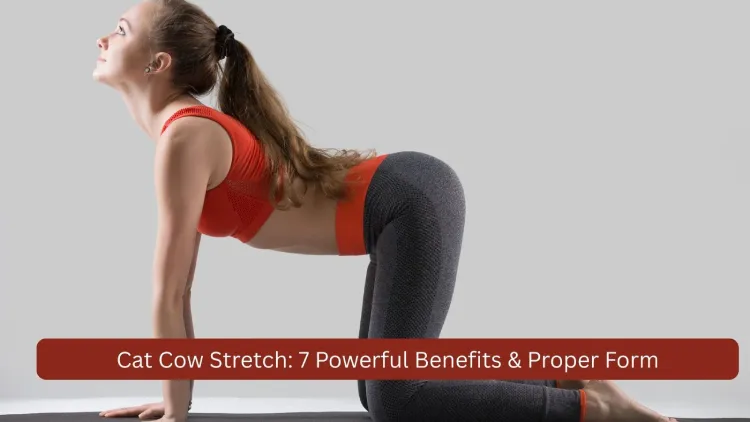

One of the best yoga poses for increasing spinal mobility, reducing stiffness, and supporting overall back health is the cat-cow pose. It is a combination of two soft poses, Cat and Cow, practised in a slow, rhythmic movement to warm up the spine and improve posture.
- What Is the Cat Cow Stretch?
- Worked Muscles in Cat Cow Stretch
- The Cat Cow Stretch has several benefits
- The Cat Cow Stretch (Step-by-Step) How to Do It
- Common Mistakes to Avoid
- Cat Cow Stretch Variations
- Who Does the Cat Cow Stretch?
- Cat Cow Stretch for Back Pain
- Most Ideal Time to do Cat Cow Stretch
- Conclusion
- Frequently Asked Questions
What Is the Cat Cow Stretch?
The cat-cow pose is a fundamental yoga pose that alternates between two postures: Cat Pose and Cow Pose. These postures put the spine under two normal movements- flexion and extension, which are useful in keeping the vertebral column flexible and mobile.
According to the yoga traditions, Cat Pose is Marjaryasana, and Cow Pose is Bitilasana. When performed in unison, they form a smooth, flowing movement that energises the spine and engages the core muscles.
The cat-cow stretch is typically performed first in yoga classes because it helps the body warm up for more advanced stretches and movements. It warms the back muscles, enhances breathing/movement coordination, and promotes proper back posture.
Another factor that has made the cat-cow stretch very common to practice is its simplicity. It requires neither greateribility, strength, or equipment, making it appropriate for both beginner and experienced yoga practitioners.
The movement is also known as the Cat-Cow yoga flow, and in fitness programs, it is commonly incorporated into warm-ups, rehabilitation, and mobility exercises.
Worked Muscles in Cat Cow Stretch
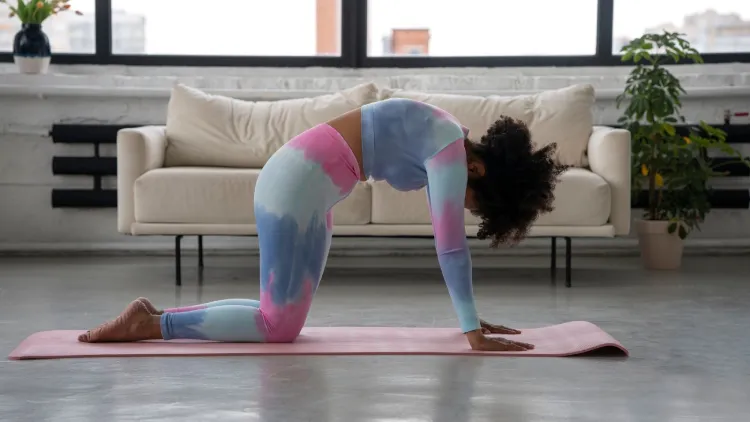
The cat cow pose is a gentle exercise that stretches and activates key muscle groups that support the spine and core.
Primary Muscles
- Spinal erectors: These are the muscles that run along the spine, and they are the ones that hold the posture. They are also activated by the cat-cow stretch, which moves the spine through controlled flexion and extension.
- Abdominal muscles: The stomach muscles stabilize the torso and the lower back. In the isometric phase of the movement, the core contracts and tightens.
- Hip flexors: The hip flexors help in the movement of the pelvis, which is necessary for spinal mobility.
Secondary Muscles
- Neck muscles: The motion of the spine is continued by the neck, enhancing movement and decreasing rigidity.
- Shoulders and upper back: The shoulders hold the upper body, and the arms hold the body weight.
- Glutes: The glute muscles assist and hold the pelvis and ensure that it is in the right position during the movement.
Since the cat cow pose engages these muscles simultaneously, it provides balanced spinal support and improves posture.
The Cat Cow Stretch has several benefits
Cat cow offers many physical and functional benefits that can be practised regularly.
1. Enhances Flexibility of the Spinal Cord
The spine moves in two opposite directions during the cat cow break. Such stringent flexion and extension will support healthy spinal discs and enhance flexibility over time.
A flexible spine will enable better movement and reduce the risk of stiffness from prolonged sitting.
2. Supports Lower Back Health
The cat cow stretch is often performed by many people to relieve mild lower back pain. Light spinal movement can enhance blood flow to the vertebrae and muscles, which may help reduce tension.
Although it may not cure severe ailments, the stretch is commonly used in physical therapy courses to help relieve mild back stiffness.
3. Treatment of Sciatic Nerve Irritation
The pain in the sciatic nerve may appear when the sciatic nerve is put under pressure in the lower spine. Light stretching activities, such as the cat-cow pose, can help reduce stiffness in the lower back and hips.
Severe sciatica, however, requires a medical evaluation, and certain exercises should not be performed, as they can worsen symptoms.
4. Enhances Posture
Weak core muscles and a rigid spine are the common causes of poor posture. The cat cow pose strengthens the muscles that support proper alignment.
In the long run, body movement can promote a more upright posture through practice.
5. Promotes Healthy Breathing
Prying is accompanied by movement when doing a cat cow stretch. Breathing in with a back bend and out with a rounded posture helps expand the lungs and improve awareness of breathing.
6. Helps to relax the Nervous System
Slow, rhythmic breathing can help slow the nervous system and reduce stress. This is why the cat cow stretch can be an appropriate supplement to morning or evening yoga sessions.
7. Enhances the General Spinal Health
Spinal mobility is essential for long-term health. Frequent movement helps keep the discs healthy and prevents degeneration.
The Cat Cow Stretch (Step-by-Step) How to Do It
Doing the cat cow stretch properly will ensure the greatest benefit and minimise the risk of strain.
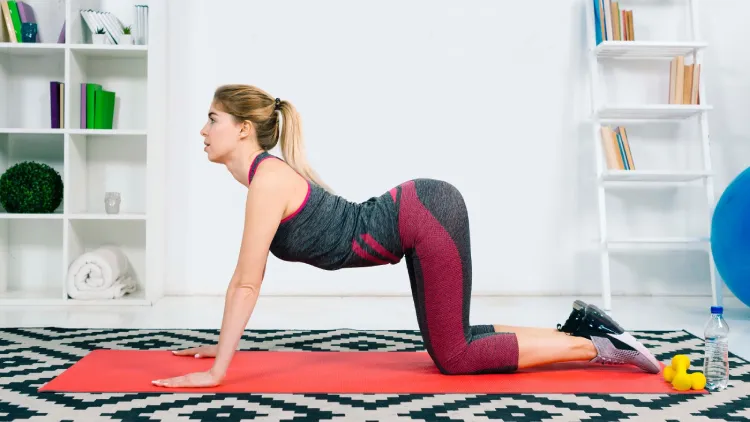
Step 1: Begin in Tabletop Position
Bring your hands to the floor, right below your shoulders, and your knees to your hips. Remain standing straight and look at the floor.
This is a stable tabletop posture with a relaxed, natural spine alignment.
Step 2: Move Into Cow Pose
Breathe slowly and pull your stomach to the ground. Frontal bend your chest, and have the tailbone lean up.
The spine is in the form of a flexible arch, and the shoulders are free, and the neck is in its natural form.
Step 3: Move Into Cat Pose
Slowly breathe out as you flex your back towards the ceiling. Pull in your belly and tuck your chin in between your breasts.
This motion stretches the upper and lower back and the abdominal muscles.
Step 4: Repeat the Motion
Switch between these two positions as you move smoothly through each position with the help of your breath.
Most yoga teachers recommend 8-12 repetitions per set, slow movement, and breath control.
There is no need to stay in each position for long; a few seconds should suffice to increase the stretch, and long holds are not typical, given the nature of the movement.
Common Mistakes to Avoid
The cat cow stretch is easy, but common mistakes can make it ineffective or uncomfortable.
Moving Too Quickly: When rushed during movement, the spine cannot stretch fully and may reduce the benefits of the exercise.
The slow, coordinated movement allows the vertebrae to move correctly.
Collapsing the Shoulders: Other novices exert excessive pressure on the shoulders and wrists. Shoulders have to be stable and slightly engaged.
Overarching the Lower Back: The spine in Cow Pose is supposed to be arched, not too much. This is due to an unwarranted amount of stress that is exerted on the lumbar spine by overarching.
Holding the Breath: The rhythm of the movement depends on breathing. Loss of coordination between breathing and movement reduces the benefits of relaxation and flexibility.
Lack of Core Engagement: The abdominal muscles should be slightly engaged during the cat phase of the movement to protect the spine.
Cat Cow Stretch Variations
Several cat-cow stretches allow individuals to adjust the movement based on their fitness level or physical condition.
- Seated Cat Cow: This difference is done when one is seated on a chair. It is convenient for office workers who want to relieve stiffness after prolonged sitting.
- Standing Cat Cow: Standing cat cow- here the hands are placed on the thighs, and the same motion of arching and rounding is done using the spine.
This one is handy for taking posture breaks
- Cat Cow With Child’s Pose: Other yoga practices merge cat cow with Child pose to come up with a more soothing flow of spinal mobility.
- Cat Cow With Resistance Band: Advanced practitioners may attach light resistance bands to enhance muscle engagement and stability.
Who Does the Cat Cow Stretch?
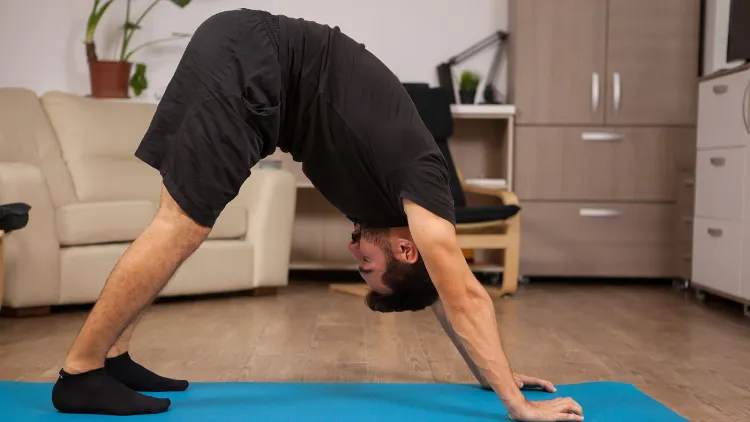
The cat cow pose is appropriate for most individuals and is usually prescribed as an initial yoga pose.
- People Who Benefit Most
- Sedentary office employees.
- Novices in yoga.
- Sportspeople before the workouts.
- People who need to have better posture.
- Individuals with back stiffness of mild severity.
- These are where care is required.
Even though the stretch is smooth, some people must take it lightly.
Individuals who have suffered severe injuries to the spinal cord, have undergone surgery to the back, or are experiencing extreme nerve pain must consult a medical expert before doing the movement. In certain scenarios, overspinal movement is likely to worsen the already existing conditions.
Patients who have suffered acute disc injuries like acute L4-L5 disc bulges might need special exercises that a healthcare expert prescribes.
Cat Cow Stretch for Back Pain
The cat cow pose is also very commonly used as a supportive pose by individuals experiencing mild back pain.
How It Helps
The flow is a gentle movement mobilising the spine and a boost of circulation around the spinal discs. This has the capacity of enhancing the flexibility of muscles around it and decreasing rigidity.
Controlled spine movement can relieve pressure and encourage relaxation in individuals with mild nerve compression or muscle tightness.
The stretch, however, is to be done gradually and in a comfortable range. In case the pain is enhanced in the process of the movement, it must be discontinued at once.
Additional exercises for people with persistent sciatica include pelvic tilts, gentle hamstring stretches, and nerve-gliding movements. In extreme situations, expert advice from a physiotherapist is advisable.
Most Ideal Time to do Cat Cow Stretch
The cat cow pose can be done at any time of the day according to the individual’s preference and habit.
- Morning Practice: Most individuals perform the stretch in the morning because it loosens the spine when getting up after sleeping, helping the body move throughout the day.
- Before Exercise: It is commonly used to warm up before yoga, mobility, or strength exercises.
- During Work Breaks: Seated variations of the stretch are able to be done by individuals who sit for prolonged periods in order to decrease stiffness.
- Evening Relaxation: Light evening stretches can help unwind tension built up throughout the day.
Yoga teachers usually advise practising on an empty or light stomach to reduce discomfort.
Conclusion
The cat cow pose is an easy yet effective yoga pose that helps improve spinal flexibility, maintain proper arm and leg posture, and enhance overall mobility. It combines mild spinal flexion and extension with regulated breathing to help maintain normal movement patterns and mitigate stiffness from sedentary lifestyles.
The cat cow stretch is one of the most common mobility poses in yoga and rehabilitation programs because it is accessible to beginners and can be modified to suit various fitness levels. When done correctly and accurately, it can help improve spinal health, posture, and comfort during daily movement.
Frequently Asked Questions
1. What is the number of times you are supposed to do the cat cow stretch?
According to most yoga gurus, the cat cow can be done with 8-12 repetitions every time. It can be practiced 1-2 times a day, which may improve the movement of the spine, decrease the stiffness, and enhance posture.
2. Does the cat cow pose help with lower back pain?
Yes, the cat cow stretch could be used to treat light lower back stiffness by enhancing the motions of the spine and blood flow around the spine. Nonetheless, a doctor should consider severe pain.
3. What are some of the mistakes in the cat cow stretch?
Some of the most common errors are over-speeding, collapsing the shoulders, over-arcing the lower back and holding back the breath. The movement should be done slowly, accompanied by controlled breathing, in order to be effective.
4. What is the alternative to the cat cow stretch?
The cat cow pose is also referred to as Cat- Cow yoga flow. It is a combination of Cat Pose (Marjaryasana) and Cow Pose (Bitilasana) to create a mild motion of spinal mobility that is applied during yoga warm-ups.