

If push-ups make your shoulders feel shaky, or your shoulder blades seem to stick out when you reach overhead, the serratus anterior is often the missing piece. These fan-shaped muscles on the side of your ribs (serratus anterior exercises) hold your shoulder blades in place and help them glide freely when you push, punch, or lift your arms.
If you’re not one of the few individuals who require more repetitions of more complex exercises, such as a lying dumbbell punch, wall slides, and a push-up plus, performed 2-3 times per week, this is a good place to start. There’s no need to have a gym at home.
In this guide, you’ll find out what these exercises are, how to check if your serratus is weak, which are the best movements and their respective classification, and a quick and easy 6-week plan.
- What are Serratus Anterior Exercises?
- Serratus Anterior Exercises at a Glance
- What Does the Serratus Anterior Muscle Do?
- How Do You Know If Your Serratus Anterior Is Weak?
- Which Serratus Anterior Exercises are the Best?
- How Often Should You Do Serratus Anterior Exercises?
- Can Serratus Anterior Exercises Help a Winged Scapula?
- Start Your Serratus Routine This Week
- Conclusion
- Frequently Asked Questions
What are Serratus Anterior Exercises?
Serratus anterior exercises are exercises that work the serratus anterior and focus on the two primary actions of this muscle. The first is protraction, the movement of the shoulder blade forward around the rib cage. The second movement is called upward rotation, which is a tilting of the shoulder blade upwards as your arms go up.
The serratus is involved in a bench press or overhead press, but the larger muscles (pecs and deltoids) provide most of the force. Serratus exercises include a conscious upward movement of the shoulder blade, for example, the added “plus” on the top of a push-up, to carry more of the weight.
Serratus Anterior Exercises at a Glance
| Exercise | Main job trained | Equipment | Level | Sets x Reps |
| Wall push-up plus | Protraction | Wall | Beginner | 2–3 x 12–15 |
| Quadruped scapular push | Protraction | None | Beginner | 2–3 x 10–12 |
| Lying dumbbell punch | Protraction | Dumbbell | Beginner | 2–3 x 12–15 |
| Push-up plus | Protraction | None | Intermediate | 2–3 x 8–12 |
| Foam roller wall slide | Upward rotation | Foam roller, wall | Beginner | 2–3 x 10–12 |
| Band serratus punch (high angle) | Protraction + upward rotation | Resistance band | Beginner–Intermediate | 2–3 x 12 each arm |
| Dumbbell scaption | Upward rotation | Light dumbbells | Intermediate | 2–3 x 10–12 |
| Half-kneeling landmine press | Protraction + upward rotation | Barbell + landmine | Intermediate–Advanced | 2–3 x 8–10 each arm |
What Does the Serratus Anterior Muscle Do?
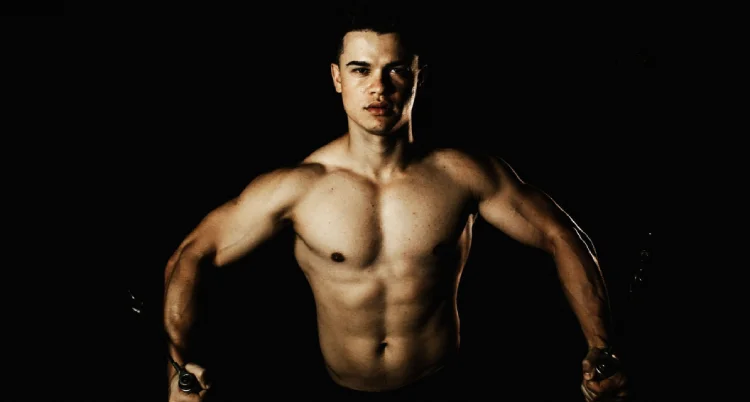
The serratus anterior is a muscle that moves your shoulder blade (scapula) forward around your rib cage and, with the upper and lower trapezius, is responsible for moving the scapula upward, allowing you to lift your arms overhead. Often referred to as the ‘boxer’s muscle’ because it is the prime mover in the extension of a boxing punch.
The muscle starts as finger-like slips on your upper ribs and attaches along the inner edge of the shoulder blade. This results in a saw-tooth appearance, hence its name “serratus.” StatPearls (NIH) mentions that a shoulder girdle that is fixed may lift ribs to assist breathing.
How Do You Know If Your Serratus Anterior Is Weak?
The serratus anterior is often weak and shows up as a shoulder blade that lifts off the back, especially the inner edge or lower corner. It could also be seen as a shrug during overhead reach or a pinch in a press.
Try this 30-second phone check:
- Turn your phone to take a back-to-back picture of your phone.
- Complete 5 slow wall pushups in a tight-fitting T-shirt.
- Watch the video. Check if one or both of the shoulder blades are popping out like little wings at the bottom of each repetition.
If the motion is mild and even, it is common. If you have clear winging on one side, you have winging that hurts, or you can see resting wings, check it out.
The serratus anterior is innervated by the long thoracic nerve. StatPearls says that injury to this nerve may lead to paralysis of the muscle and a winged scapula, not necessarily a workout plan.
Which Serratus Anterior Exercises are the Best?
The push-up plus, foam roller wall slide, the wall push-up plus, and the lying dumbbell punch are the best serratus anterior exercises. They practice protraction, rotation up, or both, with minimal shrugging. A meta-analysis of 19 studies in 2019 revealed that the standardpush-upp plus exhibited high activity in the serratus anterior.
When you can perform 3 sets of 15 reps of the exercise, move up a level.
Protraction Exercises (Push and Reach Forward)
1. Wall Push-Up Plus
This teaches the “plus,” the extra push at the end of a push-up.
How to do it:
- Stand an arm’s length from a wall, hands on it at shoulder height.
- Do a slow wall push-up with your body in a straight line.
- At the top, keep your elbows straight and push the wall away so your upper back rounds slightly.
- Hold for 1–2 seconds, then let your shoulder blades sink back together.
Sets and reps: 2–3 sets of 12–15, 2–3 days a week.
Avoid this: Shrugging your shoulders toward your ears during the push.
Progression: Step your feet farther from the wall.
2. Quadruped Scapular Push
This isolates protraction with straight arms.
How to do it:
- Get on your hands and knees, hands under shoulders.
- Keep your elbows straight and let your chest sink slightly between your shoulder blades.
- Push the floor away so your upper back rises toward the ceiling.
- Move only your shoulder blades. Your elbows and hips stay still.
Sets and reps: 2–3 sets of 10–12, 2–3 days a week.
Avoid this: Arching or rounding your lower back instead of moving your shoulder blades.
Progression: Do it from a high plank.
3. Lying Dumbbell Punch
Lying down quiets your traps so you can feel the serratus work.
How to do it:
- Lie on your back holding a light dumbbell straight up over your shoulder.
- Keep your elbow locked and reach the weight toward the ceiling, lifting your shoulder blade off the floor.
- Pause for 1 second at the top.
- Lower slowly until your shoulder blade touches the floor again.
Sets and reps: 2–3 sets of 12–15 each arm, 2–3 days a week.
Avoid this: Bending the elbow to fake the reach.
Progression: Use a heavier dumbbell.
4. Push-Up Plus
This is the classic, research-backed serratus move.
How to do it:
- Assume full push-up position or on the knees if necessary.
- Do a controlled push-up with elbows at 45º.
- At the top, slightly push the floor over by an additional 1-2 inches.
- Keep your body in a straight line the whole time.
Sets and reps: 2–3 sets of 8–12, 2–3 days a week.
Do not do this: Walk with sagging hips in the “plus”.
Easier: With hands on a bench or on knees.
Upward Rotation Exercises (Reach Overhead)
5. Foam Roller Wall Slide
This trains upward rotation as your arms rise.
How to do it:
- Face a wall with a foam roller under your forearms.
- Step one foot back and brace your abs lightly.
- Roll it up the wall as you reach overhead, letting your shoulder blades glide forward and up.
- Stop if you feel a pinch, then roll back down slowly.
Sets and reps: 2–3 sets of 10–12, 2–3 days a week.
Avoid this: Arching your lower back as your arms go up.
Progression: Add a light band around your wrists.
6. High-Angle Band Serratus Punch
This blends a forward reach with an upward angle.
How to do it:
- Anchor a resistance band behind you at waist height.
- Stand in a staggered stance with your elbow bent at your side.
- Punch forward and up at about a 45-degree angle, reaching your shoulder blade forward at the end.
- Return slowly without letting the band snap your arm back.
Sets and reps: 2–3 sets of 12 each arm, 2–3 days a week.
Avoid this: Twisting your torso to push the band.
Progression: Step farther from the anchor or use a thicker band.
7. Dumbbell Scaption
Scaption raises your arms in your shoulder blade’s natural plane.
How to do it:
- Stand tall holding light dumbbells, thumbs pointing up.
- Raise your arms at about a 30-degree angle in front of your body, forming a “V.”
- Lift to about shoulder height or slightly above, as long as it’s pain-free.
- Lower over 3 seconds.
Sets and reps: 2–3 sets of 10–12, 2 days a week.
Avoid this: Using weights that are too heavy, which leads to shrugging.
Easier option: Use no weight.
8. Half-Kneeling Landmine Press
This angled press trains both jobs under load.
How to do it:
- Wedge a barbell in a landmine or corner and kneel on the same-side knee as your working arm.
- Hold the end of the bar at your shoulder.
- Press up and forward, reaching your shoulder blade around your ribs at the top.
- Keep your ribs down and lower the bar slowly.
Sets and reps: 2–3 sets of 8–10 each arm, 2 days a week.
Avoid this: Leaning back to press instead of reaching forward.
Easier option: Use the empty bar.
How Often Should You Do Serratus Anterior Exercises?
Do serratus anterior exercises 2 to 3 days a week, with at least one rest day between sessions. Pick 3 or 4 moves per session, covering both protraction and upward rotation. Give a new program at least 6 to 8 weeks before you judge the results.
Use this 6-week plan:
| Weeks | Protraction move | Upward rotation move | Sets x Reps |
| 1–2 | Wall push-up plus, lying dumbbell punch | Foam roller wall slide | 2 x 12–15 |
| 3–4 | Quadruped scapular push, lying dumbbell punch | Wall slide, band serratus punch | 3 x 12 |
| 5–6 | Push-up plus | Dumbbell scaption, landmine press | 3 x 8–12 |
Can Serratus Anterior Exercises Help a Winged Scapula?
Serratus anterior exercises are commonly used to help with mild scapular winging caused by weakness or poor control. They are unable to repair nerve damage. See a doctor or physical therapist before training winging if the following: Obvious, painful, sudden, or after surgery or injury.
If you see any of the following:
- Sudden pain in the shoulder or on the side of the ribs
- Numbness, tingling, or weakness down your arm
- Pain that persists for over 2 weeks.
Stretchlee Tip: Exhale on the “plus”
It is attached to your ribs, and the breath will influence how much you can feel it. Exhale deeply as you push out the floor or wall and allow the ribs to drop. Many folks find that the reach increases and the shrug is gone.
Start Your Serratus Routine This Week
A strong serratus anterior keeps your shoulder blades steady when you push and reach overhead. Start this week with the wall push-up plus, lying dumbbell punch, and foam roller wall slide, 2 to 3 days a week. Retake the phone check after 4 weeks, then move up the plan. Pair these serratus anterior exercises with a shoulder mobility routine for better overhead reach.
Conclusion
Serratus anterior exercises can enhance the control, stability, and overhead movement of the shoulder blade. Do exercises that are beginner friendly such as wall push-up plus, lying dumbbell punch, foam roller wall slide, etc., and progress to more difficult exercises as you become stronger. Do 2 – 3 sets of training per week, emphasise correct movement, and stick to the 6-week training plan. Don’t forget controlled movement is more important than lifting more weight.
Frequently Asked Questions
Can you train the serratus anterior at home?
Yes, wall push-up plus, quadruped scapular push, and push-up plus are exercises performed without equipment.
How many weeks will it take to build the serratus anterior up?
Good control can usually be achieved in 6-8 weeks with regular training 2-3 times a week.
Do serratus anterior exercises help with posture?
Yes, they can help control and stabilize the shoulder blades, which can aid in creating good posture.
Is a push-up sufficient for the serratus anterior?
Push-up plus and wall slides are a better way to directly work the serratus than regular push-ups.