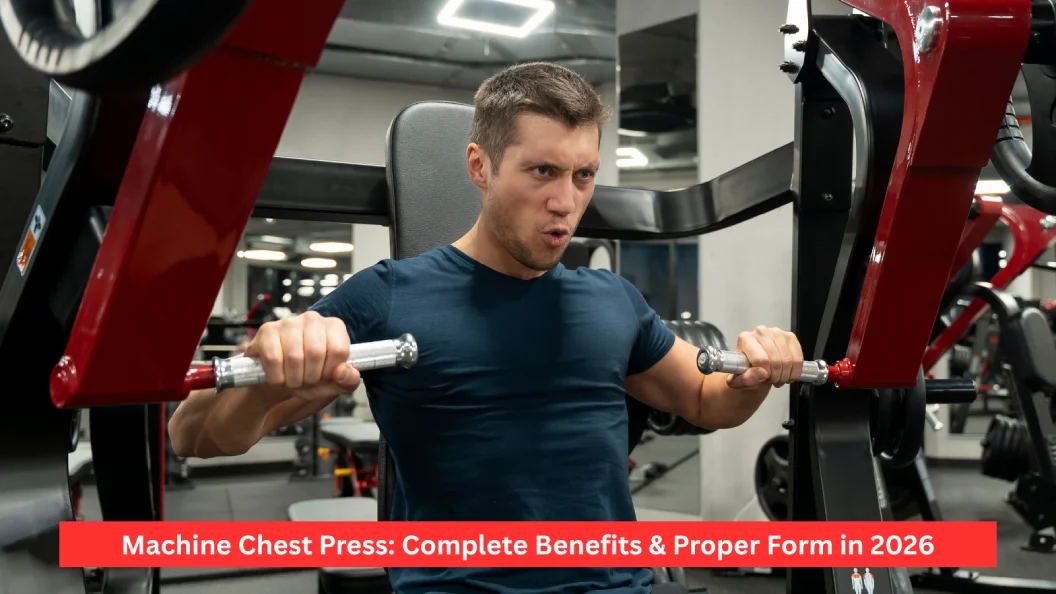

This machine chest press is a great and easy beginner’s workout to build chest, triceps, and front shoulder muscles. Set the chest press machine at the mid-chest position, press with control, and perform progressive overload to gain stronger, bigger chest muscles.
- What's a machine chest press?
- What Muscles Does the Machine Chest Press Work?
- How to Do the Machine Chest Press Correctly
- Machine Chest Press Form Tips
- Benefits of the Machine Chest Press
- Machine chest press for building muscle
- Machine Chest Press Strength
- Common Machine Chest Press Mistakes
- Machine Chest Press vs. Bench Press
- Machine Chest Press Alternatives
- How to progress the machine chest press?
- Is the Machine Chest Press Good for Beginners?
- Does Machine Chest Press Build Chest?
- How Often Should You Do Machine Chest Press?
- Safety Tips for the Machine Chest Press
- Conclusion
- Frequently Asked Questions
What’s a machine chest press?
The machine chest press is a seated pressing movement that makes use of handles to push against resistance. The machine provides much more control of the movement path than a barbell or dumbbell press.
This is why the seated chest press machine is beneficial for people who are just beginning their weight training routine as well as for those who have been training for a while and need a stable platform to train their chest. Gyms can feature flat, incline, or decline machines, or plate-loaded and selector machines.
This exercise primarily works the pectoralis major with some assistance from the triceps and the front deltoids.
What Muscles Does the Machine Chest Press Work?
The chest press machine activates the chest, triceps, and front shoulder muscles.
1. Pectoralis Major
During the machine chest press, the pectoralis major is the main muscle that contracts. It aids in pushing the upper arm forward and in the direction of the midline.
In the case of a flat machine, it offers a standard chest-press angle, while an incline machine chest press can give an upper chest focus.
2. Triceps
During these movements, the triceps straighten your elbows when you push the handles forward. They perform all exercise movements and can get tired before the chest when resistance is too high.
3. Anterior Deltoids
Front shoulders help to move upper arms forward. They are normal since the machine chest press exercise is a compound exercise.
4. Other Supporting Muscles
Your upper back, shoulder stabilizers, and your core keep your body pressed against the pad. The machine does require less stabilization than dumbbells or a barbell, though.
How to Do the Machine Chest Press Correctly
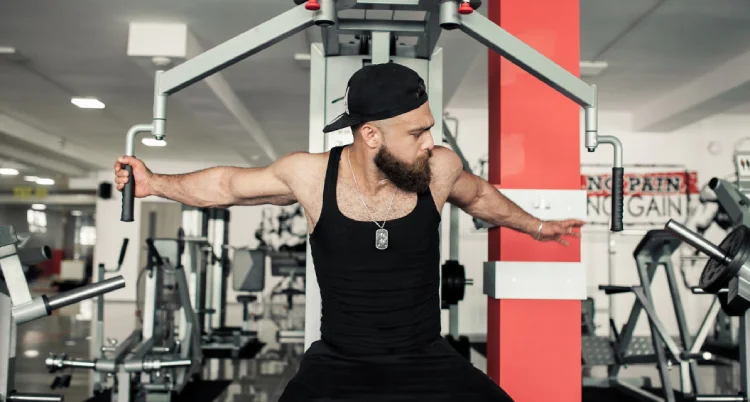
Step 1: Adjust the Seat
Sit upright in the chair and adjust the chair so the handles are roughly at the level of the middle of your chest.
Do not put your feet up on the pad or off the floor, and do not lean back on the pad.
Step 2: Set Your Upper Body
Hold the handles in a natural, comfortable position with your shoulders. Prevent them from rolling too far forward.
Step 3: Brace Your Body
Tighten your abdominal muscles and keep your trunk steady. Do not have to use your legs or swing your body.
Step 4: Push the Handles Forward
In a smooth motion, push the handles forward. Find a way to move your arms, not your body.
Step 5: Finish the Press
Straighten your arms out, but do not do so violently with elbows locked out. Briefly contract your chest at the end.
Step 6: Return Slowly
Let the handles go back under control towards the chest. Do not let the weight fall on the ground.
Machine Chest Press Form Tips
This exercise can be more comfortable and effective if you make sure you have good form on the chest press machine. Keep your back to the pad.
- Stand with your feet on the floor.
- Adjust the handles to about mid-chest level.
- Do not let your shoulders get out of control.
- Maintain a straight wrist.
- Don’t use too much elbow.
- Take a comfortable range of motion.
- Press without momentum.
- Control the return.
- Select an appropriate resistance.
If you are unable to feel your chest, first inspect your seat height, grip, range of movement, and weight. Too much resistance can lead to the shoulders and triceps taking over.
Benefits of the Machine Chest Press
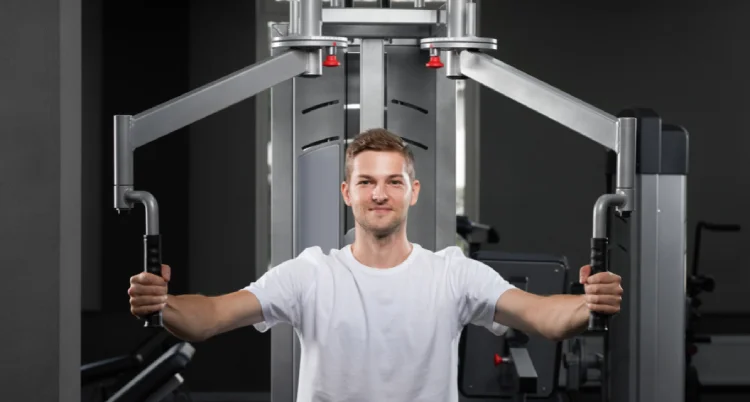
1. Builds Chest Strength
Machine chest press exercises the horizontal pushing motion and can help strengthen the upper body if it is performed regularly.
Strength should not be measured on a single number, but on your experience, skill, and body weight.
2. Helps Develop the Chest
A chest press machine will enable you to get a great amount of chest-training volume while doing controlled repetitions.
Muscle growth is not dependent on the machine, but rather on training volume, effort, progressive overload, nutrition,n and recovery.
3. Beginner-Friendly
This exercise is relatively easy to learn due to the guided movement. There is no need for beginners to balance two dumbbells or a barbell.
4. Easy to Track
It can be used to record weight/reps and to take it up when technique levels are consistent.
5. Supportive for Training near Fatigue
The supported position can allow for easy targeting of challenging sets for the chest without the same level of stabilization required as with free weights.
6. Provides Consistent Resistance
This machine controls the motion, making it possible to reproduce the same pattern in each session.
Various machines such as a Hoist chest press, Nautilus chest press, Hammer chest press, or plate-loaded chest press can feel different due to the differences in the resistance path and design of the machines.
Machine chest press for building muscle
A reasonable number of sets to begin with for building muscle is 3–4 sets of 8–12 reps.
May also use more or fewer reps as per the program. The key is the selection of a resistance challenging but ndoes ot compromise good technique.
For example:
- Week 1: 50 kg × 8
- Week 2: 50 kg × 10
- Week 3: 50 kg × 12
- Week 4: Add a little weight.
This is a more helpful process than attempting to move as much weight as you can.
Machine Chest Press Strength
The stronger option would be to do more of these movements with less resistance, e.g., 3-5 sets of 5-8 with heavier resistance.
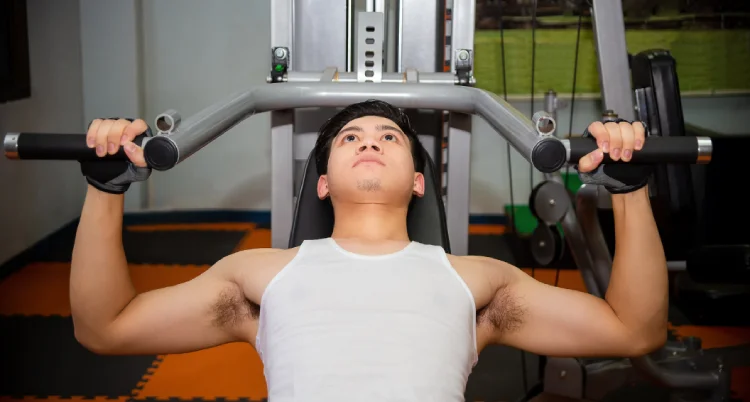
But machine bench press strength doesn’t necessarily equal barbell bench press strength. Machines are more stable, while the bench press demands more control of a free weight.
It also relies on the individual’s weight and experience when they are lifting things. One person can have a difficult time doing a 60 kg bench press, while another may find it easy. It’s the same with 80 kg, 100 kg, or more.
Common Machine Chest Press Mistakes
Using Too Much Weight
If there is strong resistance, patients may have limited ROM and repeat the exercise incorrectly.
Fix: Decrease the weight and do clean reps.
Your seat should be neither too low nor too high.
The seat height will affect the pressing angle if it is not adjusted correctly.
Fix: Make handles about the level of the chest.
Letting the Shoulders Roll Forward
This may alter the motion and make the movement uncomfortable.
Fix: Maintain upper back support and control shoulders.
Moving Too Quickly
The more quickly the repetitions are repeated, the less control will be had.
Fix: Squeeze gently and pull back slowly.
Failing to keep the elbows at a normal angle.
Elbows that are very wide may give a feeling of discomfort.
Fix: Natural elbow position, comfortable pressing.
Using Partial Repetitions
Very short reps can decrease the amount of helpful motion.
Fix: Move with a comfortable range of motion; don’t overwork joints.
Locking Out Aggressively
Never straighten elbows.
Fix: Complete each move with good control.
Machine Chest Press vs. Bench Press
Both exercises train the chest, triceps, and shoulders, but they have different demands.
| Feature | Machine Chest Press | Bench Press |
| Stability | High | Lower |
| Movement path | Guided | Self-controlled |
| Balance demand | Lower | Higher |
| Beginner-friendly | Generally easier | Requires more technique |
| Chest training | Yes | Yes |
| Free-weight skill | Lower | Higher |
The machine is useful for stable, controlled chest training. The bench press is more specific to barbell pressing strength.
Dumbbell presses provide another option and require each arm to control its own weight. Therefore, dumbbell and machine presses are not simply a matter of one being universally better.
Machine Chest Press Alternatives
- Dumbbell Bench Press: Dumbbells will work the same primary pressing muscles but need greater stabilization.
- Barbell Bench Press: The barbell bench press is great for free-weight pressing strength.
- Push-Ups: Push ups work the chest, shoulder muscles, and triceps with minimal equipment. These may be made harder or made more challenging by adding extra resistance.
- Cable Chest Press: On the cable chest press machine, you can choose the resistance and angle of the pressing motion.
- Resistance Band Chest Press: Resistance bands can be used at home, on vacation, or when there is no gym equipment available.
Based on your goals, these exercises can all be a viable alternative to the chest press machine.
How to progress the machine chest press?
Progressive overload: gradually increase training intensity.
Steps are available:
A small amount of weight will be added to the final product.
- Increasing repetitions
- Adding a set
- Increasing range of motion:
- Improving technique
- Increasing control
- Training consistently
Never compare the numbers of machines directly between gyms. One setting of 60 kg can be quite different from another.
Is the Machine Chest Press Good for Beginners?
Yes. The machine chest press is typically an easier workout as it offers support and directs resistance.
Begin with a weight that will not be too heavy and learn the set before trying harder sets.
There is no need to strive for a specific bench-press figure. Gradual strength development using good technique is more beneficial.
Does Machine Chest Press Build Chest?
Yes. With the right machine training volume and intensity, progressive overload, nutrition, and recovery, the chest press machine can be used to build chest muscle.
Different angles can be used for more comprehensive training of the chest. A flat chest press machine offers a regular pressing angle, whereas an incline chest press machine focuses on the upper chest.
The pressing angle can be changed with the use of a decline chest press machine, which can be utilized for variety in the workout.
It is not possible to isolate three distinct muscles in the chest, but you can target different parts of the pectoralis major muscle with different angles.
How Often Should You Do Machine Chest Press?
Chest presses don’t have to be done every day.
Chest training 1-2 times per week may be sufficient for many individuals. Your total weekly pressing volume and recovery should determine how often you train.
If you are already doing dumbbell presses, bench presses, push-ups, and fly movements, you might not need to increase the amount of machine work.
Safety Tips for the Machine Chest Press
Here are some general safety tips:
- Inspect the machine before use.
- Adjust the seat properly.
- Start with a warm-up set that is at a lower weight.
- Keep your back supported.
- Maintain good foot stability.
- Avoid jerky movements.
- NEVER sacrifice form for weight.
- If pain or unusual pain occurs, stop.
- Increase resistance gradually.
If you need assistance setting up, contact a professional.
Heavy max lifts should be done with caution, particularly with free weights.
Exercise Idea: Machine Chest Press.Workout Idea: Machine Chest Press.
A basic chest exercise might consist of.
Warm-up:
- Light movement followed by one or two easy pressing sets.
- Workout:
- Machine Chest Press — 3 × 8–12
- Incline Dumbbell Press — 3 × 8–12
- Cable Fly — 2–3 × 10–15
- Push-Ups — 2 controlled sets
The Planet Fitness chest press machine may be convenient if you attend Planet Fitness training, but not all locations are likely to have the same equipment.
Some gyms also have a standing chest press machine, or they might have the plate-loaded versions with a seat.
Conclusion
The machine chest press is a great workout to build chest strength and muscle. It is easy for beginners and advanced lifters to use due to its guided movement.
To get the most out of the chest press machine, emphasize correct form, slow speed, adequate recovery, and a well-rounded workout.
Don’t base your progress on the amount of weight you can lift. The resistance of various machines varies from one piece of equipment to another, and even free-weight benchmarks vary based on body weight, experience, technique, and training history.
The machine will help you increase your chest but not muscle fat on the belly in particular. Eating right, exercising, and maintaining healthy habits are essential to overall fat loss.
Frequently Asked Questions
1. What muscles does the machine chest press work?
The primary muscles worked with this machine chest press are the pectoralis major, with the triceps and front shoulders helping with the pressing motion.
2. Is chest press better than dumbbells?
Yes. The chest press machine offers a guided motion, allowing beginners to master correct technique and safely develop chest strength.
3. How many sets and reps on machine chest press?
If muscle growth is your goal, begin with 3-4 sets of 8-12 repetitions with the weight being challenging yet executed in a controlled and proper manner.
4. Is the machine chest press better than the bench press?
There is no one right or wrong way. The bench press will demand a great deal more balance, control, and free-weight technique, whereas the machine chest press will be much more stable.