
One of the most useful core training devices for strengthening, stability, and control of the muscles is the ab roller. It exercises all your core, the abs you can see, but also includes deep stabilizing muscles on your lower back, hips,s and shoulders. When properly used and regularly maintained, the ab roller may assist in improving posture, core stamina, and overall athletic performance. But only seeing abs is the result of training, and the amount of body fat, or narrowly defined abs, will not be the result of just any exercise. This guide covers all the aspects of technique and progression, of benefits, mistakes, and realistic expectations.
- What is an Ab Roller?
- Muscles Worked During Ab Roller Exercises
- Benefits of Ab Roller Exercises
- Proper Technique for Ab Roller Exercises
- Beginner Exercise
- Intermediate Exercise
- Advanced Exercise
- Common Mistakes to Avoid
- How Often Should You Do Ab Roller Exercises?
- Ab Roller Exercise Variations
- Safety Tips for Ab Roller Training
- Conclusion
- Frequently Asked Questions
What is an Ab Roller?
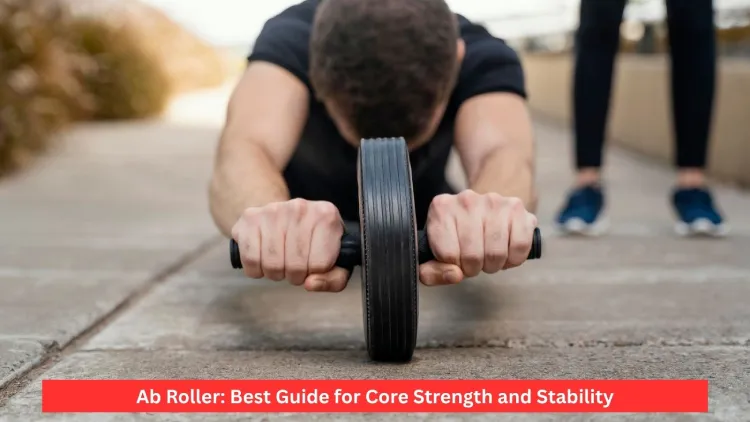
The ab roller is the simplest yet the most powerful fitness equipment available in the market that is used in core training. It typically involves a wheel and has handles on either side. The ab roller has minimal design but brings considerable resistance since it requires your body to balance the motion of rolling.
When you roll on it, you are not simply rolling up and down. You are manipulating all your body weight at the same time, keeping your core muscles in tension. This renders the ab roller much more demanding than the classic abdominal workouts, such as crunches.
What is so effective about the ab roller is that it will train your body in a functional pattern of movement- extension and control- the same as many things you will do in life, which are lift, bend, and stabilize your spine.
The ab roller is an exercise that, unlike most isolation exercises, requires the coordination among multiple muscle groups to perform it all, making it a whole-core strength tool as opposed to merely being an ab builder.
Muscles Worked During Ab Roller Exercises
The ab roller is able to use a much greater number of muscles than many individuals would anticipate. People are often misled to think that it is simply an exercise of the ab, but actually the whole anterior-chain exercise.
The muscles that are considerably important when it comes to ab roller movements are the following:
- Rectus abdominis (front abs)
- Transverse abdominis (deep core stabilizer)
- Obliques (side core muscles)
- Erector spinae (lower back support muscles)
- Hip flexors (to produce movement and control stability)
- Deltoids (shoulders)
- Lat muscles (serve to support the upper back)
- Triceps (arm extension control)
The ab roller makes your core resist falling as it prolongs. It is the anti-extension power that makes it so useful in helping to improve core stability and posture.
Individuals who have weak cores are usually unable to control the ab roller as these supportive muscles are not strong enough to regulate the movements. Regular training over time will be able to strengthen these weak points and enhance the overall control level.

Benefits of Ab Roller Exercises
A highly effective core training device that can no longer be equated to just ab exercises is the ab roller. It enhances deep muscles, enhances stability, and helps to maintain overall body control.
1. Strong Core Development
A roller ab implements a strong abdominal wall and not the abs on the surface.
- Turns on deep core stabilizers.
- Tones the back muscles of support.
- Enhances general core control.
Develops the ability to use abdominal strength.
2. Improved Posture
Using it on a regular basis is helpful to correct improper posture due to weak core muscles.
- Reduces slouching
- Strengthens spinal support
- Enhances the sitting and standing posture.
- Enhances body balance
3. Functional Strength
It enhances real-life movement and everyday physical performance.
- Assistance in getting up and down.
- Improves movement stability
- Regulates the physical tasks in buildings.
- Lessens the risk of injury.
4. Better Athletic Performance
Ab roller training has several benefits for athletes.
- Engages balance and coordination.
- Increases central transfer of power.
- Supports explosive movements
- Increases body control in sports
5. Muscle Endurance
It helps to extend the period of time that the core muscles can remain active.
- Improves core stamina
- Reduces early fatigue
- Supports longer workouts
Enhances muscle endurance as time goes by.
6. Support of fat loss (Indirect Effect)
It assist in enhancing the body composition, but not necessarily fat burning.
- Developed lean muscle in the core.
- Increases workout intensity
- Supports calorie-burning training
The key factor in fat loss is diet and consistency.

Proper Technique for Ab Roller Exercises
Proper shape is essential during the usage of it. Inadequate technique may cause lower back tension or inefficient training.
Step-by-Step Guide:
- Get on your knees, take the ab roller, and grasp it with both hands. Make your core tight, even before you move.
- Gradually push the ab roller forward to your shoulders, keeping your knees straight.
- When you stretch, do not allow your hips to fall. The ab roller must be running in a controlled manner as opposed to a fast and uncontrolled roll.
- After completely straightening out, take a little rest and then shorten the ab roller with your core muscles and not your arms.
- It is also important to breathe. Inhale rolling forward and exhale rolling backwards. The ab roller is most efficient when the movements are slow and deliberate.
When you are arched in your back, or you are deflated in your belly, you are going too far. The ab roller must never be pushed; rather, it must be controlled.
Beginner Exercise
To novices, the introduction of the ab roller should be gradual.
Begin with limited rollouts. This will allow you to only roll the ab roller a short distance forward rather than all the way extended. This aids in developing an underlying force.
Novices are advised to emphasize:
- Ab rollers that are knee-supported.
- Lack of a full scope of movement.
- Slow, controlled tempo
- Firmness B. f. movement
At this point, the ab roller is more oriented toward learning control rather than the construction of supreme strength. This stage may be underestimated by many individuals, yet it is a necessary step towards long-term development.
Intermediate Exercise
When a simple control has been constructed, it will be able to move through a full range of motion, starting at the knees.
When at this level, it becomes more difficult. You will begin to stretch further forward but remain stable. Repetitions are more regulated and slower in tempo.
The tasks at this step comprise:
- Complete knee roll-outs using a b roller.
- Longer extension range
- Controlled eccentric movement
- Core endurance development
The intermediate users can start seeing apparent changes in abdominal strength with the constant use of the ab roller.
Advanced Exercise
High-level training on the ab roller involves the use of good core stability and good control. At this stage, full rollouts are done using almost full body extension. The more advanced can even move on to standing rollouts, although this is extremely hard.
Advanced training involves:
- Full extension rollouts
- Delayed negative phase control.
- Very little rest between sets.
- During movement, there is high core tension.
In this phase, the ab roller will be taken as a very serious tool of strength and not a mere exercise.

Common Mistakes to Avoid
The ab roller is also abused by many people who diminish its performance, adding to possible damage.
One of the common errors is the act of arching the lower back. This occurs when the core is not properly engaged. The other error is the use of momentum as opposed to controlled movement. The ab roller never needs to be done in a hurry.
Other mistakes include:
- Going too far too soon.
- Not engaging the core before movement
- Holding breath incorrectly
- Allowing hips to drop during rollouts.
Discipline and control are more required in the use of the ab roller than speed or strength.
How Often Should You Do Ab Roller Exercises?
It must be used depending on the fitness level and the ability to recover.
Novices may work with it 2-3 times a week. This can be raised to 3-4 times per week by the intermediate users. It can be used more often by the advanced trainees; however, recovery is important.
The ab roller is usable on a daily basis, though only by those who have acquired experience in using the device and do not neglect management of intensity and volume. When using it, overtraining the lower back and core muscles may even result in fatigue.
Regularity is more important than regularity. Such exercises as controlled ab roller are more effective than casual daily training.
Ab Roller Exercise Variations
Various types can be used to enable better progress and challenge the various muscles.
Common variations include:
- Kneeling rollouts
- Wide-hand grip rollouts
- It control drills with the help of the wall.
- Partial range rollouts
- Single-knee support variations
The different forms of it vary in difficulty and muscle engagement by a small amount. This permits gradual development without any leveling off.
Safety Tips for Ab Roller Training
Everything has to be safety-related when it comes to using it.
It is always best to warm up first. The ab roller puts strain on the core and the lower back,k thus one should prepare to do so.
Some of the most important safety precautions are:
- Keep your core tight throughout the process of each movement.
- Do not roll out suddenly or hurriedly.
- Break, when you experience sharp pain in your lower back.
- The gradual instead of the rush intensity progress.
Breathing: When exercising on the ab rollers, one should take controlled breaths.
When used properly, it is safe, and when abused, it causes strain.

Conclusion
One of the best devices that can develop the real core strength, improve posture, and develop full-body stability. As opposed to plain abdominal exercises, the ab roller exercises deep stabilizing muscles, which help in functional movement and athletic performance.
Nevertheless, visible abs are realized not only with the help of a b roller. They need regular training, nutrition, and general body fat control. Although it will help a great deal to tighten your belly muscles, diet contributes a significant amount to defining your belly.
It is not a useful tool at the outset of the learning curve, yet with practice, it can be discovered to be a potent tool for changing core strength. It can help to be a significant part of your fitness when properly used and regularly exercised.
Frequently Asked Questions
1. Do the ab rollers work?
Yes, the ab roller is incredibly effective for core strength. It appeals to deep abs, lower back, and with the help of stabilising muscles. But conspicuous abs also require low body fat, not only through the use of it.
2. Am I able to train on it daily?
Advanced users can use it on a daily basis; however, a majority of them are getting more results with 3-5 sessions per week. The significance of rest is that the central needs need restoring after which they would become stronger.
3. What exercise is best for abs, coupled with the ab roller?
The ab roller can be most effective with exercises such as planks, leg raises, and bicycle crunch exercises. The combination of these movements will create a stronger and more balanced core.
4. Is it just a simple ab machine necessary to get visible abs through using an ab roller?
No, it builds muscle; however, visible abs primarily rely on reduced body fat, due to diet and other body fitness.