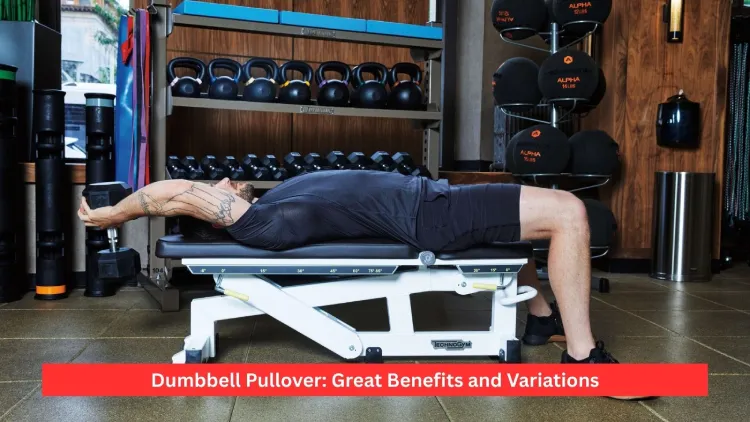

The dumbbell pullover is an inclusive exercise type which mostly targets the chest and lats and involves the triceps, shoulders and the core. It is also between push and pull propulsion, which is why it is one of a kind as far as balanced muscle development is concerned. If done correctly and to the right amount of movement, the dumbbell pullover can build up the chest, develop the lats, develop better coordination with the upper body, and develop shoulder mobility without undue stress to the joints. Its performance is substantially reliant on technique, intent and programming as opposed to heavy loading.
- What is a dumbbell pullover?
- Muscles Worked in Dumbbell Pullover
- Advantages of Dumbbell Pullover Exercise
- Dumbbell Pullover (Step-by-Step)
- Dumbbell Pullover Form Tips
- Dumbbell Pullover errors.
- Dumbbell Pullover Carries
- Including Dumbbell Pullovers in a Workout
- Who is the right person to do the Dumbbell Pullover?
- The Anatomy of the Chest, Back, and Triceps
- The Dumbbell Pullover and the Development of the Chest
- Exercise Choice and Safety in the Shoulder
- Balance: Triceps, Arms, and Upper-Body
- Strength Rules, Exercise Balance and Callisthenics
- Final Thoughts
- Frequently Asked Questions
What is a dumbbell pullover?
Dumbbell pullover is a resistance type of exercise which is done with the help of one dumbbell, usually on a flat bench or floor. The exercise is to take a dumbbell behind the head with a controlled shoulder movement of extension, and then it should come back to the initial stance above the chest. In contrast to the majority of the exercises that can be categorised as push or pull ones, the dumbbell pullover is an exercise that invites a combination of both movement forms.
This is the reason why the dumbbell pullover is usually incorporated in the chest training, back training and upper body training. This exercise focuses on long distances of motion and muscle stretch that, with correct use, could lead to hypertrophy. The dumbbell pullover also requires arm and shoulder control since the arms are overhead.
Muscles Worked in Dumbbell Pullover
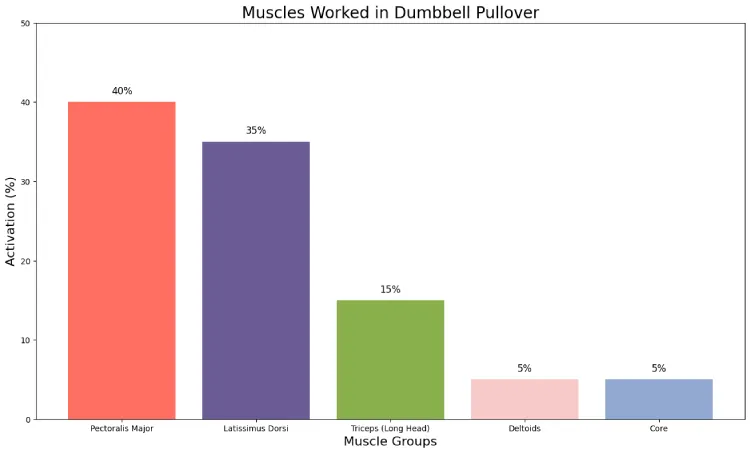
The dumbbell pullover utilises several muscle groups, which makes it an effective type of exercise that is a compound exercise.
Primary Muscles
Pectoralis major (chest):
The chest takes up a significant role in the lifting stage, particularly when the movement commences by straining the arms towards the centre. That is why the dumbbell pullover is used by a great number of lifters to stimulate the development of the chest.
Latissimus dorsi (lats):
The lats are much used in drawing the dumbbell towards oneself, having been stretched out. When the lifter pulls using the elbows as opposed to pulling using the hands, there is a tremendous lat engagement.
Secondary Muscles
Triceps (long head):
Since the deltoid triceps extend over the shoulder joint, they work during the shoulder extension. This helps in building triceps, though the motion is not a direct arm extension as in the case of skull crushers.
Deltoids:
Throughout the dumbbell pull-over, the anterior and posterior deltoids help stabilise the shoulders and control the shoulder movements.
Isometric action of the abdominals and deep stabiliser muscles helps to avoid extreme lower back arching in the overhead movement.
Advantages of Dumbbell Pullover Exercise
Dumbbell pullover has a number of exercise-specific advantages that render it useful in multiple training objectives.
Among the benefits is one of upper-body balance. Being a dumbbell pullover exercise, the exercises apply pressure to both the chest and back, thus alleviating the muscular imbalance that is brought about by heavy pressing or pulling. This even-handed movement helps to have healthier shoulders and better posture.
The other advantage is increased muscle coordination. The dumbbell pullover teaches the chest, the lats, triceps and shoulders to coordinate their movements and work as one. This coordination is easily transferred to other compound exercises like bench presses, pull-ups and overhead presses.
It is also an exercise that encourages deep underweight muscle stretch. This is particularly pronounced in the chest and lats, which can facilitate muscle development when they are coupled with the regulated pace and with appropriate rest.
Dumbbell Pullover (Step-by-Step)
The dumbbell pullover should be done properly, and this is the way to ensure that the shoulders are left protected and the right muscles are targeted.
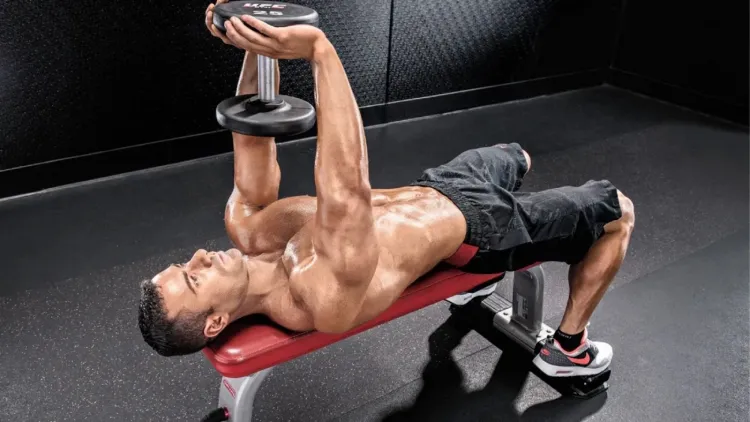
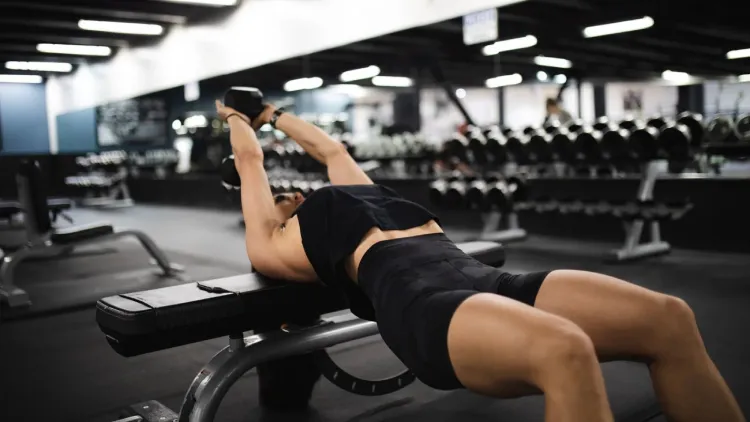
- Lie on a bench with a head raised and feet set deep.
- Loosely hold in either hand one dumbbell with which you will hold by the inner plate or handle.
- Arms- Raise your arms over your chest, slightly bent at the elbows.
- Tuck your abdomen in, and maintain the ribs in a down position.
- Gradually bring down the dumbbell slowly behind your head in a smooth curve.
- Starting with your upper arms, most or so parallel with the torso.
- Use your chest and just the lats to bring the dumbbell back to the point of origin.
- Inhale as you are back to the top.
- This rhythmical movement style makes the dumbbell pullover train the targeted muscles as opposed to straining the joints.
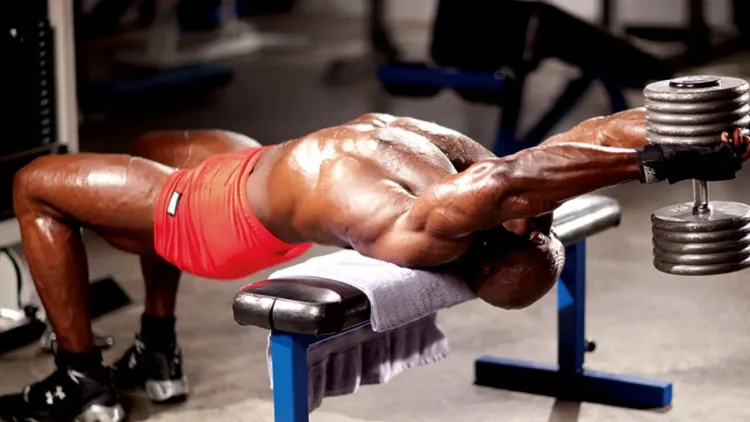
Dumbbell Pullover Form Tips
The right form will mean the difference between the dumbbell pullover developing muscle and will result in discomfort.
- It helps maintain a slight bend in the elbows to relieve the joints of the elbow and ensure that the exercise does not become a triceps isolation movement. A neutral spine and an engaged core will provide cover to the lower back, particularly with the involvement of heavier weights.
- The size of movement must be determined by the comfort of the shoulder and not its depth. When the dumbbell is lowered excessively, this may irritate the shoulder labrum or rotator cuff, especially among lifters with limited mobility.
- Grip pressure also matters. Grabbing something tight but not too tight is more preferable to connecting with the chest and the lats.
Dumbbell Pullover errors.
One of the biggest errors in using the dumbbell pullover is the excessive weight.
- Poor control, reduced range of motion and more shoulder stress are the consequences of heavy loading.
- Flaring of the ribs and arching of the lower back are other common problems. This will relieve the pressure on the chest and lats and will exert an unwarranted burden on the lumbar spine.
Other lift-off wrongly transforms the dumbbell pullover into the skull-crusher type of movement by bending and stretching the arm joints past necessary limits. This decreases the chest and lat involvement and increases the elbow strain.
Dumbbell Pullover Carries
The various types of dumbbell pullover give options to the lifters to vary the difficulty and focus.
- The floor dumbbell pullover also reduces mobility and is very suitable for inexperienced individuals or those with shoulder constraints.
- The single-arm dumbbell pullover is known to maximise unilateral workouts and involvement of the core, which emphasises asymmetries across sides.
- A decline bench dumbbell pullover alternates slightly more stress to the lower fibres of the chest, whereas a deceleration variation extends time to hypertrophy.
Including Dumbbell Pullovers in a Workout
The dumbbell pullover can be coded in various forms based on the objectives of training.
In exercises where the chest is stressed, it would be a good accessory exercise to a press movement that would burn the pecs further through a deep stretch. It supplements the vertical pull in the back exercises, with shoulders lineal extension, instead of elbow flexion.
In the case of hypertrophy, loads of 8-12 are good. Restricted and lighter weight increases control and stability of the shoulder. Due to its compound nature, the dumbbell pullover is reserved in-between workouts instead of being a finisher.
Who is the right person to do the Dumbbell Pullover?
The dumbbell pullover can be used by an amateur, intermediate, and advanced lifter once adapted accordingly.
Novices have better movement awareness and coordination of the upper body. It can be used by intermediate lifters to raise lagging development of the chest or lat. Advanced athletes commonly use it as a source of muscle balance and friendly-to-the-joint volume.
Individuals who experience problems with shoulder labrum or rotator cuff injury are advised to restrict the range of motion or even replace the floor differences. The deep upright rows and presses behind the neck and extreme range fly movements are exercises that generally put a lot of stress on the labrum, and the controlled pullovers will usually be safe as long as they are properly performed.
The Anatomy of the Chest, Back, and Triceps
The dumbbell pull-over usually causes controversy as to whether it trains the chest or the back. However, in practice, the contribution of the two muscles is not equal, and the situation varies depending on the technique. Pulling forward with the elbows and searching with the shoulder extension would make the lat more engaged, and the arms more compressed would make the chest more engaged.
The triceps and especially the long head are helpful during the movement. Although the dumbbell pullover cannot substitute direct triceps exercises, it does play an important part in the general triceps building. The best type of movements to continue building the compound triceps strength is through close-grip presses, dips, and overhead extensions.
The Dumbbell Pullover and the Development of the Chest
Dumbbell pullover may also help in developing the chest in case of regularly performed and intertwined with pressing exercises. It does not separate lower chest muscles only, but alterations and changes in the path of the arms may mildly bias lower chest muscles.
The soreness in the chest is not a good measure of the quality of workouts. Absence of soreness following dumbbell pullovers or presses is more likely due to adaptation and not bad training. Growth of muscles relies on progressive overload, sufficient volume and recovery.
The concept of enlargement of the chest in the form of pullovers is misconstrued. Although the dumbbell pullover does not actually enlarge the ribcage of any adult, it has the capability of enhancing the posture, the size of the chest muscles, as well as the breathing mechanism, which may give the illusion of a larger chest.
Exercise Choice and Safety in the Shoulder
In the moderate range, the dumbbell pullover is usually shoulder-friendly. Activities with descriptions that tend to exacerbate the structures of the shoulders are heavy upright rows, too much internal rotation under the weight, and deep dips, with a lack of good control.
The best shoulder exercises are the ones that enable the natural movement of the joints, like the lateral raises, the overhead presses with the neutral grip and the controlled rowing exercises. Exercises that cause stress to the torn labrum should be avoided, and modified pullovers can be safe compared to extreme overhead lifts.
Balance: Triceps, Arms, and Upper-Body
The triceps constitute a substantial proportion of total arm mass, and serve to add in excess of half of upper-arm size. As much as isolation exercises such as skull crushers do reach all three triceps heads, compound movements are the key in terms of highest strength.
Dumbbell pullover is not considered to be the best exercise for the triceps, but it complements heavy presses and extensions by loading the long head in its stretched position.
Strength Rules, Exercise Balance and Callisthenics
Basic exercises of the body weight, like pull-ups, dips, and push-ups, can be regarded as the most fundamental callisthenic activities. Although high-rep push-ups may possess an enduring and muscle-toning effect, the loss of fat around the chest is not reliant on any particular physical activity.
Callisthenics and resistance training are no different with regard to structured training principles such as the balancing of volume, controlled tempo and consistent progression. The dumbbell pullover easily fits into these principles as a multi-joint movement, which is under a controlled manner.
Final Thoughts
Overall, the dumbbell pullover becomes one of the best exercises to create a balanced upper body, provided that this process is done with a proper technique and realistic expectations. It trains the chest and lats simultaneously, facilitates triceps action, enhances coordination, and provides a useful range of motion for any training program.
The dumbbell pullover does not replace key compound exercises, but supplements them by serving a specialised training purpose. When wisely used, it helps to build muscle, keep the joints in good condition and develop long-term strength without unjustified danger.
Frequently Asked Questions
1. Should the dumbbell pullover be considered in a chest exercise or a back exercise?
Both the back and the chest workouts can feature the dumbbell pullover as it involves the activation of the pectorals and the lats. The position it takes is determined by training purpose, in that when it is applied after the pressing exercise, the chest muscles are engaged, whereas when it is applied following pulling exercises, the lat muscles are engaged.
2. Is it safe to have beginners do the dumbbell pullover?
Yes, one can safely do the dumbbell pullover with light weights, a small range of movement and emphasis on controlled movement. Floor pullovers will also be appropriate in cases of beginners, as they will decrease the amount of strain on the shoulders and increase confidence in movements.
3. It should be known whether the dumbbell pullover enhances shoulder mobility.
The dumbbell pullover, when done correctly and with a regulated motion, will help shoulder movement by strengthening stable overhead movement. Nevertheless, when it has high depth or bad control, it can be uncomfortable for users or individuals with a problem with their shoulders.
4. In what number of days per week should the dumbbell pullovers be done to build up the muscle?
Dumbbell pullovers may be done 102 times per week in an upper-body or split workout. Controlled tempo, moderation of volume and progressive overload outweigh the importance of frequency concerning muscle growth.