
One of the most straightforward and effective home workouts or exercises in the gym to increase arm size, strength, and shape is the use of dumbbells to perform a biceps workout using dumbbells. With a combination of various versions of curls, temple regulation, good frequency training, and rest periods, you can gradually build up and build the biceps in size and power. Two types of results can be easily observed even after a few weeks of regular training, but a complete change usually occurs, based on effort, nutrition, and rest, within 8-16 weeks.
It is not about the frequency of training but about training intelligently with progressive overload, correct form, and allowing adequate rest between training sessions. A proper exercise of the biceps with dumbbells is able to give your arms complete growth without machines and complex tools.
What are the reasons for using Dumbbells when training biceps?
Dumbbell biceps exercises are effective in the sense that it allows a person to move naturally as compared to machines, which tend to limit movement patterns. This assists the muscle fibers to work more fully and decreases the chances of a strength difference between arms.
Among the greatest benefits of dumbbell exercise for the biceps is that both arms are independent of each other. This corrects dominance problems where one arm will be stronger than the other. It also initiates the stabilizer muscles to work, making the arms stronger.
Biceps can be developed using dumbbells only as long as one engages in progressive overload. This involves building up reps, sets, and weight as time goes by. A lot of individuals have been able to build magnificent muscles with just a dumbbell workout at home.
The other important advantage is versatility. Using only two dumbbells, you will be able to do various forms of curl movements that will work in varying sections of the bicep,s such as the short head, long head, ad and brachialis.

Best Biceps Exercises Using Dumbbells
Standing Dumbbell Bicep Curl
The standing dumbbell curl is the basis of nearly all successful dumbbell-based biceps exercises since it provides the correct arm action, raw strength creation, and permits progressive overload more easily than the vast majority of single-movement activities.
Execution:
Complete and maintain a straight, feet shoulder-width wide. Holding one dumbbell in each of your hands, your arms should be straight with your shoulders compact at your sides. Maintain a straight back, loose shoulders, and a strong core. Gradually proceed to slowly raise both dumbbells straight upwards and make sure that your elbows are held tightly to your body. Squeeze your biceps at the top, but only momentarily, and then lower the weights in a slow and controlled action.
The lowering (eccentric movement) is equally significant as the lift since the former develops deep muscle tension and enhances growth more efficiently in a biceps exercise involving the use of dumbbells.
Why It Works:
This practice is usually referred to as the king of simple arm workouts since it enables you to carry comparatively excessive weight and yet observe a firm regimen. It engages the entirety of the biceps muscle and develops size and strength in the same process.
This movement typically becomes the initial exercise in a well-constructed biceps workout using dumbbles that involves the use of dumbbells; it forms the basis of all other curls.
Training Insight:
Achieving the ability to lift 20 kg dumbbells with good technique can be regarded as strong among the general lifetime athletes. But power is not the sole objective. The biggest mistake that many lifters commit is not focusing on clean execution and instead focusing on heavy weight.
To achieve any growth of your real muscles in a dumbbell biceps workout, use dumbbells.
The most important thing to note is:
- Complete mobility.
- Controlled tempo
- NNobodyswinging
- Continuous strain of the muscle.
Slower and fewer reps can yield better results compared to heavy but loose lifting.
2. Alternating Dumbbell Curl
A very useful variation is the alternating curl, where coordination, control,l and muscle symmetry are enhanced, so it is an important component of any dumbbell biceps workout using dumbbells.
Execution:
Stand/sit with two dumbbells in your hands. Raise one dumbbell at a time (with the other arm straight). After the first arm is done with its repetition and gets back to its starting position, repeat with the other arm.
This programmed switching causes each arm to operate separately, which enhances concentration and decreases momentum.
Benefits:
Among the greatest benefits of this exercise is that it eliminates the possibility of cheating by swinging the body. Most novices tend to involve their back or shoulders when doing curls, thereby limiting the activation of the biceps.
When doing a good biceps exercise with dumbbells, alternating curls can be beneficial:
- correct arthropathy of the arms.
- Improve neuromuscular control
- Increase dthe iscipline of the form.
- Extend loads per arm.
Practical Insight:
The majority of beginners advance more quickly when they begin doing alternating curls and then succeed with heavier bilateral curls. This develops a good mind-body rapport.
Properly structured biceps exercises with the aid of dumbbells regularly involve this movement in the middle of training to ensure perfect discipline in the actions performed following more intensive workouts.
3. Hammer Curl
Another type of curling, the hammer curls, plays a vital role in the overall thickness of the arm,m and because many beginners only use the traditional curls, they fail to consider the hammer curls. As a matter of fact, a full biceps exercise with dumbbells should consist of dumbbell hammer curls to develop a well-balanced arm.
Execution:
Grasp those dumbbells so that the palms are facing inwards towards your body (neutral grip). Hold your elbows to your sides and roll the weights up, but do not rotate your wrists. Gradually bring them under control. Neutral grip relocates the muscle focus and taps into more profound arm muscles.
Benefits:
Hammer curls not only act on the biceps, but also the brachialis and brachioradialis. These muscles lie below the biceps and are located on their side, and when they are built up, the biceps are pushed outward, which makes the arm appear fatter.
The hammer curls are employable in a proper biceps exercise with the use of dumbbells to:
- Increase arm thickness
- Improve forearm strength
- Enhance grip performance
- Develop working lifting power.
Additional Insight:
Hammer curls cannot be compromised in case you want not only maximal muscle growth but also general arm mass. They are believed by many advanced weight lifters to be one of the most significant actions of a biceps workout using dumbbells routine.
4. Concentration Curl
One of the best isolation exercises that maximizes biceps contraction and enhances the definition of the muscles is the concentration curl. It is usually exercised at the tail end of a dumbbells session, when a biceps workout using dumbbells is in full blast to exhaust the muscle.
Execution:
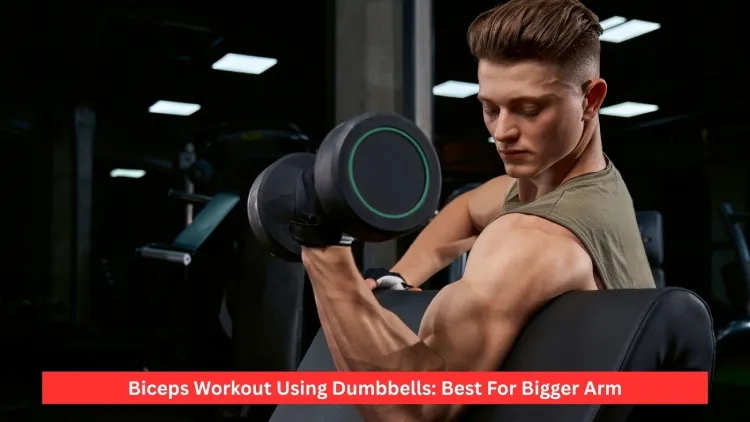
Sit and spread your legs on a chair or bench. Position one hand with a dumbbell and lean an elbow against the inside of the thigh. Gradually raise the weight, paying full attention to squeeze the biceps when at the top. Reduce the mass slowly without allowing the momentum to dominate.
This is an exercise that virtually eliminates body support and thus, all the work is done by the biceps.
Benefits:
The greatest benefit of this motion is the great tightening it produces. It enhances the roundness of the biceps, the strength of the short head, and the enhancement of muscle shape.
Dumbbell concentration curls assist in a special biceps exercise:
- Enhance muscle definition and quality.
- Strengthen mind-muscle connection
- Eliminate cheating movements
- Maximize isolation
Training Insight:
Performing this exercise is more effective using lighter weights and a slower tempo. No one is lifting him; it is about control and full contraction.
5. Incline Dumbbell Curl
One of the most effective exercises to stretch and lengthen the biceps muscle is the incline dumbbell curl exercise. It is an important part of a full biceps exercise that utilizes dumbbells, as it is used to work the long head of the biceps.
Execution:
8. Sit on a sloping bench at about 45 degrees to a 60-degree angle. Hold arms straight behind, holding dumbbells. Gradually stretch and raise the weights with your elbows held rigid. The next repetition should begin by bringing them to full extension.
This exercise becomes so effective due to its deep stretch at the bottom.
Benefits:
This motion stretches the biceps under tension, which is one of the most powerful muscle-growth stimuli. It assists in the formation of the long head that aids in the height and shape of the biceps.
An excellent biceps training with dumbbells entails incline curls since they:
- Improve muscle length
- Develop biceps peak.
- The greater the flexibility at load.
- Strengthen stretched-position strength
Additional Insight:
Delayed soreness is observed in many lifters who have undergone incline curls due to the deep stretch. This is the indicator of good muscle engagement when it is properly performed in a biceps exercise with dumbbells.
6. Reverse Dumbbell Curl
The reverse dumbbell curl is a practical strength exercise that enhances the strength of the forearms and muscles that help support the arms. It is the status quo, but it has a big role to play in the prevention of injury and grip strength during a biceps exercise involving dumbbells.
Execution:
Grip dumbbells, palms facing downwards (pronated grip). Hold your elbows tight to your body and raise up on the weights gradually. Put attention on control and not heavy loading. Return to the same slow speed by reversing the weights.
The grip alters the muscle emphasis, and the workload is shifted to the forearms and brachialis.
Benefits:
- Reverse curls: Reverse curls help develop balanced arm strength through targeting neglected muscles. Well-built forearms enhance grasping power, and this aids in all other curling actions.
A complete biceps workout using dumbbells includes reverse curls to:
- Make forearms and grip strong.
- Improve elbow stability
- Reduce injury risk

Balance arm development
Training Insight:
Since this exercise puts a lot of emphasis on smaller muscles, one should use lighter weights. Excessive use may cause strain on the wrist or elbow. Combined with other styles, reverse curls make a balanced biceps combination using dumbbells that builds not only beauty, but also functional strength.
Full Biceps Workout Using Dumbbells (Sample Routine) via Dumbbells
A well-built bicep training with dumbbells ought to balance out on volume, intensity, and recovery.
Beginner Routine:
- Standing Curl -3 sets × 12 reps
- Hammer Curl -3 sets x 10 reps.
- Concentration Curl -3-sets of 10 repetitions.
Intermediate Routine:
- Decline Curl- 4 sets and 10 reps.
- Alternating Curl – 3 set x 12 reps
- Hammer Curl – 3 sets of 12 reps.
- Reverse Curl – 3 sets × 10 reps
Advanced Routine:
- Incline Curl – 4 sets × 8–10 reps
- Heavy Standing Curl – 4 sets- 8 reps
- Hammer Curl – 4 sets 12 reps.
Concentration Curl – 3 Sets x 12 reps (slow pace)
An effective workout with dumbbells for the biceps does not need to be a daily bicep workout. It is best to have two to three sessions per week to grow.

Tips in Training to improve outcomes
To achieve the most out of a biceps workout using dumbbells, a training strategy shouldn’t be less important than the choice of exercises.
Key Principles:
- Concentrate on slow, deliberate reps.
- Avoid swinging weights
- Full range of motion.
- Increase resistance gradually
Flex train biceps: 2-3 times a week.
Recovery Insight:
It is during rest, but not training, that muscle growth occurs. Overtraining may make things time-consuming. Soreness should not take over 72 hours or performance decline; this could be overtraining. Also, a balanced biceps workout using dumbbells with weights never excludes the days of rest.
Stretching:
Post-workout stretching is used to aid in flexibility. One excellent biceps stretch is to fling your arm backwards from your body and softly twist the shoulder, opening up the muscle.
Common Mistakes to Avoid
The reason why many are not able to grow is that their biceps work out with dumbbells is not well executed.
Major mistakes include:
- Using momentum instead of muscle control
- Exercising the biceps daily with no rest.
- Leaving out the complete extension at the bottom.
- Too soon, the lifting is too heavy.
- Not varying exercises
Injury Insight:
The micro-tears or tendon strain are the two common causes of the pain in the biceps after curls. Normal pain is mild, but a sharp pain can be a symptom of tendonitis. In these situations, the intensity needs to be reduced, or the load changed over to light loads. An intelligent biceps exercise with a dumbbell will not cause pain, as it will be focused on form instead of weight.

Final Thoughts
Fully developed arm strength, size, and shape can be achieved with the use of dumbbells alone and not through the assistance of machines. As a beginner or advanced lifter, proper exercise choice, controlled movement, recovery, and progressive overload are the keys to success. The improvement of most individuals is evident in a few weeks, and long-term progress demands time and discipline. Train mindfully, do not over-train,n and work on betterment with the current session. Finally, biceps exercise with dumbbells is one of the most effective and available methods to have strong and defined arms throughout life.
Frequently Asked Questions
1. Does exercise with just dumbbells build biceps?
Yes. You can simply use a dumbbell biceps exercise to gain size and strength as long as you have the right form and vary the weight or the number of reps with time.
2. Can we train biceps daily?
No. The exercise that involves the use of dumbbells to train the biceps should be performed 2 -3 times a week to give the muscles time to rest and develop.
3. Why does it take time to develop biceps?
Regular exercising of the biceps with a dumbbell, you can see the results after 4-8 weeks, and the greater changes after 8-16 weeks.
4. What are the greatest errors of biceps exercises?
Swinging of weights, excessive weight, and a lack of full range of motion are common biceps exercise errors, particularly with the use of dumbbells.