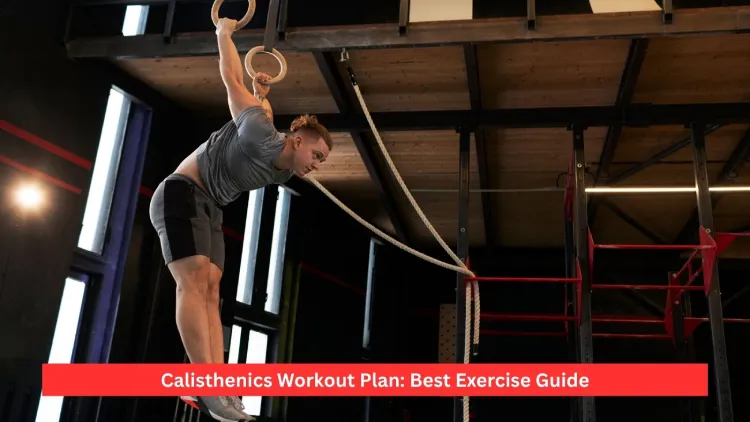

A calisthenics workout plan focuses on bodyweight exercises like push-ups, pull-ups, squats, and planks to build strength, muscle, and endurance. Expect to train 3-6 days a week, consisting of upper body, lower body, and core exercises. The following steps should be used to promote progress: reps, better form, and harder variations. When accompanied by adequate rest, water intake, and diet, calisthenics are sufficient to build muscle, burn fat, and enhance overall fitness.
- Full Body Calisthenics Workout Structure
- Beginner Calisthenics Workout Plan
- Intermediate Calisthenics Workout Plan
- Advanced Calisthenics Workout Plan
- Weekly Calisthenics Workout Plan
- Exercise Progression in Calisthenics
- Calisthenics Circuit Workout Example
- Key Exercise Tips
- Nutrition After Exercise
- Fat Burning and Calories
- Training Duration
- Downsides of Calisthenics
- Comparing Calisthenics and Weights
- Age and Training
- Muscle Growth Differences
- Bone and Strength Benefits
- Conclusion
- Frequently Asked Questions
Full Body Calisthenics Workout Structure
When a calisthenics workout plan is well-designed, it must contain exercises that work on the whole body. Having the right workout plan will guarantee that your body gains in all aspects and avoids any weaknesses.
Push Exercises
Push exercises focus on the chest, shoulders, and triceps. The exercises, such as push-ups and dips, are key to developing the upper body and chest. These movements can be adjusted to make them more challenging, so that you can gradually gain muscle.
Pull Exercises
New exercises aimed at the back and biceps are the pull exercises. The most effective type of bodyweight pulling movement is the pull-up, which is commonly regarded as one of the big three in calisthenics, the others are push-ups and squats. These are the basic exercises that support any calisthenics training programme.
Leg Exercises
The bottom body exercises consist of squats, lunges, and one legging. The exercises enhance and strengthen the hip and leg stability and mobility. More advanced forms, such as pistol squats, make a lot of difference.
Core Exercises
Core training is essential for stability and performance. Planks, leg-raises, and dynamic exercises such as mountain climbers enhance abdominal muscles and general control.
Structuring Your Session
An entire session typically consists of:
- 5–8 exercises
- 3–5 sets per exercise
- 20-8 repetitions (depending on level)
An 80/20 rule, in many forms, is the method that many athletes use to gain their results; 80 percent of their gains are through doing basic, basic, basic movements, and 20 percent is through variation and intensity methods.

Beginner Calisthenics Workout Plan
The basic calisthenics workout plan is concentrated on mastering the basic movements and gaining the basis of strength.
1. Push-Ups
- The most basic exercise of the upper body is the push-up.
- They mainly affect the chest, shoulders, and triceps. Only through constant practice can a robust base of more advanced pushing movements be established, which will aid in the development of the chest over time.
2. Bodyweight Squats
- Squats are necessary to strengthen the lower body.
- They involve the quadriceps, hamstrings, and glutes. Regular squatting enhances the mobility and strength required to do intense leg exercises.
3. Incline Push-Ups
- This fluctuation makes it less challenging and allows new people to be strong over time.
- It enables the proper form development that is essential to the progress of the contents of any calisthenics program in the long term.
4. Glute Bridges
- Glute bridges build up the posterior chain.
- They aid in the use of the under-utilized glutes and provide good posture and movement efficiency.
5. Plank Hold
- Planks develop the stability of the core.
- They tighten the abdominal muscles, which play a vital role in virtually all movements in calisthenics.
6. Assisted Pull-Ups
- Pull-ups are not particular to novices, and thus, you can use some help.
- This workout develops the pulling power to do full pull-ups in the future.
At this stage, it is best to train 3-4 days a week. The duration of the sessions must be 30-60 minutes with enough time breaks to rest.
Intermediate Calisthenics Workout Plan
A moderate calisthenics exercise program is more vigorous and adds to the routine more strenuous tasks.
1. Standard Push-Ups
- Push-ups at this phase are more regulated and increased in volume.
- They are also important in making the chest stronger and more outlined.
2. Pull-Ups
- Backs require pull-ups.
- They help in increasing total upper body thickness and strength, too.
3. Lunges
- Lunges enhance one-legged strength and balance.
- They aid in the correction of muscle imbalances and enhancement of coordination.
4. Dips
- Dips are very useful in strengthening the chest and triceps.
- One of the best workouts to build upper body pushing strength is them.
5. Leg Raises
- The lower ab muscles are strengthened with the help of leg raises.
- They play a vital role in the formation of the core and management.
6. Mountain Climbers
- It is a dynamic movement that builds endurance and burns calories.
- When performed consistently, high-intensity exercises such as this can dramatically boost calorie burning and aid in fat burning, even burning belly fat.
The intermediate training usually has definite schemas, e.g., the so-called 3-3-3 rule, i.e., 3 exercises per muscle group, 3 sets per exercise, and 3 times per week.

Advanced Calisthenics Workout Plan
A developed calisthenic exercise program incorporates explosive, extremely controlled movements.
1. Decline Push-Ups
- This change enhances activation of the upper chest.
- It is very powerful in developing a larger and more powerful chest.
2. Pistol Squats
- One-legged squat, which requires strength and balance.
- It is one of the most challenging lower-body exercises.
3. Muscle-Ups
- A combination of pull-up and dip.
- This volcanic action generates strength and organization.
4. Handstand Push-Ups
- Shoulder exercise at a high level.
- It grows strong, balanced, and in control.
5. Hanging Toes Raise to Knees
- This enhanced core action enhances strength and flexibility.
6. Burpees
- Efforts that include a combination of cardio and power.
- High-rep burpees are also capable of burning a lot of calories and are relatively the closest bodyweight workouts to incredibly high-calorie burn workouts.
Elite athletes tend to have 4-6 training days a week, but rest becomes of high importance. Fatigue, deteriorated performance, and stagnation in progress can become the results of overtraining.
Weekly Calisthenics Workout Plan
It is important to have a well-laid plan of weekly calisthenics workouts to maintain progress.
- Day 1 – Upper Body: Push-ups, pull-ups, dips, planks
- Day 2 – Lower Body: Squats, lunges, glute bridges, calf raises
- Day 3 – Core + Conditioning: Leg raises, mountain climbers, planks, burpees
- Day 4: Rest
- Day 5 – Full Body: Combination of all major exercises
The frequency of training can be different. A lot of individuals exercise 3-5 days a week, and high-performance athletes can exercise more frequently. Nevertheless, the number of intense sessions per day is usually too many, which may adversely affect recovery.
Exercise Progression in Calisthenics
In any calisthenics workout plan, progression is imperative.
- Ways to Progress
- Increase repetitions
- Add more sets
- Reduce rest time
- Use harder variations
- Slow down the movement tempo
Progression is achieved through large movements because a person can gain more control and make the movements difficult (as compared to weight training).
Although conventional programs such as the 5-3-1 are weight-based, the same can be adopted by cycling intensity by doing fewer reps, which are more intense, and more reps, which are easier.

Calisthenics Circuit Workout Example
A calisthenics workout plan is most effective using circuit training.
Perform exercises continuously:
- Push-ups
- Squats
- Pull-ups
- Plank
- Lunges
- Play several rounds.
This type is good at increasing stamina, burning calories, and cardiovascular fitness.
Key Exercise Tips
Rest Between Sets
Ordinarily, rest falls within:
- 30–60 seconds for endurance
- 60–90 seconds for strength
- Adequate rest averts fatigue and sustains performance.
Recovery and Overtraining
Overtraining is indicated by signs such as:
- Persistent fatigue
- Decreased performance
- Unrelieving muscle soreness.
- To sustain progress, recovery is a necessity.
Muscle Growth with Calisthenics
Using bodyweight exercises alone can indeed make you build muscle. Compound movements such as push-ups, dips, and pull-ups will stimulate multiple muscle groups and therefore be effective for hypertrophy.
Certain muscles, like calves and forearms, take longer to develop, and others, like the back and the chest, react faster.
Chest Development
Constructing a large chest with variations such as: can be achieved with a well-crafted calisthenics workout plan.
- Push-ups
- Dips
- Decline push-ups
Nutrition After Exercise
Once you finish a session in a calisthenics workout program, your body requires nutrients in order to rejuvenate and restore muscle. Protein is important in muscle rebuilding, and it aids your body in recuperating after workouts such as push-ups, pull-ups, and squats.
Eggs are also good sources of protein, and depending on your level of training and the desired outcome, you may need additional protein sources like chicken, fish, or plant foods. Protein plus carbohydrates can also be used to replenish after exercise.
Hydration is also important. Taking water during and after training helps in maintaining performance, preventing fatigue, and aiding in recovery. Most exercises only require water, which is especially true when the workout takes less than an hour.

Fat Burning and Calories
A properly organized calisthenics exercise program can help lots in fat burning. High heart-rate exercises such as burpees, mountain climbers, jump squats, and high-rep circuits, among others, burn a great deal of calories.
Although indirectly building belly fat, no exercise will make your body drop overall fat, and as a result make the belly leaner. The integration of the strength-based movement and high-intensity workouts is among the most effective ways to enhance muscle tone and caloric expenditure.
The trick lies in consistency and striking a balance between workouts and rest.
Training Duration
The average duration of most exercises in a calisthenics workout plan should range between 45 and 75 minutes. The range gives sufficient time to engage in various exercises with a correct intensity and rest.
Even shorter workouts can be effective provided they are not too long, but intense and well-organized; longer workouts can cause fatigue and decrease performance. Indoctrinating excessively also has a tendency to cause overtraining, hence slowed progress.
It is necessary to concentrate on quality, rather than on quantity; controlled movements and correct form are more significant than just working harder.
Downsides of Calisthenics
A calisthenics workout plan is very effective but has its limitations. Isolating particular muscles may prove to be more difficult than in the case of weight training. The majority of exercises are compound exercises, that is, several muscles are exercised simultaneously.
Advancement may be cumbersome at the advanced stages as well. You will have to use more advanced variations, which would be more skilled and controllable, rather than adding weight to them. This may be impeding in case it is not handled in the right way.
One more weakness is that there is no resistance outside of the body, and it could be difficult to develop muscles to maximum size, as is in heavy weightlifting.
These obstacles can, however, be met by changing variations in exercises, adding more, and refining technique. With the correct attitude, calisthenics is one of the most efficient and effective training techniques to attain power and fitness.
Comparing Calisthenics and Weights
Muscle and strength can be gained efficaciously through both calisthenics and weight training. A calisthenics workout plan aims at body weight training, such as push-ups, pull-ups, and squats, which enhance control, balance, and functional strength. These movements include training of various muscle groups simultaneously, thus becoming efficient and practical.
External resistance used in weight training is simple to increase intensity by merely adding weight. In certain instances, this enables a quicker development, and in particular cases when specific muscles are being addressed.
Calisthenics, on the other hand, enhances the natural ability of coordination and control over the body. To achieve optimal performance, many individuals often combine the two procedures/techniques whereby they utilize the bodyweight exercise to enhance general body strength and weights to help in developing specific muscles.
Age and Training
There is nothing wrong with a 25-year or later beginning of a calisthenics exercise schedule. Consistency, choice of exercise, and recovery are more vital than age in progress.
Calisthenics is particularly appropriate for adults, as exercises can be easily modified to your level. Simple movements with simple variations can be basic but can be extended and advanced to more complex movements without overstraining the joints for beginners.
Through practice, strength, endurance, and flexibility can be enhanced at any age.
Muscle Growth Differences
Not all muscles develop at an equal rate. Compared to smaller muscles, such as the shoulders, traps, and legs in a calisthenics workout plan, the larger muscles, such as the chest, back, and legs, are more likely to develop faster due to the compound exercises.
Smaller muscles, like calves and forearms, tend to develop more slowly and might require additional care by increasing repetitions or specific variations.
In most exercises, core muscles are always engaged to aid the development of strength and stability in the long run. Nevertheless, muscle definition is also visibly dependent on the general fat in the body. Balanced muscle growth is based on consistency and progression.
Bone and Strength Benefits
A calisthenics exercise regimen is known to make muscles and bones strong. Squats, lunges, or pull-ups are examples of exercises that provide controlled stress to the body in support of bone density and healthy joints.
The tendons and ligaments of these movements are also made stronger, and the overall stability is enhanced with decreased risk of injury. Since calisthenics involves the natural models of movement, it improves balance and strength through coordination and functioning.
With time, frequent exercise results in a firmer, more robust body that will not only excel in exercise but also in day-to-day tasks.

Conclusion
Well-thought-out workout program in calisthenics is an effective method to train strength, muscle, stamina, and general fitness with minimal equipment ( body weight ).
With basic exercises and slow and consistent workouts, you can make a miracle without going to the gym. Calisthenics is an all-inclusive training system, whether you are aiming to build your muscles, lose weight, or even increase athletic performance. The trick is easy enough: learn the ropes, be regular, and constantly push your body by varying exercises.
Frequently Asked Questions
1. Does a calisthenics exercise program pack on muscle?
Yes, a good calisthenics work program can make you gain muscle. Exercises such as push-ups, pull-ups, and dips offer sufficient resistance to spur muscle building, particularly as you become increasingly challenged by variation and volume.
2. Which frequency of a calisthenics workout plan should I use?
The majority experience tremendous outcomes as they train 35 days a week. Beginners can gradually increase to 3 days, with the intermediate and advanced people training more often regarding recovery and intensity.
3. Does calisthenics suffice to lose fat?
Yes, using a calisthenics fitness regimen could help in losing fat, provided it is consistent. Exercises with high intensity, such as burpees and mountain climbers, aid in burning calories that take place in the entire body because of proper nutrition.
4. What should be the duration of a calisthenics workout?
The average length of a calisthenics workout plan session is 45 to 75 minutes. This gives time to have various exercises, good rest, and correct form without overtraining.