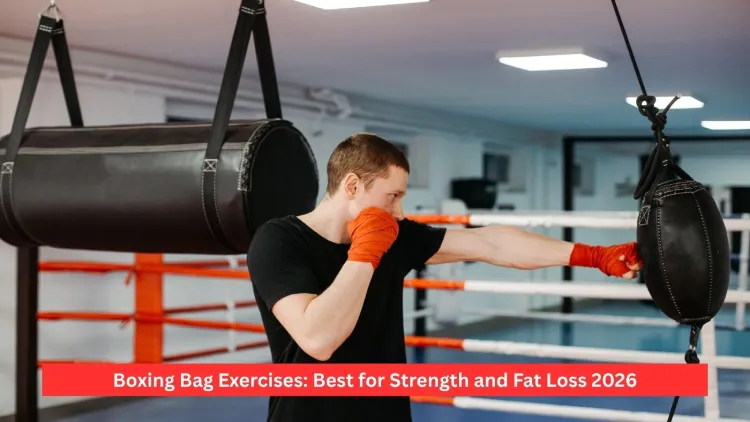

Boxing bag exercises provide a great total-body training session that builds strength, aerobic endurance, and coordination. They work the arms, shoulders, core, and legs; they are fat-burning and also help construct lean muscle. Heavy bag training will also improve balance, reaction time, speed, and athletic ability. It is a combination of cardio and strength exercises, making it suitable for both newcomers and seasoned practitioners. Boxing bag exercise routines enhance fitness, support weight loss, and can significantly affect physical transformation and changes in mindset.

- Benefits of Boxing Bag Exercises
- Muscles Worked During Boxing Bag Exercises
- Essential Boxing Bag Exercises
- Beginner Boxing Bag Workout
- Advanced Boxing Bag Workout
- Tips for Effective Boxing Bag Training
- Common mistakes to avoid:
- Why Boxing Bag Exercises Are Effective for Weight Loss
- How Boxing Bag Training Can Change Your Body
- How Often Should You Train With a Boxing Bag?
- Bone Health and Boxing Bag Workouts
- Possible Disadvantages of Boxing Training
- Conclusion
- Frequently Asked Questions
Benefits of Boxing Bag Exercises
There are several physical and mental advantages to boxing bag workouts.
Full-Body Workout
The striking of the heavy bag engages the upper body, lower body, and core at the same time. When punching, the movements of the arms, legs, and torso need to be synced. Boxing bag routines work the body in a holistic system of exercises instead of concentrating on a single muscle group in isolated exercises.
The shoulders are engaged constantly to ensure stability and punch, with the chest and triceps creating the power. The feet are to be positioned and advanced for balance and power to be generated in the legs. Core muscles rotate and stabilize when performing a combination. The multi-muscle exercise is very functional and effective, as it involves several muscles involved in a single exercise.
Improves Cardiovascular Fitness
Boxing bag training allows for high heart rates and is great for calorie burn and cardiovascular health. The punches are repeated in intervals, and movements are made to the bag, which is beneficial to the aerobic and anaerobic systems.
Short bursts of intensity (time-cycled) can, over time, increase stamina and endurance. Boxing Bag circuits are also popular choices for athletes looking for a type of interval training that will effectively develop their cardiovascular capacity without depleting the muscles.
The number of calories burned in a vigorous heavy bag session depends on the intensity of the workout, the body weight of the trainer, and the length of time of the training, and these can be hundreds of calories. Training sessions can provide enough calories during a high-intensity run or circuit training session.
Enhances Strength and Power
Continuous striking develops muscular endurance in the shoulders, chest, arms, and legs, and develops explosive power. Punches involve pushing with the legs up to the body and have the potential to increase athletic strength.
Heavy bag training can also be useful to boost the activation of fast-twitch muscles. Explosive combinations, hooks, and uppercuts involve quick movements with the intention to increase speed and power output. The exercises can help to increase punch strength, reaction time, and athletic ability over time.
Increases coordination and balance skills.Improves coordination and balance.
Good footwork and punching add to the control, balance, and coordination of the body. When training to throw combinations, the nervous system must be trained to move the bag around while throwing and improve movement efficiency.
Many of the beginning students do not get a good balance during punches. However, regular exercise enhances posture, body movements, and stability. The athletes/people looking for enhanced functional motion in daily life will find this helpful.
Stress Relief
Boxing bag exercise is a good method to relieve stress and concentrate the mind. Moving in rhythm linked with physical exertion will often decrease anxiety and tension.
A key advantage of heavy bag exercise is that it is a stimulant workout – you have to concentrate and be physically tough to perform the exercises. Along with it, this mix may bring a better mood, enhance self-confidence, and contribute to mental well-being.
Supports Bone Strength
Hit or weight-bearing activity potentially can stimulate bone health. Boxing bag exercises include standing, impact, and tension, which may help keep bones stronger with proper nutrition and resistance training.
For healthy bone density, particularly during aging, the activities that encourage movement, stability, and strength are suggested as well. Shadow boxing, pace movement, resistance training, walking, and balance exercises are all forms of exercise that may result in long-term skeletal health.
Muscles Worked During Boxing Bag Exercises
Boxing bag exercises work a lot of different muscle groups, such as:
- Shoulders
- Biceps
- Triceps
- Chest
- Core muscles
- Back muscles
- Glutes
- Quadriceps
- Hamstrings
- Calves
Since the whole body is engaged, boxing bag training is beneficial to the Athletic formation and Functional Fitness. During multiple attempts at punching, the shoulders are in use, and the core is in use to generate power during an arc for hooks, crosses, and uppercuts.
Legs also make a huge difference – it all begins with the bottom. Calves, quadriceps, and glutes aid in balance, movement, and explosive power. The back muscles maintain good posture and assist with the recovery of the punch.
Some muscles, such as calves, forearms, and shoulders, might be more susceptible to development or simply not develop well based on body type and/or genetics. When boxer bag training is combined with the use of correct nutritional principles and training methods, however, it can help the individual develop their endurance, conditioning, and muscle development.

Essential Boxing Bag Exercises
Jab
Not a single workout for the boxing bags would be complete without this exercise.
How to Perform
- Assume your stance, ready for boxing.
- Keep your guard up.
- New lead arm held straight out in front of the bag.
- Pull your hand in quickly to face.
Benefits
- Improves speed
- Builds shoulder endurance
- Develops coordination
Jab is considered boxing’s base. While easier to learn than any of the other punches, the Jab can have a profound effect on timing, rhythm, and efficiency of movement. The quickness and accuracy of a jab will also keep your distance and retain control.
When using a boxing bag, concentrate on snapping the punch, NOT pushing the bag. Controlled technique will be more effective than uncontrolled force.
Cross Punch
A strong cross punch is done with the back hand.
How to Perform
- Turn hips and shoulders.
- Stretch your right arm to the bag.
- Turn your foot back to add power.
- Go back into guard position.
Benefits
- Builds upper-body power
- Strengthens the core
- Improves rotational movement
The cross is a big power play due to the use of full-body rotation. Good form helps channel energy work through the legs, hips, and shoulders into the punch.
The mixture of the jab and cross is one of the most frequently used punching attacks in boxing. This is the ‘1-2’ sequence that many beginners are familiar with. Boxing terms used for numbers:
- 1 = Jab
- 2 = Cross
- 3 = Lead hook
- 4 = Rear hook
- 5 = Lead uppercut
- 6 = Rear uppercut
This knowledge helps to make combinations easier to train with the bags and makes training them more efficient.
Hook Punch
Hooks hook HOOK to the side of the bag in a circular motion.
How to Perform
- This will bend the elbow at a right angle.
- Punch with rotation of the hips.
- Use front knuckles to strike the bag.
Benefits
- Improves punching power
- Isolates shoulders and core strength.
- Enhances rotational stability
Proper body rotation and balance are necessary for Hooks. If they are performed properly, they can provide a forceful, coordinated energy. In boxing, the “3 punch” is called the lead-hook combination.
There are even some advanced combinations, such as sequences like 3-3-3, which are highly likely to involve multiple throws of hooks or punches, without stopping, for conditioning and endurance training.
Uppercut
There is an upward punching movement in the uppercuts.
How to Perform
- Keep knees just slightly flexed.
- Push up on legs.
- Using a punch move, stamp up and towards the bag.
Benefits
- Activates legs and core
- Builds explosive strength
- Improves coordination
Uppercuts are better shot from a close distance with a solid “leg drive”. These can make a huge difference when it comes to engaging the lower body and doing core movements.
The pattern of movement upwards also benefits the coordination of the upper body and legs. Many high-level boxing bag workouts feature alternating between endurance and power foot motion, which is the upper cut.
Punching Combinations
Punch combinations are supposed to be a lot of exercise and cardiovascular.
Example Combination
- Jab
- Cross
- Hook
- Cross
Make combinations continuously for 30-60 seconds.
Benefits
- Improves stamina
- Improves the rhythm and timing
- Burns calories quickly
Combination training is used so that there is an increase in the amount of cardio required, and to create a more boxing movements pattern. The more the skill is developed, the more complex combinations can be introduced.
Depending on boxing style, or boxing parlance, there are also boxing systems that feature a “7 punch”, usually a lead hook to the body.
Power Punch Rounds
In this exercise, emphasis is put on maximum punching force.
How to Perform
- For each of the next 20 seconds, throw a powerful punch.
- Rest for 10 seconds.
- Repeat for multiple rounds.
Benefits
- Builds explosive strength
- Improves muscular endurance
- Increases intensity
When playing Power Rounds, you use fast-twitch muscle fibres, which puts a lot of stress on them. They are drills that can help develop strike power and also anaerobic conditioning.
Speed Punch Drills
Speed Drills: Throw some quick punches and very little rest.
How to Perform
- Pull the punching bag down hard and quickly for 15-30 seconds.
- Maintain proper form.
- Sit for a short rest, then repeat.
Benefits
- Improves hand speed
- Boosts cardiovascular fitness
- Increases endurance
Fast punching drills can also help to develop reaction time and endurance in the shoulders. It is important to have good technique when moving quickly to avoid breakdown in technique due to fatigue.
Footwork Around the Bag
The footwork is an essential component of boxing performance.
How to Perform
- Walk around the bag, keeping a stable body position.
- Practice forward, backward, and side movements.
- Include actions with punches.
Benefits
- Improves agility
- Enhances balance
- Develops coordination
Quality footwork enhances efficiency and helps minimize potential energy lost during fitness activities. Did not remember that movement is important in training, but having the right position is key to the heavy bag workout.

Beginner Boxing Bag Workout
Here is a simple beginner boxing bag workout:
| Exercise | Duration |
| Jab and Cross | 1 minute |
| Hook Punches | 1 minute |
| Uppercuts | 1 minute |
| Punch Combinations | 1 minute |
| Rest | 30 seconds |
Perform the circuit 3-5 times.
For beginners, focus on consistency and not power. Carrying out correct body stance, breathing, and movement patterns is significant compared to hitting the boxing bag with all your force.
Begin short sessions of only 15 – 20 minutes. Slowly make a greater effort and length of time as endurance builds up. Hand wraps and gloves can also be utilized to help protect the knuckles and wrists in the early stages of training.
For people who have no experience, it’s common to get tired when you are doing exercises for the shoulders. Muscular endurance can be greatly improved with continued practice.
Advanced Boxing Bag Workout
For experienced individuals, try this advanced workout:
| Exercise | Duration |
| Speed Punches | 45 seconds |
| Power Punches | 45 seconds |
| Punch Combinations | 1 minute |
| Footwork Drills | 1 minute |
| Burpees Between Rounds | 30 seconds |
Complete 5–8 rounds.
Advanced exercises can be very challenging due to the explosion of movement, endurance, and effort. These exercises will test cardiovascular endurance and strengthen the muscles while developing coordination.
Boxing bag circuits are an excellent way to lose lots of calories with high intensity. A few people can burn up to 500 calories in a hard 30-minute workout of boxing, depending on intensity and physical size.
If an individual seeks to burn fat, boxing bag training can be extremely beneficial when coupled with walking, strength training, and the correct diet.
Tips for Effective Boxing Bag Training
- Punch with Proper Form – Avoid strain on wrists, elbows, and shoulders by using the right punching technique.
- Keep the core engaged: A strong core enhances the stability, balance, and hitting strength from punching.
- Wear Hand Wraps and Gloves – Avoid injury to hands and wrists when using the heavy bag.
- Concentrate on controlled breathing – release the breath on punching to make it throughout the hour, and avoid fatigue.
- Start slowly: begin by focusing on technique before increasing the level of activity.
- Target the Most Suitable Time to Exercise – Participate in exercise at the time that is most convenient for you and allows you to maintain exercise over time.
Common mistakes to avoid:
- Every Punch – Overpower – Focus on control and technique instead of all-out effort on each punch.
- Failure to incorporate footwork – Good foot movement also enhances balance, power transference, and coordination.
- Dropping Your Hands – Always keep your guard up. If you have to drop, look, maintain the proper boxing form and posture.
- Poor Posture – Do not lean too far forward to minimise stress on shoulders and lower back.
- No Warm-Ups – Get your heart rate elevated with light jogging, jumping rope, or shadow boxing before practice.
Why Boxing Bag Exercises Are Effective for Weight Loss
Boxing bag exercises are an excellent combination of cardiovascular and strength routine that burns tons of calories from woodworking. Punch fast and engage several muscle groups to burn calories and build up endurance.
They are also excellent for fat loss, as they involve a lot of explosive movements such as punching, footwork, and combos. They do not specifically combat belly fat, but they can lower body fat in general, leading to a more defined belly with time.
Boxing bag training can be a powerful weight loss and fitness tool when paired with regular exercise routines, proper nutrition, and regular exercise, such as walking.

How Boxing Bag Training Can Change Your Body
A regular boxing bag workout will very obviously change your body composition. Many individuals develop:
- Leaner muscles
- Better posture
- Increased shoulder definition
- Stronger core muscles
- Improved leg endurance
- Reduced body fat
Boxing is not all about getting big muscles; it is a mixed bag of strength and cardio, which from time to time can end up generating an athletic rather than heavy frame. These repetitive types of movements enhance muscle endurance and overall conditioning.
Is it OK to grow muscles with a boxing bag?
Yes, particularly lower body muscular endurance and lower body lean muscle growth. Although boxing bag training might not be as effective in creating muscle size and overall muscle, it will still promote muscle growth due to the repetitive resistance and impact movements.
With repetitive heavy bag play and practice, the shoulders, arms, back, and core are clearly seen to expand.
How Often Should You Train With a Boxing Bag?
For most people:
- Beginners: 2–3 sessions per week
- Intermediate: 3–5 sessions per week
- Advanced: 5–6 sessions per week
Have enough rest days to avoid overtraining and muscle fatigue.
Others might ask, what happens (says what) if they punch a punching bag daily? If intensity changes on a daily basis and recovery is emphasized/increased, training is possible daily. But too many, without breaks, of heavy bag training could increase the risk of overuse injuries, shoulder strain, or discomfort in the wrist.
Incorporating hard intervals and easier recovery exercises can help to optimize sustained schedule adherence and exercise effectiveness.
Bone Health and Boxing Bag Workouts
Movement, resistance, and impact exercises might help to maintain strong bones. Boxing bag training is the incorporation of standing movement, muscular tension, and controlled impact, which can play a role in maintaining bone strength.
Resistance training, walking, balance exercises, and good nutrition can have a positive impact on individuals who want to strengthen their bones. The minerals calcium, Vitamin D, Magnesium, and protein are all important to the health of the bones.
Some cultures also believe that the key to a long and healthy life is to ensure an active lifestyle. Regular walking, mobility work, balance exercises, and eating a nutritious diet are typical strategies that promote health in the long run.
Another balance exercise sometimes suggested to help with stability and movement to strengthen bones is standing on one foot.
Hydration and nutrition are also important. When used with exercise and a diet rich in calcium and nutrients, these drinks can help keep bones healthy.
Possible Disadvantages of Boxing Training
While there are numerous benefits that come from boxing bag training, there are some disadvantages when you try to train improperly.
These may include:
- Wrist strain
- Shoulder soreness
- Hand injuries
- Overtraining fatigue
- Having poor posture due to incorrect technique
Slow or inaccurate punching technique and/or too much force can create injury potential. Learning correct mechanics and gradually progressing intensity are important for safe training.
Even for new and total beginner boxers, intense boxing exercise can be a little tough. It’s generally best to start slowly and gradually work up in increments.

Conclusion
Boxing bag exercises offer some of the top workouts for strength, endurance, coordination, cardiovascular health, and overall fitness. Whether you’re just starting or looking to master some high-level bag usage, a boxing bag can incorporate a wide range of movements and offer total-body training.
These exercises can be used to help burn calories, build endurance in the muscles, assist fat loss, build muscle in the core, and promote athletic conditioning. There may also be benefits to regular heavy bag session training when it comes to posture, movement quality, and body composition in general.
Boxing bag workouts can be highly beneficial, whether you’re looking for stamina, fitness, lean muscle growth, stress reduction, or conditioning. Consistency, proper technique, slow progression, balanced recovery, and continuing maintenance of fitness over time are the keys to success.
Frequently Asked Questions
2. Will using a boxing bag increase my core strength?
Boxing bag training is great for full-body exercise as it uses the arms, shoulders, core, back, and legs simultaneously. Strengthens muscle, cardiovascular, endurance, coordination, and overall fitness in a single workout.
2. Does a boxing bag workout burn fat and shape the body?
Yes, regular box bag training helps to burn calories, increase metabolism, and lower total body fat. As it passes over time, it may give you a smoother body, slimmer look, and assist in lasting weight loss if you have implemented a good diet.
3. For how many times a week do I need to work on the boxing bag?
The beginner may start 2-3 times a week, intermediate – 3-6 times a week, as long as they are not getting tired, and advanced – 3-6 times a week, depending on recovery. The importance of rest and proper technique to prevent overtraining and injuries.
4. Do Boxing Bag Exercises promote muscle growth and strength?
Yes, boxing bag training builds lean muscle, particularly in the shoulders, arms, core, and legs. It makes muscles more explosive, endures longer, and helps them grow more muscle, but unlike bulk, it contributes to functional strength.