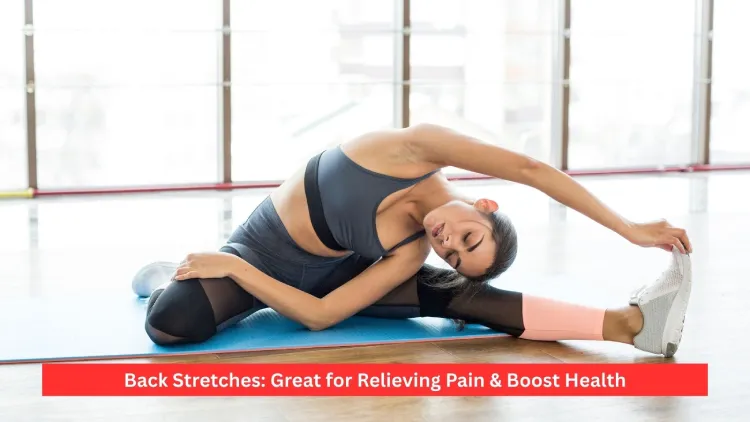

Back stretches are necessary exercises to alleviate tension, decrease stiffness as well and enhance mobility in your spine. Specific exercises that stretch the lower back, hips, hamstrings, and glutes can unlock a tight back and alleviate chronic pain and build strength in the posture. Adding yoga techniques like daily stretching can improve the spinal condition in general, not only decreasing the intensity of the back pain but also increasing the flexibility, the strength of supportive muscles and overall of the spine.
1. Cat-Cow Stretch
Location: Whole spinal column, central, buttocks.
Cat-Cow is among the best exercises that can be used to warm as well as stretch the spine. It is a life force movement which involves light spinal flexion and extension, hence it can be done by starters and experienced exercisers.
How to do it:
- Start in a table form on your hands and knees with your wrists close to your shoulders as well as your knees close to your hips.
- Breathe in, bend your back with stretching belly down to the floor and lifting up of head and tailbone to the ceiling (Cow Pose).
- Ease, arching your spine minuscule to the ceiling, drawing in your chin as well and challenging your belly button ( Cat Pose).
- Perform this movement in 10-15 repetitions, paying attention to smooth control breathing.
Benefits:
- Enhances the spinal motion and flexibility.
- Lowers the tension of the lower back and neck.
- Improves correct posture through core worker muscles.
- Helps will release tight hips and lower back by firing up the muscles around it.
This is especially effective when one is having a lot of back stiffness due to the length of sitting or sitting in an inappropriate posture. This stretch can be used periodically as a basis for more compound back exercises.

2. Child’s Pose
Target area location: Lower back, hips, and shoulders.
In Child’s Pose, the spine is stretched out with ease, and the hips are also opened; the lower back is also relaxed. Physical therapists and fitness trainers like it as a way to get comfortable and relax.
How to do it:
- Sit down on the floor behind on your knees.
- Place your arms forward and the mat and bend the torso downwards.
- Place your forehead on the floor and have your shoulders and your upper back relax all the way.
- Maintain the position of 30-60 seconds, taking deep breaths.
Benefits:
- Alleviates lower back, hip and buttock tightness.
- Strengthens the spine and the shoulders.
- To loosen a stiff back, one should move the vertebrae softly in a way that will decompress them.
- Promotes stress and relaxation.
This stretch can be incorporated in a routine practice, performing it at the same time, as short as 20 minutes per day, as it will feel very rewarding on the stiffness of the back, and the flexibility of the spine in the long run.
3. Seated Forward Bend
Location of focus: The lower back, hamstrings.
The Seated Forward Bend is applied to the lower back, as it also stretches hamstrings. This factor is very important in the alignment of the spine and the posture. Tight hamstrings may also be a contributing factor to back pain, and therefore, the stretch will be a necessity for general back health.
How to do it:
- Sit up on the floor, keeping your legs straight in front of you.
- To stretch your spine and work your spine up and down, breathe in, then straighten out all the time when bending your back forward, this time bent towards your feet, exhale.
- Bend your back straight instead of curling too much, and maintain the posture between 20-30 seconds.
Benefits:
- Soothes the back and hamstrings of the lower part.
- Helps stop tightness in the posterior chain, which causes back pain.
- Promotes spinal mobility and flexibility.
To people who are having pain or tightness in their buttocks or glutes, a fold over the buttocks or on the glute may be used by making a fold and reaching it to a small extent. It is also suggested and used as a pre-workout or post-workout regimen to avert injury.

4. Knee-to-Chest Stretch
Target area: Lower back, glutes.
The Knee-to-Chest Stretch is very powerful in relieving the Lower back and tightening the muscles on the glutes and hips. It is an easy activity that would make one feel less stiff and more comfortable in a short time.
How to do it:
- Get into a position of lying on your back with your knees bent and your feet flat on the floor.
- Keep one knee bent in the direction of the chest, keeping the other foot to the ground.
- Hold between 20-30 seconds, and change legs.
- To continue further, both knees are brought towards the chest of the person, simultaneously.
Benefits:
- Bends the lower back and the glutes.
- Soothes tension in the buttocks or tight hips.
- It may be used to stretch a stiff back.
- Aids the general body position and movement.
This movement indirectly helps the knees and helps to relieve the load on the sacroiliac joint, so it is a universally applicable part of the back-focused workout.
5. Spinal Twist
Spine, lower back, obliques.
Spinal twists are effective stretches to reduce tension along the spine, enhance rotational flexibility as well and appeal to oblique muscles. They also assist in the alleviation of the tightness of the lumbar and mid-back.
How to do it:
- Lie on your back, and with your arms straight out to the side.
- Bay your knees and simply fold one leg forward and let it fall to one side, but not your shoulders.
- Wait 20-30 sec, and change sides.
Benefits:
- Improves the spinal mobility and rotational flexibility.
- Soothes back pain in the lower and mid-back.
- Helps helps loosen tight hips and lower back at the same time.
- Prevents backache in people who have stiffness due to poor posture or office work.
Spinal twists will add to your everyday routine of back stretches and help avoid chronic spinal stiffness as well as promote healthier spinal movement patterns.

6. Cobra Stretch
Location area: Lower back, chest, spine.
The Cobra stretch or the back extension stretch is a stretch that builds and stretches the spine, as well as opens the chest and shoulders. It works especially well in overcoming the impact of constant sitting.
How to do it:
- Lie on the floor face down, with the palms kept under the shoulders.
- Breathe in and push into your hands to lift your chest off the floor, bending your elbows slightly.
- Breathe in (retain 15-20 seconds) and breathe out.
Benefits:
- Firms the lower back and is a light form of stretch.
- Extension of the chest and shoulders, an enhancement of the posture.
- Helps bears loosen back in a quick and effective way.
- Loose stiffness of the spinal extensors.
Cobra stretch has also been ranked among the top 3 exercises that are available in keeping the back healthy, together with pelvic tilt and their bridge exercises, which are a central set of moves to maintain the health of the spine and the body in a stable condition.
7. Pelvic Tilt
Target area: Lower back, core
Pelvic tilts are non-vigorous exercises which improve the lower back and internal core muscles and lengthen the lumbar spine. They are an essential part of the back pain prevention and posture improvement exercise.
How to do it:
- Sit on your back and keep your feet flat to the floor.
- Bend your lower back on the floor and engage your abdominal muscles, and lift your pelvis upwards.
- Wait to get several seconds, let go and repeat 10-15 times.
Benefits:
- Develops stiff muscles around the spinal column.
- Tension in the lower back is relieved.
- Helps unlock back and enhance spinal instructions.
- Lessens the danger of loss of body in other exercises.
It is a good exercise that forms a complete back program, mostly applied in lower back pain rehabilitation.

8. Standing Forward Fold
Location: Lower back, hamstrings.
Standing Forward Fold is a stretch pose which lengthens the spine and hamstrings; it enhances blood flow. It is a great method of stretching the back muscles and relieving the stress of standing or lingering.
How to do it:
- Support feet in an upright position that is hip wide.
- Lean forward with the hips to enable your torso to be suspended towards the floor.
- Have a slight bend at the knees, should you want, and rest your neck and head.
- Wait 20 -30 seconds, taking deep breaths.
Benefits:
It relieves the lower back and hamstring tension.
- Helps the spine to be flexible and mobile.
- Encourages back rest and eliminates stress on the back.
This is an effective stretch in terms of enhancing hamstring flexibility, which in turn enables the back and decreases stiffness. It may also be used to treat conditions that are related, like plantar fasciitis, by stretching the back chain.
Other Back Stretching Tricks and Advice.
To enjoy the maximum benefits of back stretches, it is worth taking the practical tips as follows:
- Warm-up initially: Find some cardio that is not challenging, or do some dynamic stretches to get your muscles ready.
- Breathing: Pay attention to slow, purposeful breathing that helps achieve greater relaxation and better depth of stretching.
- Bounce: Stretches need to be done without bouncing, and thus to avoid injury.
- Pay attention to your body: Lad, stretch till the strain, but not soreness.
- Consistency is key: 20-minute stretching excessively might help take back pain down, especially indeed the days of the week.
- Use the 3-3-3 principle: To the gym attendee, an easy standard of 3 sets, 3 reps and 3-5 full work stretches per movement is just enough to stretch the muscles and work them out.
- Stretching after exercises: Stretching will help decrease muscle pains, tight hips, and maintain the health of the spine.

Benefits of Back Stretches
There are many benefits to the inclusion of these exercises in your workout:
- Alleviates lower back pain and stiffness.
- Enhances flexibility and mobility.
- Loose tight hips and buttocks.
- Improves spinal positioning and posture.
- Removes tension and stress in muscles.
- Helps to avoid injuries and to create overall mobility.
- Heightens the flow of blood to muscles.
- Helps in overcoming back pain and sciatica.
- Helps in improving the joints, knees, and hips.
- Strength training and daily life performance.
Safety and Considerations
Back stretches are not very dangerous usually; however, some precautions should be observed:
- Do not overexert the body; this may overstretch the muscles and ligaments.
- Discontinue it in case of sharp pains or numbness.
- See a doctor in case of a chronic back problem or injury.
- Do not overstretch when starting; start slowly and progressively.
Stretching can be inappropriate as an initial management tool of such serious conditions as the plantar fasciitis or high-degree arthritis; however, such gentle stretches, along with specific treatments, can help. Nutritional deficiencies, such as vitamin D or calcium deficiency, have the potential to worsen skeletal muscle problems, and hence, it is important to have a balanced diet.

Final Thoughts
Back stretches are not just a temporary alleviation of stiffness but rather a long-term investment in the spinal health, the mobility, as well as the well-being of the body. With the help of such exercises as the Cat-Cow, Child’s Pose, using your Knee-to-Chest, and Knee-to-Chest-to-Spinal-Twists, you could open up tight spots, eliminate stress, and avoid chronic pain.
Even only 20 minutes of daily stretching can have a tremendous impact, as it can help to stay upright, open tight hips and lower back, and be more flexible. Always have in mind that the best back exercise is the one that is done safely, consistently, and in good breathing and a good position.
Back stretches are an easy and efficient way to relax your back and improve your flexibility, or just keep your back healthy, regardless of whether the aim is to reduce pain, enhance flexibility, or just use it to keep your back in top fitness. Get them involved in your way of life and your back will pay you with even more strength, comfort and movement.
Frequently Asked Questions
1. What should be the frequency of the back stretches?
You should extend your back every day or weekly (at least 3-4 times), this is the best way to do it. Flexibility, reduction of stiffness, and maintenance of spinal health can also be achieved even by a 20-minute of daily, regular stretching.
2. Are back stretches helpful in the treatment of chronic lower back pain?
Yes. Regular back bends, including Cat- Cow, Child’s and Knee-to-Chest, can lower the strain, give a better as well and ease the discomfort due to chronic lower back pain. Stretching also aids in effectiveness when combined with proper posture and exercises known as core.
3. Should beginners do back stretches?
Absolutely. Spinal Twist and Seated Forward Bend are the most beginner-friendly back stretches that are beginner-friendly. Begin with simple stretches; do not overstretch or strain too hard, or one may be injured.
4. Do other areas, such as the hip and hamstring, increase in flexibility through stretching?
Yes. Many back stretches target other muscles surrounding, such as the hips, glutes and hamstrings. To mention an example, Knee-to-Chest and Standing Forward Fold are useful to loosen the tight hips and enhance the flexibility of the lower parts of the body, which provides spinal health.