
Yoga positions are effective body weight exercises that enhance strength, flexibility, balance, and endurance. This manual includes basic poses, routines, and principles, along with other styles of yoga-and these are designed to help you create an entire system of exercises through the use of yoga poses.
- What Are Yoga Positions?
- Advantages of Yoga Postures as Exercises
- Yoga Poses that are the best for exercise
- The way to design a yoga practice
- Things on the Learning Sets of Yoga Positions
- Yoga has several styles of practice.
- Basic tenets of Yoga postures
- Structural Foundations and Systems
- Yoga Positions in Categories
- Higher Yoga Asanas and Level of Difficulty
- Traditional and Historical Perspective
- Famous Yoga Poses in Workouts
- What is the Right number of Yoga Poses to Practice?
- How to Practice Yoga Positions Safely
- Mistakes to Be careful of
- Are Yoga Poses sufficient as exercise?
- Conclusion
- Frequently Asked Questions
What Are Yoga Positions?
Yoga positions are a series of organized body movements that are meant to strengthen the body, increase flexibility, and make the body more efficient in overall movements. Such postures are also known as asanas, in which they are performed in series or held in place, ensuring they exercise various muscle groups.
In contrast to high-intensity exercises, yoga poses emphasize slow movement, balance, and body awareness. Both poses engage certain muscles and ensure a better level of coordination and stability. Simple standing postures evolve to sophisticated balancing types, as the yoga conscious exercises are self-sufficient, having no machinery to operate.
Pragmatically, yoga postures are work-outs. They are a replica of normal body movements, including bending, stretching, twisting,g and stabilization, making it very effective in long-term fitness.
Advantages of Yoga Postures as Exercises
The poses associated with yoga positions have numerous advantages when practiced regularly as an exercise program.
1. Improves Flexibility
Through frequent poses, the yoga positions gradually stretch the muscles and increase the movement of the joints. With time, stiffness disappears, and the movement becomes easier.
2. Builds Strength
There are lots of yoga poses where body weight is utilized as a resistance. Such postures as plank, chair, and warrior strengthen muscles in the hands, legs, and abdomen.
3. Improves Balance and Coordination.
Maintaining the yoga posture will teach the body to maintain balance, enhance balance, and reduce falls.
4. Boosts Core Stability
Most yoga positions involve the use of core muscles. This makes the abdomen stronger and favors improved posture.
5. Foster Recovery and Injury Prevention.
Light stretching by using yoga poses makes muscles less tight and enhances blood circulation to aid in recovery following vigorous exercises.
6. Improves Endurance
Prolonged yoga poses develop stamina in the muscles and the strength of the mind.
Yoga Poses that are the best for exercise
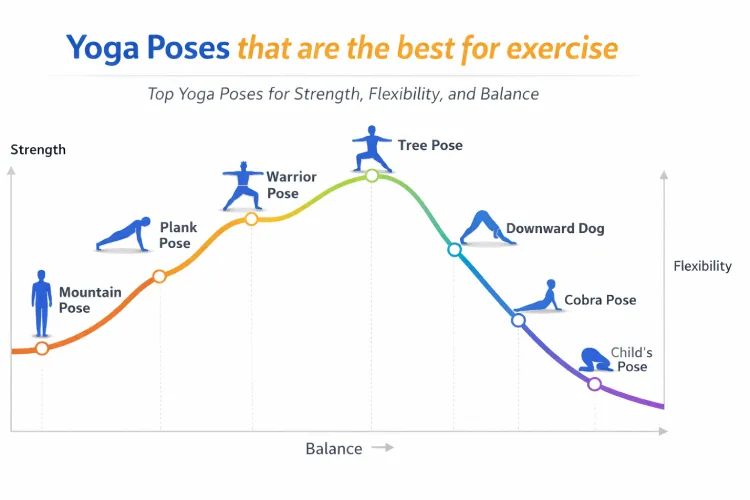
Some of the most efficient yoga positions that can be considered full-body exercises are shown below:
1. Mountain Pose (Advanced Exercise)
How to Do It:
Sit erectly with feet drawnin closen to each other, arms slack, and core active.
Benefits:
- Improves posture
- Builds foundational strength
- Enhances body awareness
2. Downward Facing Dog (Full Body Stretch)
How to Do It:
Lift hips upward,d forming an inverted V shape.
Benefits:
- Makes arm and shoulders stronger.
- Stretches hamstrings
- Improves circulation
3. Plank Pose (Core Strength Exercise)
How to Do It:
Maintain an upright posture and lean on your hands and feet.
Benefits:
- Builds a strong core
- Improves endurance
- Strengthens the upper body
4. Warrior I (Lower Body Strength)
How to Do It:
Lunge forward with arms overhead.
Benefits:
- Strengthens legs
- Improves balance
- Opens hips
5. Warrior II (Stability and Endurance)
How to Do It:
Bend your knee in front and extend your arms without losing balance.
Benefits:
- Builds stamina
- Strengthens legs
- Improves coordination
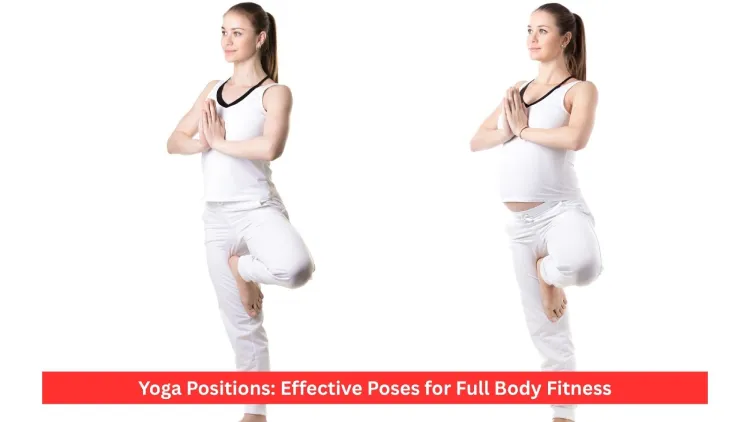
6. Tree Pose (Balance Exercise)
How to Do It:
Get on one leg, then put your other foot on your inner thigh.
Benefits:
- Improves balance
- Enhances focus
- Strengthens legs
7. Back and Glutes Bridge Pose
How to Do It:
When lying on your back, raise your hips.
Benefits:
- Strengthens glutes
- Improves spine flexibility
- Opens chest
8. Cobra Pose (On the Spine Strengthening)
How to Do It:
Raise his chest and lie on his back.
Benefits:
- Strengthens spine
- Improves posture
- Stretches chest
9. Child Press (Recovery Exercise)
How to Do It:
Bend on your knees and lie backward.
Benefits:
- Relaxes muscles
- Reduces tension
- Promotes recovery
10. Chair Pose (Lower Body Workout)
How to Do It:
Kneel in a sitting posture.
Benefits:
- Strengthens thighs
- Engages core
- Builds endurance
The way to design a yoga practice
Yoga positions need to be arranged systematically in order to maximize the results.
Warm-Up (5–10 minutes)
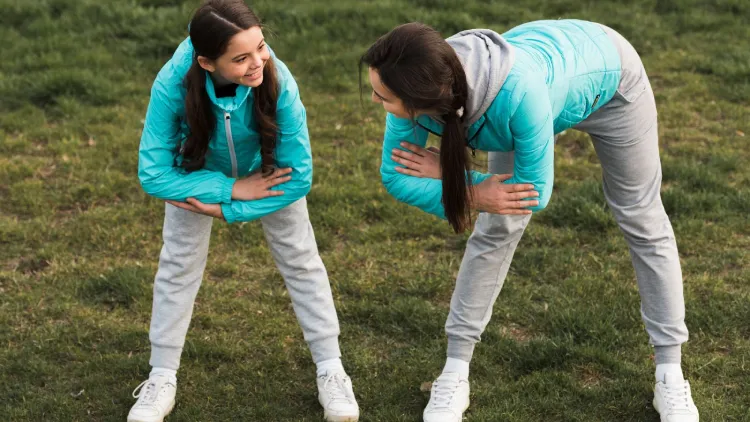
The first stage should be soft yoga postures to get the muscles ready. Both the standing stretches and light bends are done slowly, thereby aiding in an increase in blood flow.
Main Workout (15–30 minutes)
Combine shapes of yoga based on strength, balance, and flexibility. Complete rest balance could involve standing postures, abdominal activities, and active movements.
Cool Down (5–10 minutes)
Finish with resting yoga poses like Child Pose to ease the tension in the muscles and enhance the recovery.
Things on the Learning Sets of Yoga Positions
The poses of yoga positions are commonly arranged in a series. A flowing sequence,e which is a combination of 12 positions common to yo,ga, is used in full body activation. Such sequences comprise forward bends, backbends, and strength poses to help in a harmonized workout.
Certain routines consist of 7 basic yoga postures easy enough that any beginner can follow, but some can go up to 10, 12, 15, or 20 poses, depending on the level of difficulty in the workout and the length of time.
The other, more traditional systems have longer sets, like 26 structured yoga positions carried out in a fixed sequence. These practices are geared toward systematically attacking the whole body.
Yoga has several styles of practice.
The yoga poses are performed in various exercise styles.
All these styles are oriented to one approach:
- Strength styles focus on the practice of difficult yoga poses.
- Flow styles: The flow styles unite the yoga postures into smooth motion.
- The styles that relate toflexibilitys are deep and slow stretching.
- Balance-oriented styles are preoccupied with control and stability.
Several styles of yoga have been identified, and they are usually divided into 4, 7, 8, or even 15 yoga styles based on classification. Others work on physical exercise, and others integrate exercise with breath inhalation.
Basic tenets of Yoga postures
The main principles present in yoga postures will guarantee even safety and efficacy in the course of the exercise. Adhering to these principles can make you achieve improved results and minimise the possibility of injury.
1. Proper Alignment
Correct posture in every yoga pose is proper alignment. This makes sure that the correct muscles during certain activities are used and unnecessary straining of the joints is avoided. Balance and general efficiency of movement are also enhanced.
2. Controlled Breathing
Inactive breathing is very important during the execution of yoga poses. Slow and controlled breathing allows one to stay in balance, endurance in muscles, and the body can be relaxed even in difficult poses.
3. Consistency
To improve progress, it is necessary to practice yoga positions frequently. As the person progresses,s the consistency enhances strength, flexibility, and balance. The results can be observed even with short daily sessions.
4. Moderation between Strain and Rest
The yoga postures are not supposed to be painful but rather challenging. It is aimed at a compromise with muscles, which are occupied but not overstrained. This method will permit sustainability to be improved steadily without the risk of injury.
5. Mind-Body Connection
Pay attention to the movements of your body in some yoga positions. This will give you more understanding and control. This association can assist you in doing exercises more efficiently and minimize the possibility of the wrong position.
Structural Foundations and Systems
Yoga poses have wider frameworks within which they are instructed in yoga:
- There are 4 foundations of some system which revolve around discipline, movement, awareness, and control.
- Some of them spread to 5 or more principles of breathing, relaxation,n and focus.
- Developed systems are also 8-step systems explaining an all-embracing method of physical and psychological training.
Such systems guarantee that yoga is exercised to perform effective exercises, but not random movements.
Yoga Positions in Categories
The positions in yoga can be classified into three broad categories, according to the way the body is disposed. All types are significant to the establishment of a balanced exercise program.
1. Standing Positions
Standing yoga postures are wonderful for developing the sense of strength, stability, and balance. They are predominantly focused on the legs, the core, and the back, and enhance posture and coordination. Such poses in yoga are mostly performed as the initial exercises in order to mobilize the body and boost energy.
2. Seated Positions
Sitting yoga poses emphasize postures and flexibility. They hamper the hips, hamstrings, and lower back, and also enhance controlled motion. These are yoga poses that are good for enhancing mobility and are often applied in the middle or cool-down part of a routine.
3. Lying Positions
The yoga positions, which lie on the floor, are suitable to relax and recuperating. They aid in muscle tension reduction, enhancement of the spinal position, and gentle strengthening. Such yoga poses are typically performed when one is finished with a workout to relax the body and recover.
Higher Yoga Asanas and Level of Difficulty
Although most yoga poses are not difficult, there are some that are very tough. The poses involved in advanced stages are very demanding in terms of strength, flexibility, and balance.
The hardest yoga poses usually entail:
- Full body balance
- Deep backbends
- Arm balancing techniques
Some poses are deemed to be the most challenging poses because of the strength and control needed. It is, however, a matter of difficulty with respect to the individual level of fitness and experience.
Traditional and Historical Perspective
The poses in yoga positions have been modified over the ages, with certain sets of practices discussing dozens of poses, or symbolic numbers like 84 or even a thousand different poses have been stated.
In real life, contemporary workout plans emphasize several practical yoga exercises that would give the best physical results.
Yoga is regarded as one of the oldest types of organized physical activity, and body conditioning and movement training have a long history in comparison to other movement systems.
Famous Yoga Poses in Workouts
Out of all yoga poses, some have been popular in practice because of their effectiveness:
- Downward Dog
- Plank Pose
- Warrior Poses
- Tree Pose
- Cobra Pose
- Chair Pose
They tend to be included in lists of the most popular yoga positions, as they can be practiced by a wide range of fitness levels and target several muscle groups.
What is the Right number of Yoga Poses to Practice?
The yoga poses you take in the session are subject to the purpose:
- The novices may start with 7-10 yoga poses.
- Intermediate routines can consist of 1220 positions.
- Long runs can be used in advanced levels.
It has more to do with consistency rather than with the quantity of yoga poses taken.
How to Practice Yoga Positions Safely
A good warm-up should come before starting.
- Pay attention to proper posture.
- Avoid overstretching
- Progress gradually
- Listen to your body
A safe practice of yoga bears long-term benefits without any injury.
Mistakes to Be careful of
- Breath associates with poses.
- Doing yoga in a hurry.
- Ignoring alignment
- Skipping recovery poses
These are the errors that should be avoided to enhance the efficiency of your workout.
Are Yoga Poses sufficient as exercise?
Yoga poses have the capability to offer a total exercise by enhancing strength, flexibility, and endurance. They can substitute regular exercises in the case of a large number of individuals when exercised regularly.
Nevertheless, yoga poses can be combined with other types of exercise to increase general fitness.
Conclusion
One of the most effective and elastic types of exercise that can change your physical fitness is yoga. Starting with the simple poses that are friendly to beginners, to the more challenging ones, they offer a total system of gaining strength, getting better in flexibility, and gaining balance.
Regular yoga postures and correct techniques are able to offer a complete workout of the body, without using equipment and high impact training.
Frequently Asked Questions
1. What are the most popular yoga postures?
The usual yoga postures are Mountain, Downward Dog, Plank, Warrior, Tree, Cobra, and Chair Pose.
2. What is the number of yoga positions?
No definite amount. There are routines of 7-26 yoga positions and symbolic numbers, such as 84, in the traditional texts.
3. What are the main types of yoga?
Various styles of yoga positions are adopted, such a strength based yoga, flow-based yoga, flexibility-based yoga, and balance-based yoga.
4. What is the hardest yoga position?
Advanced yoga poses are the most difficult ones, and they demand great balance, flexibility, and core power.