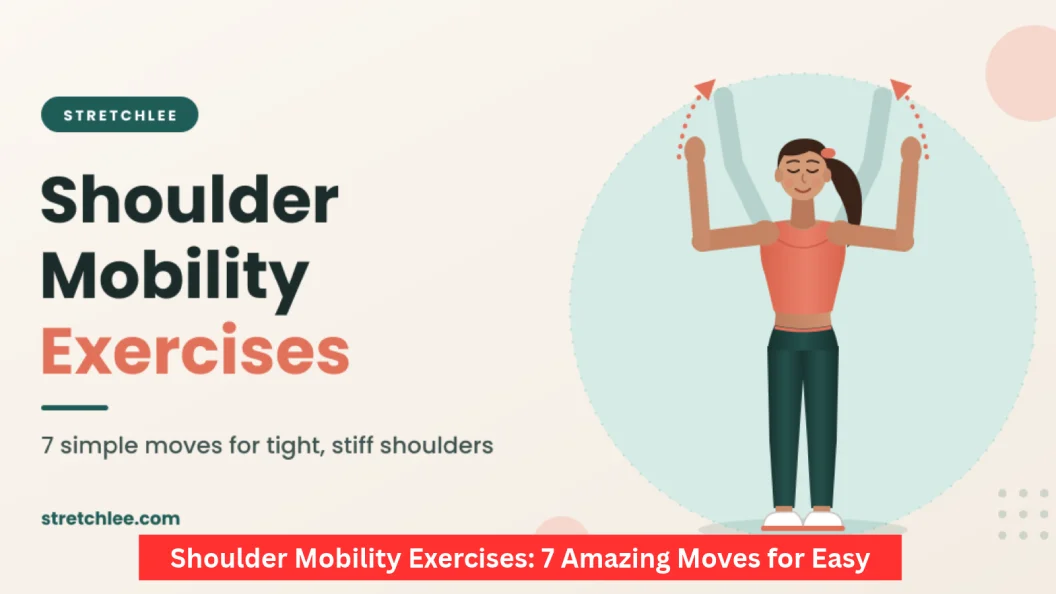

Shoulder mobility exercises may reduce stiffness, increase your range of motion, and make movement more comfortable. Here are 7 simple exercises to help you increase shoulder mobility, flexibility, and upper-body movement.
- What are Shoulder Mobility Exercises?
- Quick Shoulder Mobility Routine at a Glance
- What Is Shoulder Mobility, and How Do You Know Yours Is Tight?
- What Are the Best Shoulder Mobility Exercises?
- How Often Should You Do Shoulder Mobility Exercises?
- How to Build Your Routine
- How Long Does It Take to Improve Shoulder Mobility?
- When Should You Stop or See a Professional?
- Your Next Step
- Conclusion
- Frequently Asked Questions
What are Shoulder Mobility Exercises?
Shoulder mobility exercises are slow, controlled exercises that move your shoulder joint and shoulder blade through its full range of motion. The easiest way to start is with the following 10-minute routine, which you can repeat 3-5 times per week. Stretch each stretch for approximately 30 seconds and avoid having them hurt.
Why does it matter? Every day, you stretch, lift, and carry with your shoulders. When they’re stiff, your neck and lower back do the lifting for you, and now it’s becoming cumbersome to get a hold of something that’s on top of a heavy shelf.
Key Takeaways
- Shoulder mobility is your ability to move your arm through its full range of motion with control, not just how far a muscle can stretch.
- A 10-minute shoulder mobility routine done 3 to 5 days a week is enough for most healthy adults to make steady progress.
- Static stretches work best after a short warm-up and should be held for at least 30 seconds without bouncing.
- Your upper back (thoracic spine) and shoulder blades affect how high you can lift your arms, so a good routine trains them too.
- Stop any exercise that causes sharp pain, numbness, or tingling, and see a professional if pain lasts or gets worse.
Quick Shoulder Mobility Routine at a Glance
| Exercise | Sets x Reps or Hold Time | Best For | Level |
| Shoulder CARs | 2 x 5 slow circles each way, each arm | Full-joint warm-up | Beginner |
| Wall slides | 2 x 10 | Overhead reach, posture | Beginner |
| Thread the needle | 2 x 8 each side | Upper-back rotation | Beginner |
| Doorway chest stretch | 2 x 30 sec | Rounded shoulders | Beginner |
| Cross-body shoulder stretch | 2 x 30 sec each arm | Back of the shoulder | Beginner |
| Band pull-aparts | 2–3 x 15 | Shoulder blade strength | Beginner–Intermediate |
| Bench lat stretch | 2 x 30–45 sec | Lats, overhead lockout | Intermediate |
What Is Shoulder Mobility, and How Do You Know Yours Is Tight?
Shoulder mobility is the range of movement and control you can achieve with your arm. It relies on the ball-and-socket joint (glenohumeral joint), shoulder blade (scapula), upper back, and the muscles around them. Common indicators of limited overhead reach are trouble reaching overhead, a pinch at the top of a reach, or rounded shoulders.
The shoulder joint is the place where your collarbone, upper arm bone, and shoulder blade come together. The ball is held in place in its socket by four small rotator cuff muscles. The larger muscles, such as the deltoids, pecs, and lats, are responsible for the bulk of the work.
Signs your shoulders are tight or weak:
- You can’t raise both arms straight overhead without arching your lower back.
- Your fingers stay far apart when you reach one hand behind your head and the other up your back.
- Your shoulders round forward when you sit at a desk.
- Your arms tire fast when you hold them overhead.
What Are the Best Shoulder Mobility Exercises?
The best shoulder mobility exercises involve some joint circles with control, some upper-back rotation, some chest and back-of-shoulder stretching, and some light band work on the shoulder blades. Do the 7 moves below in order. Each contains sets, reps, or hold time, how often to do it, and an easier and harder version.
Most beginners rush through their reps. I have to tell people when I teach this routine to move at half their speed; otherwise, the slower reps will reveal where they are at a loss.

1. Shoulder CARs (Controlled Articular Rotations)
Purpose: This warms up the joint by taking it through its biggest pain-free circle, and it shows you where you’re tight.
- Stand tall and lightly brace your abs so your ribs don’t flare.
- Make a fist and raise one arm forward and up as high as you can without arching.
- At the top, turn your palm out and sweep the arm back and down behind you.
- Reverse the circle. If you feel a pinch, make it smaller.
- Dose: 2 sets of 5 slow circles each way, each arm, 3–7 days a week
- Feel it here: Deep in the shoulder joint and around the shoulder blade
- Common mistake: Twisting your body to fake extra range
- Easier: Smaller circles while seated
- Harder: Take 20 seconds per circle and squeeze your fist hard
2. Wall Slides
Purpose: Wall slides train your shoulder blades to rotate upward so you can reach overhead without arching.
- Stand with your back against a wall, feet about 6 inches out, knees soft.
- Press your lower back gently toward the wall and raise your arms into a “goalpost” shape.
- Slide your arms up slowly, keeping elbows and wrists near the wall.
- Stop before your lower back peels off or you feel a pinch, then slide down.
- Dose: 2 sets of 10, 3–5 days a week
- Feel it here: Back of the shoulders and below the shoulder blades
- Common mistakes: Arching your lower back; shrugging toward your ears
- Easier: Let your forearms leave the wall and go halfway up
- Harder: Face the wall with a light band around your wrists
3. Thread the Needle
Purpose: This opens your upper back (thoracic spine), which gives your shoulders a better base to move from.
- Start on your hands and knees, hands under shoulders, knees under hips.
- Reach your right arm toward the ceiling and follow it with your eyes.
- Sweep the same arm under your chest toward the left, palm up.
- Rest your shoulder and head on the floor for 2–3 breaths, then reach up again.
- Dose: 2 sets of 8 each side, 3–5 days a week
- Feel it here: Upper back and the back of the shoulder
- Common mistake: Letting your hips drift back toward your heels
- Easier: Sit in a chair, hand behind your head, and rotate
- Harder: Hold the threaded position for 20–30 seconds
4. Doorway Chest Stretch
Purpose: This stretch opens the chest and the front of the shoulders, which often tighten from sitting.
- Stand in a doorway with your forearms on the frame, elbows just below shoulder height.
- Step one foot forward.
- Lean gently until you feel a stretch across your chest.
- Keep your chin tucked and ribs down, and breathe slowly.
- Dose: 2 holds of 30 seconds, up to daily
- Feel it here: Across the chest and front of the shoulders, not inside the joint
- Common mistake: Elbows above shoulder height, which can pinch
- Easier: One arm at a time with a smaller lean
- Harder: Hold for 45–60 seconds
5. Cross-Body Shoulder Stretch
Purpose: This targets the back of the shoulder, a common tight spot for lifters and throwers.
- Sit or stand tall and bring your right arm across your chest.
- Hold it just above the elbow with your left hand, not on the joint.
- Gently pull the arm toward your chest.
- Keep your right shoulder down, away from your ear. Switch sides.
- Dose: 2 holds of 30 seconds each arm, 3–7 days a week
- Feel it here: Back of the shoulder and upper back
- Common mistakes: Pulling on the elbow joint; twisting your torso
- Easier: Keep the arm lower with a lighter pull
- Harder: Do it lying on your back to keep the shoulder blade still
6. Resistance Band Pull-Aparts
Purpose: Pull-aparts strengthen the muscles between your shoulder blades so you can control your new range.
- Hold a light resistance band at shoulder height, palms down, elbows slightly bent.
- Pull the band apart until it lightly touches your chest.
- Squeeze your shoulder blades for 1 second without shrugging.
- Return slowly over 2–3 seconds.
- Dose: 2–3 sets of 15, 2–4 days a week
- Feel it here: Between the shoulder blades and back of the shoulders
- Common mistake: Using a band that’s too heavy, so your back arches
- Easier: A lighter band or wider grip
- Harder: Palms-up grip with a 3-second pause
7. Bench Lat Stretch (Prayer Stretch)
Purpose: This loosens the lats and triceps, which often limit how high your arms go overhead.
- Kneel facing a bench or couch with your elbows on the edge, palms together.
- Walk your knees back until your hips are over them.
- Sink your chest toward the floor, hands drifting behind your head.
- Keep your ribs tucked so your lower back doesn’t sag. Breathe out and hold.
- Dose: 2 holds of 30–45 seconds, 3–5 days a week
- Feel it here: Sides of your back near the armpits and backs of your upper arms.
- Common mistake: Holding your breath
- Easier: Child’s pose with your arms on the floor
- Harder: Hold a dowel between your hands

How Often Should You Do Shoulder Mobility Exercises?
Do shoulder mobility exercises 3 to 5 days a week for about 10 minutes per session. If you are extremely stiff, you can do a quick session every day, as long as it doesn’t cause any pain. Harvard Health recommends shoulders be stretched 3 to 7 times per week, and as often as daily if very stiff.
How long should you hold each stretch?
Start with 30-second holds. Harvard Health says static holds of 30 seconds to 2 minutes work best after a warm-up.
How to Build Your Routine
The 10-minute version (3–5 days a week):
- Shoulder CARs – 2 minutes
- Thread the needle – 2 minutes
- Wall slides – 2 minutes
- Doorway chest stretch – 2 minutes
- Band pull-aparts – 2 minutes
The 20-minute version (2–3 days a week): Do all 7 moves in order, 2 sets each, resting 20–30 seconds. Before lifting, do the active moves and save long holds for after.
How Long Does It Take to Improve Shoulder Mobility?
People generally feel more relaxed immediately after a session, but with regular practice, change takes place. Most experience improved overhead reaching in a few weeks, with 3-5 sessions per week. Be consistent rather than do long sessions.
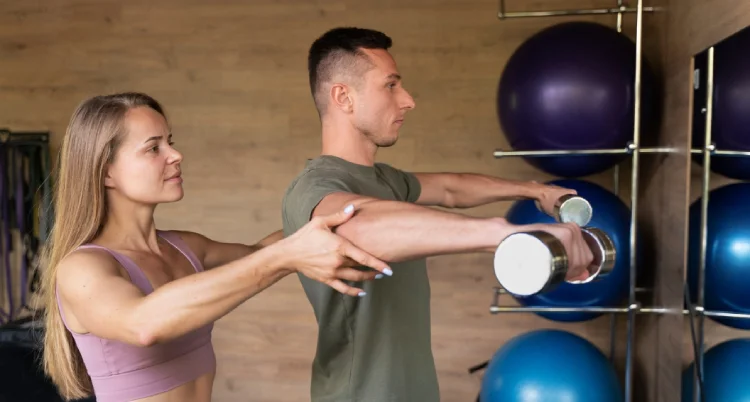
See if you can fit it into the back scratch test: Reach one hand over the shoulder and one up your back and photograph the space, then repeat the test every 2 weeks.
When Should You Stop or See a Professional?
Stop and see a doctor or physical therapist if you feel sharp pain, numbness, tingling, or weakness, or if pain lasts more than 2 weeks or gets worse. If you’ve had a recent injury, a dislocation, or shoulder surgery, get cleared before you start any shoulder mobility routine.
Red flags:
- Sharp or stabbing pain during any move
- Numbness, tingling, or pain running down your arm
- Night pain that wakes you up
- A feeling that your shoulder might slip out of place
- Pain that lasts more than 2 weeks or keeps getting worse
With rotator cuff injuries, therapists usually rebuild range of motion first and add strength later.
Stretchlee Tip: Check your ribs before you blame your shoulders
Many people who “can’t” get their arms overhead are really flaring their ribs. Before each overhead rep, breathe all the way out through pursed lips until your ribs drop, then lift. If your back still peels off the wall during wall slides, your limit may be upper-back and core control, not your shoulder joint. That’s why thread the needle is in this routine.
Your Next Step
Tight shoulders usually come from too little movement, not too much. You now have 7 moves, a 10-minute plan, and clear signs to stop. Start the short routine three times this week, keep every rep pain-free, and retest your back-scratch reach in two weeks. These shoulder mobility exercises work even better when your upper back moves well, so never skip thread the needle.
Conclusion
The key to improving shoulder mobility isn’t a complicated workout; it’s consistency. Do these 7 shoulder mobility exercises 3-5 times per week to become more mobile and comfortable. Move slowly and concentrate on good form, and do not make any of the exercises painful. These simple movements can help to develop improved shoulder motion and ability to perform daily tasks over time.
Frequently Asked Questions
What is the best exercise for shoulder mobility?
There’s no single best exercise, but shoulder CARs come close because they move the joint through its full circle with control. For the best results, pair them with an upper-back move like thread the needle and a stretch for tight spots, such as the doorway chest stretch. Variety covers more of the shoulder’s range.
Can you do shoulder mobility exercises every day?
Yes, most healthy adults can do gentle shoulder mobility exercises every day. Keep daily sessions short, around 5 to 10 minutes, and stay in a pain-free range. If your shoulders feel sore the next day, cut back to 3 or 4 days a week and lower the intensity of your stretches.
Should you do shoulder mobility before or after a workout?
Do active moves like shoulder CARs, wall slides, and band pull-aparts before a workout to warm up the joint. Save long static holds, like the doorway and cross-body stretches, for after training or a separate session. This order prepares your shoulders to lift without making them feel loose or unstable.
What’s the difference between shoulder mobility and flexibility?
Flexibility is how far a muscle can lengthen when something stretches it, like your other hand or a doorway. Mobility is how far you can actively move the joint yourself, with control and strength. Good shoulders need both, so a smart routine mixes stretches with active, controlled movements and light band work.