
Do you notice your upper back tightening after sitting at your desk for long periods? Restricted mobility can make even basic tasks like reaching, twisting, and bending uncomfortable. At-home Thoracic Mobility Exercises at Home focus on increasing flexibility, rotation, and movement in the upper back with gentle, simple stretches. Try these 7 simple exercises to relieve a stiff upper back and to make everyday activities more comfortable.
- What Is Thoracic Mobility?
- What Do You Need for Thoracic Mobility Exercises at Home?
- 7 Best Thoracic Mobility Exercises at Home
- Which Home Thoracic Exercise Should You Choose?
- Common Errors in Thoracic Mobility at Home
- When and How Often Should You Practice?
- Who Should Avoid or Modify These Exercises?
- Conclusion
- Frequently Asked Question
What Is Thoracic Mobility?
Thoracic mobility is the ease of the thoracic spine moving. The middle and upper portion of your back consists of 12 vertebrae (T1 – T12).
The thoracic spine is different than your lower back because it attaches to your rib cage. It helps you rotate your torso, reach over your head, and move your upper torso.
There are four important movements:
- Rotation: Rotating upper body left or right.
- Extension: Gently bending your upper back backward.
- Flexion: Rounding your upper back forward.
- Side bending: bending to one side.
It doesn’t take a lot of flexibility to move well. More useful aims are to move easily and control muscles.
The mobility of the thoracic spine is also not the same as stretching one back muscle. These exercises require the movement of the spine and its associated joints.
What Do You Need for Thoracic Mobility Exercises at Home?
A benefit of having home mobility training is that you don’t need a lot of equipment in order to get the training.
To get started with:
- A stable chair with no wheels.
- An exercise mat or comfortable carpet.
- A small towel.
- An open wall.
- Space to reach out arms safely.
- A foam roller is not required.
Select a chair that will not slip as you move. When practising on the floor, remove any items from around the floor that could make it awkward to turn on.
Wear clothing that gives freedom of movement.
Most importantly, start with a smaller range that you think you would need. You intend to move in a comfortable manner—not to stretch as far as possible.
7 Best Thoracic Mobility Exercises at Home
These movements include seated, standing, and floor-based options. Choose whichever positions work best for you.
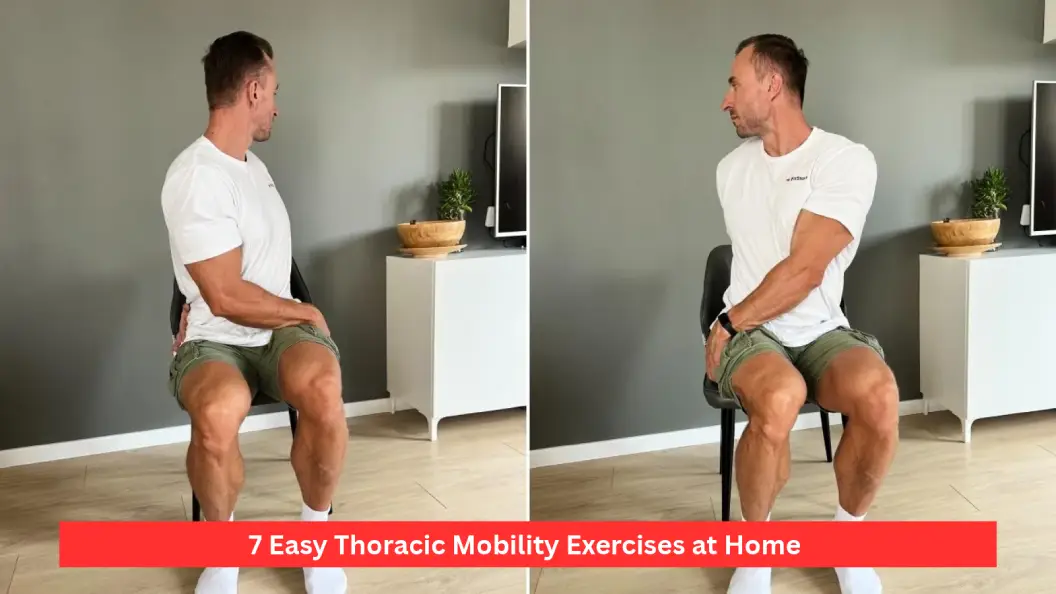
1. Seated Thoracic Rotation
If you spend much of your day sitting, this is an easy exercise to begin with.
It helps you practice rotating your upper body without needing floor space.
How to do it:
- Sit upright on a stable chair.
- Place both feet flat on the floor.
- Cross your arms over your chest.
- Slowly turn your upper body toward the right.
- Keep your hips facing forward.
- Return to the center and repeat toward the left.
Complete 5–8 comfortable repetitions on each side.
Form tip: Imagine your chest turning with your shoulders. Avoid turning only your neck.
Beginner modification: Reduce the rotation distance if your back feels restricted.
This exercise is particularly convenient during short breaks from computer work.
2. Open Book Stretch
The open book stretch is a gentle floor-based movement that emphasizes upper-back rotation.
How to do it:
- Lie on your side with both knees bent.
- Place a cushion beneath your head.
- Extend both arms forward with your hands together.
- Slowly lift your upper arm toward the ceiling.
- Continue opening your chest until you reach a comfortable position.
- Return slowly and repeat.
Perform 6–8 repetitions before switching sides.
Keep your knees comfortably stacked to reduce unnecessary movement through your lower back.
Form tip: Follow your moving hand with your eyes only if your neck feels comfortable.
Beginner modification: Place a pillow between your knees or use a smaller opening movement.
Don’t force your upper arm to touch the floor.
3. Thread the Needle
Thread the needle helps to gently rotate the top of the back whilst you are still supported on your hands and knees.
How to do it:
- Start on all fours on an exercise mat.
- Place hands under shoulders.
- Place right arm under left arm.
- Gently rotate the upper body.
- Stop when your upper back feels comfortable in movement.
- Return to starting position.
- Repeat 5-8 times on each side.
You may feel a pulling sensation in your upper back and shoulder area.
Form tip: Do not push your shoulder into the floor.
Beginner modification: Do not fully straighten the supporting arm and decrease the rotation.
If it causes pain in the knees, kneel while seated.
4. Seated Chair Thoracic Extension
This movement lets you practice extending your upper back using furniture you already own.
How to do it:
- Sit on a sturdy chair with a supportive backrest.
- Place both feet firmly on the floor.
- Bring your hands behind your head for gentle support.
- Position your upper back against the top of the backrest.
- Slowly lean backward through your upper-back region.
- Return upright with control.
Perform 5–8 slow repetitions.
You should feel controlled movement rather than sharp pressure on your spine.
Form tip: Avoid dramatically arching your lower back to create a deeper position.
Beginner modification: Keep your arms crossed over your chest and perform a smaller backward movement.
This is a practical option when you don’t want to interrupt your day with a full exercise session.
5. Cat-Cow With an Upper-Back Focus
Cat-cow is a mix of flexion and extension of the spine.
You can focus your attention throughout your entire spine, but the middle and upper back are more of a focus.
How to do it:
- Begin on your hands and knees.
- Place your hands below the level of your shoulders.
- Make a slow arc towards the ceiling with a rounded back.
- Allow your head to move with the rest of your body.
- Gently lower your chest, reversing the movement.
- Repeat for 8-10 slow, controlled reps.
Don’t arch your back so it is uncomfortable.
Form tip: If you move slowly enough, you will be able to feel which part of your spine is moving.
Learning modification: Put a folded towel under your knees.
If you don’t find the floor position comfortable, sit up and gently round and extend your upper back.
6. Wall Angels
Wall angels combine shoulder movement with upper-body positioning.
They aren’t isolated thoracic spine exercises, but they can complement your home mobility routine.
How to do it:
- Stand with your back against a wall.
- Position your feet slightly forward.
- Bend your elbows into a comfortable goalpost shape.
- Slowly slide your arms upward.
- Stop before your shoulders become uncomfortable.
- Lower your arms with control.
Complete 6–10 repetitions.
Keep your neck relaxed and avoid forcing your wrists or elbows against the wall.
Form tip: Maintain a comfortable rib-cage position rather than arching your lower back.
Beginner modification: Move your arms through a smaller range or stand slightly away from the wall.
This exercise is useful when you want to combine upper-body movement with gentle shoulder control.
7. Towel-Assisted Thoracic Extension
A rolled towel can provide gentle support beneath your upper back.
How to do it:
- Roll a small towel into a firm, comfortable shape.
- Lie on your back with your knees bent.
- Position the towel beneath your upper-back region, not your neck.
- Support your head with your hands if needed.
- Gently allow your upper back to extend over the towel.
- Return to a neutral position with control.
Try 5–6 comfortable movements.
Avoid pressing your spine aggressively against the towel.
Form tip: Keep the towel positioned around your upper back rather than beneath your lower back.
Beginner modification: Use a thinner towel or choose seated chair extension instead.
Which Home Thoracic Exercise Should You Choose?
| Exercise | Equipment | Main focus |
| Seated rotation | Chair | Rotation |
| Open book | Mat | Rotation |
| Thread the needle | Mat | Rotation |
| Chair extension | Chair | Extension |
| Cat-cow | Mat | Flexion and extension |
| Wall angels | Wall | Shoulder movement and upper-body control |
| Towel extension | Rolled towel | Extension |
If you’re a beginner, seated rotation and chair extension are practical starting choices.
If you’re comfortable getting onto the floor, open book and thread the needle offer additional movement options.
Simple 5-Minute Thoracic Mobility Routine at Home
You don’t need a long workout to practice upper-back movement.
Try this short routine when you have a few minutes available.
| Exercise | Duration |
| Seated thoracic rotation | 1 minute |
| Seated chair extension | 1 minute |
| Open book, both sides | 1 minute |
| Thread the needle, both sides | 1 minute |
| Gentle cat-cow and relaxed breathing | 1 minute |
Total: 5 minutes
Move at a comfortable pace and take breaks if necessary.
For a chair-only version, replace floor exercises with gentle seated rotations, controlled side bends, and small upper-back extensions.
This routine is intended for general mobility practice, not as rehabilitation for a spinal injury.
Common Errors in Thoracic Mobility at Home
Twisting Mostly Through Your Lower Back
During rotational exercises, hips may move excessively.
Fix: Minimize range and maintain a relatively stable pelvis during an exercise when it is needed.
Forcing Your Neck
You don’t have to turn your head more to get better thoracic rotation!
Fix: Maintain a comfortable position; have your eyes move with the muscles.
Stretching Your Back Lower Back
You can arch the lower back instead of extending the top of your back.
Fix: Smaller movements, but maintain control of the ribs and pelvis.
Rushing Through Repetitions
If you’re going too fast, it’s harder to regulate your body.
Fix: Take your time and make your movements slow and deliberate.
Using Unstable Furniture
Rolling or sliding chairs can provide an unnecessary risk.
Fix: Sit on a firm, stationary chair.
When and How Often Should You Practice?
Gentle upper-back mobility movements can fit into different parts of your day.
You might perform seated rotations after long periods at a computer, practice cat-cow during a morning movement session, or include open book exercises in an upper-body warm-up.
Start with a few comfortable sessions per week.
Some people tolerate daily gentle movement, but there’s no universal requirement to practice every day.
Consistency matters more than pushing into difficult positions.
Who Should Avoid or Modify These Exercises?
Mobility exercises of the thoracic spine are not suitable for all conditions.
If you have recently had a spinal injury, a vertebral fracture, you know you have spinal instability, you have had back surgery recently or significant unexplained pain, do not begin without professional advice.
Spinal bending and twisting exercises should be modified for an individual who has osteoporosis.
If you feel sharp pain, dizziness, weakness, numbness, tingling, or it makes it worse, STOP.
These exercises are general movement options and are not a substitute for individual medical or physiotherapy care.
Conclusion
At-home thoracic mobility exercises are a great way to get some upper back rotation, extension, and controlled movement practice.
Use a sturdy chair and some basic exercises. Include floor-based movements as appropriate and pay attention to smooth technique instead of trying to increase depth of movement.
If you’re looking for beginner-friendly stretching and movement instructions, check out Stretchlee and discover exercises for your schedule.
Frequently Asked Question
1. What Are the Best Thoracic Mobility Exercises for Beginners?
Some easy, beginner exercises include seated thoracic rotation, open book, and cat-cow.
2. How Often Should You Do Thoracic Mobility Exercises?
Begin with some easy sessions each week. Slow daily activity might also be appropriate.
3. Do You Have Any Thoracic Mobility Exercises at Home?
Yes. Seated rotation, cat-cow, and wall angels are exercise moves that involve little or no equipment.
4. How Long is a Thoracic Mobility Routine?
Completion time: five minutes, depending on your comfort level and pace.