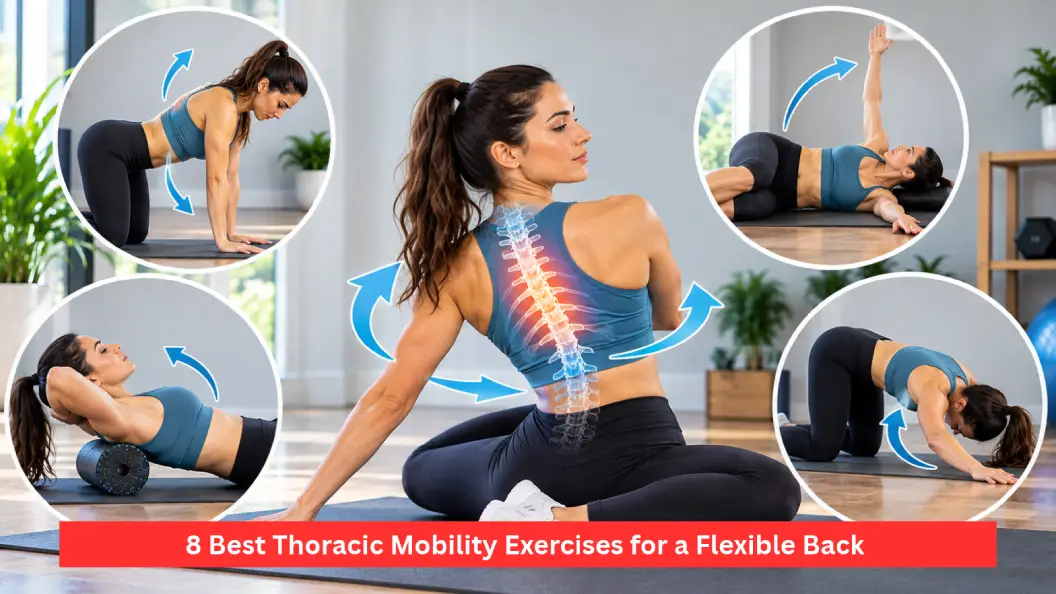

Thoracic mobility exercises enhance upper and middle back mobility, decrease stiffness, and increase comfort in daily activities. Here are eight easy exercises to help you become more mobile while moving slowly and without overtaxing your strainers.
- What Is Thoracic Mobility?
- Why is thoracic mobility important?
- 8 Best Thoracic Mobility Exercises
- Thoracic Rotation vs. Extension: What's the Difference?
- Common Thoracic Mobility Mistakes
- Simple 5-Minute Thoracic Mobility Routine
- When Should You Do Thoracic Mobility Exercises?
- Who Should Avoid or Modify These Exercises?
- Conclusion
- Frequently Asked Questions
What Is Thoracic Mobility?
Thoracic mobility is defined as the movement that’s possible in the middle and upper part of your back (thoracic spine).
There are 12 vertebrae in this area, which begin at T1 and extend to T12. These lie between your neck and lower back and are linked to your rib cage.
Your thoracic spine has four main movements:
- Rotation: rotating your upper body to the left or right.
- Extension: bending your upper back backwards slightly.
- Flexion: Rounding your upper back forwards.
- Side bending: Lifting your body to the side.
These movements help in daily tasks like reaching, turning, and lifting.
Flexibility is not the only aspect of good mobility. It is also being able to control the movement without excessive use of other body parts.
Why is thoracic mobility important?
Your upper back plays a role in how easy it is for you to move your arms, shoulders, and torso.
The neck and spine muscles are engaged when turning your head to see around corners or turning to look at your blind spots while driving.
The thoracic spine also works to position the upper body when performing overhead exercises.
Excessive arching in the lower back or shifting the movement to the neck may be a way of compensating for the restriction in movement in this area.
But doesn’t it mean that if your thoracic spine is stiff, there is something wrong with it?
There are many factors that can affect your movement, including muscle tension, shoulder mobility, previous injuries, and your individual anatomy.
Mobility practice is regular exercise, and it can be a good way to explore comfortable movement, but it isn’t a guaranteed solution to back pain or posture issues.

8 Best Thoracic Mobility Exercises
You don’t need to perform every exercise in one session. Start with two or three comfortable movements and gradually build your routine.
1. Seated Thoracic Rotation
This beginner-friendly exercise helps you practice turning your upper body without getting onto the floor.
How to do it:
- Sit upright on a stable chair with your feet flat.
- Cross your arms over your chest.
- Keep your hips facing forward.
- Slowly rotate your upper body toward the right.
- Pause briefly before returning to the center.
- Repeat toward the left.
Perform 8–10 controlled repetitions per side.
Form tip: Move your chest and shoulders together instead of turning only your head.
Best for: Beginners and desk workers.
2. Open Book Stretch
The open book stretch exercises upper-back rotation, while your whole body stays on the ground.
How to do it:
While on your left side with knees bent comfortably, lie on your side.
- Lift knees and raise both arms in front.
- Raise right arm slowly upward.
- Press chest open towards the right.
- Follow with your eyes, if comfortable, the moving hand.
- Slowly go back and repeat.
- Work up to 6-8 on each side.
Do not move hips and lower back unnecessarily by keeping knees together.
For beginners, put a cushion under the head and under the knees (if needed).
Ideal for: Thoracic rotation control.
3. Thread the Needle
A floor-based rotation exercise with the shoulders that is called thread the needle.
How to do it:
- Begin on your hands and knees.
- Place hands under shoulders.
- Put your right arm under your left arm.
- Bring upper body towards left, turn slightly at the waist.
- Only move your right shoulder as far as it is comfortable.
- Go back to starting position.
- Perform 6–8 slow repetitions on each side.
Do not push your shoulder to the floor.
Tip: Avoid excessive twisting in your lower back, and let the upper back rotate naturally.
4. Cat-Cow With a Thoracic Focus
Cat-cow involves alternating spinal flexion and extension.
Although several regions of your spine participate, you can emphasize gentle movement through your upper back.
How to do it:
- Begin on your hands and knees.
- Keep your hands below your shoulders.
- Slowly round your back upward.
- Allow your head to relax naturally.
- Reverse the movement by gently lifting your chest and relaxing your upper back downward.
- Continue for 8–10 repetitions.
Don’t force an exaggerated curve in your lower back.
Beginner tip: Use extra padding beneath your knees.
Best for: Gentle spinal movement and warm-ups.
5. Foam Roller Thoracic Extension
A foam roller can provide support while you practice extending your upper back.
How to do it:
- Sit on the floor with your knees bent.
- Place a foam roller horizontally beneath your upper back.
- Support your head with both hands.
- Keep your hips grounded.
- Gently extend your upper back over the roller.
- Return to a comfortable upright position.
Repeat 5–8 times without forcing the movement.
Avoid placing the roller directly beneath your neck or using it to bend your lower back aggressively.
Form tip: Start with a small range and keep your neck supported.
Best for: People comfortable with basic mobility movements.
6. Seated Chair Thoracic Extension
This variation is convenient when you want to move your upper back during a work break.
How to do it:
- Sit upright on a stable chair with a supportive backrest.
- Place your feet firmly on the floor.
- Support your head gently with your hands.
- Position your upper back against the top of the backrest.
- Slowly lean backward through your upper-back region.
- Return upright with control.
Repeat 6–8 times.
Avoid leaning so far backward that you lose balance or strain your lower back.
Beginner tip: Use a sturdy chair without wheels.
Best for: Desk-friendly extension exercises.
7. Quadruped Thoracic Rotation
This exercise is a combination of upper-back rotation and a supported hands-and-knees position.
How to do it:
Begin on all fours.
Rest your right hand behind your head.
Continue to put your left hand on your body.
Rotate the right elbow slowly up.
Follow with the upper part of your body.
Go back to the starting position.
Reps and sets: 6-8 on each side.
Perform as many as possible with relatively stable hips.
Tip: Do not just lift your elbow, but rotate your chest while lifting your elbow.
Ideal for: Practicing rotational control.
8. Kneeling Bench Thoracic Extension
To assist with movement of the upper back, a strong exercise bench will be useful to support your arms.
How to do it:
- Sit on a stable bench on a soft mat, kneeling.
- Rest elbows on the bench.
- Place hands in a comfortable position.
- Move hips backwards slowly.
- Let chest drop slowly between arms.
- Go back to starting position.
- Repeat 5–8 controlled movements.
- Do not push the lower back flat, and do not push the chest down.
Tip for beginners: Use the seated chair extension if you are in pain when kneeling.
Ideal for: Upper back extension practice.
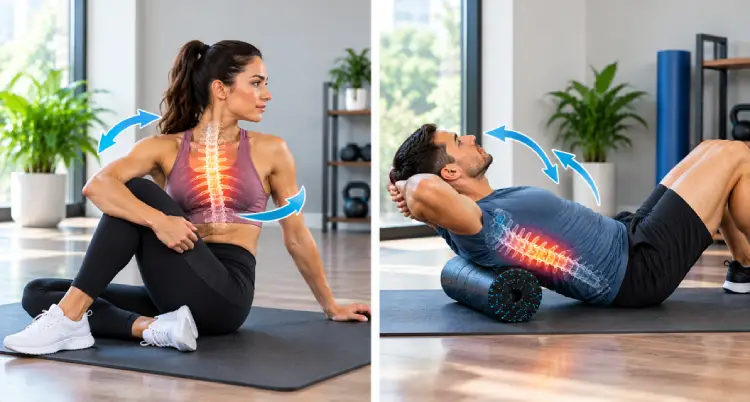
Thoracic Rotation vs. Extension: What’s the Difference?
Rotation and extension are both important thoracic movements, but they serve different purposes.
| Movement | What it means | Suitable exercises |
| Rotation | Turning your upper body sideways | Open book, seated rotation, quadruped rotation |
| Extension | Gently bending the upper back backward | Foam roller extension, chair extension |
| Flexion | Rounding the upper back forward | Cat-cow |
| Combined movement | Moving through more than one direction | Thread the needle, cat-cow variations |
If turning feels particularly restricted, consider starting with a comfortable rotation exercise.
If you want to practice upper-back extension, try the chair-supported variation.
There’s no need to push into painful positions or perform every movement at maximum range.
Common Thoracic Mobility Mistakes
Small technique mistakes can reduce control and make exercises uncomfortable.
Twisting Mainly Through Your Lower Back
When practicing rotation, your hips and lower back may move excessively.
Fix: Use a smaller range and stabilize your hips where the exercise requires it.
Moving Your Neck Too Much
Turning your head farther doesn’t necessarily mean your thoracic spine is rotating more.
Fix: Let your eyes follow the movement naturally without forcing your neck.
Forcing a Deeper Range
Aggressive twisting or bending may irritate sensitive joints.
Fix: Stop at a comfortable range and progress gradually.
Holding Your Breath
Breath-holding can increase unnecessary tension during movement.
Fix: Breathe naturally while moving slowly.
Rushing Through Repetitions
Fast movements may make it harder to notice where your spine is moving.
Fix: Use controlled repetitions instead of chasing a high number.
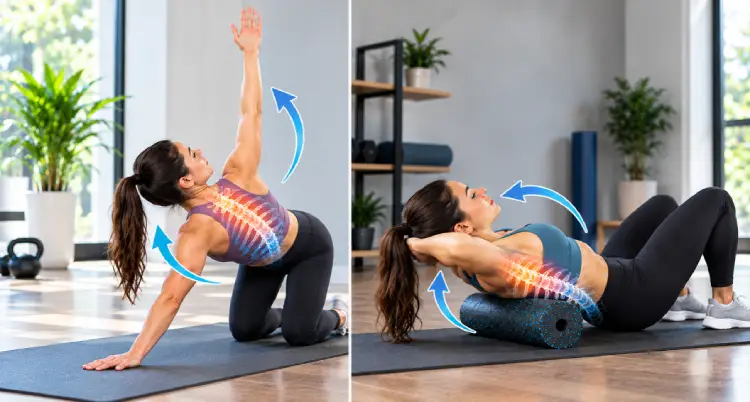
Simple 5-Minute Thoracic Mobility Routine
You don’t need a lengthy workout to practice upper-back movement.
Try this beginner-friendly routine:
| Exercise | Duration |
| Seated thoracic rotation | 1 minute |
| Seated chair extension | 1 minute |
| Open book stretch, both sides | 1 minute |
| Thread the needle, both sides | 1 minute |
| Gentle cat-cow and breathing | 1 minute |
Move at your own pace and reduce the number of repetitions when needed.
If getting onto the floor is uncomfortable, replace open book and thread the needle with additional comfortable seated rotations and side bends.
This routine is intended for general mobility practice, not rehabilitation following a spinal injury.
When Should You Do Thoracic Mobility Exercises?
There are several times throughout the day to perform gentle thoracic movements.
- Morning: Some gentle movements will help you discover comfortable spinal movement.
- Movement variety after sitting for long periods: seated rotation and seated extension.
- Before exercise: Controlled dynamic movement can be incorporated into upper-body warm-up.
- In a mobility session: You can perform both rotation and extension exercises without haste.
Select a frequency that you can manage. It’s not so much about doing an intensive routine every day; it’s about having consistent, comfortable practice.
Who Should Avoid or Modify These Exercises?
Not every medical condition is a good time for thoracic mobility exercises.
If you have had a recent spine injury, you know you have spine instability, a vertebral fracture, recent spine surgery, or unexplained pain, please contact your healthcare provider for advice before trying them.
Individuals who have osteoporosis or other health issues that affect bone strength might need certain adjustments, especially if twisting the spine or bending is an issue.
If you feel sharp pain, dizziness, weakness, numbness, or tingling, STOP.
Do not attempt to move if the symptoms are cause for concern.
Conclusion
Thoracic mobility exercises offer a practical way to explore upper-back rotation, extension, and controlled spinal movement.
Start with simple movements such as seated rotation and open book stretches. Focus on comfort, breathing, and gradual progress rather than forcing your spine into difficult positions.
For more accessible stretching and mobility exercises, visit Stretchlee and build a routine that supports your everyday movement.
Frequently Asked Questions
What Are the Best Thoracic Mobility Exercises for Beginners?
Gentle chair extensions, seated thoracic rotations, and open books are good starting points.
How Can I Improve Thoracic Spine Rotation?
Do controlled rotating moves—don’t push your neck or lower back.
Can Thoracic Mobility Exercises Help Upper-Back Stiffness?
They can help to enhance the mobility in a movement where stiffness is due to limited mobility.
How Often Should You Do Thoracic Mobility Exercises?
Begin a few times a week or with light daily practice, as tolerated.