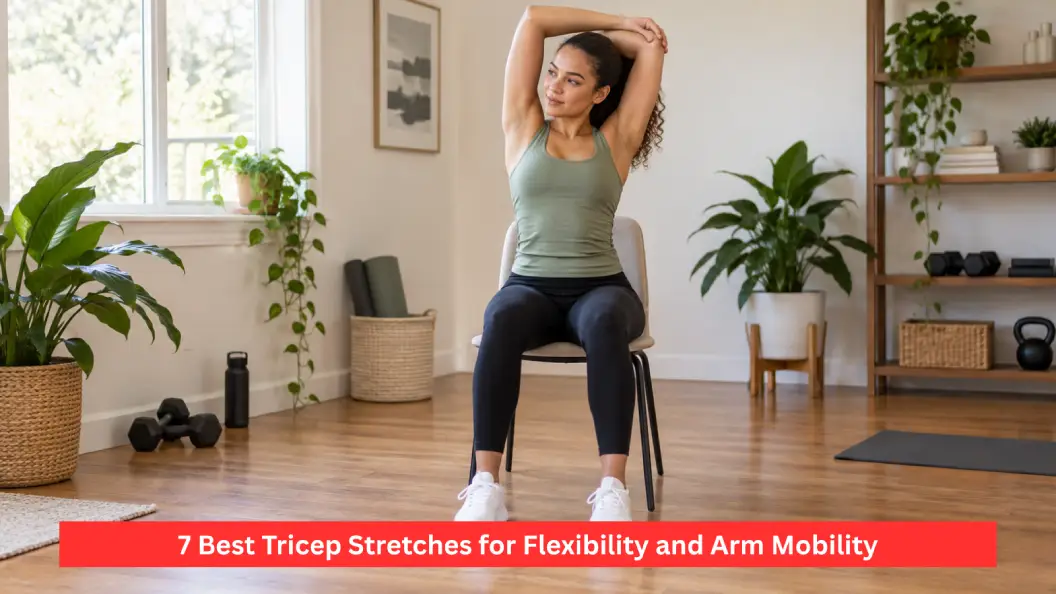

Tricep stretches can help promote flexibility in the back of the upper arms and make it easier to move. These are easy, no-equipment-required movements that can help decrease upper-body tightness and keep the body mobile.
- What Are Tricep Stretches?
- How to Tell If Your Triceps Are Tight
- 7 Best Tricep Stretches to Improve Arm Flexibility
- Which Tricep Stretch Should You Choose?
- 5 Benefits of Tricep Stretches
- 5 Common Tricep Stretching Mistakes to Avoid
- How Long Should You Hold a Tricep Stretch?
- When Is the Best Time to Stretch Your Triceps?
- Who Should Avoid or Modify These Stretches?
- Conclusion
- Frequently Asked Question
What Are Tricep Stretches?
Tricep stretches are flexibility exercises that target the triceps brachii, a three-headed muscle located at the back of your upper arm. This muscle includes the long head, lateral head, and medial head, which work together to straighten your elbow.
Many tricep stretches involve bending your elbow and gently moving your upper arm overhead. This position can lengthen the triceps, particularly the long head, because it crosses both the shoulder and elbow joints. These movements can help maintain upper-arm flexibility and comfortable movement.
How to Tell If Your Triceps Are Tight
Tight triceps may make it uncomfortable to bend your elbow fully or raise your arm into an overhead position. It may also be noticeable to pull at the back of the upper arm when reaching behind your head.
But lack of looseness does not necessarily mean that triceps should be stretched further. Restricted shoulder mobility, restrictions in the joints, or other issues may also impact arm motion. Do not stretch if pain or discomfort is experienced.
7 Best Tricep Stretches to Improve Arm Flexibility
You don’t need to complete every variation in one session. Choose one or two exercises that suit your mobility, comfort, and available equipment.
1. Standing Overhead Tricep Stretch
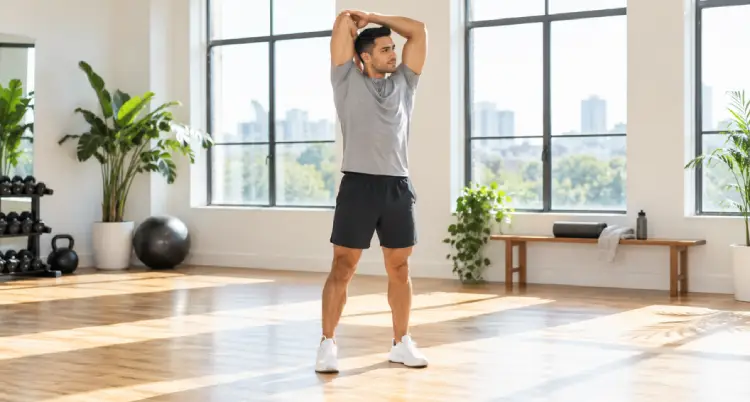
Keep your feet about shoulder width apart and stand straight. Raise your right arm above your head and bend your elbow towards your upper back. With your left hand, slowly push the right elbow back. With no pressure, hold for 10-30 seconds, then alternate arms.
2. Seated Overhead Tricep Stretch
Sit comfortably on a firm chair with your back straight. Raise one arm above your head, bend the elbow, and move your hand toward your upper back. Use the other hand to gently pull the elbow in. Repeat on the alternate side for 10- 30 seconds.
3. Towel-Assisted Tricep Stretch
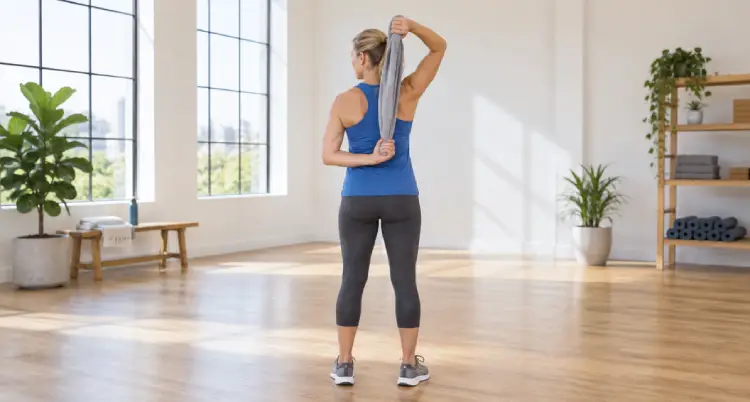
Hold a small towel behind your back with one hand above your shoulder and the other hand near your lower back. Slowly pull the towel upward with your top hand until you feel a gentle stretch in your upper arm. Avoid pulling too hard. Hold briefly, then switch sides.
4. Cross-Body Arm Stretch
Lie on your back with your knees bent and feet resting on the floor. Raise one arm toward the ceiling, bend your elbow, and gently move your hand toward your shoulder. Use your opposite hand to support the elbow if needed. Hold for 10–30 seconds and switch arms.
5. Wall-Supported Overhead Triceps Stretch
Stand near a wall and raise one arm overhead. Bend your elbow and position your hand behind your head. Use the wall for balance while gently adjusting your elbow into a comfortable position. Hold for 10–30 seconds and repeat on the opposite side.
6. Kneeling Bench Tricep Stretch
Sitting at a solid bench, rest both elbows on the bench. Move hands to upper chest and slowly bend chest towards the ground. Ensure movements are controlled and lower back does not arch unduly. If comfortable, hold for 10 – 30 seconds.
7. Dynamic Overhead Tricep Movement
Stand upright and raise one arm overhead. Gently bend and straighten your elbow through a comfortable range of motion. Repeat 8–10 times on each arm without forcing the movement. This is a dynamic mobility exercise rather than a static triceps stretch.

Which Tricep Stretch Should You Choose?
| Stretch | Best suited for |
| Standing overhead | Everyday flexibility |
| Seated overhead | Desk breaks |
| Towel-assisted | Limited comfortable reach |
| Cross-body | Additional shoulder stretching |
| Wall-supported | Controlled overhead positioning |
| Kneeling bench | Experienced exercisers |
| Dynamic overhead | Warm-up movement |
Start with the simplest comfortable option. More complicated movements aren’t automatically more effective.
5 Benefits of Tricep Stretches
Tricep stretches can be useful when included in a balanced flexibility routine.
1. Supports Upper-Arm Flexibility
Tricep stretching helps keep the back of the upper arm flexible. With regular practice, it will become easier to move your arms through comfortable ranges of motion.
2. Helps Maintain Shoulder Mobility
Overhead tricep stretches require you to use both your shoulder and elbow joints. They can be practiced correctly, which can help to promote comfortable movement of the upper body.
3. Complements Strength Training
Stretching exercises offer a form of exercise that is different from resistance training. It can assist you in maintaining a well-rounded exercise program that incorporates flexibility exercises.
4. Supports Comfortable Daily Movements
Flexible upper arm muscles allow for more comfort when doing everyday tasks such as reaching up or putting things on a shelf.
5. Requires Minimal Equipment
Many of the triceps exercises can be done at home without equipment. A few variations can be done with the use of a towel or a sturdy bench.
5 Common Tricep Stretching Mistakes to Avoid
Correct technique is more important than how deeply you stretch.
1. Pulling Your Elbow Too Hard
The only disadvantage of forcing the elbow back is that it can cause more discomfort. Apply gentle pressure, and stop when you feel a slight stretch.
2. Arching Your Lower Back
Too much back arching can impact your posture in overhead stretches. Maintain torso stability; do not lean back.
3. Holding Your Breath
Maintain a normal breathing rate for each stretch. Breathing exercises can help you stay in a comfortable position.
4. Stretching Through Pain
A stretch should NOT cause a sharp pain. Stop when there is pain, numbness, or unusual discomfort.
5. Rushing Through Movements
Take your time when going into and out of each position. Avoid bouncing or sudden movements in order to force a deeper stretch.
How Long Should You Hold a Tricep Stretch?
For most static tricep stretches, hold each position for 10–30 seconds. Beginners can start with shorter holds and gradually increase the duration as they become more comfortable. Repeat each stretch 3–5 times if appropriate for your routine. Keep your breathing relaxed and avoid bouncing or forcing your arm into a deeper position.
When Is the Best Time to Stretch Your Triceps?
Tricep stretches can be performed either after exercise or in a separate exercise session focusing on flexibility, when your muscles are warm. Do some easy dynamic arm exercises before strength training, instead of long static stretches. If your triceps feel uncomfortable after exercise, then let your body recover and do not do aggressive stretching.
Who Should Avoid or Modify These Stretches?
People experiencing elbow pain, shoulder injuries, recent surgery, or unexplained arm discomfort should seek appropriate medical guidance before performing tricep stretches. Modify any movement that feels uncomfortable, and never force your elbow or shoulder beyond its comfortable range. Stop immediately if you experience sharp pain, tingling, or numbness.
Conclusion
Tricep stretches can be easily incorporated into an upper-body flexibility routine. Standing over head stretches, towel assisted stretches all the way to the towel assisted arm variations provide you with different ways to focus on comfortable arm mobility. Begin with an exercise that is appropriate to your flexibility level, perform the exercise with good form, and don’t push yourself too far. Triceps stretches can be a valuable exercise with regular, careful practice.
Ready to improve your upper-body flexibility? Explore more expert stretching guides at Stretchlee and make flexibility a regular part of your fitness routine!
Frequently Asked Question
1. What is the best stretch for tight triceps?
The overhead triceps stretch is an easy exercise kbxb lvevovcno sggce-uvw kirslklildq.
2. Can You Stretch Your Triceps Every Day?
Yes, but if it feels good, stretching daily will keep them flexible.
3. How Long Should You Hold a Tricep Stretch?
Maintain each stretch for 15-30 seconds, but do not force the stretch.
4. Should You Stretch Triceps Before or After a Workout?
Always use dynamic stretches prior to exercise and static stretches afterwards.