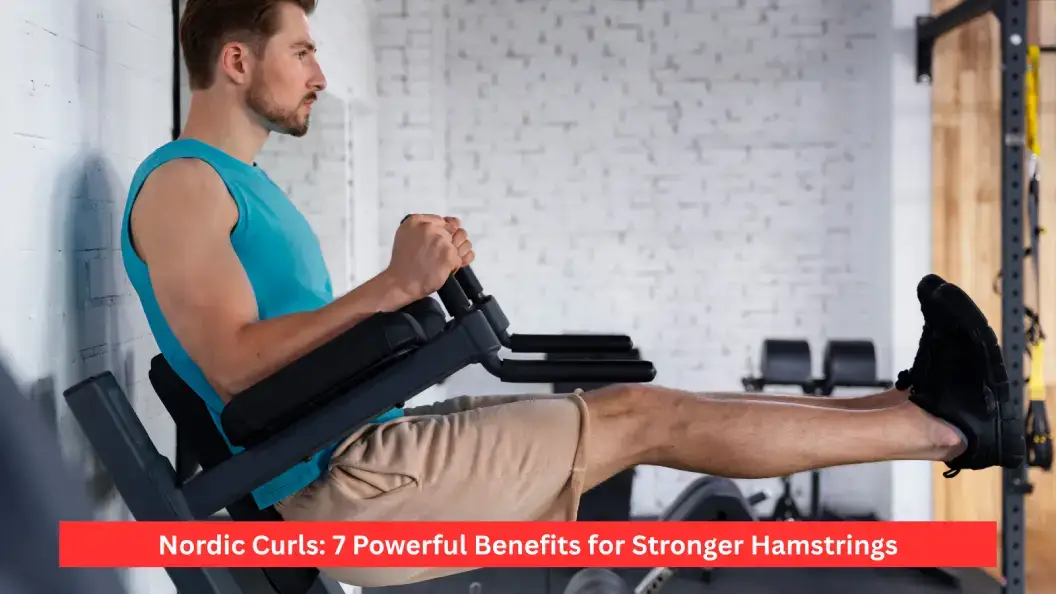

Nordic curls are a bodyweight exercise that builds hamstring strength and control. They’re popular among athletes and fitness enthusiasts and involve slowly lowering your torso with your hips extended. This guide details Nordic curl benefits, form, beginner variations, and tips for workouts.
- What Are Nordic Curls?
- What Are Nordic Curls?
- 7 Benefits of Nordic Curls
- How to Do Nordic Curls With Proper Form
- Nordic Curl Variations for Beginners and Advanced Athletes
- Nordic Curls vs. Leg Curls
- How Many Nordic Curls Should You Do?
- Common Nordic Curl Mistakes to Avoid
- Are Nordic Curls Suitable for Everyone?
- Conclusion
What Are Nordic Curls?
Nordic curls are a hamstring bodyweight exercise that involves slowly bending your upper body forward while your hips are extended with your ankles locked. Your hamstrings are used to slow the fall in your descent and to assist in returning to the starting position.
Here are some important things to know about Nordic curls:
- Main muscles worked: Hamstrings.
- Primary training effect: Eccentric hamstring strength.
- Equipment: Must have a secure ankle anchor and a padded surface.
- Ideal for: Hamstring strengthening, athletic training, injury prevention.
Assisted reps and a small range of motion are recommended for beginners.
What Are Nordic Curls?
Nordic curls, also known as Nordic hamstring curls, are a lower-body strength exercise that primarily targets the muscles at the back of your thighs. The exercise uses your body weight as resistance while your hamstrings control the movement against gravity.
To perform a Nordic curl, you kneel on a padded surface and secure your ankles beneath a stable anchor or have a training partner hold them firmly. You then lower your torso forward as slowly as possible, maintaining a straight line from your knees through your shoulders.
The lowering phase is the main focus because the hamstrings produce force while lengthening. This type of muscle action is called an eccentric contraction.
Nordic curls require relatively little equipment, but they place considerable demand on the hamstrings. Proper technique and gradual progression are therefore important, particularly if you are new to eccentric training.
7 Benefits of Nordic Curls
1. Build Eccentric Hamstring Strength
Nordic curls have one major advantage – the strengthening of eccentric hamstring strength. Your hamstrings need to be able to pull the body weight forward instead of just shortening to pull a weight.
This strength is beneficial to use when running, sprinting, jumping, or changing direction. These movements involve a control of force in the hamstrings and also a lengthening action, particularly in the late swing phase of sprinting.
To build up control and strength in this important group of muscles, it helps to have regular, progressive training.
2. Help Reduce Hamstring Injury Risk
Nordic curls are commonly used in sports injury prevention programs. A systematic review and meta-analysis in the British Journal of Sports Medicine showed that Nordic hamstring exercises (NHE) led to a decrease in hamstring injuries by about 51% in all the studies included.
This, however, is for training and is not an assurance that the exercise itself will ward off all injury. Also, consistency, training volume, recovery, and overall conditioning are important.
3. Support Sprinting Performance
Strong hamstrings help athletes produce and control force during sprinting. Nordic curls can contribute to the eccentric strength required when the legs move rapidly through the running cycle.
For sprinters and field-sport athletes, the exercise can complement sprint drills, acceleration work, and other lower-body strength exercises.
Nordic curls are not a replacement for sprint training, though. To improve sprint speed, combine strength work with practice that matches the demands of your sport.
4. Strengthen the Back of Your Legs
The hamstrings consist of three muscles: the biceps femoris, semitendinosus, and semimembranosus. Together, these muscles help bend the knee and extend the hip.
Nordic curls primarily challenge the hamstrings through knee-flexion control. Adding them to a balanced leg workout can help strengthen the back of your thighs alongside exercises such as Romanian deadlifts, glute bridges, and conventional leg curls.
5. Require Minimal Equipment
You do not need an expensive gym machine to perform Nordic curls. A padded mat and a reliable way to secure your ankles are usually sufficient.
A sturdy training partner can hold your ankles, or you can use a purpose-built Nordic curl bench. Whatever setup you choose, the anchor must be secure enough to prevent your feet from slipping during the movement.
Avoid using unstable furniture or improvised anchors that could move or tip over.
6. Develop Better Control During Lower-Body Movements
Nordic curls train you to control your body against resistance. This skill can complement other exercises that require the hamstrings to manage force during running, jumping, and deceleration.
The exercise may be particularly useful for athletes who need to stop quickly or change direction. Still, improved performance depends on a complete training program, not Nordic curls alone.
7. Offer a Measurable Strength Progression
Nordic curls can be adjusted as your strength improves. Beginners can use their hands for support, limit the lowering range, or use assistance from a resistance band.
As you gain control, you can gradually lower yourself farther and reduce the amount of assistance.
This approach makes it easier to track progress without immediately attempting full repetitions that your hamstrings may not yet be ready to handle.
How to Do Nordic Curls With Proper Form
Learning the correct technique is essential because Nordic curls can be difficult even for experienced gym users.
Follow these steps to perform the exercise safely.
Step 1: Set Up Your Position
Lay a soft mat under your knees. Now kneel up straight, with your ankles anchored firmly or have a training partner hold them securely.
Your knees should be about hip-width apart, and your torso should be upright. Take time to ensure your feet and ankles are comfortable before getting started.
Step 2: Brace Your Core
Draw your belly button up and in and keep your knees, hips, and shoulders in a straight line.
Avoid bending at the hips or arching your lower back. Your upper body should move together as one unit.
Step 3: Slowly lower your body.
Start to bend forward from the knees, maintaining a straight back and hips. Use your hamstrings to counteract the pull of gravity and control the movement downwards.
Do not bend down more than you can keep correct form. This is not a floor exercise, so you don’t have to make it to the floor to get the point of the exercise.
Step 4: Trap yourself with your hands
When the torso is nearing the ground and can’t be controlled by the body, grip the ground with your hands to stop the fall.
Use arms to absorb the rest of the motion; don’t let the body come down all at once.
Step 5: Start in the Starting Position
Gently push through hands to return to upright kneeling position. If necessary, use assistance rather than forcing your hamstrings to raise your whole body.
Repeat the movement with good control; end the set when technique starts to decline.
Form tip: Focus on a slow, controlled lowering phase rather than trying to complete every repetition without assistance.
Nordic Curl Variations for Beginners and Advanced Athletes
You can modify Nordic curls according to your strength, experience, and training goals.
Assisted Nordic Curls
Assisted Nordic curls are a practical starting point for beginners. Use a resistance band, your hands, or help from a training partner to reduce the load.
The goal is to control the lowering phase without allowing your hips to fold or your torso to drop suddenly.
Partial-Range Nordic Curls
In this variation, lower your body through a smaller range of motion that you can control comfortably.
Gradually increase the range as your eccentric strength improves. This is useful if a full Nordic curl is currently too demanding.
Full Nordic Curls
Full Nordic curls involve lowering your torso close to the floor under control before catching yourself with your hands.
Returning to the upright position without assistance is considerably harder. Do not force this version until you have developed sufficient strength.
Banded Nordic Curls
Attach a suitable resistance band securely so that it assists your torso during the lowering and returning phases.
Choose enough assistance to maintain good form. As your strength improves, you can reduce the assistance gradually.
Nordic Curls vs. Leg Curls
Both exercises target the hamstrings, but they use different equipment and movement patterns.
| Feature | Nordic Curls | Machine Leg Curls |
| Equipment | Ankle anchor or partner | Leg curl machine |
| Resistance | Body weight and assistance | Adjustable machine load |
| Main focus | Eccentric hamstring control | Knee-flexion strength |
| Difficulty | Often challenging for beginners | Easier to adjust |
| Progression | Range of motion and assistance | Weight and repetitions |
| Best use | Eccentric strength and athletic programs | General hamstring training |
Neither exercise is automatically better for every person. Nordic curls are useful for eccentric training, while machine leg curls allow more precise load adjustments. Including both may be appropriate if they fit your training plan and recovery needs.
How Many Nordic Curls Should You Do?
Nordic curls are demanding, so beginners should start with a small training volume instead of performing large numbers of repetitions immediately.
A practical starting point is 1–2 sets of 3–5 assisted repetitions once or twice per week. Use a controlled range of motion and allow enough recovery between sessions.
As your strength improves, you may progress toward 2–3 sets of 4–8 repetitions, depending on your training experience and overall workload.
These numbers are general starting guidelines rather than a universal prescription. Athletes following a structured injury-prevention program should use a plan suited to their sport, training schedule, and recovery capacity.
Avoid adding more repetitions simply because you can tolerate soreness. Increase training volume gradually and pay attention to how your hamstrings respond.
Common Nordic Curl Mistakes to Avoid
Letting Your Hips Bend
Folding at the hips will decrease the intended movement pattern. Maintain a straight back, hip, and thigh line when bending down.
Dropping Too Quickly
The controlled eccentric challenge is greatly eliminated by letting gravity take you down. If it is not possible to lower down smoothly, use assistance and/or shorten the range of motion.
Doing too many repetitions
Nordic curls can lead to significant muscle soreness, especially initially when you first add them. Start with a small amount and build up slowly.
Using an Unstable Anchor
A slipping or moving ankle anchor can cause a fall. Ensure that your setup is stable and suitable for the arrangement before each set, and use correctly designed and purposeful arrangements.
Ignoring Pain
It is expected that some muscle effort will be required; however, sharp pain in the hamstrings or knees is not to be endured. If any pain is of concern, discontinue the exercise and consult a trained health care provider if necessary.
Are Nordic Curls Suitable for Everyone?
Nordic curls can be useful for many healthy adults, recreational exercisers, and athletes. However, their difficulty makes them less suitable as an immediate starting point for everyone.
If you are new to strength training, begin with easier hamstring exercises, such as glute bridges or machine leg curls, before attempting more demanding Nordic curl variations.
If you have a current hamstring injury, persistent knee pain, or have recently undergone surgery, consult a qualified physiotherapist or healthcare professional before adding Nordic curls to your routine.
Choose a variation that allows you to maintain control throughout the movement. The goal is to build strength progressively, not to complete the hardest version as quickly as possible.
Conclusion
Nordic curls are an effective exercise for developing eccentric hamstring strength with minimal equipment. They can support a well-rounded lower-body routine and are particularly valuable in athletic programs that focus on hamstring conditioning and injury prevention.
From my perspective, the most important part of Nordic curl training is learning to control the lowering phase. Beginners do not need to perform full repetitions immediately. Assisted movements, partial ranges, and gradual progression provide a more practical starting point.
Add Nordic curls to a balanced training program, monitor your recovery, and focus on consistent technique. Over time, this approach can help you build stronger hamstrings without making every workout unnecessarily difficult.
Frequently Asked Questions
1. What muscles do Nordic curls work?
The main muscles worked with the Nordic curl are the hamstrings: biceps femoris, semitendinosus, and semimembranosus.
2. Do Nordic curls prevent hamstring injuries?
Certainly, research has indicated that Nordic hamstring exercises may help to decrease the risk of hamstring injuries when added to a regular training program.
3. Can beginners do Nordic curls?
Yes. If this is your first time trying these exercises, it’s best to exercise in a shorter range of motion or to use assisted Nordic curls so as to build strength and maintain proper form.
4. How often should you do Nordic curls?
For beginners, the number of sessions per week may be 1 or 2, and the number of sets and reps can be 1–2 sets of 3–5 reps, with rest.