

The biceps brachii is a two-headed muscle at the front of the upper arm. Works to flex the elbow, turn the forearm, and assist in rotating the shoulder. It has two heads: the long head and the short head.
- What is the Biceps Brachii?
- Biceps Brachii Anatomy
- Biceps Brachii Structure
- Biceps Brachii Origin and Insertion
- The Biceps Brachii's Function
- Biceps Brachii Nerve Supply
- Biceps Brachii vs. Brachialis
- Biceps vs. Brachialis: Which muscle is stronger?
- Biceps Brachii vs. Triceps Brachii
- Biceps Brachii and Muscle Growth
- How to Build the Biceps Brachii
- Common Biceps Brachii Injuries
- How to train Biceps safely?
- Conclusion
- Frequently Asked Questions
What is the Biceps Brachii?
The biceps brachii muscle is a double-headed muscle located on the front of the upper arm, twith along head and a short head. It links the shoulder girdle to the forearm and is important in elbow flexion, supination of the palm, and some shoulder movements. Along with brachialis and brachioradialis, it aids in everyday activities, as well as resistance training activities like lifting, pulling, and carrying.
Biceps Brachii Anatomy
The biceps brachii is found on the front of the upper arm. It is located above the brachialis and runs from the shoulder to the elbow.
The name “biceps” means that the muscle has two heads:
- Long head
- Short head
Though originating from different sources, these heads unite further down the arm and perform together in several movements.
Long Head of the Biceps
The long head originates from the supraglenoid tubercle of the scapula. It goes through this area of the shoulder and into the upper arm.
The long head can assist in the shoulder’s movement, stability, and elbow movement across the shoulder joint.
Short Head of the Biceps
The short head is attached to the coracoid process of the scapula. Joins the long head to make up the principal mass of the biceps muscle.
It is important to understand that the two heads of the biceps muscle originate from different parts of the body when learning the biceps anatomy and the action of the muscle during various exercises.
Biceps Brachii Structure
The two heads unite to form one muscle belly before going on to the elbow. The muscle becomes strong near the lower arm, forming a distal tendon.
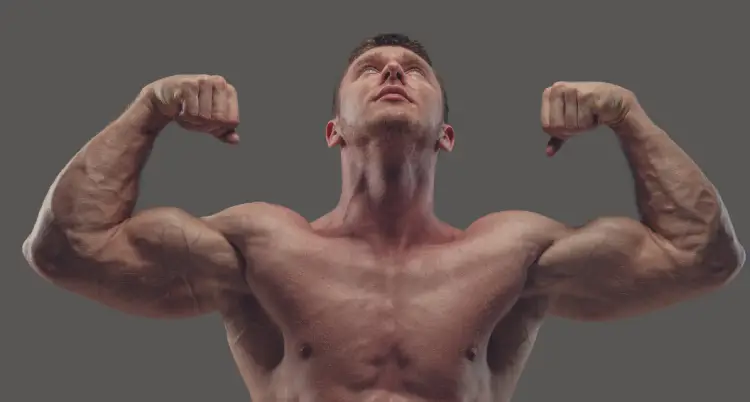
With this setup, the biceps will affect both the shoulder and elbow joints. Since its distal attachment is on the radius, it can also help rotate the forearm.
So, the biceps is more than just an elbow-bending muscle. It is involved in a number of movements of the upper limb, which is why it has a particular anatomical position.
Biceps Brachii Origin and Insertion
The biceps brachii insertion and origin will aid in understanding its actions.
The long head arises from the supraglenoid tubercle of the scapula and the short head arises from the coracoid process of the scapula. The two heads join together and extend into a distal tendon.
The tendon is mainly inserted on the radial tuberosity, the distal part. There is a corresponding extension through the forearm fascia called the bicipital aponeurosis.
| Structure | Attachment |
| Long head | Supraglenoid tubercle of scapula |
| Short head | Coracoid process of scapula |
| Distal tendon | Radial tuberosity |
| Bicipital aponeurosis | Forearm fascia |
These biceps brachii attachments allow the muscle to contribute to elbow flexion and forearm supination.
The Biceps Brachii’s Function
Elbow flexion and forearm supination are the two actions that the main biceps brachii is responsible for. Also helps with a few shoulder movements.
1. Elbow Flexion
Elbow flexion is when the forearm is moved towards the upper arm. Simple examples include curls.
In this movement, the biceps muscle is used in conjunction with the brachialis and brachioradialis. The brachialis muscle is particularly significant since it is one of the significant flexors of the elbow.
2. Forearm Supination
Supination is a rotation of the forearm towards the palm being up.
The biceps is well suited for producing supination when the elbow is flexed. This action can be required when turning a screwdriver, opening some lids, or carrying an object with the palm facing the sky.
3. Shoulder Contribution
The biceps runs across the shoulder joint and can help shoulder movement. Another function of the long head is to assist the shoulder region.
It’s also important for the full function of the muscle because although the shoulders contribute to this movement, it’s less significant than the elbow and forearm.
Biceps Brachii Nerve Supply
The biceps is the most strongly motor innervated by the musculocutaneous nerve, which is predominantly C5 and C6 nerve roots.
The anterior compartment of the arm is supplied by the musculocutaneous nerve, which passes through the anterior compartment and innervates the muscles that make elbow flexion.
The blood supply to the Biceps Brachii.
Branches of the brachial artery provide blood to the biceps brachii.
Blood carries oxygen and nutrients to the muscles required for contraction and to maintain and repair tissues after exercise.
Biceps Brachii Exercises
There are a number of exercises that can be done to effectively train the biceps and other flexors of the elbow.
Dumbbell Curl
Place dumbbells in front of you with palms facing each other. Elbows should be close to the sides, and the weight brought towards the shoulder.
Relax and drop the dumbbells slowly.
Barbell Curl
The barbell curl works on both arms simultaneously. Maintain control of the torso and prevent overswinging.
A weight that will allow you to show good technique throughout the set.
Hammer Curl
The hammer curl is performed with a neutral grip (palms facing up). It works the biceps, but also engages the brachioradialis and brachialis.
This modification can be beneficial when it’s necessary to train elbow flexors in a different hand position.
Incline Dumbbell Curl
Incline curls position the arms behind the body and shift the shoulder position throughout the exercise.
Keep a comfortable range of motion and don’t overstretch the shoulder at the bottom.
Chin-Up
Chin-up is a combination of elbow flexion movement and pulling action. They exercise the biceps as well as the latissimus dorsi and the upper body muscles.
A supinated (underhand) grip usually puts more of an emphasis on the elbow flexors than other pulling grips will.
Biceps Brachii vs. Brachialis
The biceps brachii vs. brachialis comparison is helpful since both muscles bend the elbow, but have different functions and anatomy.
The brachialis is located beneath the biceps. It attaches to the humerus and joins the ulna. Does not attach to the radius and does not supinate the forearm, unlike the biceps.
The biceps is attached to the radius, and it helps you flex your elbow and supinate your forearm.
The differences between Biceps Brachii and Brachialis
The main differences are:
- Biceps: Outer surface of the front of the upper arm.
- Brachialis: This is deeper under the biceps.
- Biceps: flexes the elbow, supinates the forearm.
- Brachialis: chief flexor of the elbow.
- Biceps: attaches to the radius.
- Brachialis: attaches to the ulna.
The brachialis is one of the prime players in elbow flexion, and it can be a significant contributor to elbow-flexion power.
Biceps vs. Brachialis: Which muscle is stronger?
This isn’t a straightforward answer, as their contribution varies with movement and with each joint position.
The brachialis is a strong elbow flexor, and the biceps flexes the elbow and supinates the forearm. They do not perform the same functions.
Biceps Brachii vs. Triceps Brachii
The biceps brachii vs. triceps brachii comparison shows two major muscles that perform opposing actions at the elbow.
The biceps is a two-headed muscle that is found at the front of the upper arm. The triceps is located at the back and has three heads.
| Feature | Biceps | Triceps |
| Location | Front of upper arm | Back of upper arm |
| Heads | 2 | 3 |
| Main elbow action | Flexion | Extension |
| Main nerve | Musculocutaneous | Radial |
| Distal attachment | Radius | Olecranon of ulna |
The biceps helps bend the elbow, while the triceps helps straighten it. Both contribute to upper-arm size and strength.
Biceps Brachii and Muscle Growth
Consistent resistance training, proper nutrition, and recovery are key to building biceps.
Useful principles include:
- Use the correct level of resistance when training.
- Challenge the training in a gradual manner.
- Use controlled repetitions.
- Eat sufficient amounts of protein and calories.
- Give adequate rest between high-intensity workouts.
- Work the upper arm, not just a single muscle.
Genetics also play a part in the size, shape, and the way the biceps looks, its shape, where the tendons attach, and its muscle shape.
How to Build the Biceps Brachii
You can do a variety of curling and pulling exercises in a simple biceps workout.
A dumbbell curl, a hammer curl, and a chin-up, for instance, can be performed in a workout. It is not necessary to have many exercises to stimulate the muscle effectively.
Emphasize regular exercise and gradual loading. When strength (or another training variable) has improved, slowly add more resistance, repetitions, sets, or a different training variable, not all at once.
The emphasis should always be on good technique.
Biceps Brachii and Range of Motion
A controlled range of motion will give the biceps a range of elbow & forearm positions to work through.
When curling, do not try to bend the joints into awkward positions. The optimal range may vary depending on the type of exercise, movement ability, training history, and objective.
It is usually more beneficial to incorporate a comfortable and controlled movement rather than a large range of motion.
Why are muscular arms so considered attractive features?
Having fit, strong, and athletic arms is sometimes linked to fitness and strength, and it may be attractive to some people.
No one has a standard size for biceps they find attractive. Some people prefer more muscular physiques, while others prefer leaner or less muscular arms.
The shape of the upper arm also relies on the shape of the triceps, forearms, body shape, and proportions. So, the size of the biceps alone isn’t sufficient to give a full perspective on arm appearance.
Common Biceps Brachii Injuries
Muscle strains and tendon injuries of the biceps can occur, especially when subjected to sudden or excessive loading.
Distal Biceps Tendon Injury
The muscle attaches to the radius near the elbow via the distal biceps tendon. The sudden force may tear the tendon, causing pain, bruising, weakness, and/or an obvious alteration in the shape of the arm.
Biceps Tendon Issues in the elbow area
The long-head tendon crosses the shoulder region and can get irritated or injured. The symptoms can be pain around the front of the shoulder and problems with some movements.
Popeye Deformity
The muscle belly may glide downward from a ruptured long-head biceps tendon and leave it looking like a Popeye deformity.
Sudden, intense pain, marked weakness, bruising, or any perceptible change in arm shape needs to be evaluated by a trained health care professional.
How to train Biceps safely?
Use resistance that allows for maintaining proper technique. Avoid excessive swinging or using momentum to complete repetitions.
Build up resistance slowly and allow muscles sufficient recovery time between challenging exercises.
Some of the best ways to go about it are:
- Prepare for more challenging training.
- Use controlled movements.
- Don’t gain too much weight at once.
- Keep joints in good alignment.
- Allow adequate recovery.
If you have severe or abnormal pain, discontinue and stop.
Biceps Brachii and Everyday Activities
The biceps is involved in a variety of motions every day, such as:
- Picking up objects
- Carrying bags
- Pulling objects
- Bending the elbow
- Turning tools
- Carrying objects with the palm up
These are usually not movements that involve just the biceps. Several muscles typically move the shoulder, elbow, and forearm at the same time.
Conclusion
The biceps brachii is a bi-articulate muscle, located on the anterior surface of the upper arm. The long and short heads run on different parts of the scapula and meet each other to form a single muscle, which inserts into the radius.
It is primarily involved in the flexion of the elbow and supination of the forearm and has a secondary role in shoulder movement. Underneath it lies the brachialis as an important flexor of the elbow and the triceps brachii as an important extensor of the elbow.
Biceps can be developed by exercises like chin-ups, curls, incline curls, and hammer curls. To make long-term progress, things like regular resistance training, correct technique, progressive training, nutrition, and recovery are important.
Frequently Asked Questions
How many heads does the biceps brachii have?
The biceps brachii has long and short heads. They start individually and combine to make one muscle.
2. What is the main action of the biceps brachii?
It acts on elbow flexion and forearm supination. It also helps with some of the shoulder’s movements.
3. What is the difference between the biceps brachii and brachialis?
The biceps flexes the elbow and turns the forearm over; the brachialis is a primary elbow flexor and is under the biceps.
4. Which exercises work the biceps brachii?
The elbow flexors, such as the biceps, can be effectively trained with dumbbell curls, barbell curls, hammer curls, incline curls, and chin-ups.