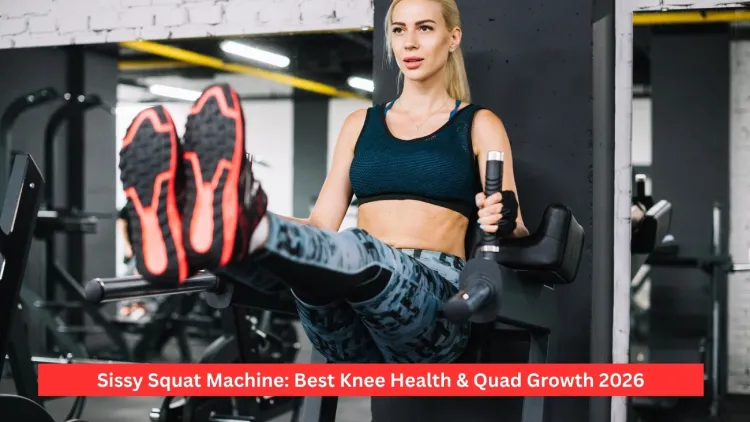

Sissy squats are some of the best lower-body exercises to help build stronger quads, balance, and improve lower-body endurance. It enables users to perform a controlled, knee-dominant squat while simultaneously engaging the front thigh muscles and reducing pressure on the hip and lower back. Sissy squat machines are marketed for a wide variety of purposes, ranging from enhancing leg definition for bodybuilders and athletes to ensuring the stability of their knees and improving overall leg performance and definition in beginner fitness enthusiasts.
This machine may also help with mobility, increase bone density through its resistance training, and muscle development around the knees. The sissy squat machine is a great option to add to a strong training routine or a rehabilitation workout, if it’s used correctly with proper form.
- What is a ‘Sissy Squat Machine'?
- How the Sissy Squat Machine Works
- Muscles Worked by the Sissy Squat Machine
- Benefits of Using a Sissy Squat Machine
- The proper usage of a Sissy Squat Machine
- Common Mistakes to Avoid
- Who Should Use a Sissy Squat Machine?
- Sissy Squat Machine vs Traditional Squats
- Best Training Tips for Results
- Final Thoughts
- Frequently Asked Questions
What is a ‘Sissy Squat Machine’?
The Sissy squat machine is a special machine that facilitates users to squat, but with a focus on the quads, and to provide additional balance and support. The Machine fixes the feet and lower legs while allowing the knees to go forward and the torso to bend backwards during the exercise.
This is a variation of the classic Sissy squat exercise, but it offers more stability and safety with the machine. This helps the user isolate the quadriceps more easily, without having to possess any advanced balance skills.
Used for challenging front thigh muscles, the sissy squat machine is an alternative to standard squats that work more than one muscle group at once. This makes it a well-thought-after supplement for bodybuilding and sports training programs where being strong is crucial for training the quads.
Due to its superior ability to work the leg muscles in isolation, a sissy squat bench is a popular exercise machine for many fitness facilities and home equipment stores.

How the Sissy Squat Machine Works
The sissy squat machine is designed to fix the legs below the knees and have the user perform controlled movements.
Most machines include:
- Adjustable ankle pads
- Foot platform
- Calf support pads
- Resistance options on some models available
While the knees move forward, to extend the body backward (in one motion). This puts believers under a lot of tension with the quadriceps and makes the thighs do more work during the movement.
Leisurely spine-strengthening function, guided position helps to maintain balance. People who just have slight pain in the lower back when they lift heavy weights, the sissy squat machine is overdoing the barbell squat, as it you place less compression on your spine.
All squats place some level of loading on the spine, but the sissy squat machine will place less spinal loading than heavy-loaded squats or squats with a barbell on the back. This is beneficial for someone who wants to avoid putting too much strain on the lower back.
Severe spinal conditions (at L4-5 or L5-S1) should, however, be approached with caution. Twisting, jerking, or heavy loading exercises tend to aggravate pain in the lower back. Good posture and slow motion continue to be important.
Muscles Worked by the Sissy Squat Machine
The sissy squat machine predominantly works the quadriceps muscle but also activates a number of other supporting muscles.
1. Quadriceps
Primary muscles involved with the movement are the quadriceps. These muscles give strength to your legs and are responsible for the extension of the knee; they also enhance the stability of your leg and muscle definition.
When people ask me what muscle the sissy squat works best, the answer is obvious: the quads. The exercise is performing a good activation of the rectus and the vastus muscles.
2. Hip Flexors
The hip flexors stabilize the movement in a backward direction as the body is returning to the starting position.
3. Core Muscles
Lower core and abdomen work to hold posture and balance throughout the exercise.
4. Knee Stabilizers
Knee joint tendons and stabilizing muscles are also activated during the exercise. This gradual strengthening can be beneficial to the knee in the long-term.

Benefits of Using a Sissy Squat Machine
The sissy squat machine has several benefits related to strength training and muscle development, as well as joint support.
1. Strong Quad Isolation
A basic squat is extremely hard on your glutes, hamstrings, and bottom. The sissy squat machine provides a higher percentage of the lift through the quads, which can help when developing the leg muscles.
2. Improved Knee Strength
Correctly executed controlled movements may be effective in strengthening the muscles around the knees. Enhanced muscle strength, better joint support, and stability.
Resistance exercises that are carefully applied and limit knee discomfort are used by some individuals to enhance their range of motion. But it is important to seek medical advice before starting before you do them if you have severe arthritis or joint damage.
3. Bone Density Support
Bone-building activities such as squats might be beneficial in the long term. Provides weight-bearing motion that helps make bones stronger and more resilient.
Squat movements are regarded by many health professionals as one of the best exercises that people can do to keep their bones healthy as they age. With resistance training and nutrition, vitamin D, calcium, and enough protein, one can reinforce the bones naturally.
4. Better Muscle Definition
A wide motion range allows for greater muscle contractions, heightening muscle definition and appearance on the thighs when using the sissy squat machine.
5. Controlled Lower-Body Training
The machine configuration provides an environment that enables or leaves the user with greater control and ease of balance. This is great for someone inexperienced or recovering from muscle weakness.
Additional support for Blood Sugar Control.
Squat exercises recruit more big muscles and thus utilise the glucose better by the body. Strength training can play a role in helping with blood sugar control in concert with a healthy lifestyle.
The proper usage of a Sissy Squat Machine
It is important to use the sissy squat machine properly for maximum safety and effectiveness.
Before applying the illustrated steps, read the following instructions:
Make sure the ankle pads rest properly so that the foot remains steady throughout the exercise.
Step 1: Stand Upright
Tighten your core and lift your torso off the floor before you move.
Step 2: Lower Slowly
Lean back as if to pull knees towards chest, keeping knees moving in a controlled motion.
Step 3: Maintain Alignment
Do not bend at the waist beyond the point of no more than straighten at the knees to the shoulders.
In Step 4, push back up to close up the circle.
Sit back up to the starting position using quads control.
Slow and controlled reps are safer than quick and jerky reps.

Common Mistakes to Avoid
There are a few different errors that can make the sissy squat machine less effective or put additional strain on joints.
- Relying on momentum rather than muscle control. Bringing in momentum, not muscle control.
- Moving too quickly
- Knee Capsers – letting knees fall in
- Not following the proper warm-up procedures
- Leaning unevenly
- Performing over high repetitions that are not in good form.
One of the most common errors in knee pain is overdoing it with the exercises. Never ignore pain while training.
Knee arthritis sufferers should also refrain from certain exercises, such as jumping, deep impact exercises, and twisting. Controlled strength training is safer than high-impact, explosive activity.
Who Should Use a Sissy Squat Machine?
Multiple kinds of people can gain benefits from the sissy squat machine.
- Muscle bullies who build only their quadriceps muscles
- People are growing their leg stamina
- People who are new to learning about the mechanics of a controlled squat
- Athletes who want to make their knees more powerful!Those who love exercise and would like to make their knees stronger!
- The person is constructing the stability ball for the lower body. The person is creating a lower leg stability ball.
But certain individuals may not undertake this workout or should make modifications.
If the knee is very unstable, it has significant arthritis or a new injury to any of the ligaments, an older injury to the lumbar discs, or is very bad, alternative exercises may be necessary. People with L5 weakness or nerve compression symptoms should ask a healthcare professional for advice before attempting heavy lower-body activities.
Sissy Squat Machine vs Traditional Squats
| Feature | Sissy Squat Machine | Traditional Squat |
| Main Focus | Quadriceps | Full lower body |
| Balance Needed | Lower | Higher |
| Spinal Loading | Lower | Higher |
| Muscle Isolation | High | Moderate |
| Weight Capacity | Moderate | High |
| Beginner Friendly | Yes | Moderate |
The traditional squat is said to be the ‘king of all exercises’ not only because it targets many muscle groups at once, but also because it can provide a good amount of full-body strength. For some trainers, squats even go so far as to being the “mother of all exercises” due to their all-around athletic advantages.
Nevertheless, the sissy squat machine is a one-of-a-kind way to efficiently work the quads as opposed to traditional squats.
Best Training Tips for Results
Here are some training strategies that you can use to get the most out of using the sissy squat machine:
- Use of controlled repetitions when training.
- The correct warm-ups should be performed before training activities.
- Use quad isolation combined with compound exercises. Clear off isometric quads with compound exercises.
- Avoid putting your weight on your knee, pay attention to the position of your body and knees.
- Gently increase resistance over a period of time
- RecovEase in between sessions/recovery
Core/lower back exercises can also help in facilitating a lower-body workout safely. Many physical therapists advocate stretching to stabilize the core using movements like modified planks, curl-ups, and bird-dogs to help lower-back stability.
If lower back pain has occurred at L4-L5, you might try sleeping with a pillow underneath your knees, while you are on your back, to decrease the back pressure.
For the spine, gentle walking, stretches, movement exercises, and controlled strengthening exercises are often preferred over heavy twisting or intense activities for recovery.

Final Thoughts
The sissy squat machine offers a great way to add strength to the quads, gain more lower body endurance,e and add muscle definition. Due to the controlled design, it can be used to train the legs, allowing for better stability that reduces loading on the balance and spine as compared to some squat variations.
If performed correctly, the sissy squat machine can help build the strength of your knees, help maintain bone health, and enhance your overall lower body performance. It can also be used to add to your other lower-body strength-building routines, such as conventional squats, lunges, and leg presses.
While the machine can be used to provide numerous benefits, it’s crucial to maintain proper form and make smart training decisions. Begin slowly, emphasizing control and avoiding overstraining. The sissy squat machine is consistent and can be used safely with proper technique when speaking about its incorporation into the corner’s instruction. Talking about the machine’s incorporation in the training of legs, one could insist on its consistency and proper use with its safety.
Frequently Asked Questions
Are the Sissy Squat Machines suitable for novices?
Yes, the sissy squat machine is beginner-friendly because of the support and balance offered during the exercise.
Which muscles do the sissy squats work?
The difference between the sissy squat machine and normal squats is that the latter focuses primarily on the quadriceps with additional engagement of the core, hip flexors, and knee stabilizers.
Is it safe to do sissy squats with knees?
If executed correctly and with controlled movement, sissy squats can aid in strengthening the muscles around the knees.
Can the sissy squat machine be an alternative to squats?
The sissy squat machine is excellent for targeting the quads; however, the squat is superior when it comes to overall lower body strength and muscle building.