
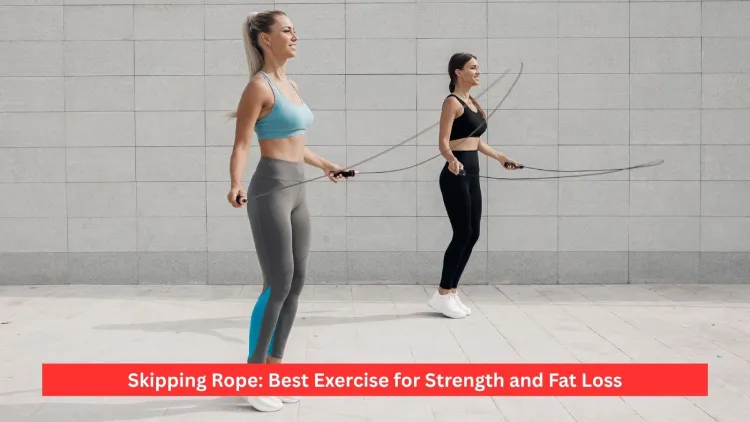

One of the most effective exercises is the process of skipping rope. It is healthier for the heart, burns calories, builds muscle, and is better at coordination. It is also effective for body fat reduction as well as a stamina boost and weight loss in the long term. Skipping rope, even 10 minutes of it, can produce similar results as longer low-intensity exercises. Knowing how and doing it with style, rest, and consistency can successfully turn your body around.
- What is a skipping rope exercise?
- Benefits of Skipping Rope
- Muscles Worked During Skipping Rope
- How to Do Skipping Rope Correctly
- 6 Jump Rope Variations for Beginners to Advanced
- Jumping Rope Workout Plan
- Can Skipping Rope Help You Lose Weight?
- How Many Calories in Jump Rope?
- Common Mistakes to Avoid
- Is jump rope safe?
- How many times should you jump rope?
- Skipping Rope vs Walking: Which Is Better?
- Who should be careful when jumping rope?
- Final Thoughts
- Frequently Asked Questions
What is a skipping rope exercise?
Skipping rope, or jumping rope, is a rhythmic exercise that involves repeatedly jumping over the rope as it passes under your foot. It is a combination of aerobic exercise, coordination, balance, timing, and lower body muscular endurance.
Easy to do at home, in a gym, or outdoors, and only needs a rope and a little space. Those who are beginners can work on their basic jumps, and those who are advanced can work on variations like high knees, side-to-side jumps, and double under.

Benefits of Skipping Rope
Skipping rope is a beneficial exercise that has a number of fitness benefits, such as better cardiovascular fitness, coordination, muscular endurance, and calorie burn.
1. Improves Cardiovascular Fitness
Skipping rope is an aerobic activity that provides a cardiovascular challenge. It can aid in improving aerobic fitness and endurance with regular training.
2. Supports Calorie Expenditure
Skipping rope is an energetic exercise that could boost calorie burn while exercising. Along with a healthy lifestyle and diet, this can help with weight management.
But exercise can’t target fat loss in one body part. The first place where fat is burned is different for everyone.
3. Improves Coordination and Balance
Jumping rope demands hand-eye and foot coordination and timing. With practice, coordination, balance, and rhythm can be enhanced.
4. Supports Muscular Endurance
The rope is repeatedly swung on the calves, quadriceps, hamstrings, glutes, and core as the upper body handles the rope. Muscular endurance and coordination can be achieved through regular practice.
5. Improves Agility and Footwork
Jumping rope involves rapid and coordinated movements, and it can help improve footwork, rhythm, and agility. These skills may apply to different sports or everyday motion.
6. Can Support Weight Loss
Yes, skipping rope can help to reduce weight due to the energy that is expended. But fat loss is possible in the long run if all the factors of calorie balance, nutrition, exercise, recovery, and consistency are taken into account.
7. Can Skipping Rope Reduce Belly Fat?
While skipping a rope can help you lose body fat in general, it cannot target belly fat in particular. To lose body fat in the long-term, it is usually necessary to maintain a calorie deficit for a prolonged period.
Muscles Worked During Skipping Rope
Skipping rope involves multiple muscle groups to jump, land, maintain posture and control the rope. These are the main muscles that are engaged: calves, quadriceps, hamstrings, glutes, core, shoulders and forearms.
| Muscle/Area | Role During Jumping Rope |
| Calves | Help produce repeated jumps and absorb landing forces. |
| Quadriceps | Assist with knee extension during each jump. |
| Hamstrings | Help control lower-body movement and stability. |
| Glutes | Support hip stability and jumping movements. |
| Core | Helps maintain posture, balance, and body control. |
| Shoulders | Help control the movement of the rope. |
| Forearms & Wrists | Help rotate and control the rope efficiently. |
Muscles Worked During Skipping Rope
Skipping rope involves multiple muscle groups to jump, land, maintain posture, and control the rope. These are the main muscles that are engaged: calves, quadriceps, hamstrings, glutes, core, shoulders and forearms.
Can jumping rope increase muscles?
The main benefit of jumping rope is that it is a cardiovascular exercise. It can help with lower body conditioning, muscle endurance and coordination, but should not be used as a substitute for progressive resistance training if the primary training objective is to build muscle mass. m
How to Do Skipping Rope Correctly
Good technique can help to maintain control and minimise exertion.
Step-by-Step Guide
- Use the Correct Rope Length: Use a rope length that is appropriate for your height and allows for comfortable movement.
- Holding your body in proper position is important: you should hold your head forward, back upright, and shoulders relaxed.
- Turn the Rope With the Wrists: Turn the rope with your wrists, not your big arms.
- Keep Jumps Low and Land Softly: Land on the balls of your feet and keep your jumps low.
- Keep the beat steady: Begin slowly and build up until increased speed or duration is reached.
How to Choose the Right Jump Rope Length
Stand on the middle of the rope and lift the handles up. The rope must be long enough so it is not too slack to comfortably rotate. This may depend on the style of the jump, the height of the person, and the type of rope used.
6 Jump Rope Variations for Beginners to Advanced
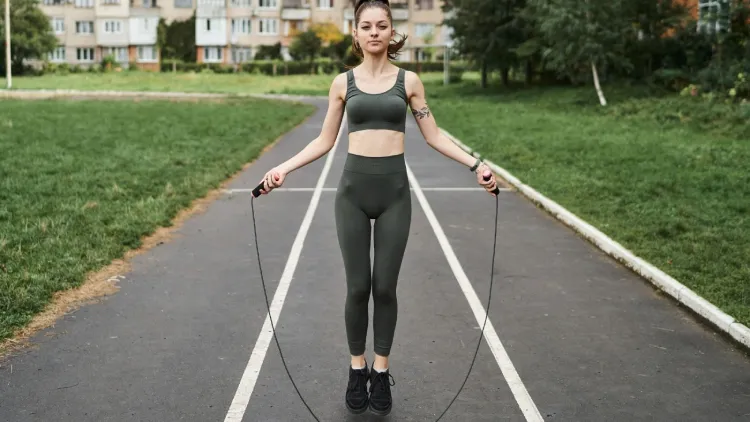
Different jump rope variations can improve coordination, footwork, endurance, and overall conditioning. Start with basic movements and progress as your technique improves.
| Variation | Level |
| Basic Jump | Beginner |
| Alternate-Foot Step | Beginner |
| Side-to-Side Jumps | Beginner–Intermediate |
| High Knees | Intermediate |
| Criss-Cross | Intermediate |
| Double Unders | Advanced |
1. Basic Jump
The basic jump provides the foundation for the jump rope program and is best for the beginner in learning rhythm and timing.
2. Alternate-Foot Step
Taking turns on jumping with each hop, like jogging in place.
3. Side-to-Side Jumps
Slightly jump from side to side for more lateral movement and to test coordination skills.
4. High Knees
Raise knees up to a greater height with each jump to add more intensity and challenge to the lower body.
5. Criss-Cross
Jump with both arms in front of the body, requiring more coordination and timing.
6. Double Unders
Underfoot the rope twice in one jump. This is an advanced action where speed, timing, and control are mandatory.
Jumping Rope Workout Plan
A well-designed jump rope program can enhance endurance, coordination, and general conditioning. The first point for beginners is to work on technique and to work up slowly rather than attempt to perform as many jumps as possible.
Beginner Routine (10 Minutes)
Do short sets and work on proper form.
- Jump: 30 seconds
- Rest: 30 seconds
- Repeat: 8 rounds
Intermediate Routine (15–20 Minutes)
Increase variety and duration of work as technique goes up.
- Basic jump: 60 seconds
- Alternate-foot step: 30 seconds
- Rest: 30 seconds
- Repeat: 8–10 rounds
Advanced Routine (20–30 Minutes)
Increase intensity of variations and intervals and keep technique good.
- Basic jump: 60 seconds
- High knees: 60 seconds
- Double unders: 30 seconds
- Rest: 30 seconds
- Repeat: 8–12 rounds
Build up over time and as fitness improves by cutting back on rest, adding time to work, or increasing the difficulty of the variation.
Can Skipping Rope Help You Lose Weight?
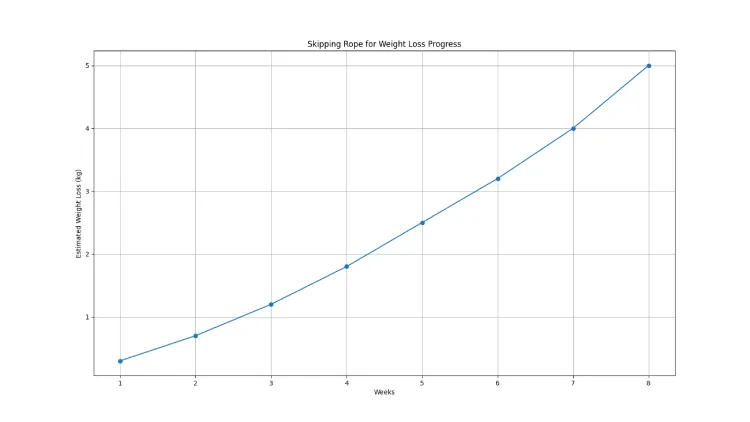
Yes, skipping rope can help you lose weight because it burns more calories during physical activity. But losing weight sustainably requires more than just skipping rope.
- Riding the Rope: A high-intensity exercise that can burn more calories during your workout.
- Calorie balance: If the activity is coupled with suitable food intake, then regular activity can help achieve a calorie deficit.
- Nutrition: Eating a well-balanced diet supplies the nutrients required for an active lifestyle and weight management goals.
- Consistency is key: It is better to exercise regularly and incrementally, rather than too much at once.
- Individual differences: It depends on different factors like activity level, nutrition, body composition, training intensity, etc.
There’s no such thing as spot reduction when it comes to losing weight with a skipping rope. The overall body fat is lost over a period of time and varies in each person.
For the beginner, try doing the rounds for short periods of time, and build up the time as you get more comfortable and fit with the jump rope.
How Many Calories in Jump Rope?
There aren’t many set rules about the number of calories one burns while jumping rope, but it’s definitely a lot. It is dependent on the following:
- Body weight: people who have a higher body weight tend to expend more energy in the same activity.
- Intensity: More demanding and faster jumps will involve more energy.
- Length: Longer sessions tend to result in more calories burned.
- Jumping style: Can be done in different ways – high knees and double unders – to boost workout intensity.
- Rest periods: Longer or more frequent breaks (reduction in the time spent actively jumping).
Unfortunately, there is no magic calorie-burn number that is true for all people. Do not set a calorie goal, but instead concentrate on gradual progression, proper form, and consistent training.
Common Mistakes to Avoid
- Excessive jumping enhances fatigue and stress on the joints.
- The hands should be used to reduce efficiency with arms.
- Not warming up before the exercise heightens the risk of injury.
- Bad posture results in discomfort.
- Without rest during overtraining, fatigue may result.
These errors can be avoided to achieve success in skipping rope in the long term.
Is jump rope safe?
If done correctly and incrementally, jumping rope can be a safe and effective form of exercise. The repeated jumps and landings may make this an activity that is best performed gradually by the beginner.
Safety Tips for Skipping Rope
- Seek professional advice: If you have a pre-existing injury or condition which may be impacted by impact exercise, please check with a suitably qualified healthcare professional before training.
- Use appropriate footwear: Wear shoes that provide support and comfort when jumping.
- Exercise on a stable, appropriate surface: Do not exercise on hard surfaces or rough surfaces.
- Warm up first: Loosen muscles and joints before exercising.
- Try to begin with short time periods: If you become more fit, work up to more intense or longer exercise sessions.
- Give rest: Allow periods of rest or lighter sessions to prevent undue fatigue.
- If there is significant pain, stop: Do not go through an intolerable or persistent pain.
How many times should you jump rope?
The frequency of jumping rope depends on your fitness level, training volume, goals, and recovery.
- Beginner Level: 2–3 sessions per week, with rest days in between sessions.
- Intermediate: 3-4 times per week, depending on recovery and training intensity.
- Advanced: Frequency may change depending on the volume and intensity of training, and on your general workout plan.
Rest and slow progression are key, as jumping rope is a repetitive impact activity. Don’t take it on yourself that jumping every day will get you better results; ramp up the amount of exercise you do and how hard you do it over time.
Skipping Rope vs Walking: Which Is Better?
Skipping rope and walking can both support cardiovascular fitness and an active lifestyle, but they differ in intensity, impact, and accessibility.
| Factor | Jumping Rope | Walking |
| Intensity | Usually vigorous | Usually low to moderate |
| Impact | Higher | Lower |
| Equipment | Rope | None |
| Coordination | Higher | Lower |
| Beginner Accessibility | Moderate | High |
| Time Efficiency | High | Moderate |
| Progression | Speed, intervals, variations | Pace, distance, incline |
Neither is universally better. The better option depends on your goals, fitness level, preferences, and ability to tolerate impact.
Who should be careful when jumping rope?
Jumping rope will require repetition of jumping and landing, so it may require additional precautions before incorporating it into your routine.
Those who are new to exercise, have a lot of joint pain, are recovering from an injury, or have concerns about the impact of higher-intensity exercises may benefit from lower-intensity

Final Thoughts
One of the best exercises to enhance overall fitness is the use of the rope. It improves the tone of muscles, increases stamina, and helps in losing fat.
Through practice, you can shape your body, enhance coordination, and give yourself confidence through practicing skipping rope. You may be trying to lose some weight, run long distances, or stay fit; either way, skipping rope is an effective and strong option.
Ready to improve your fitness? Explore more effective workouts, stretching routines, and fitness tips at Stretchlee to build strength, mobility, and endurance.
Frequently Asked Questions
Q. Does skipping rope help you lose weight?
Yes. This can help with weight loss as it boosts energy expenditure.
Q. What is the duration for a beginner to jump rope?
Begin with short time periods, for example, 30 seconds of jumping, followed by 30 seconds of rest.
Q. How many calories are burned when jumping rope?
It is based on body weight, intensity, duration, and rest periods.
Q. Can Skipping Rope Reduce Belly Fat?
It can help with overall fat loss, but it will not target belly fat.