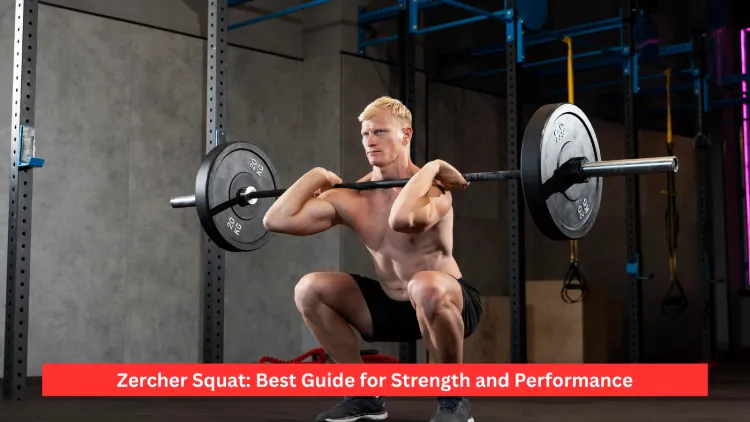

The Zercher squat is a type of squat that uses the front-loaded version of the barbell move; the weight is carried in the crook of the elbows. Zercher squat develops very strong quads, strong glutes, a stronger core and better postures besides putting the total body stability at a greater challenge than most of the squat variations. It is also particularly helpful to athletes, fighters, and lifters who desire functional strength, enhanced bracing capacity, and elevated lifting mechanics. The Zercher squat is an uncomfortable, technically challenging exercise, but no other compound exercise is more effective at developing real-world strength, leg development, and core endurance.
- What Is a Zercher Squat?
- Muscles Worked in Zercher Squat
- Advantages of Zercher Squat (Expanded)
- Zercher Squat (Step-by-Step) How to Perform.
- Proper Form Tips
- Common Mistakes (Expanded)
- Variations of the Zercher Squat (Expanded)
- Who Should Do Zercher Squats?
- Programming Recommendations (Expanded)
- Zercher Squat vs Back Squat
- Safety Considerations (Expanded)
- Final Thoughts
- Frequently Asked Questions
What Is a Zercher Squat?
A zercher squat is a type of squat with a barbell, in which the squatter holds the barbell in the gap between the arms rather than resting it on the back or shoulders. This special loading position alters the whole-body function during the squat.
The weight supported by the upper back is taken in a normal squat. In a Zercher squat, the load is placed directly in front of the body, which keeps the torso upright and adds an additional burden on the core, arms, and upper back.
This workout is usually referred to as uncomfortable but is considered the most effective since it keeps the lifter under tension throughout the kinetic chain. The Zercher squat has been common in both functional fitness programs and combat sports training, as well as strength sports.

Muscles Worked in Zercher Squat
The Zercher squat is one of the best lower-body exercises because it engages multiple muscle groups at once.
- Quadriceps: The quads enhance a lot as there is more knee flexion in the front-loaded position. This makes the Zercher squat the best for leg development and size.
- Glutes: The glutes are the muscles that propel hip extension as the person lifts. The deeper the squat, the more glute activation will occur.
- Hamstrings: The hamstrings also stabilize the hips and help with descent and ascent.
- Core Muscles: The deep core stabilisers, obliques, and abdominal muscles strain to prevent backward falls.
- Upper Back: Trapezius and rhomboids keep positioning and do not round.
- Arms: Biceps and forearms are in unremitting isometric tension, so the Zercher squat is not similar to other types of squats.
Advantages of Zercher Squat (Expanded)
Zercher squat has many strength, muscle-building, and performance advantages, which is why it is a very good workout among amateurs and experienced trainers.
Develops Superior Core Strength
The ability of the Zercher squat to build a strong and stable core constitutes one of the greatest benefits of this exercise. When the weight is being held in front of the body, then your abs should be working hard to ensure that your torso does not collapse out. This tension is a continuous one that tightens the muscles of the deep core and enhances stability.
Enhances Full-Body Stability
Zercher squat involves the coordination of the upper and lower body. All the reps test your balance, posture and control, which enhances the overall athletic performance and efficiency of movement in the other exercises and sports.
Increases Functional Strength
This very exercise is similar to real-life lifting patterns involving the carrying of objects in front of the body. The squat with Zercher develops useful strength which can be applied to normal everyday activities, sports performance, and heavy lifting in real life.
Promotes Better Squat Position
The load being lifted in front also causes a more upright position of the torso to be taken due to the Zercher squat. This helps enhance squat mechanics, prevents excessive forward bending, and even improves positioning in additional squat variations.
Develops Strong Quads
The Zercher squat exerts a lot of strain on the quadriceps since it flexes the knee at a higher degree. This makes it very effective for the growth of leg size and strength, as well as the development of the overall lower body.
Builds Mental Resilience
Bar in the elbows may also be uncomfortable to hold, particularly in heavy sets. The Zercher squat is used to develop mental toughness in that you learn to remain in command and focused even when uncomfortable and exhausted.
Knee-Friendly Training
In other instances, the ERP of the Zercher squat position decreases the load on the lower back when compared to conventional squats on the back. It can serve as a good alternative in cases where the lifters in question are dealing with discomfort when using other types of squats, provided that it is done with an adequate load and in proper form.

Zercher Squat (Step-by-Step) How to Perform.
Step 1: Bar Setup
A barbell should be placed on a rack so that it is easy to pick it up at waist level.
Step 2: Elbow Positioning
Fold your arms and put the bar on your elbows. Cross your hands to keep them safe.
Step 3: Lift the Bar
Recently, stand and take a step backwards, keeping the back tight.
Step 4: Stance
The feet are supposed to be shoulder-width with some orderly, turned-out toes.
Step 5: Descent
Bend and get down on your knees and your hips, allowing your chest to be straight.
Step 6: Depth
Get as low as you can go; preferably parallel level or further.
Step 7: Ascent
Push off with heels and stand straight up again, keeping the tension. The squat must be performed with a sense of control instead of being fast, particularly among beginners.
Proper Form Tips
To achieve the maximum performance and safety during the Zercher squat, it is important to adhere to the following principles:
- Remember to maintain the tallness of the chest in the motion.
- Straighten your back before the repetitions.
- Do not allow the bar to run up.
- Keep the spine in an upright posture.
- Elbows are to be maintained close to the body.
- Reduction and elevation of control.
- Begin with less weight than the increase.
Common Mistakes (Expanded)
Forward Leaning
Bending forward decreases efficiency and causes lower back strain in the Zercher squat. Have your chest raised, and remain erect.
Poor Bar Control
Unless your elbows have a stable bar, it becomes hard to maintain balance. Elbows should be kept tight, and the bar should be held in place on the Zercher squat.
Ego Lifting
To lift too heavy too soon may make you fall out of shape. Begin with the Zercher squat, start with light and work on the technique.
Weak Core Engagement
Regardless of a tight core, you can lose control and posture. Always stick your stomach in the Zercher squat.
Rushing Reps
Large repetitions decrease control and risk of injury. Carry out every Zercher squat in a slow and perfect manner.
Variations of the Zercher Squat (Expanded)
By including the changes to the Zercher squat in the routine, you will enhance your strength, address the weak areas, and make your exercises more efficient and interesting. All the variations are focused on a rather different part of fitness: control, stability, or endurance.
Zercher Box Squat
The squat involves a squat over a box or bench, then the Zercher box squat.
- Helps enhance depth consistency and control.
- Trains good squat mechanics, particularly for beginners.
- Lessens the chances of falling too much or labouring.
Such an alternation is extensive in case you are not able to maintain a low squat or would like to gain some confidence about the Zercher squat.
Dumbbell Zercher Squat
The dumbbell Zercher squat involves using a dumbbell instead of a barbell positioned ahead of you, using your arms and placing the dumbbell vertically.
- Perfect for those who are new to the movement pattern.
- Minimizes the impact on the elbows of a barbell.
- More convenient and less risky at-home exercise.
It has been the best initial position before advancing to a full-fledged Zercher squat using a barbell.
Sandbag Zercher Squat
The sandbag Zercher squat uses a sandbag rather than a barbell, making it unstable.
- Enhances hand-hold strength and coordination.
- Develops practical, real-world power.
- Activates more muscles that are stabilising because of weight changes.
- This fluctuation is trendy in sportive and utility fitness training.
Zercher Carry Squat Combo
It is an advanced variation in which the weight is held in a Zercher hold, then the sagittal walk is performed, followed by squats.
- Develops stamina and comprehensive body training.
- Strengthens without using weight.
- Simulates carrying and lifting of life.
- It is an upside-down yet very efficient method for taking the Zercher squat to a new level.

Who Should Do Zercher Squats?
The Zercher squat is very helpful in:
- Combat sports, e.g. wrestlers, MMA.
- Powerful actors who want to gain some core and leg muscles.
- People are enhancing functional strength.
- Squat lifters and depth lifters.
- Individuals who want full-body compound workouts.
It is especially widespread in athletics, where wrestling with opponents, or barre and lifting opponents, is prevalent.
Programming Recommendations (Expanded)
The Zercher squat is available in various program options based on your experience level and training objectives. Being both a strength- and core-intensive workout, it fits into most workouts.
Beginner Level
When new to the Zercher squat, the primary aim should be to learn posture and familiarise yourself with bar placement.
- Do 3 bouts of light weight, 8-10 reps.
- Rest 60–90 seconds between sets.
- Train it 1–2 times per week.
At this level, control, balance and posture are more crucial than heavy lifting.
Intermediate Level
As the technique comes together, you can add intensity and volume.
- Complete 4 rounds of medium weight 6-8 reps.
- Rest 90–120 seconds between sets.
- Train it 2 times per week.
Zercher squat at this stage assists in building strength, stability of the core and muscle mass, particularly in the quads and the glutes.
Advanced Level
The Zercher squat is one of the effective strength-forming exercises for experienced lifters.
- Among the heavier weights, do 5 rounds of 3-6 repetitions.
- Rest 2–3 minutes between sets
- Wise, train it 1 2 times/week based on the overall program.
This is based on the choice to maximize strength, power of the bracing and safety of carrying heavier loads.
Zercher Squat vs Back Squat
The two forms of squats are good, but they have various applications.
The Zercher squat:
- Lays more stress on central power.
- Builds upright posture
- Engages the upper body more
- The reduction of back loading among some lifters.
The back squat:
- Allows heavier loading
- Pays a greater deal of attention to the strength of the posterior chain.
- Is superior to maximal strength raising.
- It is commonly used in combination by many lifters.
Safety Considerations (Expanded)
- Warm up: Light cardio, then a few squats using body weight before commencing the Zercher squat. Warm up your muscles and joints by adding 1-2 sets of light.
- Pad where necessary: The bar may get casual in the elbows. Pressure reduction: Use a towel/pad and remain form-focused.
- Start light: It is not a good idea to dive into heavy weights. Learn to work the Zercher squat first, then add the load slowly.
- Movement: Sit down gradually, but do not bounce. A regular heart rate is safer with you and enhances muscle activity.
- Pay attention to your body: Otherwise, as long as you experience sharp pain in your elbows or in your lower back, cease. Bend your shape or add the weight.
- Keep stable: Hold your back muscles tight and your chest up to maintain balance and support your spine.

Final Thoughts
The Zercher squat is among the most distinctive and challenging types of squats in strength training. It develops a unique form of leg power, core, and upper-body endurance that is difficult to develop through other exercises.
Although it is very uncomfortable at first, the Zerker squat can be effective once one gets used to it. It is particularly beneficial for athletes and lifters who want to develop strength outside the gym.
This squat is a high-impact exercise in any balanced training regimen that enhances resilience, control, and overall strength.
Frequently Asked Questions
1. Does the Zercher squat build muscle?
Yes, the Zercher squat is very effective for building muscle, especially in the quads, glutes, and core. The individual is in a front-loaded posture, which adds more tension to the muscle and demands greater control, promoting strength and hypertrophy.
2. What makes the Zercher squat so difficult?
The Zercher squat is not easy because the weight is held in front and requires more energy from the core, upper back, and arms. It is also based on good balance and proper bracing, thus more difficult than usual squats.
3. Is the Zercher squat better than the regular squats?
When necessary, Zercher squats can be used instead of regular squats to improve positioning and strengthen the core. Nevertheless, it is generally preferable to use both to develop the whole body and its lower part.
4. Does it mean that the Zercher squat is safe with beginners?
The Zercher squat is safe for beginners when performed with light weight and in proper form. It is better to start slowly, pad where required, and focus on technique, which will build confidence and reduce the risk of injury.