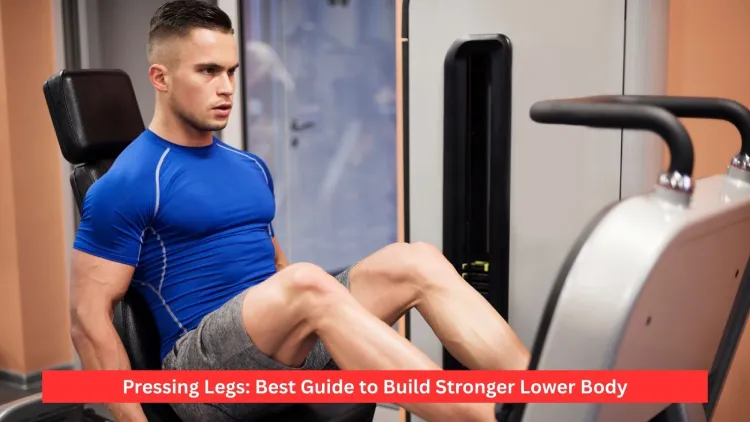

Leg pressing is the best lower-body workout that focuses on the quadriceps, glutes, hamstrings, and calves to maintain the stability of the joints and how the leg muscles work generally. Learned in a machine, it offers a safe environment, a controlled setting for both beginners and athletes. It muscles, strengthens the bones, helps in keeping the joints strong and also helps in making one have better performance in sports with the right technique. The mobility and strength of the lower body are enhanced with time through frequent training of pressing the legs.
- Muscles Worked During Pressing Legs
- Benefits of Pressing Legs
- Wearing Fancy Legs the Right Way
- Proper Form Tips
- Common Mistakes When Pressing Legs
- Pressing Legs Variations
- Pressing Legs vs Other Leg Exercises
- Ideal Sets and Repetitions
- Who Should Do Pressing Legs?
- Tips to Improve Results
- Sample Leg Workout With Pressing Legs
- Conclusion
- Frequently Asked Questions
Muscles Worked During Pressing Legs
Pressing legs is also regarded as a form of lower-body exercise since it uses a number of muscles at the same time. In comparison to isolation movements, which involve a single muscle, compound exercises are effective in stimulating multiple muscles and therefore contribute to growth in strength, coordination, and muscle building.
When pressing the legs, the following muscles are mostly involved.
Quadriceps
The most important muscles in pressing the legs involve the quadriceps, which give the pushing action. These muscles are found at the anterior part of the thigh, and they extend the knee and contribute most of the force required to lift the weight platform.
Quadriceps are very strong in nature, which is needed to perform normal routine like walking, climbing stairs, rising and running. When pressed legs are taking place, the quadriceps contract with a tight grip when you are extending your knees and pushing away the platform with your body.
Glutes
The gluteal muscles, especially the gluteus maximus, are significant in the production of power in the pressing of the legs. These muscles extend the hips, and they help a lot whenever propelling heavier loads.
Training good glutes not only enhances performance in athletic events but also provides posture, balance and stability in the lower body.
Hamstrings
As much as hamstrings are not the main push in pushing legs, they serve as auxiliary muscles. They assist in the stabilisation of the knee joint and aid in the extension of the hip during movement.
Properly developed hamstrings enhance the stability of joints as well as minimise the chances of muscle imbalances in the front and back of the thighs.
Calves
The calf muscles help in ankle stability when pressing the legs. Although they do not develop to a high level as compared to quadriceps or glutes, they assist in stabilising the correct position of the foot, as well as adding force.
Well-balanced calves enhance balance and support locomotion acts such as running and jumping.
Core Muscles
The muscles of the abdomen and lower back coordinate in stabilising the torso when pressing the legs. Although the exercise is machine-based, the core is essential in the upholding of good posture and avoiding the excessive movement of the spine.

Benefits of Pressing Legs
There are numerous benefits of pressing legs because they help a person to wwork outthe lower body. Due to the fact that the movement exercises many muscles, it accelerates strength and conditioning.
Builds Lower-Body Strength
The fact that one can safely lift heavy weights is one of the greatest advantages of pressing the legs. The machine will hold your back and will stabilise your body, enabling you to dedicate complete attention to power pushing.
This is why the action of pressing legs is a good exercise to build strong legs and enhance the performance of the lower part of the body as a whole.
Promotes Muscle Growth
Since the act of pressing legs makes use of the masses of large muscles, it is very effective in mass building. The hormones of intensity of stimulating the quadriceps, glutes and hamstrings are exercised, thereby inducing muscle hypertrophy with time.
Regular workouts would result in stronger and thicker thighs and better muscularity.
Enhances Female Athletic Performance
Leg strength is significant in the activities of athletes like running, jumping, cycling, and sprinting. It has been observed that explosive power and endurance can be enhanced by pressing the legs, which can be used to achieve a good sports performance in most sports.
Supports Joint Stability
Working out the muscles surrounding the knees and hips is a procedure that makes the knees and hips more stable. Protective structures that cushion joints during movement can be strengthened through pressing of the legs.
More powerful muscles may also help to take off the pressure on the joints that might come to help those who feel slight uneasiness upon engaging in physical exercise.
Enhances Blood Circulation
Big-mover exercises like the pressing of legs augment the circulation of blood in the lower parts. This enhanced circulation also supplies the body with oxygen and nutrition, and the body provides the muscles and joints with a potential cause of the relaxing and satisfying feeling that many people associate with the movement.
Supports Bone Density
Bone, the controlled stress caused by resistance exercises, which include the press leg can prompt bone growth and density. Building up bones is important in the prevention of age-related bone loss and healthy skeletal maintenance in the long run.
Enhances performance in terms of strength
Most of our everyday lives, such as walking, carrying, climbing stairs, and getting out of a sitting position,n all depend on the strength of our legs. Pushing up legs triggers strengthening in the muscles used in these movements, thus making daily chores not hard anymore.
Wearing Fancy Legs the Right Way
The correct form of performing pressing legs is the key to the greatest advantages and avoiding injury. Although the exercise is machine-based, a proper method is required so as to achieve safe training.
Step-by-Step Instructions
1. Adjust the Machine
Sit leg testing with the help of a leg press machine. Sit in a position where the entire part of your back and hips are supported.
2. Put Your Feet on the Platform
Have your feet placed on the platform like they were about the shoulders. The toes should be slightly pointed out of the ground so that they stay in a natural position.
3. Release the Safety Handles
When your feet are in place, unlock the safety handles, keeping your legs slightly bent.
4. Lower the Platform
Gradually bend down your knees and reduce the weight approaching your body. Move steadily so as not to drop the weight too.
5. Push the Platform Away
Also, use your heels to press and push the legs until the platform has returned to the initial point.
6. Repeat the Movement
The target movement is to repeat the required number of repetitions with constant breathing and controlled movement.
Proper training to do the pressing legs properly is necessary because it will make the muscles work efficiently, and the jointswill bee safeguarded.

Proper Form Tips
Form can be of significant difference in safety and effectiveness, as well as the correct form in which the legs are pressed.
Keep Your Back Flat
The seat against which you should sit ought to be firmly locked against the back during the whole movement. This helps eliminate preventable back-ache.
Avoid Locking the Knees
Stretching your legs to their fullest and locking the knees may strain the joints. Rather, leave a little curve on the motion.
Control the Weight
Reduction of the platform progressively enhances muscle contraction and injury minimisation.
Push Through the Heels
The heels need to be pressed in the case of pressing legs to activate the glutes and the hamstrings more.
Maintain Proper Breathing
Breathe in and push the weight, then exhale and push the weight down. Being in control of the breathing process aids in stabilising and enhancing vigour during the workout.
Common Mistakes When Pressing Legs
Although it is relatively easy to press legs, most individuals easily break down the effectiveness of the exercise.
Using Excessive Weight
Attempts to move too heavy loads usually produce poor technique. Better concentrate on motorised movements and also add resistance slowly.
Lifting the Lower Back
Spinal stress, which does not necessary happens when the lower back is removed from the seat.
Short Range of Motion
The failure to lower the platform to an adequate extent will decrease muscle activity, restricting muscle growth.
Placing Feet Too Low
Putting the feet too low on the platform may put too much stress on the knees.
To prevent these errors, pressing legs ought to be a safe and effective exercise.

Pressing Legs Variations
The pressing legs have many variations which can be used in order to differentiate the area of attack of muscles and introduce variety to the exercises.
Narrow Stance Leg Press
A straight position focuses on the quadriceps and makes it more painful on the front of the thighs.
Wide Stance Leg Press
Greater foot positioning is more effective at the inner thighs and the glutes.
Single-Leg Press
One-legged pressing: Leg lifting one leg and then the other is good in enhancing intensity and balance,e as well as in eliminating strength imbalances.
High Foot Placement
When the feet are elevated on the platform, more work is put on the hamstrings and glutes.
Low Foot Placement
Placing the lower part of the foot level raises the quadriceps when pressing the legs.
Pressing Legs vs Other Leg Exercises
Some exercises are common in lower-body exercises, but pressing legs is one of the main reasons why the machine exercise is popular.
Pressing Legs vs Squats
Squats are a traditional compound exercise because they target the legs and glutes. They need greater balance and stability of the core.
The pressing of legs, though, gives the machine more support, which allows individuals to concentrate on pushing power fully. These are good exercises that may be used together during a fitness program.
Pressing Legs vs Lunges
Lunges are balance and coordination factors, as each leg is working on its own. They also cause the stabilising muscles to be more stimulated.
The heavier objects and constant tension of the muscles are provided through pressing legs, which is why it is the best choice to use to gain power.
Pressing Legs vs Hack Squats
The Hack squats are a replica of the squat mechanism, albeit with guided direction of machine movement. The legs are pressed, which positions the body in a seated position, decreasing the load on the spinal cord and increasing the stability.
Ideal Sets and Repetitions
The frequency of sets and repetitions, during the process of pressing legs, varies based on the objective of the fitness.
For Muscle Growth
Eight to twelve repetitions in 3 or 4 sets would be effective to stimulate hypertrophy of the muscle.
For Strength Development
The maximum strength can be developed with heavier loads of 4 to 6 repetitions.
For Muscular Endurance
Endurance can be enhanced, and muscle stamina can be promoted by means of higher repetitions, including 12 to 15 per set.
The duration of rest between sets is normally 60-90 seconds.

Who Should Do Pressing Legs?
The reason is that the pressing legs are applicable to a large population of individuals who desire to enhance the strength of their lower body by exercising. Some free-weight movements are not easily acquired by beginners, as the machine is supportive and stabilised. Pressing of the legs helps athletes since the stronger legs enhance speed during running, jumping, and the overall functionality of the athlete.
Making use of pressing their legs by older people is also likely to help in preserving their muscle volume and strength. Regular resistance training maintains strength, which is lost with age. Though some endogenous injuries are meant to be healed even to people who are in the healing stages of these injuries, by stressing the legs in terms of movement, it guarantees that the spine will incur less stress.
Tips to Improve Results
Constant practice and training regimes matter in order to make the most of pressing legs.
Warm Up Properly
Warm-up Light warm-up is good to enhance the blood flow and condition the muscles to welcome more work.
Resistance should be raised slowly
. Gradual overload, which is the weight that gets gradually heavier with time, assists the muscles in becoming stronger.
At South Philadelphia Mixed with Other Exercises
The squats, lunges, and hamstring exercises fitted into the routine will form a balanced workout of the lower body.
Maintain Good Nutrition
Powerful muscles need sufficient protein, vitamins and minerals to heal and develop.
Vitamin D, calcium, and magnesium, among others, are nutrients that promote bone and joint health and can be used to ensure strong legs during training.
Stay Consistent
Frequent exercises involving pressing the legs may result in large gains in strength and muscle building.
Sample Leg Workout With Pressing Legs
A properly balanced exercise for the lower body is one that incorporates various motions to various muscles.
Example Routine
- Pressing legs- 4 sets × 10 repetitions
- Squats – 4 sets × 8 repetitions
- Walking lunges -3 sets 12 reps.
- Leg curls – 3 sets × 12 repetitions
- Calf raises- 4 sets x 15 reps.
This exercise is a power workout that builds up the lower part of the body and enhances overall muscle building.

Conclusion
One of the best lower-body exercises in the strength training program is pressing legs. The exercise is beneficial as it makes legs strong, taking care of the stability of the joints, and physical performance in general due to its ability to work with the quadriceps, glutes, hamstrings, and calves at the same time. The limited ability of the leg press machine to control the leg presses makes it available to both the novice and the expert athlete. When done properly, it may build up body muscles, strengthen bones, promote blood flow, and add to mobility in the long run.
Frequently Asked Questions
1. Do pressed legs help to keep your knees healthy?
Yes, pushing legs are good to maintain the health of the knee, provided proper form is applied. Maintaining a flat back with locked knees eradicates the stress on the knees.
2. What is the amount of weight that can be pressed by a normal individual?
It varies by fitness level. Novices will begin with lesser weight, whereas trained persons might be able to press legs of equal weight with the weight and often more.
3. Is it possible that stressed legs make the legs grow larger?
Yes. The frequent pressing leg training process focuses on the quadriceps, glutes and hamstrings, which build more size and strength of the leg.
4. Does leg pushing enhance bone strength?
Yes. I can also allow the use of resistance exercises, such as pressing legs to maintain bone density and stabilise the joints.