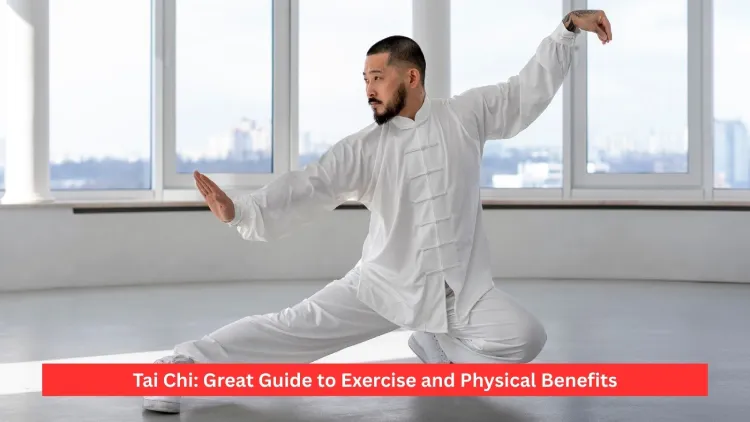

Tai chi is a non-strenuous kind of movement, which makes use of slow and flowing movements, controlled breathing, and good posture. It assists in enhancing balance, adaptability, strength, and coordination, even alongside long-term joint health. Tai chi does not need any equipment and is appropriate with nearly any age group, particularly the elderly and people with knee or arthritis issues. It may appear easy, but because of the accuracy and body control it requires, it may prove very difficult. It improves the posture, the tone of muscles, endurance, and general physical health with the habit.
- What Is Tai Chi as an Exercise?
- How Tai Chi is used as a physical exercise
- Primary Muscle Groups Involved
- Normal Tai Chi Exercise Movements
- Physical Exercises envy
- Comparison of Tai Chi and other forms of exercise
- Tai Chi as an Exercise Routine
- Who Can Be beneficiary of Tai Chi Exercise?
- Tai Chi as a Daily Exercise Habit
- Tai Chi Safety Tips
- Core Principles and Structure
- Additional Clarifications
- Conclusion
- Frequently Asked Questions
What Is Tai Chi as an Exercise?
It represents a systematic movement literature, which is established on slow, continuous and controlled body movements. Tai chi, as an exercise, emphasises conscious weight transfer, standing with the back straight, arm movements, and uninhibited breathing. Speed or explosive power is not the aim of tai chi: efficient movement, joint control, muscular endurance, and balance training are all the intentions.
Tai chi exercise has a primary purpose: internal stability and external coordination. It does not train one of the body parts separately, but the body as a whole entity. One movement in the other follows without sudden, abbreviated movement. This gives a smooth and rhythmic progression that works or activates several muscle groups in combination.
It has been said to be akin to yoga, although both exercise regimes vary. Yoga will tend to have static posture, which is held over a period, whereas tai chi focuses on motion. It can also emphasise the movement of body weight and standing-up-sitting movements. There should be an individual objective as to whether a person is better or not. Balance and lower-body functional strength are especially useful with tai chi, whereas the flexibility and floor-based stretching might be prioritised with yoga. The two can be used to complement each other.
It is primarily physical in nature. Although other people take it with a mindset where they reflect, the fundamental focus of tai chi practice is Biomechanics, correct posture, desired muscle activity, and effective movement patterns.
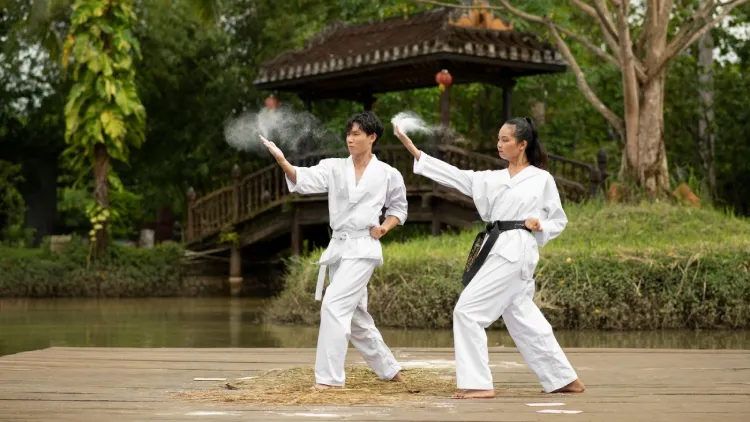
How Tai Chi is used as a physical exercise
Tai chi is a neuromuscular training system. All movements require the relationships between the brain and muscles. It is a slow-moving practice, so the body does not have to rely on momentum. Muscles should not be dropped during the movement.
The precision of tai chi is its challenge. Movements have to be neither tense nor controlled. With the spine held straight, shoulders loose, the knees a little bent back, and the weight placed purposely. It is usually not easy for beginners, who may think it involves brute strength, to perform fine body balance and precision of movement.
One principle that is commonly exercised in tai chi is the 70 per cent effort principle. This is whereby you carry out activities at approximately 70 per cent of your physical capability. Practitioners remain calm and composed, as opposed to getting joints locked or overstraining muscles. This gives the strain and endurance.
It is powerful when it is practised on a regular basis, as it increases body awareness, develops stabilising muscles, and also makes the movement more efficient. In the long-run, this enhances balance, control of the joints and muscular stamina without unnecessary strain to the body.
Primary Muscle Groups Involved
It is a complete body work which engages muscles as a result of controlled movements.
1. Leg Muscles
The work is done in the lower part of the body. Semi-squatting positions enhance:
- Quadriceps
- Hamstrings
- Gluteal muscles
- Calves
Due to constant weight displacement, tai chi builds unilateral leg strength. This will help the seniors, especially since good legs will help deter falls.
It is also said to be useful to persons with knee-related issues, provided they are done well. The gradual and gentle movements are capable of enhancing the stability of the knee and the strength of the muscles around it without causing any effects. But onall too deep postures can overstrain sensitive joints, hence posture modification is noteworthy.
2. Core Muscles
All movements are stabilised by the abdominals and lower back. Tai chi advances core endurance by upholding an upright position and rotational control. Although it does not directly help burn belly fat by itself, regular tai chi exercise is included in the total calorie expenditure and body-fat composition as part of healthy nutrition.
3. Upper Body Muscles
The hands move in circular motions involving the shoulder, forearm and upper back muscles. The slow arm positionings are also endurance-building even without weights.
In the long run a tai chi can alter the body structure. The posture, muscular and skeletal tissues become better, so the body looks more erect and symmetrical.
Normal Tai Chi Exercise Movements
It is organised with the help of flowing routines in the form of forms. Styles differ, but there exist some fundamental movements across systems.
- Commencing Form: An initial position that balances posture and breathing.
- Parting the Wild Horse’s Mane: Plays the role of taking initiative as the coordinating arm sweeps.
- White Crane Spreads Its Wings: Emphasises the balance of the upper body and weight transfer.
- Brush Knee and Push: Improves the coordination of stepping and arm extension.
- Golden Rooster on One Leg: Builds single-leg balance.
- Wave Hands Like Clouds: Enhances lateral stepping skills.
- Repulse Monkey: Backwards stepping trains with controlled arm patterns.
These seven moves are among the building blocks of training commonly integrated into beginner training programs.
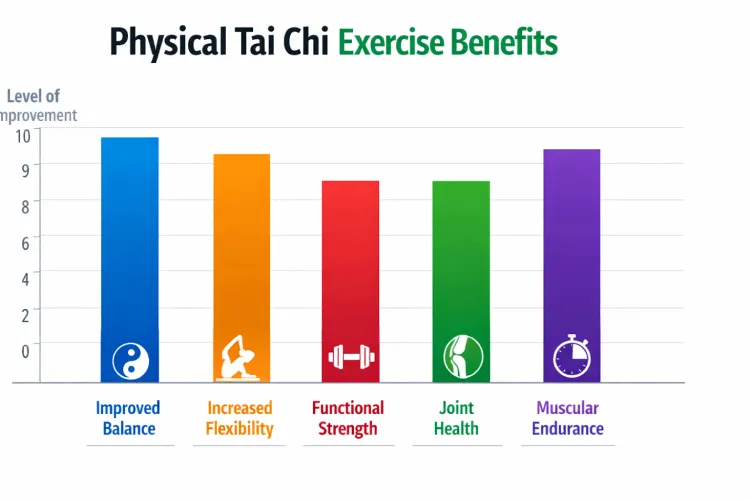
Physical Exercises envy
There are physical benefits of Tai chi.
- Improves Balance: Exercises that involve the movement of weight improve stabiliser muscles.
- Enhances Flexibility: Light rotations and flexions on the joints enhance mobility.
- Builds Functional Strength: The Semi-squat postures bear fortification on daily movement patterns.
- Supports Joint Health: Tai chi is beneficial in the management of arthritis because of the low impact it generates.
- Boosts Muscular Endurance: The time of tension is increased by slow motion.
Improved balance is widely believed to be the best thing about tai chi with regard to older age groups. Balance training is perhaps rated among the most significant daily physical activities among seniors.
Comparison of Tai Chi and other forms of exercise
It has multi-directional stepping, rotational movements, and upper-body movements in comparison with walking. Walking primarily trains forward motion, whereas tai chi is a test of balance in all aspects.
It might be superior in aiding as compared to walking, though walking gives greater cardiovascular training at moderate velocities. The mixture of the two results in a balanced routine.
In comparison to kung fu, it focuses on slow and controlled exercise. Kung fu dwells on swiftness, force and sports training. Tai chi can be a better choice if you want to exercise your joints without causing harm. Kung fu might be a better option if you desire explosive athletic skills improvement.
Tai Chi as an Exercise Routine
The practice of Tai chi can be started at almost any age. There is no “perfect” age. Definitely, children, adults, and the elderly can go out and do this safely, provided guidance is offered in proper groups. A lot of people begin with it when they are in their 50s, 60s or 70s.
In the case of seniors, simplified Yang style would be highly suggested since it is upright and also forgiving in terms of pace.
Session Duration
The average time spent is between 20 and 45 minutes. Novices can initiate with 15 minutes. Multiple sessions in a day are better at improving coordination compared to weekly sessions.
Best Time of Day
Practice in the morning enhances the motion and warms up the joints to move without any difficulties. Still, it can be practised at any time, provided that the body feels relaxed.
Who Can Be beneficiary of Tai Chi Exercise?
Tai chi suits:
- Older adults
- Patients with mild arthritis.
- People are healing low-impact injuries.
- Novices are taking training programs.
A daily routine of walks, light-bearing strength training, balance, and tai chi may be part of the routine of a 70-year-old. Balance-based exercise is believed by many fitness experts to be one of the most significant activities among the elderly.
It enhances anti-ageing effects because it ensures muscle tone, posture, coordination and mobility.
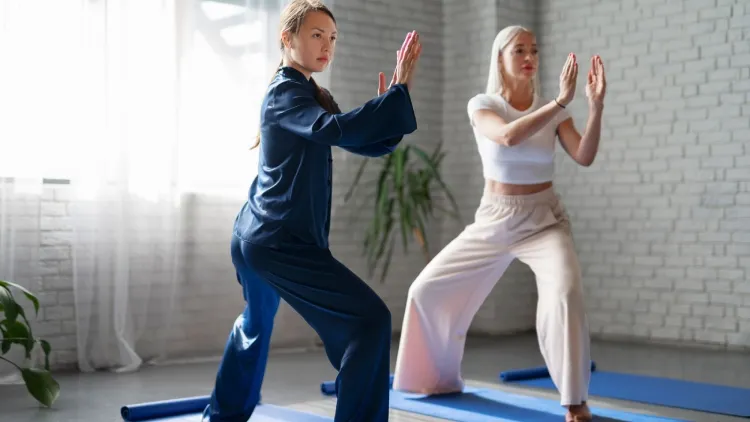
Tai Chi as a Daily Exercise Habit
Doing it every day enhances neuromuscular performance. Several weeks later, most people report that they are more balanced and flexible. Appreciable levels of posture and coordination transformation might be noted between 4 and 8 weeks of regular practice.
The 5-3-1 principle, applied occasionally in planning exercise can be loosely used:
- Light activities 5 days a week.
- Balance or strength as of 3 days.
- 1 day of active recovery
- It could be under all three categories.
Tai chi daily will lubricate the joints, increase blood circulation, and stabilise muscles. This eventually leads to the easier patterns of movement.
Tai Chi Safety Tips
Although it is non-impactful, there are disadvantages associated with it:
- Gradual development is possibly exasperating to a person who wants quick body development.
- The strain can happen in the case of improper knee positioning.
- Patient and detailed orientated.
- Proper posture might require time to learn.
Common mistakes include:
- Locking knees
- Excessive forward leaning
- Holding breath
- Moving too quickly
- Tensing shoulders
Introduction of correction and mindful pacing minimises the risk of injuries.
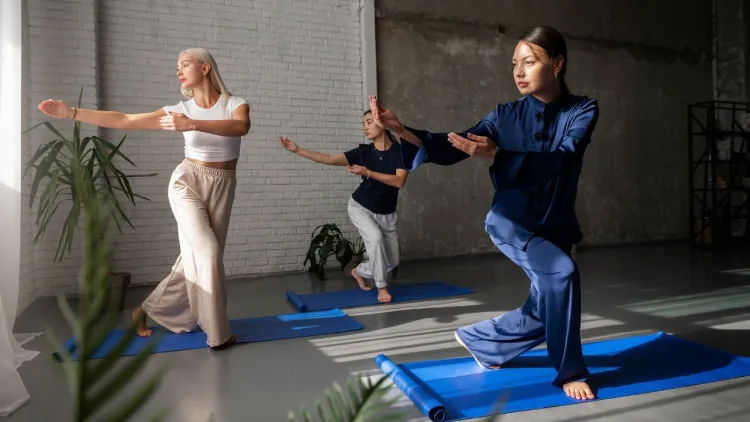
Core Principles and Structure
Tai chi has a distinct physical framework, which is the structure. Though the motions appear elegant and smooth, each movement has certain principles which make the exercise efficient and less dangerous. These rules guarantee the use of tai chi, which enhances balance, strength and coordination without stressing the joints.
It includes four (usually highlighted) pillars of tai chi practice:
1. Correct Positioning and alignment
Tai chi is based on good posture. The spine remains straight, the head is raised slightly, the shoulders are loose, and the knees are bent. The body must be stable and yet not rigid. Proper alignment enables the weight to move easily in a manner of shifting between one leg and another, and protects the knees and lower back. Over time, having the right alignment in tai chi improves daily posture and stability of the core.
2. Controlled Breathing
The tai chi breathing is slow and natural. Motions are synchronised as the breathing is regular and involves inhaling and exhaling. This is the regulated breathing to keep rhythm, avoid fastening and make the body calm. It also helps in muscular stamina by enhancing the flow of oxygen. It must never be forced out of the mouth, but rather be quiet and easy.
3. Already Relaxed and Yet Engaged Muscle Tone
Tai chi is the instruction of active relaxation. The muscles are activated to the extent that they promote balance and motion, yet are not stressful. As an illustration, legs perform in semi-squat positions, but shoulders and neck are loose. This sense of both rest and action enables tai chi to endure easily.
4. Existent, Contiguous Motion
In tai chi, movements are continuously and constantly flowing into each other. The body does not move in parts but as a unified body. The arms, legs and torso are coordinated when walking. The body control and body coordination are enhanced by this continuous movement, which enhances balance.
The tai chi secret is that relaxation is enhanced by structural control. We are not born into the world, but grow into it by being in proper alignment and smooth and connected movement, which is power. Once these guidelines are exercised on a regular basis, tai chi proves to be a very efficient and, at the same time, a very sustainable exercise.
Additional Clarifications
It does not necessarily go against religious beliefs. Being a physical movement system, it is an exercise. People have the ability to learn tai chi without involving philosophical interpretations, with the motive to do it just to be healthy.
No special equipments are necessary. Slim-fitting clothes and low-heeled shoes do the job.
Arthritis symptoms could also be addressed with the help of Tai chi as a result of its slight joint movement. Higher levels of practitioners state that mobility and reduced stiffness are improved.
Although tai chi does not burn many calories, it helps to maintain fitness and could help with fat burning when included in a wider healthy lifestyle.
Other similar tai chi-type exercises are qigong and slow-flow mobility exercises.
Conclusion
It is a low-impact, full-body exercise program that is aimed at enhancing balance, strength, flexibility and coordination. It is appropriate for almost every age group and particularly very useful to the seniors who want to be taken care of in terms of their joints. Despite the simplicity that can be conveyed, tai chi involves precision and patience; therefore, it is difficult but very rewarding.
It improves posture, muscular endurance, and physical health in the long-term through regular practice. Tai chi, no matter how long it is practised (20 minutes a day or a more elaborate exercise regimen), remains probably one of the most sustainable and accessible exercise systems today.
Frequently Asked Questions
1. How soon do you find results?
Improvements in balance, flexibility and coordination in most people are seen in 4-8 weeks of regular tai chi practice. It can be expedited by exercising at least 35 times per week. The long-term gains, including more advantageous intention, stronger legs and enhancement in joint stability, take time to manifest in several months.
2. Can tai chi be used by older adults and individuals with knee or arthritis concerns?
Yes, it is strongly advised among seniors as it is non-vigorous and involves balance and controlled movement. When used with alignment and moderate depth, the tai chi can build the muscles surrounding the knees as well as enhance joint movement, which could be used to control symptoms of mild arthritis. Nevertheless, there should be a modification of movements according to person-based comfort levels.
3. Is there any equipment required to practice tai chi?
Tai chi does not require any special equipment to perform. Loose-fitting, easy-to-move clothing and flat, supportive shoes are quite sufficient. In tai chi, one can train either at home or outside in a stable place where there is a lot of space to move around.
4. Is tai chi superior to walking or yoga?
Tai chi, walking and yoga have various advantages. It can notably be used to enhance balance, coordination and functional strength. Walking is very good in terms of cardiovascular health, whereas yoga tends to focus on the flexibility and, in some cases, on the static leg-raises. The decision you make is up to you, and tai chi can be beneficial when combined with other exercises.