


One of the most suitable exercises that should be done to develop strong, round and even bigger shoulders is termed the dumbbell lateral raise, which targets the side delts. It enhances better definition, strength, and facilitates performance on other exercises. You do not require heavy weights; light or moderate dumbbells are sufficient to grow in case you use proper form, restraint repetitions and smart training principles such as progressive overload, 3-3-3, 5-3-1 or 2-for-2. It could be performed by amateurs, medium, and professional weight lifters. Although it works, it must be combined with other shoulder activities, such as overhead press, in order to achieve maximum size, symmetry, and long-term shoulder health.
- Dumbbell lateral raise: What It Is and How It Works
- Muscles Worked
- Dumbbell Lateral Raise: How to do it (Step by Step).
- Common Mistakes to Avoid
- The Advantages of Dumbbell Lateral Raise
- Dumbbell Lateral Raise Variations.
- Tips on Programming to achieve better results.
- Who should do Dumbbell Lateral Raises?
- Safety Tips
- Conclusion
- Frequently Asked Questions
Dumbbell lateral raise: What It Is and How It Works
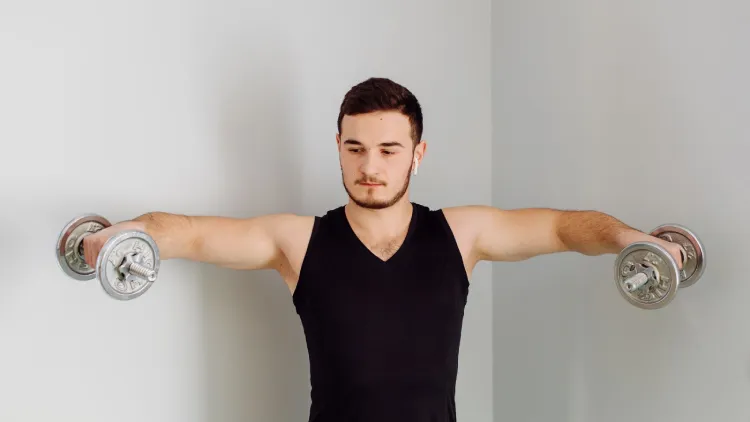
Dumbbell lateral raise is an isolating strength work that is done with a dumbbell that is held at the side of the body. This move consists of moving the arms out to shoulder level, forming the dumbbell Lateral raise abduction. The side delts are the muscles that are isolated by the movement, hence directly adding width and shape.
This exercise is highly popular due to one of its reasons being that you do not need heavy weights to enjoy its benefits. Most individuals begin with dumbbells of 35 kg, and even skilled lifters can exercise on moderate weights, increasing the reps. Actually, there is no need to use such heavy dumbbells because they might slow down the training and make it more dangerous to the muscular system.
The dumbbell lateral raise can also be used to aid other exercises since it enhances shoulder stability. It improves the muscles that aid in the overhead pressing, bench pressing and pull-ups. Even though pull-ups are very good in building up the back muscles, they do not isolate the deltoids in a manner that the dumbbell lateral raise does.
Muscles Worked
The body parts mostly utilised by the lateral raise dumbbell are:
- Lateral Deltoid ( Side Delt )- This is the primary muscle that increases h.
- Anterior Deltoid is of little help in the movement.
- Supraspinatus –acts at the initial 15 degrees of the lift.
- Upper Trapezius– stabilises the arms.
- Core and Obliques – be in the same position and do not sway.
Even though the side delts are in control contacts, the shoulder structure is maintained in other small stabilisers that are still engaged in this exercise. It is also mentioned that the lateral deltoids are some of the most difficult muscles to develop; hence, this exercise is needed in achieving balanced shoulder building development.
Dumbbell Lateral Raise: How to do it (Step by Step).
Proper form is crucial. Ineffective technique both decreases muscle involvement and predisposes the shoulder to painfulness.
- Setup: Straight, with dumbbells in hands. Shoulders are to be kept low and the chest raised.
- Brace Your Core: A firm central section ensures there is no undue swinging or balance.
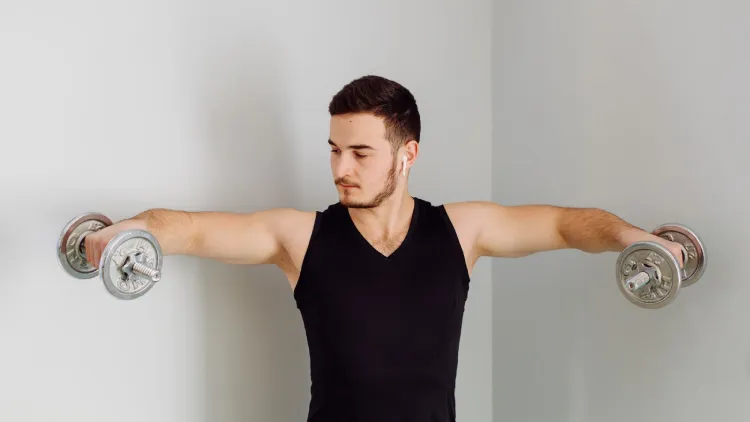
- Lift the Dumbbells: Lift your hands to your sides until they are a shoulder level. Have a slight bend in your elbows, say of 15 degrees.
- Control the Movement: Hold on the top, then bring the dumbbells down slowly. The stage of downward is to be tamed.
- Breathing: Easy breathing in and lifting, breathing out and lifting.
- Proper form is that the elbows should be bent slightly, but not so much that they are in the form of a curl. Bent yet restful arms form the best tension on the deltoids.
- This progressive method can answer the question of the correct form, and it also brings about having the shoulders to carry out the workload, rather than the traps or momentum.
Common Mistakes to Avoid
The lateral dumbbell raise is a type of exercise that many individuals do incorrectly, which diminishes its power. Here are mistakes to prevent:
Swinging the Weights
- Movement relieves the impact on the deltoids.
Using Too Much Weight
- It does not pay to be heavier in this exercise. The greatest results are produced with light-to-moderate weight.
Shrugging the Shoulders
- This transfers this tension to the traps.
- Lifting the Dumbbells Higher up.
- Raising the position above the shoulder forbears muscle activity and can result in pain.
- Elbow Bending Oversized.
- The activation of the lateral deltoids is minimised by taking advantage of a curl-like movement.
Leaning Back
This eliminates loneliness and can overwork the lower back.
These mistakes can commonly occur in the process of doing heavy or high-rep sets without good control. To illustrate, 3 groups of 20 repetitions can be a good exercise for enduring muscles, but that should only be carried out under strict form.

The Advantages of Dumbbell Lateral Raise
- Builds Shoulder Width: It works on the side delts, which makes your shoulders look broader and more sporty.
- Enhances Muscle Definition: It assists in the formation of rounded shoulders, which are capped and give an aesthetic look.
- In Favour of Strength in Other Exercises: Tougher delts will help in presses, rows, and even some dumbbell workouts, which will help to burn fat.
- Works for All Fitness Levels: It is quite common to start with a weight of 2-5 kg, which is quite efficient among beginners. Even serious bodybuilders utilise mid weights.
- Improves Stability: Greater delts provide decreasing chances of shoulder injuries and asymmetries.
- Helps Build Bigger Shoulders in Time. Lateral raises alone will not develop massive shoulders, but they are needed to develop side delt thickness, which adds great size to the shoulders.
Dumbbell Lateral Raise Variations.
- Seated Dumbbell Raise: Momentum is decreased, and the form is more restricted.
- Single-Arm Lateral Raise: Enhances muscle balance and acuity of the mind.
- Leaning Lateral Raise: Enhances motions of the deep delt.
- Cable Lateral Raise: Offers tension all throughout the movement.
- Machine Lateral Raise is Better in strict hypertrophy training, and progressive overload in case of an increase in form caused by free weights.
The most appropriate one is upon what your aim is: free weights, to train functional strength; cables, to maintain constant tension; and machines, to train controlled hypertrophy.
Tips on Programming to achieve better results.
- There is no necessity for very heavy weights. Actually, moderate weight and increased reps increase the lateral delts in the best way.
- 10-20 reps in 3-4 sets is adequate for hypertrophy.
- Isolation can be minimised by very heavy lifting, which is not necessary.
- Progressive overload is important: give an addition of 1 to 2 reps in a week or make it bigger by an addition.
- The 3-3-3 rule ( 3 seconds up, 3 seconds hold, 3 seconds down) is excellent for controlling mastery.
- The 5-3-1 rule assists in designing strength development in the compound exercises, but may serve as the basis to build a systematic training program for shoulder work.
- The 2-for-2 rule proposes that you can only add weight when you can do 2 extra workouts on your last set.
Even light to moderate weight dumbbells (even 5 kg), under the condition of controlled intensity and tempo, are sufficient.
Who should do Dumbbell Lateral Raises?
This exercise benefits:
- Novices building infrastructural strength.
- Middle bodybuilders are polishing their shoulders.
- Athletes experiencing stability.
- Bodybuilders focus on width and symmetry.
- Those who desire more beautiful college equipment.
When it is performed daily, the shoulders will be overexerted, which results in fatigue or injury. Delts require time to heal and develop, normally 48 72 hours.
Safety Tips
- Do warm-up drills on your shoulders.
- Keep the movement within control; do not jerk and swing it.
- A sharp shoulder pain is a potential indication of a condition that should be addressed.
- Work with a weight manageable and which holds the form rigid.
- Daily training is not recommended- shoulders require rest to increase.
- Machines or cables can be friendlier to the joints in case the lateral raise is painful.
Lateral raises, bending forward, also have their errors: bending the back, swinging the arms or lifting too high. These issues are they will be avoided by a flat back and slow movement.
Conclusion
Dumbbell lateral raise is an exercise that is very effective in empowering anyone who wants to have stronger, wider, and stronger shoulders. The rounding and athletic shape of the shoulders is my most important tip, defining its capacity to isolate side delts, making it necessary. Even the light to medium weights with appropriate form, regulated tempo, and astute flow produce significant outcomes. This move may be part of any predator workout clustering upper body; however, it is also suitable for a beginner group engaged in mastering the shoulder movements. Combining it with corresponding shoulder movements and letting it rest, the dumbbell lateral raise is likely to boost the shoulder strength, stability, and appearance to a considerable extent.
Frequently Asked Questions
1. Do lateral raises with dumbbells increase the size of the shoulders?
The dumbbell lateral raise is indeed very successful as the shoulder width is increased due to the isolated and strengthened lateral deltoids. They can be greatly amplified by the addition of pressure and progressive overload to add size and definition.
2. What is the weight to use during dumbbell lateral raises?
The majority thrive with light to moderate weight, i.e. 3 8 kg. It is aimed at high form and regulation. When unable to move the weight without swinging, the weight is too heavy.
3. Is it possible to have dumbbell lateral raises daily?
No. The deltoids require some 48-72 hours of rest to heal and develop. Lateral raises every day can cause fatigue, decrease performance, or injury to the shoulder.
4. Which is the most appropriate variation of the dumbbell lateral raise?
The most appropriate variation is dependent on what you are focusing on: seated lateral raises are more beneficial in terms of strict form, leaning raises are more beneficial in terms of range of movement, and cable lateral raises are more beneficial in terms of constant tension. They are all effective provided that they are programmed.