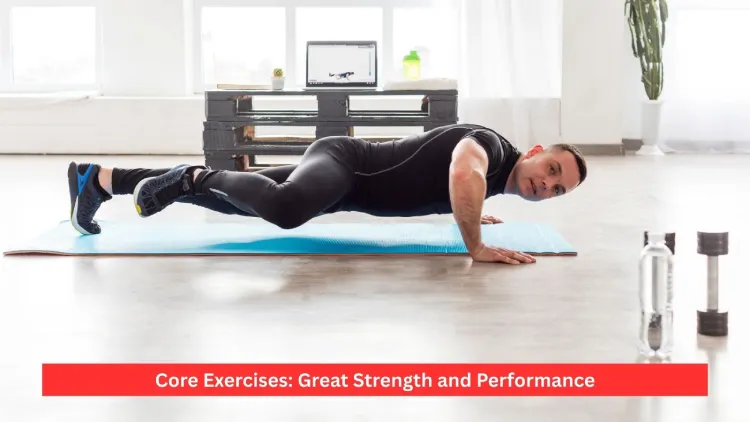

The main work is the work of stabilisation, correct posture, and strengthening, the building of core exercises. Core workouts not only enhance athletic performance, prevent injury and fight chronic pain, but also need to engage not only the abdominals but also the obliques, lower back and pelvis. The systematic movement, such as planks, crunches, leg raises and rotational movements, will help one to a strong core, both for beginners and advanced trainees.
- What Are Core Exercises?
- Benefits of Core Exercises
- Signs of a Weak Core
- How to Strengthen Your Core as a Beginner
- Top Core Exercises
- Advanced Core Concepts
- How long will it take to tighten your core?
- Core Training daily: Is it safe?
- Dealing with Core Weakness and Weak Core.
- Common Misconceptions
- Useful Core Success Tips
- Conclusion
- Frequently Asked Questions
What Are Core Exercises?
Core exercises are workouts that are specialised to apply to the muscles of your torso, which consist of the abdominals, obliques, lower back, and pelvis. These are the muscles which make your spine stable; they help you to support your posture and also help to improve your movements. Even though most people connect core training with beauty ideals, e.g., a fit belly, the practical implications are much more considerable.
A powerful core is the powerhouse of the body that can move the things to the upper and lower body. Your core is of the essence, whether you are lifting weights, running or swimming, or even performing your day-to-day activities that involve bending or twisting; it is through the core that you are going to control and stabilise the motion. Core training will make sure that your body can move safely, efficiently and powerfully.

Benefits of Core Exercises
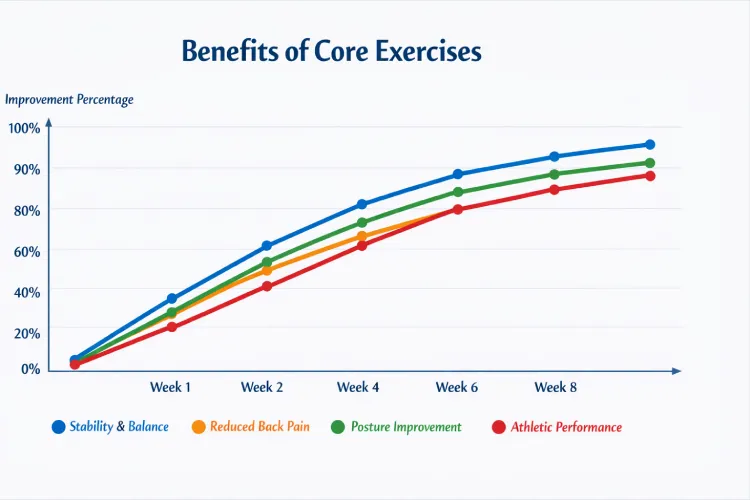
Basic exercises are not limited to the cosmetic aspect: they present numerous physical advantages:
Increased Stability and Balance:
Well-built inner muscles support the spine and pelvis, hence minimising the chances of falling and injury. Better balance, particularly, comes in handy with athletes and the elderly.
Enhanced Sporting Results:
Virtually in all sports, core strength is required. Regardless of golf clubs, sprinting or swimming, a stable core results in more efficient transfer of forces, resulting in faster, more powerful and accurate movements.
Reduced Risk of Back Pain:
Feeble core muscles have been a significant cause of lower back pain. Abdominal work is beneficial in aiding your spine, good posture and relieving chronic pain.
Better Posture:
Core exercises will work out the muscles that maintain an upright position, decrease slouching, and increase the correct position of the spine.
Functional Fitness:
A powerful centre simplifies the regular types of movements, such as grocery lifting, bending, twisting, and walking are simplified and makes them less exhausting.
Injury Prevention:
Core exercises rely on stabilising the body, which means that the joints and muscles get less load, which reduces the likelihood of strains and sprains and other injuries.

Signs of a Weak Core
It is always good to be aware of the symptoms of a weak core before getting deep into exercises:
- Persistent lower back pain
- Poor posture or slouching
- Problem with the execution of simple tasks such as bending or lifting.
- An imbalance or instability in the course of exercise.
- Lower athletic performance.
- It is deciding the situations of weakness to know where to focus your training.
How to Strengthen Your Core as a Beginner
Novices must start with the basic moves that use all the parts of the core without the excessive strain of the muscles.
Key principles include:
- Start Small: Start with short exercises, such as 15-30 second planks or 10-15 crunch reps.
- Concentrate on Form: It should be properly aligned, and the core must be effectively engaged.
- Consistency rather than Intensity: The more the practice, the better; instead of having, say, a few intense sessions.
- Gradually Progress: Add repetitions, add hold time or make it harder as one gets stronger.
The routine of a beginner would consist of planks, crunches, bicycle crunches, and dead bug exercises, which would be done 3-4 times a week.

Top Core Exercises
The following are the best exercises that can be done to develop a robust core:
1. Plank
Planks are regarded as the monarch of the core exercises because they can be used to involve multiple muscular groups at the same time.
- How to do it: Lie on your back, rise on your elbows and toes in a position of a straight line from the head to the heels. Hold, keeping your core tight.
- Benefits: Abdominals, lower back, shoulders and glutes are strengthened. Improves equilibrium and stability.
Modifications: Side plank, forearm plank, plank with leg lift, and plank with shoulder tap.
2. Crunches
Crunches work on the upper abdominal muscles, which are a source of core strength.
- How to do it: Balance on your feet, in the flat position, and bend your knees. Shoulders should be raised without resting this part on the ground.
- Tips: Do not pull your neck and move in a controlled manner so that you move most of your body.
3. Bicycle Crunch
This is a workout that involves the rectus abdominis and the obliques in the form of rotation.
- How to do it: Float on your back, raise your legs and work your knees over your opposite knees, also cycling in the air.
- Benefits: Strengthens oblique muscles and increases core stability.
4. Russian Twist
Turning motions enhance the rotational power and the oblique.
- How to perform it: Position on the floor with bended knees and with slightly bent back, and twist your weight/medicine ball over the sides by rotating the trunk.
- Advice: To make sure you do not get a strain, make sure you keep your core tight and do not slouch.
5. Leg Raises
Leg raises are done on the lower abdominals, which are the most difficult part of the abdomen to tighten.
- How to do it: Lie on your back with straight legs, try to push up until in a 90-degree position and then push down slowly.
- Reminder: To avoid injury, make sure to have your lower back always on the floor.
6. Mountain Climbers
An active workout, which is a mixture of cardiovascular and core building.
- How to do it: Begin in plank pose, but go on alternating the movement of driving the knee towards the chest, with a rapid motion.
- Pros: Makes you stronger, tones your whole body, and burns fat at the same time.
7. Dead Bug
The dead bug uses deep stabilising muscles, which are ideal when one is a beginner with weak cores.
- How to do it: This is in a position of the back (lying on the back), with arms raised, knees bent 90 degrees. Move the lower opposite arm and leg down gradually, keeping the lower back down.
- Benefits: enhances stability, coordination, and core endurance.
8. Flutter Kicks
Flutter kick shapes the lower abdomen and hip flexors, which are required to make the core of the body balanced.
- How to perform it: Lie on your back with your legs straight and your hands as they are under your hips, and kick up and down alternately.
- Tip: Keep your back straight and do not arch.
9. Superman
Trains the lower back, glutes and shoulders to be fully stable.
- How to perform it: Lie on your face with both arms and legs extended, and then take them off the ground, hold and then bring them down in a gradual manner.
- Tip: Pay attention to controlled lifts and not height.
10. Hollow Body Hold
The hollow hold is one of the most difficult core workouts, and it involves the whole torso.
- How to do it: Lie on your back, bring your legs, shoulders, and maintain the lower back against the floor.
- Benefits: Develops endurance, stability, and full-core strength.
Advanced Core Concepts
Big 3 and Big 4 Core Exercises
- Big 3 Core Exercises: Planks, dead bugs, and bridges are regarded as fundamental exercises for gaining core stability.
- Big 4 Core Exercises: Obliques and rotational movement will be focused on with big 4 core exercises, such as rotating coffee on a cable or rotating twists.
All these exercises are effective in making the whole core, front, sides and back, strengthened.
3-3-3 and 30/30/30 Rules
Fitness people do incorporate documented guidelines that would equalise training intensity. In the case of core work, the 3-3-3 plan includes:
- 3 exercises per session
- 3 sets of each exercise
- 3 sets of repetitions or time of holds.
The 30/30/30 rule, used more often in weight loss, implies 30 minutes of moderate work, 30 minutes of cardio, and 30 minutes of strength training every day and, as a result, will indirectly help to enhance core strength due to active work.
70/30 Rule in the Gym
One of the principles should underline the idea that 70 per cent of the fitness outcomes are because of organised exercises (including core exercises) and 30 per cent are due to nutrition and rest. Following this will make sure that the core gains are supported by the overall fitness habits.
How long will it take to tighten your core?
This depends on the intensity, fitness level and consistency to give a varying schedule. Intermediate outcomes of beginners could be observed as posture and stability improvement in 4-6 weeks, whereas significant strength gains could be achieved within 2-3 months of regular exercise. Professional athletes have the opportunity to develop endurance and rotational force over longer exploits since they are aimed at performance development and not beauty on its own.
Core Training daily: Is it safe?
Yes, it is a safe practice as a rule, in terms of core exercises, and it can be practised daily, fluctuating in level of intensity and type of exercises. Easy sessions should be conducted in the beginning so that they do not overtrain, whereas advanced professional practitioners can do longer and difficult sessions. The inclusion of rest days or focus area alternation will provide a non-injury, continuing improvement.
Dealing with Core Weakness and Weak Core.
It would take time to build strength when the core is weak:
- Begin with more basic movements such as dead bugs and planks.
- Movements to the dynamic motion of mountain climbers and leg raises.
- Add rotational movement exercises, such as twisting on the back, as the oblique.
- Pay your attention to the posture and slow movements to get maximum muscle involvement.
The symptoms of a weak core are common lower back pain, instability when balance exercises are done, poor posture, and inability to complete routine physical activities such as lifting and twisting.
Common Misconceptions
- Crunches by Himself is Not the Build-Up Core Strength: There should be a full core work of checking stability, rotational and lower back.
- Walking Can Assist Core Strength: Walking is an indirect body activity that uses core muscles, although specific exercises are required to achieve significant improvement.
- Abs Every Day: As long as the intensity and volume are regulated to prevent overtraining, it is fine to attack abs daily.
Useful Core Success Tips
- Engage Core In All Movements: It involves the conscious activation of the abdominal muscles in any exercise.
- Consistency is Essential: 30 minutes to 20 minutes in a session, 3 to 4 times a week is enough for most individuals.
- Excessive Crunches: 100 crunches a day will never produce any visible abs when diet and exercise are not combined.
- Balance Core with Cardio: HIIT, treadmill, and dynamic exercises are added to support core strength and endurance.
Conclusion
Functional fitness focuses on core exercises, which involve stability, endurance, and strength. Planks and crunches all the way to hollow holds or superwoman lifts, a graded program will tighten your whole torso, better your posture, decrease the intensity of back pain and increase overall performance on the field. No matter what level of trainee ability you possess, regular training, correct posture and development will help you create a strong core competence that will help you in your daily endeavours and physical ambitions.
Your core is as you really are; investing in your core means investing in your health. Be consistent to gain more performance, become more stable, and be less prone to injury.
Frequently Asked Questions
1: How can my strength be enhanced?
A combination of exercises working on all the areas, such as planks, crunches, leg raises, and rotational exercises like Russian twists, is the best way to strengthen your core. It is important to be consistent, well-formed, and to develop gradually to achieve effective results.
2: What is the frequency of core exercises?
The main exercises are to be conducted 3-5 times a week. Beginners can begin with moderate sessions 2-3 times a week, whereas the advanced trainees can include short sessions daily with emphasis on various core muscles so as to prevent overtraining.
3: How soon will you realise the results of core training?
In 4-6 weeks of regular training, most individuals have observed better posture, stability and endurance. The results and great gains can be achieved in several months (2-3 months), according to the intensity of the workouts, the frequency of workouts, and the general condition of the body.
4: Are core exercises helpful in preventing back pain?
Yes. Training of the core muscles will make the spine more stable and will enhance the posture and decrease the load affecting the lower back, which helps to prevent or decrease chronic back pain and enhances the overall capacity to be fit in terms of its functionality.