
Crow Pose is a challenging bodyweight exercise that develops upper body, core strength, and balance. It can be learned by novices using correct progressions, and it gets easier with practice. It might seem intimidating, but Crow Pose enhances balance, coordination, and strength. It can be mastered within a matter of weeks with good technique, practice, and progression.
- What is Crow Pose?
- Muscles Worked in Crow Pose
- How to Do Crow Pose (Step by Step)
- Benefits of this Exercise
- Common Mistakes to Avoid
- Tips for Beginners
- Progressions of Crow Pose
- Advanced Variations
- Safety Considerations
- How to Include Crow Pose in Your Workout
- Sample Exercise Routine Including Crow Pose
- Who Should Do Crow Pose?
- Final Thoughts
- Frequently Asked Questions
What is Crow Pose?
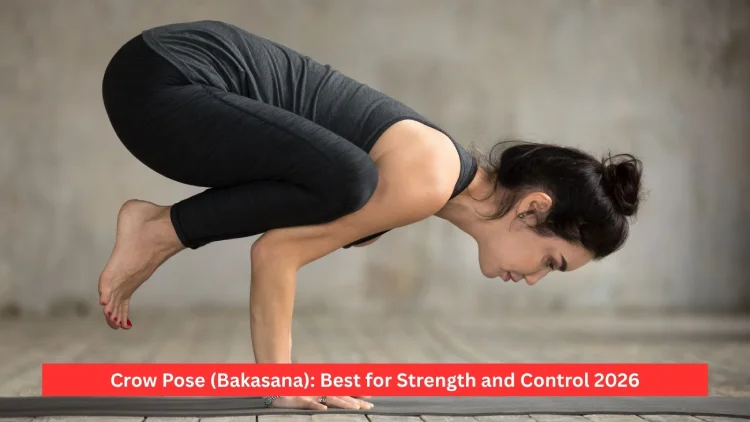
Crow Pose (Bakasana) is a bodyweight exercise similar to a handstand in which all weight is borne on the hands, and the knees are placed on the upper arms. It is a highly efficient, small movement exercise that will strengthen, stabilize, and improve coordination.
It is one of the best pre-requisite balance exercises because it allows you to practice balancing your weight forward. Unlike traditional strength training exercises such as planks or push-ups, Crow Pose involves dynamic muscular contraction, or “action and reaction,” to maintain balance.
This pose is particularly beneficial for improving your functional strength, which will help in other exercises like push-ups, handstands, and calisthenics. This exercise also enhances joint proprioception (the sense of being aware of a position in space) and neuro-facilitation (the ability to efficiently engage your muscles).
The other important component of Crow Pose is that it introduces more complex movements. Now it’s not the most difficult exercise you can do in bodyweight training, but it is essential to learning more advanced balance poses.

Muscles Worked in Crow Pose
It is a full-body exercise, working several different muscle groups at once. That’s why it’s so beneficial.
Core Muscles
The core is key in Crow Pose. It keeps you upright and stops you from falling forward. Without engaging your core, you would not be able to hold the pose.
Shoulders
Your shoulders are responsible for supporting much of your weight. Your deltoids work to help balance your upper body and keep your arms in line.
Arms (Triceps and Forearms)
The triceps keep your elbows slightly bent: the forearms allow you to grip the bar with the help of the hands.
Wrists
Wrists are the foundation for the pose. With regular practice, Crow will increase wrist strength and stability.
Hip Flexors
These muscles help to lift and bring your legs towards your body, making the pose closer to the ground (and a little more stable).
It involves the use of all these muscles, so it is sometimes referred to as a strong pose during exercise, as well as a good balance pose.
How to Do Crow Pose (Step by Step)
Crow Pose is a pose that requires focus and time.
Follow these steps carefully:
1. Begin in a Squat
Start with a squat, feet together. Make sure your knees are spread apart.
2. Set Your Palms on the Ground
Position your hands shoulder-width apart on the ground, palms down. Fingers should splay out for support.
3. Position Your Knees
Knees should sit on the upper part of your arms. The closer to your head they are, the easier this will be.
4. Lean Forward
Lean forward slowly. This is the key movement of Crow Pose. It’s important that your weight shifts to the hands.
5. Lift Your Feet
From here, lift one, then the other foot. Look straight ahead instead of down to the ground.
6. Hold the Position
Holding the pose for 10-30 seconds. You can work up to a longer hold.
7. Return Safely
Bring your feet back down to the floor. As a beginner, you may not be able to hold the Crow Pose for very long in the beginning, but it can take a few days or weeks to get used to it. Slowly and steadily wins the race.

Benefits of this Exercise
1. Strengthens Upper Body
Balancing your weight on your arms and wrists in Crow Pose strengthens the shoulders, arms, and wrists.
2. Improves Core Stability
It is difficult to balance without a strong core. It strengthens and tightens the core.
3. Improves Coordination and Balance
This pose works on body stability, increasing balance and coordination.
4. Develops Wrist Strength
It strengthens and toughens your wrists, useful in other poses.
5. Improves Self-Control
Crow Pose provides a feeling of body control, which may be transferred to other exercises.
For these reasons, it is included in bodyweight training exercises.
Common Mistakes to Avoid
Despite its simplicity, it can be quite difficult because of these mistakes:
- Gazing down instead of forward (balance is off)
- Leaving the abs relaxed, causing wobbles
- Having knees too low on the arms
- Not bending the arms
- Not daring to lean forward
The reason why many people find Crow Pose so confusing is that they tend not to lean forward. That’s one of the main reasons why it’s challenging.
Tips for Beginners
And while it is not necessarily an easy pose for the beginner, it can definitely be worked up to.
- Begin by balancing on one foot
- Continue to use a cushion in front to alleviate fear
- Use your core before lifting your feet
- Do it every day, but in short bouts
- Move slowly and carefully
It is certainly not an easy pose, but by no means is it impossible, either. When taught correctly, it can be safely performed by beginning students.

Progressions of Crow Pose
It’s common for beginners to find Crow Pose too challenging at first. It’s a complex exercise for strength, balance, and coordination, so it’s best to build up to the full pose. These preparatory exercises help prepare your body gradually, fewer injuries and discouragements. These exercises allow you to get stronger and more familiar with the muscles and skills you need to balance in it.
1. Frog Stand
Frog Stand is an excellent crowd pose variation for beginners. Here, you rest your knees further down your arms, near your elbows, to make it more accessible. This pose demands less core strength than the Crow Pose, as your center of gravity is not as high. This pose allows you to practise balancing your weight on the palms of your hands.
2. One-Leg Crow Pose
This is a good variation for gaining confidence. Rather than lifting both feet simultaneously, you lift one while still having your other foot touching the ground. This makes the pose less challenging and helps concentrate on balance and posture. This builds balance and awareness and eventually transitions to lifting both feet to complete this exercise.
3. Elevated Feet Practice
Placing a yoga block, step, or other elevated surface under your feet simplifies learning the Crow Pose. Placing your feet on an elevated surface makes it easier to lift them from the floor. You can then concentrate on hand position, distribution of weight, and activating the core. It can be particularly beneficial for those new to the pose who find it hard to lift.
These are a great way to make Crow Pose more manageable and to build up your strength, balance, and confidence. Regular practice of these poses may help you learn the poses much faster.
Advanced Variations
After mastering it, you can progress to more complex variations that demand a higher level of skill, balance, and strength. These variations not only increase the difficulty of the exercise but also set you up for more complex bodyweight skills.
Straight Arm Crow Pose
In this pose, your arms are kept straight rather than bent. This makes the pose harder on your shoulders and core, so it’s a harder variation of Crow Pose. It also enhances joint stability and control.
Side Crow Pose
This pose has a rotational twist. Your legs are to one side, and your arms are supporting your weight. This exercise works your obliques and enhances rotational control.
Crow to Handstand Transition
This is a complex pose where you go from Crow to Handstand. This transition is a very challenging move, requiring quickness, balance, and shoulder strength. Advanced yoga practitioners use this to gain dynamic balance and strength.
Crow Pose is thought to be a simpler variation of a handstand because your body remains more connected to the floor, and your weight is not so high. But it still requires a great deal of strength and balance, particularly for those new to the pose.
Safety Considerations
Although Crow Pose offers numerous benefits, it must be done safely. Given the weight is on the wrists and shoulders, correct form and progression are crucial.
The Crow Pose should be modified for some people:
- Those with wrist injuries or poor wrist strength
- People with shoulder instability or pain
- Those who have recently undergone surgery
- Those who experience pain when trying the pose
To avoid injuries, stretch your wrists and shoulders before attempting the Crow Pose. Take it slowly with progressions and never strain to get into the pose. You can also practice on a soft mat or put a cushion in front of you to minimise the fear of falling forward.
It’s important to listen to your body. Best to stop and modify if it doesn’t feel right.

How to Include Crow Pose in Your Workout
Crow Pose can be performed in many ways to suit your fitness purposes. It’s both a strengthening and balance pose, so it can be part of a strength training or functional fitness routine.
You can use Crow Pose:
- As a warm-up exercise to warm up your core and upper body
- As part of a weightlifting routine to strengthen your back
- As a balance exercise for coordination
- As a finishing pose to challenge balance and stamina
When you start, aim for 10-30 seconds per set. You can build up to a longer hold time and additional sets as your strength increases. However, quality trumps quantity, so be consistent.
Sample Exercise Routine Including Crow Pose
Here’s a basic routine that includes Crow Pose:
- Plank – 30 seconds
- Push-ups – 10–15 repetitions
- Squats – 15 repetitions
- Crow Pose – 15-30 seconds hold
- Rest – 60 seconds
- Do 3-4 circuits.
This exercise circuit can help build the strength to perform the Crow Pose and improve overall fitness. This routine increases core stability (plank), upper body strength (push-up), and lower body stability (squats), which are essential in Crow Pose.
Who Should Do Crow Pose?
This pose can be safely performed by most people. It is particularly beneficial for those seeking strength, balance, and coordination.
It is suitable for:
- Beginner level, who is willing to progress
- Intermediate exercisers who want to improve balance
- Sportspeople seeking to improve coordination and strength
- Those looking for body-weight exercises
But Crow Pose isn’t suitable for all. It may not be suitable for people with joint problems, especially in the wrists and shoulders.
Through proper technique and a gradual progression, Crow Pose can be modified to accommodate various levels of fitness, making it a beneficial and worthwhile exercise.

Final Thoughts
Crow Pose is a useful exercise to develop strength, balance, and coordination. It may be a challenging exercise, but with enough practice, it’s possible for most.
It’s not the most difficult exercise, but it is pivotal in bodyweight training. The Crow pose provides a foundation for more challenging exercises, which in turn increases your level of fitness.
By taking your time, using the correct form, and practising consistently, you can make Crow Pose one of your best exercises.
Frequently Asked Questions
1. How long will it take to learn Crow Pose?
Learning the Crow Pose can take different amounts of time for individuals. For some, it may take a few days to a few weeks, depending on their upper body and core strength and how regularly they practice. With regular practice and suitable preparation, the average learning time is 2-4 weeks to hold the pose stably.
2. How is Crow Pose so tough?
Crow Pose is initially challenging because it involves balance, strength, and coordination. And can’t get balance right by moving weight forward and perhaps engaging core muscles. It also depends on the fear of falling. As these issues improve, the exercise – it gets easier.
3. What are some progressions once Crow Pose is mastered?
Once you are comfortable with Crow Pose, you can move on to more complex movements like Straight Arm Crow Pose, Side Crow Pose, or even convert it to a handstand. These poses add more difficulty and build on balance, coordination, and flexibility skills.
4. How long to practice Crow Pose?
It’s recommended to start with 10-30 seconds per repetition. With practice, you can build up to holding the pose for 30-60 seconds or longer. It’s important to prioritise form over time.