

Looking to increase arm size and strength? These 10 effective bicep workouts can help you to build muscle, strengthen your arms and work towards your fitness goals. Learn proper training methods, exercises, how often to train each week, and nutrition for maximum results at home or in the gym.
- What Are Bicep Exercises?
- 1. Barbell Bicep Curl
- 2. Dumbbell Bicep Curl
- 3. Hammer Curl
- 4. Incline Dumbbell Curl
- 5. Preacher Curl
- 6. Concentration Curl
- 7. Cable Bicep Curl
- 8. EZ-Bar Curl
- 9. Chin-Ups (Underhand Grip)
- 10. Cable Rope Hammer Curl
- Advanced Bicep Training Techniques
- How to Structure an Effective Bicep Workout
- Misconceptions When Training Biceps
- Protein and Nutrition
- Nutrition Tips for Bicep Muscle Growth
- How Quickly Do Biceps Grow?
- Biceps Development Tips
- Conclusion
- Frequently Asked Questions
What Are Bicep Exercises?
Bicep exercises are resistance training exercises that build the muscle at the front of the upper arm. The main muscle of the upper arm is the biceps brachii, with two heads: a long head and a short head. Both bend the elbow and turn the forearm up with the palm up.
Other muscles that flex the elbow include the brachialis and the brachioradialis. These muscles are used in different ways during various exercises like standard curls, hammer curls, and chin-ups. Mixing movements can be useful to build even upper-arm strength.
1. Barbell Bicep Curl
The barbell bicep curl is a popular compound free-weight exercise for building biceps strength and muscle size. It allows you to train both arms together and gradually increase the resistance as your strength improves.
How to Perform:
- Stand upright with your feet shoulder-width apart.
- Hold a barbell with an underhand grip, keeping your hands shoulder-width apart.
- Keep your elbows close to your sides and your upper arms relatively still.
- Curl the bar toward your shoulders without swinging your body.
- Slowly lower the bar to the starting position.
Training Tip: Choose a weight that allows controlled repetitions and a comfortable range of motion.

2. Dumbbell Bicep Curl
These dumbbell bicep curls give each arm a chance to get the same workout and can be used to balance training in both arms. The exercise can be done with both arms or alternating sides.
How to Perform:
- Holding dumbbells in both hands, stand upright.
- Elbows close to body and palms towards front.
- Slowly rotate one or both dumbbells towards shoulders.
- Squeeze biceps at the top for a short period of time.
- Reduce weights under control.
Training Tip: Avoid swinging your body or using excessive weight. Work on controlled repetitions.
3. Hammer Curl
Hammer curls have a neutral grip, with your palms facing one another throughout the movement. This is a variation that works the brachialis and brachioradialis muscles in addition to the biceps, which helps to make the upper arm and forearm stronger.
How to Perform:
- Hold dumbbells in both hands and stand up straight.
- Keep hands palms inwards.
- Elbows should be tight to the body.
- Wrap the dumbbells towards the shoulder, but do not turn the wrist.
- Slowly lower both weights.
Training Tip: Keep the neutral grip at the end of each rep and do not use momentum.
4. Incline Dumbbell Curl
The incline dumbbell curl is done on an angled bench with your arms slightly behind your body. This starting position will allow the shoulder to be in extension and lengthen the biceps, especially the long head, before the curling movement is started.
How to Perform:
- Adjust the bench to a comfortable angle.
- Place dumbbells in both hands and sit back.
- Let your arms hang naturally with your elbows extended.
- Hold dumbbells in front of your chest and curl towards your shoulders.
- Gradually lower the weights, keeping control.
Practice Tip: Start with lighter weights, as the starting position may feel a bit more difficult to stretch.
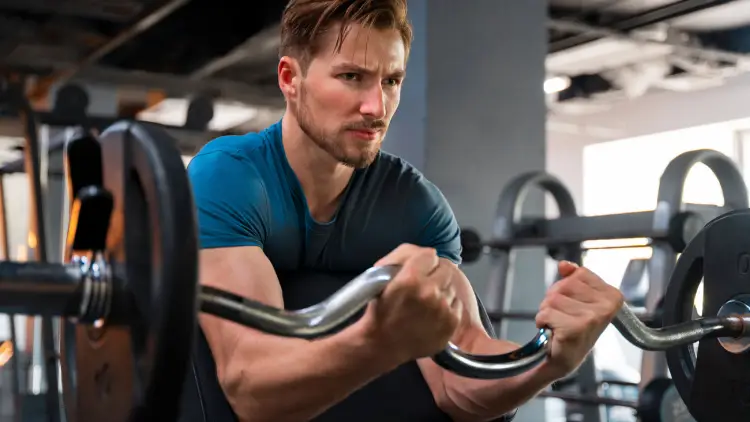
5. Preacher Curl
This exercise is called the preacher curl, and you perform it on a padded bench with your upper arms supported. This reduces the amount of body movement and can aid concentration on the elbow flexion movement at each rep.
How to Perform:
- Sit on a preacher’s bench with your upper arms on the pad.
- Hold an EZ-bar or dumbbells with an appropriate grip.
- Keep elbows comfortably straight.
- Bend the weight over to your shoulders.
- Carefully drop the weight down, letting it come down slowly with no bouncing or pushing the elbows into the floor.
Training Tip: Do not use too much weight, and control the movement during the lowering phase.
6. Concentration Curl
This practice focuses on the mind-muscle relationship.
- Instructions: Sit up, place your elbow against your inner thigh, and roll the dumbbell slowly up.
- Benefits: Uses up maximum contraction, improves peaks, and helps those facing difficulties building the biceps.
- Tips: Perform 3 sets of 12–15 reps. Concentrate on squeezing at the top of the movement. This especially applies to lifters who have naturally shorter biceps and wish to get maximum definition.
7. Cable Bicep Curl
Cable bicep curls are performed on a cable machine, which offers resistance throughout the curling movement. Unlike some free-weight exercises, the cable puts tension on you as you move the handle up and down.
How to Perform:
- Mount a straight bar or appropriate handle on the low cable pulley.
- Positioned to face the machine, grip the handle with an underhand technique.
- Keep your elbows close to your sides.
- Twist the handle towards your chest.
- Gently return it to the starting position.
Training Tip: Avoid leaning back to lift the weight; maintain torso stability.
8. EZ-Bar Curl
EZ barbell curl is a bicep workout using this angled barbell that differs from straight barbell curls. Some individuals have a more comfortable grip when using it and still receive resistance training.
How to Perform:
- Stand up straight with the EZ bar held with the angled grips.
- Elbows should stay close to your body.
- Wind the bar around to the shoulder.
- Take a quick stop at the top.
- Slowly return to the starting position.
Training Tip: Choose a comfortable grip and a weight that will allow you to have good form.
9. Chin-Ups (Underhand Grip)
Chin-ups. It is a compound movement, but it looks forcefully to the biceps forcefully.
- How to do it: Hang on a bar using an underhand grip and pull your body up.
- Benefits: Strengthens the pulling muscles, builds up bicep size, and creates general upper-body strength. The chin-ups can also be used in order to make skinny arms bulkier as a result of continuous usage.
- Exercises: Keep on adding weight with a dip belt in the process of growth.
10. Cable Rope Hammer Curl
The cable rope hammer curl is a cable exercise variation of the regular hammer curl. It works the biceps, brachialis, and brachioradialis in a neutral hand position with a rope attachment, keeping the cable tension constant throughout the movement.
How to Perform:
- Attach a rope handle to a low cable pulley.
- Grab either end of the rope with both hands, with palms facing away from each other.
- Erect stance – arms by sides.
- Make the rope into a circle around your shoulder.
- Slowly let the rope down, keeping it controlled.
Training Tip: Do not use your torso or pull your elbows forward in the movement.
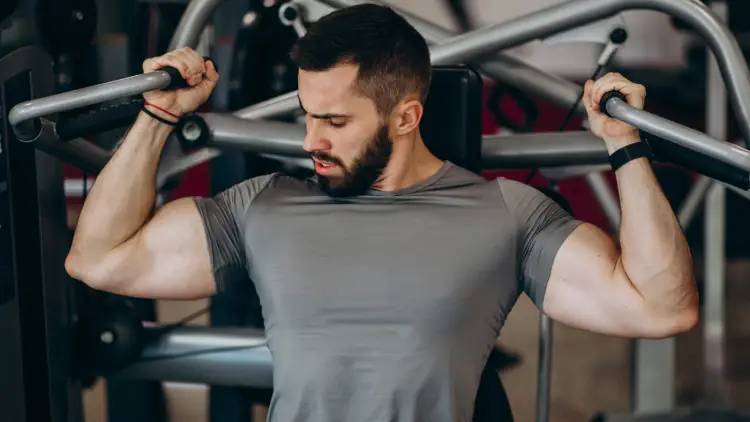
Advanced Bicep Training Techniques
1. The 21s Bicep Curl Method
The 21s method divides one set of bicep curls into three groups of seven repetitions. Perform seven bottom-half curls, seven top-half curls, and seven full-range curls. This technique increases the number of repetitions in one set and can make a workout more challenging. Start with a lighter weight to maintain proper form.
2. Progressive Overload
Progressive overload involves gradually increasing the training challenge as your strength improves. You can do this by adding resistance, performing additional repetitions, or increasing training volume. Make changes gradually while maintaining proper technique.
3. Controlled Repetitions
Controlled repetitions help you maintain proper exercise technique throughout each set. Avoid swinging the weights or using momentum to complete a curl. Focus on lifting and lowering the resistance with control.
4. Training Frequency
Train your biceps according to your overall workout schedule, recovery, and training experience. You can divide your weekly training volume across multiple sessions instead of performing all your biceps exercises in one workout.
How to Structure an Effective Bicep Workout
The best type of exercises to use is heavy, moderate, and isolation in order to build size and strength.
A balanced biceps workout combines different curl variations to train the upper arms from different positions. Beginners should focus on a few exercises with manageable resistance, while experienced lifters can adjust their training volume according to their goals and recovery.
Here is an example of a simple biceps workout:
| Exercise | Sets | Reps |
| Barbell Bicep Curl | 3 | 8–12 |
| Incline Dumbbell Curl | 2 | 10–12 |
| Hammer Curl | 2 | 10–12 |
| Cable Bicep Curl | 2 | 12–15 |
Rest between sets as needed to maintain good technique. Adjust the weight and repetitions according to your fitness level. You do not need to perform all 10 exercises in one workout.
Misconceptions When Training Biceps
- Movement is accomplished by momentum rather than by controlled movement.
- Failure to perform the full range of motion.
- Concentrating on isolated movements instead of on compounds.
- Overtraining and inadequate rest.
- The greatest cause of failure is almost always rushing to lift something too fast or too heavy without proper form, limiting growth, and may lead to injury.
Protein and Nutrition
Nutrition Tips for Bicep Muscle Growth
Nutrition plays an important role in supporting muscle development. Protein provides amino acids that help your body repair and build muscle tissue after resistance training. The International Society of Sports Nutrition suggests that 1.4–2.0 grams of protein per kilogram of body weight per day is sufficient for most exercising individuals.
Along with protein, include carbohydrates, healthy fats, fruits, vegetables, and enough overall calories in your diet. Foods such as eggs, chicken, fish, dairy products, beans, and lentils can help you meet your daily protein needs. Combine balanced nutrition with consistent resistance training and adequate recovery.
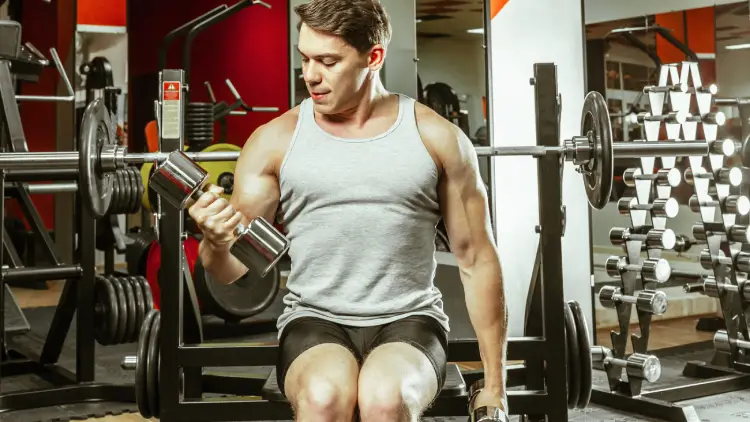
How Quickly Do Biceps Grow?
In novices, visible growth may be achieved in 68 weeks. Efforts of intermediate lifters might yield results in 8-12 weeks under regular training and dietary habits. This is also influenced by genetic factors when it comes to the biceps shape and their high point.
Biceps Development Tips
- Pay attention to the long and short development of the head.
- Mix heavy and moderate loads
- Add on complex and isolated motions.
- Train arms 1–2 times per week
- Apply such higher techniques as 21s, 7-7-7 and 3-3-3 sets.
Conclusion
Bicep exercises demand strength and hypertrophy, coupled with isolation exercises. With curls to hammer curls and cable forms, there can be bicep growth, strength, and beauty that can be maximised by a well-designed program. The secrets of bigger, stronger, and more defined arms are in slow, controlled reps, proper nutrition and a gradual process. Regardless of whether you need peak contraction, overall mass or endurance, these exercises will make you have a whole side of arm development.
Whether he has the proper methods and emphasis on form and progressive overload, anyone can develop strong and attractive biceps.
Frequently Asked Questions
1. How frequently do I attend the gym to train my biceps?
Ideally, 1-2 times a week is the best way to train your biceps. This gives adequate stimulation to hypertrophy and, at the same time, avoids overtraining.
2. What is the best bicep exercise that can be used to build size?
Barbell bicep curl is among the best exercises to increase size in general as it can be loaded heavier and as well plays with both heads of the biceps.
3. What is the time frame one realising bicep growth?
Newcomers will notice visible improvements after 6–8 weeks, whereas average lifters may have to wait 812 weeks with regular training, proper nutrition and progressive overload.
4. Would heavy or light lifting be appropriate to build biceps?
A combination is more effective; however, heavy weights are more effective in terms of strength (6-8 reps) and moderate in terms of hypertrophy (8-12 reps). End with light isolation exercises so that the muscles can be as fatigued as possible and defined.