
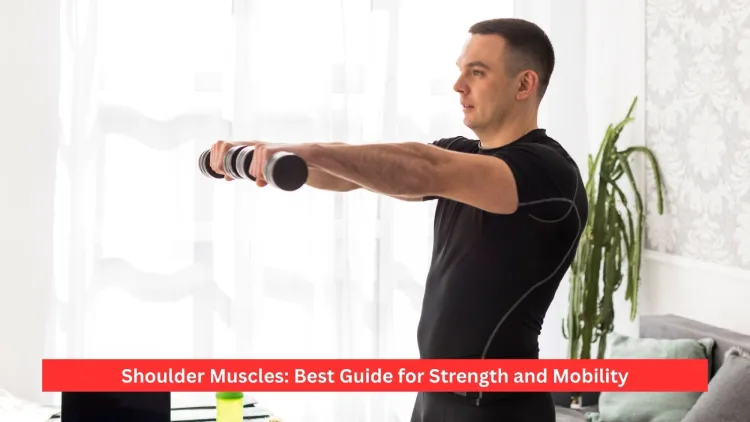

Most of the movements of the upper body are affected by the shoulder muscles, and thus, strength, flexibility, and prevention of injuries are important. Pressing, lifting, pulling, rotation, and mobility training exercises are some of the exercises that help strengthen muscle of the shoulders, joints, and ligaments. The front, side, rear, or stabilizing muscles are helped by training, which helps improve performance, posture, alleviate pain, and help in the activities of daily life. Good warm-ups, recovery and proper sleeping posture are important in long-term shoulder health.
- Shoulder Muscles in Exercise Training
- The Advantages of Exercising Shoulder Muscles
- Shoulder Muscle Warm-Up Exercises
- Shoulder Muscle Best Exercises
- Shoulder Muscles Mobility Exercises
- Beginner Shoulder Workout Routine
- Advanced Shoulder Workout
- Common Exercise Mistakes to Avoid
- Shoulder Exercise Recovery Guidelines
- Shoulder muscles Exercise Plan weekly
- Who Trains the Shoulder Muscles?
- Shoulder Exercise Safety Measures
- Shoulder Structure Exercise Science
- Considerations of Shoulder Pain and Exercise
- Best Shoulder exercises to build strength
- Muscle Coordination and Movement
- The Value of Joints and Stability during Exercise
- Shoulder Health in the Long-term with Exercise
- Conclusion
- Frequently Asked Questions
Shoulder Muscles in Exercise Training
The shoulder muscles are a coordinated body system instead of individual body parts. When exercising, a combination of several muscles works in tandem to stabilise and produce a large range of movement with the arm. The shoulder is peculiar, as it compromises its stability to provide mobility, and that is the reason exercise training is so influential in the protective mode.
Three major areas cooperate in the shoulder structure:
- The upper arm connection
- The shoulder blade movement system.
- Collarbone support structure.
These regions create four huge joints through which the movement in all directions can be performed. Running reinforces the muscles around the shoulders, such that the joints of the shoulders would be firm during pulling and physical body movement.
Principal Muscle Classifications in Exercising
By mentioning the muscles of the shoulder, trainers tend to subdivide them into three major functional groups:
- Primary movers – they perform compressing and lifting functions.
- Stabilisers – ensure that the joints are aligned.
- Assistive muscles – gladify co-ordination of intricate motions.
A lot of exercise programs target three large muscles of the shoulder in the anterior (front), the lateral (side), and the posterior (rear) parts of the deltoid. Nevertheless, other deeper muscles which are stabilizing are also important.
These deeper muscles include rotator cuff muscles, a set of four muscles, which are small but very important, and provide stability of the joint when moving. These muscles make sure that they guide rotation, prevent dislocation and make sure that they are in control during workouts.
When including intrinsic and extrinsic muscle groups, which include both the direct and indirect contributions to shoulder movement, the number of muscles that movement specialists mention amounts to up to seventeen. Exercise training does not activate these muscles independently of each other.
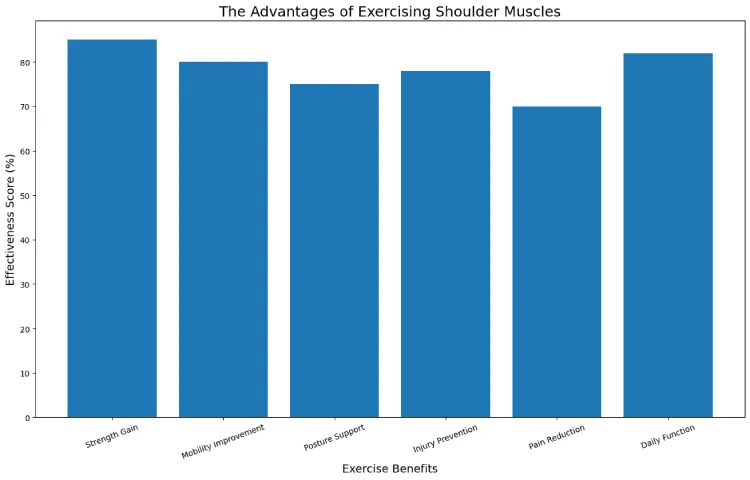
The Advantages of Exercising Shoulder Muscles
Working out on shoulder-related muscles has significantly better results than just the outward effect.
Increased Strength in the upper body
Powerful shoulder muscles help in pushing, pulling, lifting and carrying. Presses and push-ups are exercises that are dependent on the coordinated movement of the shoulders.
The most powerful muscle in the shoulders that contributes power in lifting is usually deemed to be the deltoid group since most of the force is realised during the overhead movement.
Greater Dynamics and Movement
Exercises of the shoulder help in enhancing the seven significant movement patterns of the shoulder joint:
- Flexion
- Extension
- Abduction
- Adduction
- Internal rotation
- External rotation
- Circular movement
These ranges provide training that helps to maintain a balance in mobility.
Injury Prevention
One of the major causes of shoulder pain is weak stabilisers. Workouts make the rotator cuff and supporting ligaments stronger, and this decreases the pressure on the muscles and ligaments during daily activities.
Enhanced Posture
Rounded shoulders are promoted by modern lifestyles. Straightening the rear shoulders helps in correcting the posture and minimises stress in the neck and upper back.
Athletic Performance Enhancement
Shoulder muscles play a major role in the activities of the athletes; throwing, swimming, lifting and striking. Enhanced stability translates into enhanced transfer of power.
Core Integration Benefits
Other core muscles that are mobilised through shoulder exercises are the abdominals, obliques, lower back stabilisers, diaphragm, pelvic floor and deep spinal muscles. This coordination and balance are enhanced.
Shoulder Muscle Warm-Up Exercises
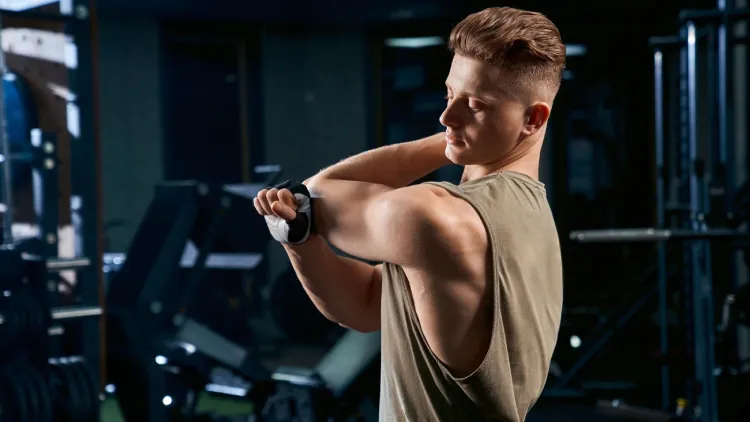
Muscles of the shoulders should be prepared before exercise since cold joints are highly subject to irritation. Proper warm up enhances the flow of blood as well as activating and stabilising muscles which control movement.
Arm Circles
Arm circles are pacifist activities that involve muscles of the shoulder that take up joint control.
How to perform:
- Extend arms outward.
- Turn slowly clockwise and anticlockwise.
- Maintain smooth movement.
This enhances the coordination of the shoulder joints with the muscles around them.
Shoulder Rolls
Shoulder roll involves external muscles that place the shoulder on top of the spine.
Benefits:
- Reduces stiffness
- Improves circulation
- Prepares the lifting muscles
- Dynamic Cross-Body Swings
It is a movement that engages those muscles that do horizontal movement and rotation.
The dynamic motion is useful in preparing the shoulder to perform various compound exercises, besides enhancing the range of motion.
The warming-up period of 5-10 minutes reduces the risk of injury significantly and preconditions the muscles in the shoulders to undergo the training in terms of strength.
Shoulder Muscle Best Exercises
The choice of exercise predetermines the degree of strength and stability formation of shoulder muscles.
1. Shoulder Press
The shoulder press is ranked among the best shoulder exercises since it entails training more than one muscle at a time.
Execution:
- Let the weights hang at the shoulder level.
- Press upward.
- Lower slowly.
This motion works out the deltoids, stabilizers and the supporting arm muscles.
2. Lateral Raises
Lateral raises are exercises that single out the side shoulder muscles that lift arms.
Key benefits:
- Improves shoulder width
- Enhances joint balance
- Increases lifting mechanics.
Restricted movements are needed to keep the stress off.
3. Front Raises
Front raises involve the strengthening of muscles that are involved in lifting and reaching exercises.
They assist in enhancing shoulder endurance and coordination.
4. Rear Delt Fly
Rear shoulder muscles are frequently ignored and are very crucial in posture.
This exercise uses muscles that mutually oppose the pushing motions and guard against the forward shoulder position.
5. Push-Ups
Pushup exercises are the best shoulder exercises, since they are both strength and stability exercises.
They activate:
- Shoulder muscles
- Chest muscles
- Core stabilizers
The shoulder joint is conditioned to stand on the body’s weight.
6. Pike Push-Ups
Pike push-ups are similar to overhead pressing and are made without equipment that develops upper shoulder strength.
They enhance the coordination of stabilising and primary muscles of the shoulder.
7. Resistance Band Pull-Apart
This is an exercise that stabilizes body and minimises the imbalance that arises due to over-pushing exercises.
Band exercises are especially effective in the prevention of shoulder soreness.
Shoulder Muscles Mobility Exercises
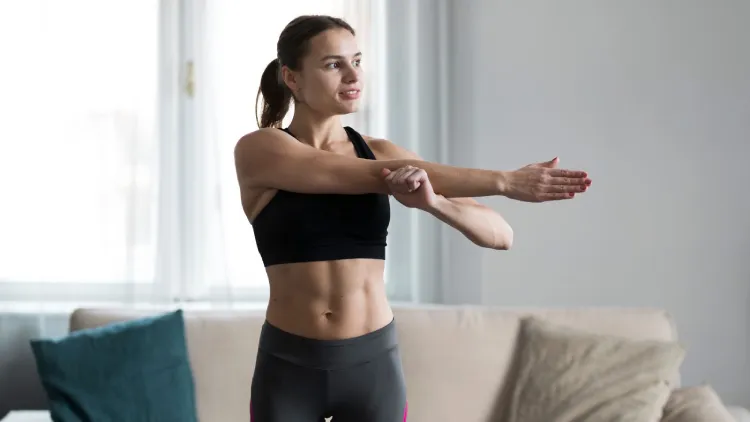
Mobility training is a healthy movement that keeps one flexible and not stiff.
Wall Slides
Wall slides enhance the communication between joints of the shoulders and stabilising muscles, and promote good posture.
Thread the Needle Stretch
This is a movement that aims at rotating the shoulder blade and releasing tension in the shoulder.
Overhead Stretch
Light stretching sustains flexibility and decreases the tightness of muscles commonly used in the shoulder.
Mobility drills prove to be particularly beneficial to those with mild pain related to muscle tension.
Beginner Shoulder Workout Routine
Beginners should focus on control rather than heavy resistance.
Routine Example:
| Exercise | Sets | Reps |
| Arm Circles | 2 | 20 |
| Shoulder Press | 3 | 10 |
| Lateral Raises | 3 | 12 |
| Rear Delt Fly | 3 | 12 |
| Push-Ups | 3 | 8–10 |
| Band Pull-Apart | 2 | 15 |
This routine activates all major shoulder muscles while maintaining joint safety.
Training two to three times weekly allows proper recovery.
Advanced Shoulder Workout
Professional athletes should have an increase in the load and diversity of movements.
Program Structure:
- Heavy presses for strength
- Balance exercises of isolation.
- The injury prevention exercises involve stability.
The incorporation of tempo control makes muscle activity more engaging with no unnecessary weight.
Developed routines test the best muscle groups of the shoulders, as well as strengthening stabilisers.
Common Exercise Mistakes to Avoid
- Using Excessive Weight: Compensatory movement patterns, which are occasioned by overloading, put stress on the ligaments and joints.
- Unhealthy Posture in Workouts: When stress is shifted backwards, the muscles of the shoulders are not used, and hence there is a greater risk of injuries.
- Disregard of Rear Shoulder Training: Exercise should be complementary; it should involve an anterior as well as a posterior strengthening.
- Eliminating Stabilisation Work: Shoulder positioning and pain prevention at the small level is determined by small stabilising muscles.
Shoulder Exercise Recovery Guidelines
The muscles of the shoulders have time to renew and strengthen with the help of recovery.
- Stretching: Moving softly brings about mobility and decreases stiffness.
- Hydration: When muscles are well hydrated, the recovery is quicker.
- Rest Periods: Give a space of 48 hours in between vigorous shoulder workouts.
- Sleep Positioning: The position during sleep has a significant influence on the comfort of the shoulders. Resting on the back with arm support or sleeping on the other side with a pillow to support the working arm is the most favourable posture for the shoulder to recover. This stands off pressure on the delicate tissues.
Shoulder muscles Exercise Plan weekly
Repeated training every week helps to avoid overtraining.
- Monday: Strength training
- Wednesday: Stability and mobility.
- Friday: Perseverance and resistance training.
This is a structure which enables muscles, joints and ligaments to rejuvenate and enhance performance.
Who Trains the Shoulder Muscles?
Virtually all persons are beneficiaries of exercise training.
- Office Workers: Posture problems, which are brought about by sitting down, are coped with through the strengthening exercises.
- Athletes: Better shoulder stability increases the performance of throwing and lifting.
- Fitness Beginners: Strength building should be developed using exercises in a controlled manner.
- Patients who have Mild Suffering: Exercises can be done then to help ease the tension in muscles that can cause pain in the shoulders.
Shoulder Exercise Safety Measures
Training on health should be knowledgeable of the health warning signs.
Maintain Pain-Free Movement
Fatigue in the muscles is a normal state, whereas sharp pains are not.
Understand Pain Sources
Muscles that are most likely to cause discomfort are the tight front shoulders and weak stabilisers. Inequality usually causes annoyance and not harm.
Watch for Red Flags
Consult a professional associated with:
- Persistent weakness
- Numbness
- Severe night pain
- Limited movement after rest
These symptoms are possible signs of severe shoulder diseases.
Ligament Protection
The shoulder joint has four major ligaments. Regular workouts take strength of nearby shoulder muscles so that the ligaments are not overstretched.
Shoulder Structure Exercise Science
The shoulder has intrinsic muscles, which are in the joint area and extrinsic muscles that attach the shoulder to the torso. Both groups are stimulated by exercise training.
The stabilising muscles contain six important intrinsic muscles that aid in controlling the movement precision and extrinsic muscles, which emit larger movements like pulling and lifting.
Some form of rotational control is provided by a special group that is commonly referred to as the rotator muscles and is in control of the rotation of the arm during exercise. When they are strengthened, they become more stable in joints and less prone to injury.
Considerations of Shoulder Pain and Exercise
Poor mechanics and overuse are the most common factors that cause the most painful but not necessarily weak shoulders.
Exercises provide prevention of such typical problems as tendon irritation or movement imbalance.
Some muscles are more likely to cause more pain since they are exposed to repetitive stress, and this is the case with the muscles of the front shoulder used in pressing exercises.
The training also avoids over-training, as one forms another weighted muscle by performing the opposite activity.
Best Shoulder exercises to build strength
Of all the exercises, three motions always bring the best results:
- Shoulder overhead presses.
- Lateral raise variations
- Body weight pressing or push-up exercises.
Such exercises use the greatest part of the shoulder muscles and enhance stability.
Muscle Coordination and Movement
The shoulder is not controlled by one muscle only. Rather than that, coordinated muscular activity leads to safe movement.
Effective lifting is done by the deltoid group, and the stabilisers maintain a smooth movement. They enable combined actions, including throwing, reaching, and rotating.
This is because exercise helps in improving communication among muscles and the nervous system, which increases coordination.
The Value of Joints and Stability during Exercise
The shoulders have four joints that collaborate in exercising to enable a wide range of mobility.
As there is high mobility, stability has to be trained purposefully by means of strengthening exercises and control exercises.
Exercise helps to strengthen the alignment of the joints and avoid overstrain on the connective tissues.
Shoulder Health in the Long-term with Exercise
Constant exercises make the shoulder muscles strong and flexible.
Long-term benefits include:
- Improved strength
- Reduced injury risk
- Better posture
- Enhanced athletic ability
- Pain-free movement
A combination of strength, mobility and recovery activities is the best.
Conclusion
The shoulder muscles are vital to almost all movements of the upper body and should be given balanced exercise to make them strong and healthy. With the help of strength training, balance exercises, stability training and recovery methods, one can enhance performance and preserve joints and ligaments.
The exercise-based training is known to improve the large lifting muscles, as well as the smaller stabilisers involved with safe movement. Regular workouts improve posture, eliminate the risk of discomfort, and help achieve functional fitness in the long term.
Shoulder muscles are strengthened, stablized and become more resilient when trained properly, resulting in easy movement during workouts, sporting and general life. With structured warm-up afterwards, specific exercises and appropriate rest, years of sustainable shoulder health will be achieved.
Frequently Asked Questions
1. What are the best exercises to use in building muscle strength in the shoulders?
Shoulder presses, lateral raises and push-ups are the best exercises that would strengthen the shoulder muscles. These movements address the front, side and back shoulders, besides enhancing stability and coordination. Doing them in the right form with reflected resistance is a way of developing strength in a safe manner.
2. What is the number of shoulder muscles that are to be trained per week?
The muscles of the shoulder can be trained at a rate of two or three times a week, and there must be a period of 4-8 hours in between some intense training. Such a program enables the muscles to rest, develop more strength and minimise the chance of overuse injury.
3. What are the problems with the shoulder during work?
The imbalance of the muscles, incorrect posture, slow stabilising muscles, or high weight of the load are often hidden factors that cause shoulder pain during workouts. The discomfort can be avoided by strengthening the muscles of the rear shoulders, enhancing mobility, and ensuring the proper technique of exercises.
4. So, which is the most effective sleeping position that helps to recover the shoulders?
Lying on the back with arm support to rest or sleeping on the other side with a pillow to support one arm affected is the best position that will help a person recover the shoulder. This pose eases muscles on the shoulders and prevents stiffness or discomfort.